TLDR Apple stock plunged at $254.43on Sept. 24 down by 1.26% YTD but behind Big Tech peers. UBS data shows strong wait times for iPhone 17 Base but muted demand for higher-end models. ASP growth may be limited by pricing strategy favoring entry-level buyers. The iPhone 17 Air’s $999 redesign and China subsidies boost near-term [...] The post Apple Inc. ($AAPL) Stock: Turns Positive in 2025 After iPhone 17 Launch appeared first on CoinCentral.TLDR Apple stock plunged at $254.43on Sept. 24 down by 1.26% YTD but behind Big Tech peers. UBS data shows strong wait times for iPhone 17 Base but muted demand for higher-end models. ASP growth may be limited by pricing strategy favoring entry-level buyers. The iPhone 17 Air’s $999 redesign and China subsidies boost near-term [...] The post Apple Inc. ($AAPL) Stock: Turns Positive in 2025 After iPhone 17 Launch appeared first on CoinCentral.

Apple Inc. ($AAPL) Stock: Turns Positive in 2025 After iPhone 17 Launch

TLDR

  • Apple stock plunged at $254.43on Sept. 24 down by 1.26% YTD but behind Big Tech peers.

  • UBS data shows strong wait times for iPhone 17 Base but muted demand for higher-end models.

  • ASP growth may be limited by pricing strategy favoring entry-level buyers.

  • The iPhone 17 Air’s $999 redesign and China subsidies boost near-term demand.

  • Apple still lags Microsoft and Google in AI, with major Siri updates delayed until 2026.

Apple Inc. (AAPL) shares were down 1.21% as of 12:46 PM EDT, dropping from around $254.43 to $251.36.
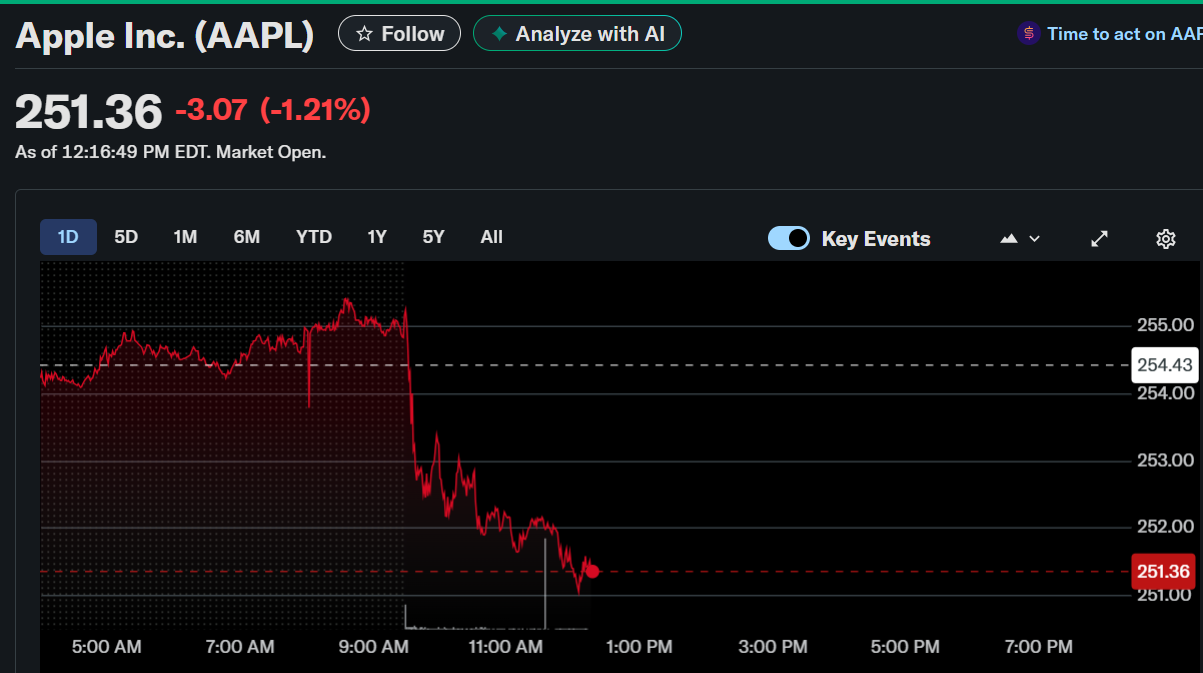
Apple Inc. (AAPL)

With these gains, Apple has erased its 2025 losses, now up 1.96% year-to-date, though still trailing the S&P 500’s 13.18% rise. The September 25 earnings report will give further clarity on Apple’s momentum.

The rally followed strong initial demand for Apple’s newly launched iPhone 17 lineup. Shares climbed 4% earlier this week as shipping times lengthened for the redesigned iPhone Air, signaling healthy interest heading into the holiday quarter.

UBS warns of ASP pressure

Despite the positive stock reaction, UBS analysts flagged potential risks for Apple’s average selling price. Evidence Lab data showed “elevated year-over-year wait times” for the iPhone 17 Base model across 30 tracked markets, while demand for higher-end models like the Pro Max looked flatter.

In the U.S., wait times for the iPhone 17 Base stretched to 18 days versus 11 days for the iPhone 16 Base. In China, wait times jumped to 25 days compared with 9 days for last year’s model, which UBS partly attributed to subsidies. However, the analysts noted that heavy mixing toward entry-level models may dampen ASP upside this quarter.

Apple’s pricing strategy

UBS pointed to Apple’s strategic pricing adjustments. The Base model now starts with 256GB storage, effectively lowering its price per gigabyte, while the Air and Pro models saw implied price increases. This mix could weigh on revenue per unit even if total shipments grow.

The $999 iPhone Air is proving a strong draw, being Apple’s first major redesign in years. Bank of America analysts reported longer delivery windows of 18 days for the Air compared with just 10 days for last year’s iPhone 16.

Broader product ecosystem and AI lag

Apple’s fall lineup also included new AirPods Pro 3 and the latest Apple Watch, which introduced AI-driven health features such as blood pressure risk alerts. Still, the company lags competitors in AI innovation. A major Siri update isn’t expected until 2026, leaving Apple behind Microsoft and Google, both of which have heavily invested in AI this year.

Performance overview

Looking beyond 2025, Apple remains a long-term outperformer. The company has returned 12.87% over the past year and 144.18% over five years, compared with the S&P 500’s 16.41% and 105.66% gains, respectively. Yet the near-term focus rests squarely on the iPhone 17’s holiday season performance and whether Apple can sustain momentum despite ASP concerns and AI challenges.

The post Apple Inc. ($AAPL) Stock: Turns Positive in 2025 After iPhone 17 Launch appeared first on CoinCentral.

Market Opportunity
NEAR Logo
NEAR Price(NEAR)
$1.513
$1.513$1.513
-0.98%
USD
NEAR (NEAR) Live Price Chart
Disclaimer: The articles reposted on this site are sourced from public platforms and are provided for informational purposes only. They do not necessarily reflect the views of MEXC. All rights remain with the original authors. If you believe any content infringes on third-party rights, please contact service@support.mexc.com for removal. MEXC makes no guarantees regarding the accuracy, completeness, or timeliness of the content and is not responsible for any actions taken based on the information provided. The content does not constitute financial, legal, or other professional advice, nor should it be considered a recommendation or endorsement by MEXC.

You May Also Like

Solana Treasury Stocks: Why Are These Companies Buying Up SOL?

Solana Treasury Stocks: Why Are These Companies Buying Up SOL?

The post Solana Treasury Stocks: Why Are These Companies Buying Up SOL? appeared on BitcoinEthereumNews.com. In 2020, everyone watched Strategy (called Microstrategy back then) scoop up Bitcoin and turn corporate crypto treasuries into a mainstream story. Now, a new wave is forming. And it’s centered on Solana. Dozens of companies are holding SOL as a bet on price. Except they’re not just holding. They’re building what’s being called Solana treasuries or Digital Asset Treasuries (DATs). These aren’t passive vaults. They’re active strategies that stake, earn yield, and tie into the fast-growing Solana ecosystem. Forward Industries, a Nasdaq-listed firm, recently bought more than 6.8 million SOL, making it the world’s largest Solana treasury company. Others like Helius Medical, Upexi, and DeFi Development are following a similar playbook, turning SOL into a centerpiece of their balance sheets. The trend is clear: Solana treasury stocks are emerging as a new class of crypto-exposed equities. And for investors, the question isn’t just who’s buying but why this strategy is spreading so fast. Key highlights: Solana treasuries (DATs) are corporate reserves of SOL designed to earn yield through staking and DeFi. Companies like Forward Industries, Helius Medical, Upexi, and DeFi Development Corp now hold millions of SOL. Public firms collectively own 17.1M SOL (≈$4B), which makes Solana one of the most adopted treasuries. Unlike Bitcoin treasuries, Solana holdings generate 6–8% annual rewards. It makes reserves into productive assets Solana treasury stocks are emerging as a new way for investors to gain indirect exposure to SOL. Risks remain: volatility, regulation, and concentrated holdings. But corporate adoption is growing fast. What is a Solana treasury (DAT)? A Solana treasury, sometimes called a Digital Asset Treasury (DAT), is when a company holds SOL as part of its balance sheet. But unlike Bitcoin treasuries, these usually aren’t just static reserves sitting in cold storage.  The key difference is productivity. SOL can be staked directly…
Share
BitcoinEthereumNews2025/09/21 06:09
Raoul Pal Predicts Bitcoin’s Correlation With ISM Index

Raoul Pal Predicts Bitcoin’s Correlation With ISM Index

The post Raoul Pal Predicts Bitcoin’s Correlation With ISM Index appeared on BitcoinEthereumNews.com. Key Points: Raoul Pal asserts Bitcoin aligns with the ISM Index cycle. Bitcoin’s price peak predicted for 2026 due to market dynamics. Potential Bitcoin price growth if ISM surpasses 60. Raoul Pal, co-founder and CEO of Real Vision, recently stated that Bitcoin’s price movement is now closely linked to the ISM index, anticipating significant impacts. This connection suggests a potential peak in Bitcoin prices by 2026, aligning with macroeconomic cycles and affecting market dynamics for investors globally. Bitcoin Market Projections Aligned with ISM Growth Raoul Pal, co-founder of Real Vision, asserts a strong connection between Bitcoin and the ISM. He suggests that the Treasury’s decision to extend debt maturity from four to five years artificially lengthens Bitcoin’s market cycle. This effectively reshapes investment expectations into a five-year cycle, delaying projections originally due in 2025 to 2026. Pal expects Bitcoin prices could surpass $300,000 should the ISM rise above 60, riding a wave of increased liquidity. This forecast synchronizes with a broader market understanding that Bitcoin trends reflect major macroeconomic cycles. Raoul Pal stated, “Bitcoin goes up as the ISM goes up… If it goes above 60, I mean, those are high prices in Bitcoin. That’s above $300,000, maybe even higher.” Investor sentiment on social platforms shows keen interest in Pal’s theory. The notion of extending cycle expectations to 2026 has prompted significant discussions among traders, with an emphasis on ISM readings as critical triggers. Official statements from Pal emphasize Bitcoin’s leading position relative to ISM metrics. Key Historical ISM Surges Boost Bitcoin Prices Did you know? Historically, when the ISM Index surpassed 60, Bitcoin has experienced significant rallies, such as those in 2017 and 2020–21. Analysts predict a similar surge if current trends continue. According to CoinMarketCap, Bitcoin’s price currently stands at $111,519.43, reflecting a 24-hour change of -1.41%. The…
Share
BitcoinEthereumNews2025/09/25 19:57
Top Altcoin Primed to Grab Market Share from Cardano (ADA) in the Upcoming Q4 Altseason

Top Altcoin Primed to Grab Market Share from Cardano (ADA) in the Upcoming Q4 Altseason

As the cryptocurrency market prepares for the potential of a Q4 altseason, investors are shifting their attention to those tokens that are creating tangible utility within the DeFi market. While Cardano (ADA) has been the long-term smart contract challenger for years, a newer player, Mutuum Finance (MUTM) is creating a buzz with its lending and […]
Share
Cryptopolitan2025/09/19 01:30