For decades, gold has anchored global portfolios as the quintessential safe-haven asset. But in the past ten years, bitcoin has rapidly emerged as its digital counterpart — and, in many cases, its outperformer. New research from Dovile Silenskyte, Director of Digital Assets Research at WisdomTree, suggests that investors may no longer need to choose between the two. Instead, the data increasingly supports a combined approach, where gold provides stability and bitcoin offers asymmetric upside. Gold vs. Bitcoin: A Changing Store-of-Value Hierarchy Gold’s safe-haven characteristics remain structurally intact. Its scarcity, established role in global markets and historical performance during periods of stress have kept it resilient. Since 2013, gold posted annualised returns of 10.4% with 14.5% volatility, delivering a Sharpe ratio of 0.6, according to Silenskyte’s analysis. Bitcoin, however, has shifted the paradigm. Over the same period, it generated annualised returns of 50.5% with 67.0% volatility, resulting in a Sharpe ratio of 0.7 — marginally outperforming gold on a risk-adjusted basis despite its extreme swings. On the Sortino ratio, which focuses on downside risk, the gap is even wider: 1.0 for bitcoin versus 0.3 for gold. In simple terms, bitcoin has historically compensated investors more efficiently for the risk taken. “Even with high volatility, bitcoin has offered superior risk-adjusted returns,” Silenskyte notes. Bitcoin Volatility: From Barrier to Manageable Risk Bitcoin’s volatility is frequently cited as the primary reason some investors remain hesitant. Yet Silenskyte’s research shows that this volatility has declined significantly over the past decade. Its 90-day annualised volatility has compressed from above 150% to under 40%, putting it within range of several commodities. At the same time, liquidity has deepened, with daily spot volumes comparable to major S&P 500 equities. Derivatives markets — particularly futures and options — provide sophisticated hedging tools that make volatility increasingly manageable for institutional allocators. “Volatility is a tax, but a declining one,” Silenskyte says. Macro Conditions Favour a Combined Allocation Rather than competing, bitcoin and gold appear to hedge different types of macro risk. Gold thrives during inflation, geopolitical turmoil and periods of negative real yields. Bitcoin, with its 21-million-supply cap and decentralised issuance, serves as a hedge against fiat debasement and technological disruption. Importantly, bitcoin and gold display a low long-term correlation of just 6%, according to WisdomTree. This gives them powerful diversification properties: gold anchors the defensive side of a portfolio, while bitcoin provides convex upside driven by digital adoption. Portfolio Implications: Not Either-Or, but Both WisdomTree’s modelling shows that adding even 1% bitcoin to a traditional 60/40 portfolio can increase the Sharpe ratio by 0.06, with only a marginal change in maximum drawdowns. The takeaway from Silenskyte’s research is clear: gold remains foundational, but bitcoin enhances the opportunity set. As digital assets mature, the case for treating the two as complementary hedges — not rivals — becomes stronger. Together, they broaden the safe-haven spectrum for the modern investorFor decades, gold has anchored global portfolios as the quintessential safe-haven asset. But in the past ten years, bitcoin has rapidly emerged as its digital counterpart — and, in many cases, its outperformer. New research from Dovile Silenskyte, Director of Digital Assets Research at WisdomTree, suggests that investors may no longer need to choose between the two. Instead, the data increasingly supports a combined approach, where gold provides stability and bitcoin offers asymmetric upside. Gold vs. Bitcoin: A Changing Store-of-Value Hierarchy Gold’s safe-haven characteristics remain structurally intact. Its scarcity, established role in global markets and historical performance during periods of stress have kept it resilient. Since 2013, gold posted annualised returns of 10.4% with 14.5% volatility, delivering a Sharpe ratio of 0.6, according to Silenskyte’s analysis. Bitcoin, however, has shifted the paradigm. Over the same period, it generated annualised returns of 50.5% with 67.0% volatility, resulting in a Sharpe ratio of 0.7 — marginally outperforming gold on a risk-adjusted basis despite its extreme swings. On the Sortino ratio, which focuses on downside risk, the gap is even wider: 1.0 for bitcoin versus 0.3 for gold. In simple terms, bitcoin has historically compensated investors more efficiently for the risk taken. “Even with high volatility, bitcoin has offered superior risk-adjusted returns,” Silenskyte notes. Bitcoin Volatility: From Barrier to Manageable Risk Bitcoin’s volatility is frequently cited as the primary reason some investors remain hesitant. Yet Silenskyte’s research shows that this volatility has declined significantly over the past decade. Its 90-day annualised volatility has compressed from above 150% to under 40%, putting it within range of several commodities. At the same time, liquidity has deepened, with daily spot volumes comparable to major S&P 500 equities. Derivatives markets — particularly futures and options — provide sophisticated hedging tools that make volatility increasingly manageable for institutional allocators. “Volatility is a tax, but a declining one,” Silenskyte says. Macro Conditions Favour a Combined Allocation Rather than competing, bitcoin and gold appear to hedge different types of macro risk. Gold thrives during inflation, geopolitical turmoil and periods of negative real yields. Bitcoin, with its 21-million-supply cap and decentralised issuance, serves as a hedge against fiat debasement and technological disruption. Importantly, bitcoin and gold display a low long-term correlation of just 6%, according to WisdomTree. This gives them powerful diversification properties: gold anchors the defensive side of a portfolio, while bitcoin provides convex upside driven by digital adoption. Portfolio Implications: Not Either-Or, but Both WisdomTree’s modelling shows that adding even 1% bitcoin to a traditional 60/40 portfolio can increase the Sharpe ratio by 0.06, with only a marginal change in maximum drawdowns. The takeaway from Silenskyte’s research is clear: gold remains foundational, but bitcoin enhances the opportunity set. As digital assets mature, the case for treating the two as complementary hedges — not rivals — becomes stronger. Together, they broaden the safe-haven spectrum for the modern investor

Bitcoin and Gold: A New Era of Complementary Safe-Haven Assets, Says WisdomTree Analyst

For decades, gold has anchored global portfolios as the quintessential safe-haven asset. But in the past ten years, bitcoin has rapidly emerged as its digital counterpart — and, in many cases, its outperformer.

New research from Dovile Silenskyte, Director of Digital Assets Research at WisdomTree, suggests that investors may no longer need to choose between the two. Instead, the data increasingly supports a combined approach, where gold provides stability and bitcoin offers asymmetric upside.

Gold vs. Bitcoin: A Changing Store-of-Value Hierarchy

Gold’s safe-haven characteristics remain structurally intact. Its scarcity, established role in global markets and historical performance during periods of stress have kept it resilient.

Since 2013, gold posted annualised returns of 10.4% with 14.5% volatility, delivering a Sharpe ratio of 0.6, according to Silenskyte’s analysis.
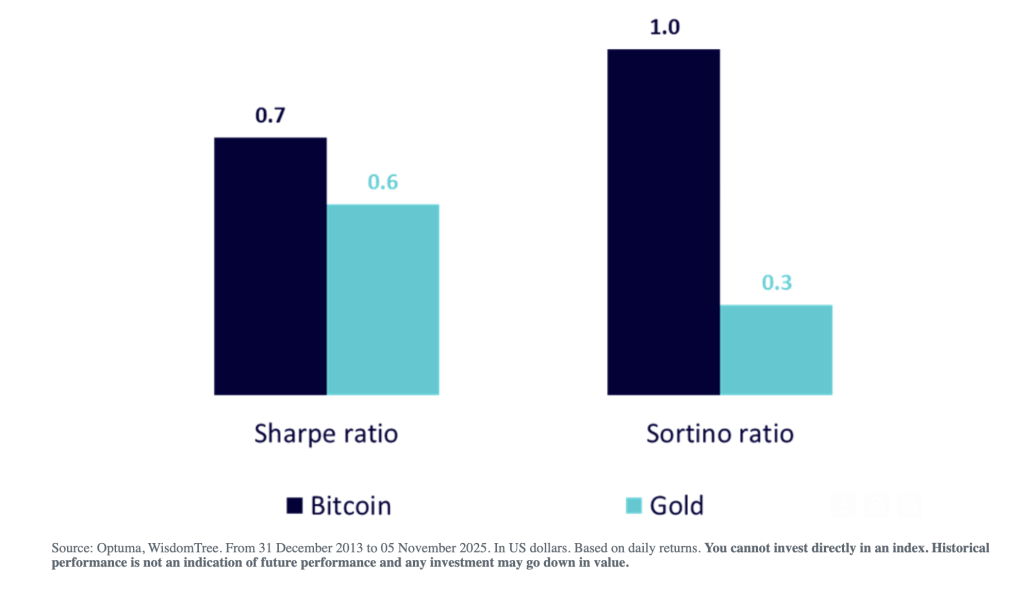
Bitcoin, however, has shifted the paradigm. Over the same period, it generated annualised returns of 50.5% with 67.0% volatility, resulting in a Sharpe ratio of 0.7 — marginally outperforming gold on a risk-adjusted basis despite its extreme swings.

On the Sortino ratio, which focuses on downside risk, the gap is even wider: 1.0 for bitcoin versus 0.3 for gold. In simple terms, bitcoin has historically compensated investors more efficiently for the risk taken.

“Even with high volatility, bitcoin has offered superior risk-adjusted returns,” Silenskyte notes.

Bitcoin Volatility: From Barrier to Manageable Risk

Bitcoin’s volatility is frequently cited as the primary reason some investors remain hesitant. Yet Silenskyte’s research shows that this volatility has declined significantly over the past decade. Its 90-day annualised volatility has compressed from above 150% to under 40%, putting it within range of several commodities.

At the same time, liquidity has deepened, with daily spot volumes comparable to major S&P 500 equities. Derivatives markets — particularly futures and options — provide sophisticated hedging tools that make volatility increasingly manageable for institutional allocators.

“Volatility is a tax, but a declining one,” Silenskyte says.

Macro Conditions Favour a Combined Allocation

Rather than competing, bitcoin and gold appear to hedge different types of macro risk. Gold thrives during inflation, geopolitical turmoil and periods of negative real yields. Bitcoin, with its 21-million-supply cap and decentralised issuance, serves as a hedge against fiat debasement and technological disruption.

Importantly, bitcoin and gold display a low long-term correlation of just 6%, according to WisdomTree. This gives them powerful diversification properties: gold anchors the defensive side of a portfolio, while bitcoin provides convex upside driven by digital adoption.

Portfolio Implications: Not Either-Or, but Both

WisdomTree’s modelling shows that adding even 1% bitcoin to a traditional 60/40 portfolio can increase the Sharpe ratio by 0.06, with only a marginal change in maximum drawdowns.

The takeaway from Silenskyte’s research is clear: gold remains foundational, but bitcoin enhances the opportunity set. As digital assets mature, the case for treating the two as complementary hedges — not rivals — becomes stronger.

Together, they broaden the safe-haven spectrum for the modern investor.

Market Opportunity
ERA Logo
ERA Price(ERA)
$0.1959
$0.1959$0.1959
+1.45%
USD
ERA (ERA) Live Price Chart
Disclaimer: The articles reposted on this site are sourced from public platforms and are provided for informational purposes only. They do not necessarily reflect the views of MEXC. All rights remain with the original authors. If you believe any content infringes on third-party rights, please contact service@support.mexc.com for removal. MEXC makes no guarantees regarding the accuracy, completeness, or timeliness of the content and is not responsible for any actions taken based on the information provided. The content does not constitute financial, legal, or other professional advice, nor should it be considered a recommendation or endorsement by MEXC.

You May Also Like

Japan’s Rate Hike Puts Bitcoin on Edge

Japan’s Rate Hike Puts Bitcoin on Edge

Japan's rate hike ends ultra-loose policies, impacting Bitcoin prices and global markets.
Share
CoinLive2025/12/22 07:43
How to earn from cloud mining: IeByte’s upgraded auto-cloud mining platform unlocks genuine passive earnings

How to earn from cloud mining: IeByte’s upgraded auto-cloud mining platform unlocks genuine passive earnings

The post How to earn from cloud mining: IeByte’s upgraded auto-cloud mining platform unlocks genuine passive earnings appeared on BitcoinEthereumNews.com. contributor Posted: September 17, 2025 As digital assets continue to reshape global finance, cloud mining has become one of the most effective ways for investors to generate stable passive income. Addressing the growing demand for simplicity, security, and profitability, IeByte has officially upgraded its fully automated cloud mining platform, empowering both beginners and experienced investors to earn Bitcoin, Dogecoin, and other mainstream cryptocurrencies without the need for hardware or technical expertise. Why cloud mining in 2025? Traditional crypto mining requires expensive hardware, high electricity costs, and constant maintenance. In 2025, with blockchain networks becoming more competitive, these barriers have grown even higher. Cloud mining solves this by allowing users to lease professional mining power remotely, eliminating the upfront costs and complexity. IeByte stands at the forefront of this transformation, offering investors a transparent and seamless path to daily earnings. IeByte’s upgraded auto-cloud mining platform With its latest upgrade, IeByte introduces: Full Automation: Mining contracts can be activated in just one click, with all processes handled by IeByte’s servers. Enhanced Security: Bank-grade encryption, cold wallets, and real-time monitoring protect every transaction. Scalable Options: From starter packages to high-level investment contracts, investors can choose the plan that matches their goals. Global Reach: Already trusted by users in over 100 countries. Mining contracts for 2025 IeByte offers a wide range of contracts tailored for every investor level. From entry-level plans with daily returns to premium high-yield packages, the platform ensures maximum accessibility. Contract Type Duration Price Daily Reward Total Earnings (Principal + Profit) Starter Contract 1 Day $200 $6 $200 + $6 + $10 bonus Bronze Basic Contract 2 Days $500 $13.5 $500 + $27 Bronze Basic Contract 3 Days $1,200 $36 $1,200 + $108 Silver Advanced Contract 1 Day $5,000 $175 $5,000 + $175 Silver Advanced Contract 2 Days $8,000 $320 $8,000 + $640 Silver…
Share
BitcoinEthereumNews2025/09/17 23:48
Stablecoins Get A Break? US Lawmakers Propose Tax Relief

Stablecoins Get A Break? US Lawmakers Propose Tax Relief

Lawmakers in the US have put forward a discussion draft that would ease tax reporting for small stablecoin payments and let some crypto earners delay taxes on staking
Share
Bitcoinist2025/12/22 07:00