In an interview with Bitcoin Archive’s Archie, early Bitcoiner and Bank to the Future co-founder Simon Dixon characterized the current moment as nothing less than “the Wall Street attack phase,” arguing that institutional finance is assembling the plumbing and incentives to pull customer coins into custodial wrappers—and, in crisis, separate investors from their bitcoin. “People […]In an interview with Bitcoin Archive’s Archie, early Bitcoiner and Bank to the Future co-founder Simon Dixon characterized the current moment as nothing less than “the Wall Street attack phase,” arguing that institutional finance is assembling the plumbing and incentives to pull customer coins into custodial wrappers—and, in crisis, separate investors from their bitcoin. “People […]

Bitcoin At Risk? Simon Dixon Alleges BlackRock’s Hidden Takeover Plan

In an interview with Bitcoin Archive’s Archie, early Bitcoiner and Bank to the Future co-founder Simon Dixon characterized the current moment as nothing less than “the Wall Street attack phase,” arguing that institutional finance is assembling the plumbing and incentives to pull customer coins into custodial wrappers—and, in crisis, separate investors from their bitcoin. “People underestimate what Wall Street is willing to do to take your Bitcoin,” he said. The essential defense, in his view, is unambiguous: “Bitcoin is money you can own, money you can spend, and money that has a fixed supply with a monetary policy that nobody can change.”

How BlackRock Is Allegedly Trying To Control Bitcoin

Dixon framed the last 14 years of Bitcoin’s history as a series of counter-attacks, from exchange failures to regulatory squeezes, culminating now in what he described as a two-tier system: bitcoin held in Wall Street custody—via ETFs, pensions, corporate treasuries and bitcoin-backed loans—and bitcoin held in self-custody. The danger, he argued, is not price manipulation forever, but engineered liquidity events designed to vacuum up coins from leveraged or custodial holders. “They can’t change the long-term price. The fixed supply is the fixed supply,” he said. “But they can do elaborate schemes to steal your Bitcoin.”

At the core of his thesis is the scale and reach of the modern asset-management complex. Dixon pointed to BlackRock’s centrality—its index weight across “20,000 companies,” its Aladdin risk platform used by large asset managers, and its proximity to policymaking—as symptomatic of a broader “financial-industrial complex.”

In Dixon’s telling, that complex has already rebuilt the crypto industry in its own image: first by presiding over (or benefiting from) a parade of high-profile implosions and banking disruptions like FTX and Celsius, then by shepherding a pro-ETF, pro-tokenization framework that channels retirement savings, insurance float and corporate balance sheets into custodial bitcoin exposure. “Through this tax efficiency plus individuals thinking about inheritance, we have essentially given the asset managers full control,” he claimed. The net effect, he warned, is the consolidation of coins into a few systemically important pools.

Archie challenged the causal chain between the 2022–2023 enforcement wave and spot ETF approvals, noting that Grayscale had to sue to win its conversion. Dixon acknowledged that “you have to take a few leaps” when reconstructing opaque policy sequences, but insisted the net result is plain: the industry was discredited and de-banked, only for a tightly regulated, Wall-Street-led version to emerge. He cited his inside view as a major creditor in the Celsius Chapter 11 as formative, saying that bankruptcy taught him how quickly “Bitcoin IOUs” become indistinguishable from the legacy system’s risks. “Anybody that’s left Bitcoin on an exchange and received a Bitcoin IOU… realizes the importance of the ability to self-custody,” he said.

The conversation repeatedly returned to leverage. Archie drew a distinction between the margin chains and rehypothecation that blew up in 2021–2022 and the long-duration, corporate-finance tools used by publicly listed “bitcoin operating companies,” arguing these are “night and day” in terms of systemic fragility. Dixon’s reply was that the real risk emerges when individually sensible structures are linked into a pipeline—ETFs and index funds directing flows, corporate debt and dividend commitments denominated in fiat, stablecoin credit interlacing with bitcoin-backed loans, distressed buyouts rolling assets into the largest public vehicles, and mining equities sitting inside the same index-fund complex.

“When you combine all of these different products together… you can then do this margin process,” he said. He sketched a scenario in which a severe drawdown triggers margin cascades and bankruptcy proceedings that deliver even more coins into a few custodial honeypots. “All you need to do to protect yourself when that event happens is own bitcoin in self-custody,” he said.

Beyond market structure, Dixon placed Bitcoin in a wider macro and geopolitical frame. He argued the United States is pursuing “fiscal dominance”—debt-financed spending that inflates away obligations—while a multipolar currency order accelerates. In that transition, he expects both gold and bitcoin to be instrumentalized. “Bitcoin is going to be placed at the very, very center of a future and upcoming currency war,” he said, asserting that the same financial-industrial network that shapes rates and credit will not hesitate to “engineer some kind of pump and dump cycle that resets the chessboard.” Whether or not readers accept that framing, his prescription does not waver: self-custody first.

Dixon also laid out a personal rule set forged across cycles: buy on a fixed cadence, hold coins in self-custody, and think in multi-year horizons. “Most people come in for number-go-ups,” he said, “but until they go through a disaster, then they realize that the money you can own and money you can spend is the real utility.” He urged viewers to build the operational competence of self-custody now—keys, inheritance planning, and disciplined accumulation—rather than outsourcing it to product wrappers that trade convenience for counterparty risk. “Everybody has to do it,” he said. “The skill of self-custody is something everyone has to do.”

Archie added two caveats for balance: allocate only capital you can leave untouched for at least four years, and remember to upgrade quality of life rather than “bask in the warmth of your UTXOs” indefinitely. Dixon agreed, stressing that the point of reducing financial anxiety is to live better, not to hoard at all costs. Still, he closed with urgency: “There will never be another five years like the five years ahead… In the next five years, you need to accumulate as much bitcoin as is humanly possible,” he said, adding his standard disclaimer—“not financial advice.”

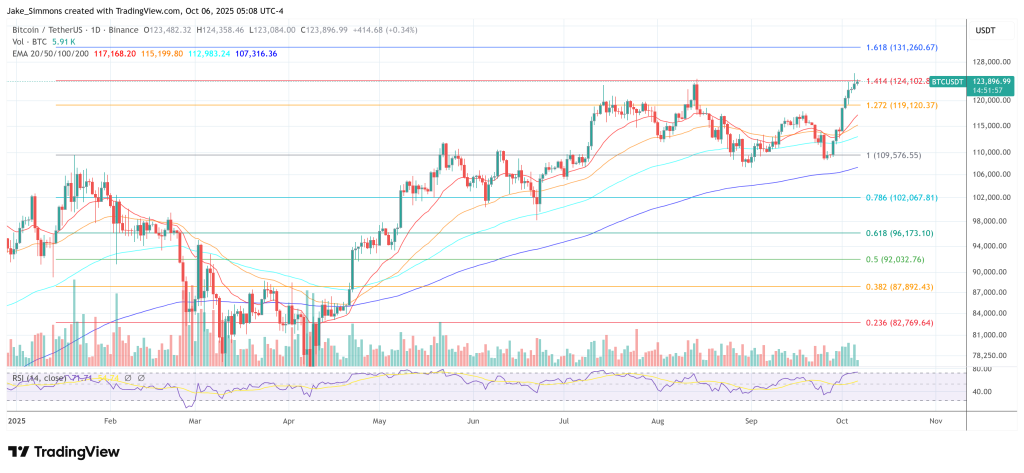
At press time, BTC traded at $123,896.
Bitcoin price
Market Opportunity
Simon the Gator Logo
Simon the Gator Price(SIMON)
$0.0000286
$0.0000286$0.0000286
-0.34%
USD
Simon the Gator (SIMON) Live Price Chart
Disclaimer: The articles reposted on this site are sourced from public platforms and are provided for informational purposes only. They do not necessarily reflect the views of MEXC. All rights remain with the original authors. If you believe any content infringes on third-party rights, please contact service@support.mexc.com for removal. MEXC makes no guarantees regarding the accuracy, completeness, or timeliness of the content and is not responsible for any actions taken based on the information provided. The content does not constitute financial, legal, or other professional advice, nor should it be considered a recommendation or endorsement by MEXC.

You May Also Like

Crucial US Stock Market Update: What Wednesday’s Mixed Close Reveals

Crucial US Stock Market Update: What Wednesday’s Mixed Close Reveals

BitcoinWorld Crucial US Stock Market Update: What Wednesday’s Mixed Close Reveals The financial world often keeps us on our toes, and Wednesday was no exception. Investors watched closely as the US stock market concluded the day with a mixed performance across its major indexes. This snapshot offers a crucial glimpse into current investor sentiment and economic undercurrents, prompting many to ask: what exactly happened? Understanding the Latest US Stock Market Movements On Wednesday, the closing bell brought a varied picture for the US stock market. While some indexes celebrated gains, others registered slight declines, creating a truly mixed bag for investors. The Dow Jones Industrial Average showed resilience, climbing by a notable 0.57%. This positive movement suggests strength in some of the larger, more established companies. Conversely, the S&P 500, a broader benchmark often seen as a barometer for the overall market, experienced a modest dip of 0.1%. The technology-heavy Nasdaq Composite also saw a slight retreat, sliding by 0.33%. This particular index often reflects investor sentiment towards growth stocks and the tech sector. These divergent outcomes highlight the complex dynamics currently at play within the American economy. It’s not simply a matter of “up” or “down” for the entire US stock market; rather, it’s a nuanced landscape where different sectors and company types are responding to unique pressures and opportunities. Why Did the US Stock Market See Mixed Results? When the US stock market delivers a mixed performance, it often points to a tug-of-war between various economic factors. Several elements could have contributed to Wednesday’s varied closings. For instance, positive corporate earnings reports from certain industries might have bolstered the Dow. At the same time, concerns over inflation, interest rate policies by the Federal Reserve, or even global economic uncertainties could have pressured growth stocks, affecting the S&P 500 and Nasdaq. Key considerations often include: Economic Data: Recent reports on employment, manufacturing, or consumer spending can sway market sentiment. Corporate Announcements: Strong or weak earnings forecasts from influential companies can significantly impact their respective sectors. Interest Rate Expectations: The prospect of higher or lower interest rates directly influences borrowing costs for businesses and consumer spending, affecting future profitability. Geopolitical Events: Global tensions or trade policies can introduce uncertainty, causing investors to become more cautious. Understanding these underlying drivers is crucial for anyone trying to make sense of daily market fluctuations in the US stock market. Navigating Volatility in the US Stock Market A mixed close, while not a dramatic downturn, serves as a reminder that market volatility is a constant companion for investors. For those involved in the US stock market, particularly individuals managing their portfolios, these days underscore the importance of a well-thought-out strategy. It’s important not to react impulsively to daily movements. Instead, consider these actionable insights: Diversification: Spreading investments across different sectors and asset classes can help mitigate risk when one area underperforms. Long-Term Perspective: Focusing on long-term financial goals rather than short-term gains can help weather daily market swings. Stay Informed: Keeping abreast of economic news and company fundamentals provides context for market behavior. Consult Experts: Financial advisors can offer personalized guidance based on individual risk tolerance and objectives. Even small movements in major indexes can signal shifts that require attention, guiding future investment decisions within the dynamic US stock market. What’s Next for the US Stock Market? Looking ahead, investors will be keenly watching for further economic indicators and corporate announcements to gauge the direction of the US stock market. Upcoming inflation data, statements from the Federal Reserve, and quarterly earnings reports will likely provide more clarity. The interplay of these factors will continue to shape investor confidence and, consequently, the performance of the Dow, S&P 500, and Nasdaq. Remaining informed and adaptive will be key to understanding the market’s trajectory. Conclusion: Wednesday’s mixed close in the US stock market highlights the intricate balance of forces influencing financial markets. While the Dow showed strength, the S&P 500 and Nasdaq experienced slight declines, reflecting a nuanced economic landscape. This reminds us that understanding the ‘why’ behind these movements is as important as the movements themselves. As always, a thoughtful, informed approach remains the best strategy for navigating the complexities of the market. Frequently Asked Questions (FAQs) Q1: What does a “mixed close” mean for the US stock market? A1: A mixed close indicates that while some major stock indexes advanced, others declined. It suggests that different sectors or types of companies within the US stock market are experiencing varying influences, rather than a uniform market movement. Q2: Which major indexes were affected on Wednesday? A2: On Wednesday, the Dow Jones Industrial Average gained 0.57%, while the S&P 500 edged down 0.1%, and the Nasdaq Composite slid 0.33%, illustrating the mixed performance across the US stock market. Q3: What factors contribute to a mixed stock market performance? A3: Mixed performances in the US stock market can be influenced by various factors, including specific corporate earnings, economic data releases, shifts in interest rate expectations, and broader geopolitical events that affect different market segments uniquely. Q4: How should investors react to mixed market signals? A4: Investors are generally advised to maintain a long-term perspective, diversify their portfolios, stay informed about economic news, and avoid impulsive decisions. Consulting a financial advisor can also provide personalized guidance for navigating the US stock market. Q5: What indicators should investors watch for future US stock market trends? A5: Key indicators to watch include upcoming inflation reports, statements from the Federal Reserve regarding monetary policy, and quarterly corporate earnings reports. These will offer insights into the future direction of the US stock market. Did you find this analysis of the US stock market helpful? Share this article with your network on social media to help others understand the nuances of current financial trends! To learn more about the latest stock market trends, explore our article on key developments shaping the US stock market‘s future performance. This post Crucial US Stock Market Update: What Wednesday’s Mixed Close Reveals first appeared on BitcoinWorld.
Share
Coinstats2025/09/18 05:30
Forbes' 2026 Crypto Investment Trends Outlook: Institutionalization, Tokenization, Stablecoins, and the AI Machine Economy

Forbes' 2026 Crypto Investment Trends Outlook: Institutionalization, Tokenization, Stablecoins, and the AI Machine Economy

PANews reported on January 2nd that Nina Bambysheva, Forbes' currency markets editor and analyst, published an article analyzing five major trends in crypto investment
Share
PANews2026/01/02 20:15
Zcash Price Faces Breakdown Risk

Zcash Price Faces Breakdown Risk

The post Zcash Price Faces Breakdown Risk appeared on BitcoinEthereumNews.com. Zcash price has maintained an apparent uptrend, fueling expectations of an impending
Share
BitcoinEthereumNews2026/01/02 20:35