The Federal Reserve (Fed) injected $29.4 billion into the US banking system through overnight repo operations on Friday, the largest single-day move since the dot-com era. At the same time, China’s central bank deployed a record cash infusion to reinforce its domestic banking sector. These coordinated liquidity moves signal a turning point for global risk assets, especially Bitcoin (BTC). Traders are closely monitoring how central banks act to stabilize markets ahead of 2026. Fed’s Liquidity Move Highlights Market Tension The Fed’s unusually large overnight repo operation followed sharp Treasury sell-offs and reflected growing stress in short-term credit markets. Overnight repos enable institutions to exchange securities for cash, providing immediate liquidity in times of tight market conditions. The October 31 injection set a multi-decade record, even compared to the dot-com bubble era. Many analysts interpret this move as a clear response to stress in Treasury markets. When bond yields rise and funding becomes more expensive, the Fed often steps in to limit systemic risks. These interventions also expand the money supply, a factor that often correlates with rallies in risk assets such as Bitcoin. Meanwhile, Fed Governor Christopher Waller recently called for an interest rate cut in December, indicating a potential shift toward more accommodative policy. This contrasts with earlier hawkish remarks from Fed Chair Jerome Powell, whose caution has fueled market uncertainty. Polymarket data now puts the odds for a third 2025 rate cut at 65%, down from 90%, showing shifting expectations for monetary policy. Probability for three Fed rate cuts in 2025 falls from 90% to 65%. Source: Roundtable Space If the Fed fails to meet these expectations, markets could face a sharp downturn. Investors have already priced in easier policy, and any reversal might cause capital to exit riskier assets. The difficult balance between liquidity injections and rate policy highlights the Fed’s challenge as it manages inflation and financial stability. China’s Record Cash Infusion Boosts Global Liquidity Meanwhile, China’s central bank also executed a record cash injection into domestic banks, aiming to support economic growth amid softening demand. The People’s Bank of China (PBOC) increased liquidity in a bid to keep lending active and prevent credit tightening. This action comes as Beijing addresses deflation and a weakened property sector. The size of the PBOC’s move is comparable to its responses during past crises. By supplying extra funds, the central bank wants to lower borrowing costs and stimulate credit growth. Such stimulus also expands global money supply and could contribute to asset inflation in stocks and cryptocurrencies. Historically, simultaneous liquidity boosts by the Fed and PBOC have preceded major Bitcoin rallies. The 2020-2021 bull run happened alongside aggressive monetary easing after the COVID-19 outbreak. Crypto traders now watch for a similar trend, as increased liquidity can lead investors to seek alternative assets that hedge against currency devaluation. Macro analysts describe the situation as a “liquidity tug-of-war” between Washington and Beijing. The Fed is balancing inflation and financial stability, while the PBOC seeks to promote growth without fueling further debt. The outcome will influence risk appetite and set the tone for asset performance in 2025. Bitcoin’s Macro Outlook Depends on Ongoing Liquidity Bitcoin’s price has remained steady in recent weeks, staying within a narrow band as traders weigh the impact of central bank actions. Bitcoin (BTC) Price Performance. Source: TradingView The pioneer crypto shows signs of consolidation, with Coinglass data indicating open interest dropped from above 100,000 contracts in October to near 90,000 in early November. This decrease signals caution among derivatives traders. Despite subdued activity, the environment could become positive for Bitcoin if global liquidity continues to grow. Lower inflation in the US, paired with an expanding money supply, favors risk-taking. Many institutional investors now consider Bitcoin a store of value, especially when monetary expansion puts pressure on the purchasing power of traditional currencies. However, Bitcoin’s rally may depend on the decisions of central banks. If the Fed reduces liquidity too soon through scaled-back repo operations or unexpected rate hikes, any positive momentum could quickly vanish. Likewise, if China’s stimulus fails to revive its economy, global risk sentiment may weaken, impacting speculative assets. The next several weeks will show whether central banks maintain liquidity support or prioritize inflation control. For Bitcoin, the outcome could decide if 2026 brings another strong bull run or just continued consolidation.The Federal Reserve (Fed) injected $29.4 billion into the US banking system through overnight repo operations on Friday, the largest single-day move since the dot-com era. At the same time, China’s central bank deployed a record cash infusion to reinforce its domestic banking sector. These coordinated liquidity moves signal a turning point for global risk assets, especially Bitcoin (BTC). Traders are closely monitoring how central banks act to stabilize markets ahead of 2026. Fed’s Liquidity Move Highlights Market Tension The Fed’s unusually large overnight repo operation followed sharp Treasury sell-offs and reflected growing stress in short-term credit markets. Overnight repos enable institutions to exchange securities for cash, providing immediate liquidity in times of tight market conditions. The October 31 injection set a multi-decade record, even compared to the dot-com bubble era. Many analysts interpret this move as a clear response to stress in Treasury markets. When bond yields rise and funding becomes more expensive, the Fed often steps in to limit systemic risks. These interventions also expand the money supply, a factor that often correlates with rallies in risk assets such as Bitcoin. Meanwhile, Fed Governor Christopher Waller recently called for an interest rate cut in December, indicating a potential shift toward more accommodative policy. This contrasts with earlier hawkish remarks from Fed Chair Jerome Powell, whose caution has fueled market uncertainty. Polymarket data now puts the odds for a third 2025 rate cut at 65%, down from 90%, showing shifting expectations for monetary policy. Probability for three Fed rate cuts in 2025 falls from 90% to 65%. Source: Roundtable Space If the Fed fails to meet these expectations, markets could face a sharp downturn. Investors have already priced in easier policy, and any reversal might cause capital to exit riskier assets. The difficult balance between liquidity injections and rate policy highlights the Fed’s challenge as it manages inflation and financial stability. China’s Record Cash Infusion Boosts Global Liquidity Meanwhile, China’s central bank also executed a record cash injection into domestic banks, aiming to support economic growth amid softening demand. The People’s Bank of China (PBOC) increased liquidity in a bid to keep lending active and prevent credit tightening. This action comes as Beijing addresses deflation and a weakened property sector. The size of the PBOC’s move is comparable to its responses during past crises. By supplying extra funds, the central bank wants to lower borrowing costs and stimulate credit growth. Such stimulus also expands global money supply and could contribute to asset inflation in stocks and cryptocurrencies. Historically, simultaneous liquidity boosts by the Fed and PBOC have preceded major Bitcoin rallies. The 2020-2021 bull run happened alongside aggressive monetary easing after the COVID-19 outbreak. Crypto traders now watch for a similar trend, as increased liquidity can lead investors to seek alternative assets that hedge against currency devaluation. Macro analysts describe the situation as a “liquidity tug-of-war” between Washington and Beijing. The Fed is balancing inflation and financial stability, while the PBOC seeks to promote growth without fueling further debt. The outcome will influence risk appetite and set the tone for asset performance in 2025. Bitcoin’s Macro Outlook Depends on Ongoing Liquidity Bitcoin’s price has remained steady in recent weeks, staying within a narrow band as traders weigh the impact of central bank actions. Bitcoin (BTC) Price Performance. Source: TradingView The pioneer crypto shows signs of consolidation, with Coinglass data indicating open interest dropped from above 100,000 contracts in October to near 90,000 in early November. This decrease signals caution among derivatives traders. Despite subdued activity, the environment could become positive for Bitcoin if global liquidity continues to grow. Lower inflation in the US, paired with an expanding money supply, favors risk-taking. Many institutional investors now consider Bitcoin a store of value, especially when monetary expansion puts pressure on the purchasing power of traditional currencies. However, Bitcoin’s rally may depend on the decisions of central banks. If the Fed reduces liquidity too soon through scaled-back repo operations or unexpected rate hikes, any positive momentum could quickly vanish. Likewise, if China’s stimulus fails to revive its economy, global risk sentiment may weaken, impacting speculative assets. The next several weeks will show whether central banks maintain liquidity support or prioritize inflation control. For Bitcoin, the outcome could decide if 2026 brings another strong bull run or just continued consolidation.

Bitcoin Eyes Liquidity Race As Fed Injects $29 Billion While China Floods Markets

The Federal Reserve (Fed) injected $29.4 billion into the US banking system through overnight repo operations on Friday, the largest single-day move since the dot-com era. At the same time, China’s central bank deployed a record cash infusion to reinforce its domestic banking sector.

These coordinated liquidity moves signal a turning point for global risk assets, especially Bitcoin (BTC). Traders are closely monitoring how central banks act to stabilize markets ahead of 2026.

Fed’s Liquidity Move Highlights Market Tension

The Fed’s unusually large overnight repo operation followed sharp Treasury sell-offs and reflected growing stress in short-term credit markets.

Overnight repos enable institutions to exchange securities for cash, providing immediate liquidity in times of tight market conditions. The October 31 injection set a multi-decade record, even compared to the dot-com bubble era.

Many analysts interpret this move as a clear response to stress in Treasury markets. When bond yields rise and funding becomes more expensive, the Fed often steps in to limit systemic risks.

These interventions also expand the money supply, a factor that often correlates with rallies in risk assets such as Bitcoin.

Meanwhile, Fed Governor Christopher Waller recently called for an interest rate cut in December, indicating a potential shift toward more accommodative policy.

This contrasts with earlier hawkish remarks from Fed Chair Jerome Powell, whose caution has fueled market uncertainty. Polymarket data now puts the odds for a third 2025 rate cut at 65%, down from 90%, showing shifting expectations for monetary policy.
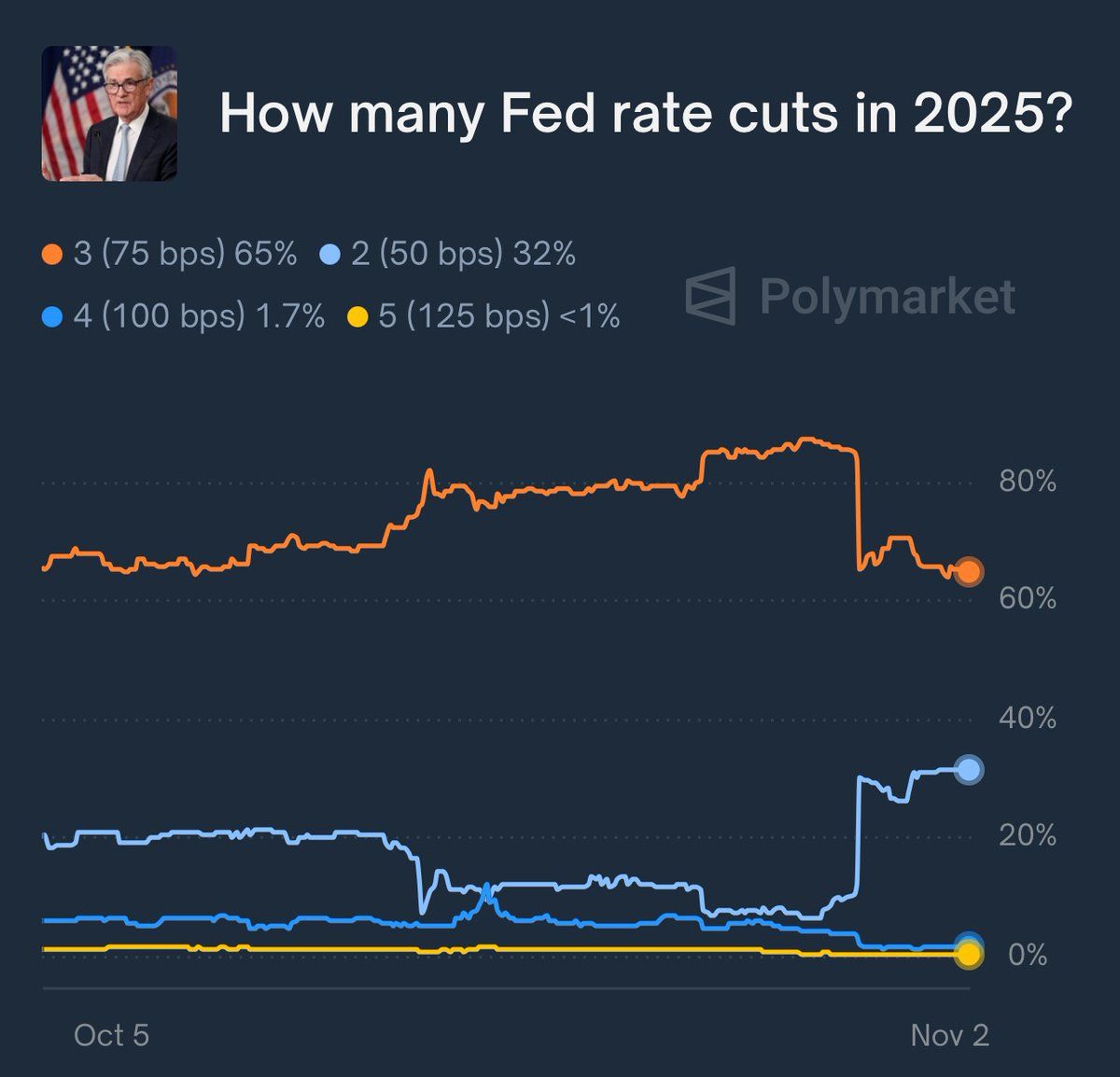
Polymarket probability chart for Fed rate cuts in 2025Probability for three Fed rate cuts in 2025 falls from 90% to 65%. Source: Roundtable Space

If the Fed fails to meet these expectations, markets could face a sharp downturn. Investors have already priced in easier policy, and any reversal might cause capital to exit riskier assets.

The difficult balance between liquidity injections and rate policy highlights the Fed’s challenge as it manages inflation and financial stability.

China’s Record Cash Infusion Boosts Global Liquidity

Meanwhile, China’s central bank also executed a record cash injection into domestic banks, aiming to support economic growth amid softening demand. The People’s Bank of China (PBOC) increased liquidity in a bid to keep lending active and prevent credit tightening. This action comes as Beijing addresses deflation and a weakened property sector.

The size of the PBOC’s move is comparable to its responses during past crises. By supplying extra funds, the central bank wants to lower borrowing costs and stimulate credit growth.

Such stimulus also expands global money supply and could contribute to asset inflation in stocks and cryptocurrencies.

Historically, simultaneous liquidity boosts by the Fed and PBOC have preceded major Bitcoin rallies. The 2020-2021 bull run happened alongside aggressive monetary easing after the COVID-19 outbreak.

Crypto traders now watch for a similar trend, as increased liquidity can lead investors to seek alternative assets that hedge against currency devaluation.

Macro analysts describe the situation as a “liquidity tug-of-war” between Washington and Beijing. The Fed is balancing inflation and financial stability, while the PBOC seeks to promote growth without fueling further debt. The outcome will influence risk appetite and set the tone for asset performance in 2025.

Bitcoin’s Macro Outlook Depends on Ongoing Liquidity

Bitcoin’s price has remained steady in recent weeks, staying within a narrow band as traders weigh the impact of central bank actions.
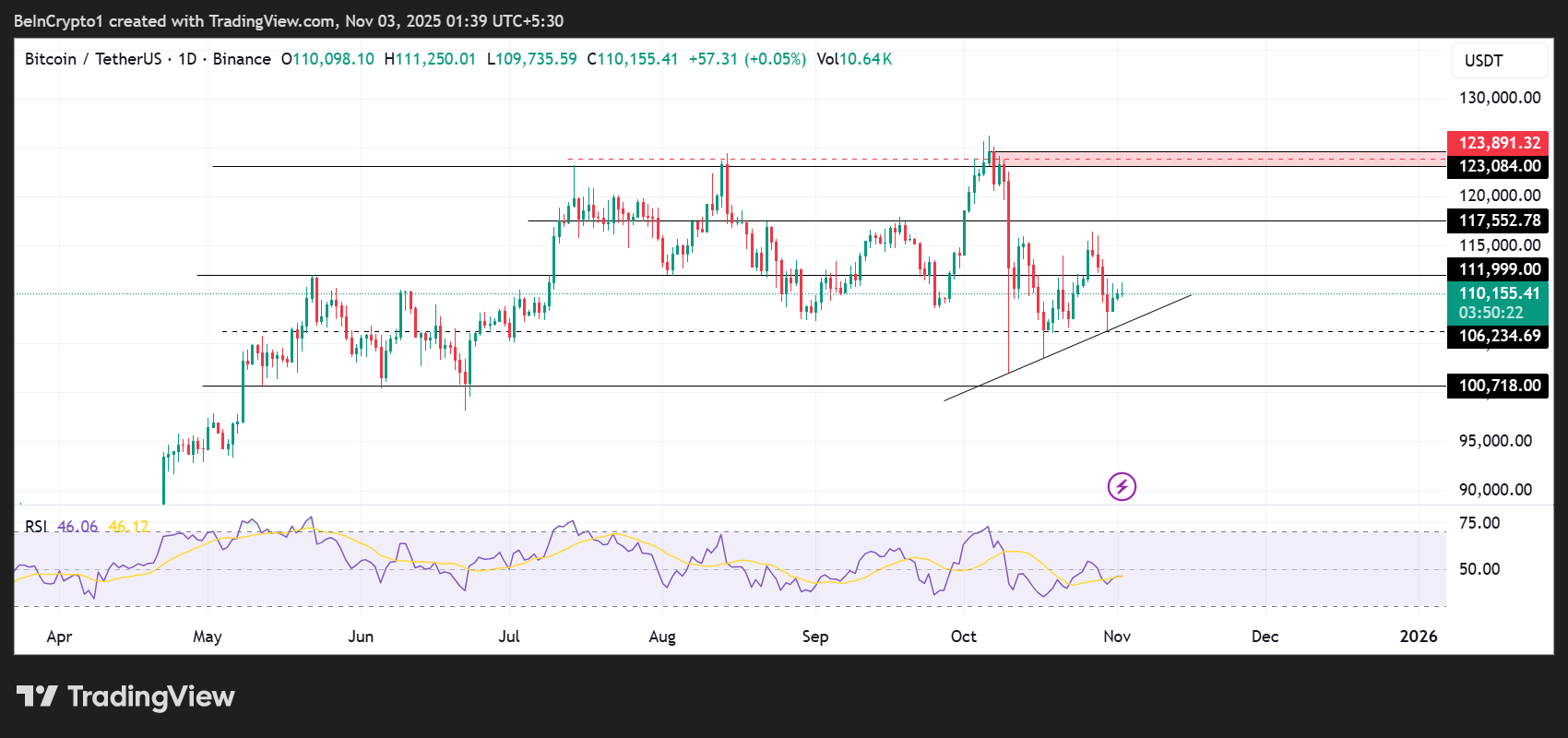
Bitcoin (BTC) Price PerformanceBitcoin (BTC) Price Performance. Source: TradingView

The pioneer crypto shows signs of consolidation, with Coinglass data indicating open interest dropped from above 100,000 contracts in October to near 90,000 in early November. This decrease signals caution among derivatives traders.

Despite subdued activity, the environment could become positive for Bitcoin if global liquidity continues to grow. Lower inflation in the US, paired with an expanding money supply, favors risk-taking.

Many institutional investors now consider Bitcoin a store of value, especially when monetary expansion puts pressure on the purchasing power of traditional currencies.

However, Bitcoin’s rally may depend on the decisions of central banks. If the Fed reduces liquidity too soon through scaled-back repo operations or unexpected rate hikes, any positive momentum could quickly vanish.

Likewise, if China’s stimulus fails to revive its economy, global risk sentiment may weaken, impacting speculative assets.

The next several weeks will show whether central banks maintain liquidity support or prioritize inflation control. For Bitcoin, the outcome could decide if 2026 brings another strong bull run or just continued consolidation.

Market Opportunity
4 Logo
4 Price(4)
$0.02292
$0.02292$0.02292
-4.06%
USD
4 (4) Live Price Chart
Disclaimer: The articles reposted on this site are sourced from public platforms and are provided for informational purposes only. They do not necessarily reflect the views of MEXC. All rights remain with the original authors. If you believe any content infringes on third-party rights, please contact service@support.mexc.com for removal. MEXC makes no guarantees regarding the accuracy, completeness, or timeliness of the content and is not responsible for any actions taken based on the information provided. The content does not constitute financial, legal, or other professional advice, nor should it be considered a recommendation or endorsement by MEXC.

You May Also Like

Cardano Eyes $1.50, While $0.0058 Layer Brett Targets $1 in 2025

Cardano Eyes $1.50, While $0.0058 Layer Brett Targets $1 in 2025

The post Cardano Eyes $1.50, While $0.0058 Layer Brett Targets $1 in 2025 appeared on BitcoinEthereumNews.com. Crypto News 24 September 2025 | 14:42 Crypto is heating up again, and traders are hunting for the next 100x altcoin before the 2025 crypto bull run really kicks in. Right now, two names keep coming up: ADA and Layer Brett ($LBRETT). The hype around ADA price prediction has investors cautiously optimistic, while Layer Brett’s crypto presale has created full-blown FOMO. At just $0.0058, $LBRETT has already raised over $4m, offering early backers a rare shot at life-changing returns in a short window. Historical performance: How ADA and Layer Brett compare When you look at ADA alongside memecoin projects like Dogecoin, Shiba Inu, and the original Brett, the differences stand out. ADA has been in the top altcoins conversation for years, with an all-time high of $3.10 that still gives long-term holders confidence. But meme token projects have mostly pumped without any real substance. This is where Layer Brett flips the script. Instead of being just another meme token, it’s an Ethereum Layer 2 project built for real utility, fast transactions, low gas fees, and staking crypto rewards. With speed topping 10,000 TPS, it delivers what congested chains can’t. Compared to ADA’s slower, research-heavy roadmap, $LBRETT is built to move fast and capture immediate opportunities. Technology and use cases driving Layer Brett The backbone of Layer Brett is its Layer 2 blockchain design. Transactions are anchored to Ethereum for security but processed off-chain for scale and low gas fees. That means users can buy and stake in seconds using ETH, USDT, or BNB, no KYC required. The staking rewards are where things get wild. Early participants are seeing around 630% APY, with incentives expected to cool as more tokens are locked. On top of that, features like NFT integrations and cross-chain bridging are already planned, giving $LBRETT both meme energy…
Share
BitcoinEthereumNews2025/09/24 20:06
Washington Faces New Dilemma Over Venezuela’s Alleged BTC Reserves

Washington Faces New Dilemma Over Venezuela’s Alleged BTC Reserves

The issue surfaced after the dramatic removal of Venezuela’s longtime leader, Nicolás Maduro, who was captured by U.S. forces and […] The post Washington Faces
Share
Coindoo2026/01/13 10:14
US Senate Prepares For Crypto Market Structure Bill Markup This Week — Here’s What to Expect

US Senate Prepares For Crypto Market Structure Bill Markup This Week — Here’s What to Expect

After months of intense negotiations involving both political parties, as well as representatives from the crypto industry and traditional banking sectors, the
Share
Bitcoinist2026/01/13 10:00