Dogecoin’s early November bounce appears weak, despite the modest 1.2% gain. DOGE price is still down 5.9% over the past week and nearly 27% this month. And now, on-chain data signals a deepening sell trend. The key question now: can Dogecoin’s $0.17 floor— which has held strong since October 11, even during the last bearish crossover — survive as long-term holders start to exit? Cost Basis Heatmap Marks The Last Line Of Defense On-chain cost basis data highlights Dogecoin’s strongest short-term support cluster between $0.177 and $0.179, where nearly 3.78 billion DOGE were last accumulated. First Cluster Protecting The Floor: Glassnode This range represents the heaviest long-term holder supply, acting as a key buffer during past sell-offs. Want more token insights like this? Sign up for Editor Harsh Notariya’s Daily Crypto Newsletter here. The cost basis heatmap shows where most investors last bought their tokens. It highlights the price zones with heavy long-term holder concentration that act as support or resistance. Bigger Dogecoin Support Cluster: Glassnode That buffer is weakening fast. According to Glassnode, Hodler Net Position Change — which tracks whether long-term wallets are adding or selling — flipped sharply negative on October 31. It dropped from an inflow of +8.2 million DOGE to an outflow of –22 million DOGE in just 24 hours. That’s a 367% reversal in holder behavior. Long-Term DOGE Holders Keep Selling: Glassnode This swing confirms that even older wallets are offloading their holdings. If this continues, it could thin out the $0.177–$0.179 cluster and expose Dogecoin’s strongest base since early October to further downside risk. Below $0.17, the next significant cost-basis cluster doesn’t appear until $0.14, leaving a wide gap for potential losses. But more on that in the next section. Looming Death Cross Could Accelerate the DOGE Price Breakdown The DOGE price structure now reinforces the bearish on-chain story. After the 50-day exponential moving average (EMA) crossed below the 200-day EMA in late October, Dogecoin extended its decline — marking the first leg of its current downtrend. The EMA is a trend indicator that smooths out price data to show market direction. Now, a second, stronger death cross is forming as the 100-day EMA approaches a drop below the 200-day EMA. Unlike the earlier crossover, this one carries more weight because both averages represent longer timeframes, reflecting sustained weakness rather than short-term volatility. If this crossover confirms, it would signal deepening downside momentum and strengthen the bearish structure already in place. In that case, Dogecoin’s strongest support zone near $0.17, highlighted by its cost basis heatmap, could finally give way — opening the door to a fall toward $0.14. That would be a near 6% dip. DOGE Price Analysis: TradingView Currently, DOGE trades near $0.18, capped by immediate resistances at $0.20 and $0.21. A daily close above $0.21, which hasn’t been tested since October 13, would be needed to invalidate this bearish bias.Dogecoin’s early November bounce appears weak, despite the modest 1.2% gain. DOGE price is still down 5.9% over the past week and nearly 27% this month. And now, on-chain data signals a deepening sell trend. The key question now: can Dogecoin’s $0.17 floor— which has held strong since October 11, even during the last bearish crossover — survive as long-term holders start to exit? Cost Basis Heatmap Marks The Last Line Of Defense On-chain cost basis data highlights Dogecoin’s strongest short-term support cluster between $0.177 and $0.179, where nearly 3.78 billion DOGE were last accumulated. First Cluster Protecting The Floor: Glassnode This range represents the heaviest long-term holder supply, acting as a key buffer during past sell-offs. Want more token insights like this? Sign up for Editor Harsh Notariya’s Daily Crypto Newsletter here. The cost basis heatmap shows where most investors last bought their tokens. It highlights the price zones with heavy long-term holder concentration that act as support or resistance. Bigger Dogecoin Support Cluster: Glassnode That buffer is weakening fast. According to Glassnode, Hodler Net Position Change — which tracks whether long-term wallets are adding or selling — flipped sharply negative on October 31. It dropped from an inflow of +8.2 million DOGE to an outflow of –22 million DOGE in just 24 hours. That’s a 367% reversal in holder behavior. Long-Term DOGE Holders Keep Selling: Glassnode This swing confirms that even older wallets are offloading their holdings. If this continues, it could thin out the $0.177–$0.179 cluster and expose Dogecoin’s strongest base since early October to further downside risk. Below $0.17, the next significant cost-basis cluster doesn’t appear until $0.14, leaving a wide gap for potential losses. But more on that in the next section. Looming Death Cross Could Accelerate the DOGE Price Breakdown The DOGE price structure now reinforces the bearish on-chain story. After the 50-day exponential moving average (EMA) crossed below the 200-day EMA in late October, Dogecoin extended its decline — marking the first leg of its current downtrend. The EMA is a trend indicator that smooths out price data to show market direction. Now, a second, stronger death cross is forming as the 100-day EMA approaches a drop below the 200-day EMA. Unlike the earlier crossover, this one carries more weight because both averages represent longer timeframes, reflecting sustained weakness rather than short-term volatility. If this crossover confirms, it would signal deepening downside momentum and strengthen the bearish structure already in place. In that case, Dogecoin’s strongest support zone near $0.17, highlighted by its cost basis heatmap, could finally give way — opening the door to a fall toward $0.14. That would be a near 6% dip. DOGE Price Analysis: TradingView Currently, DOGE trades near $0.18, capped by immediate resistances at $0.20 and $0.21. A daily close above $0.21, which hasn’t been tested since October 13, would be needed to invalidate this bearish bias.

DOGE Price On Thin Ice As Long-Term Holders Continue to Sell

Dogecoin’s early November bounce appears weak, despite the modest 1.2% gain. DOGE price is still down 5.9% over the past week and nearly 27% this month. And now, on-chain data signals a deepening sell trend.

The key question now: can Dogecoin’s $0.17 floor— which has held strong since October 11, even during the last bearish crossover — survive as long-term holders start to exit?

Cost Basis Heatmap Marks The Last Line Of Defense

On-chain cost basis data highlights Dogecoin’s strongest short-term support cluster between $0.177 and $0.179, where nearly 3.78 billion DOGE were last accumulated.
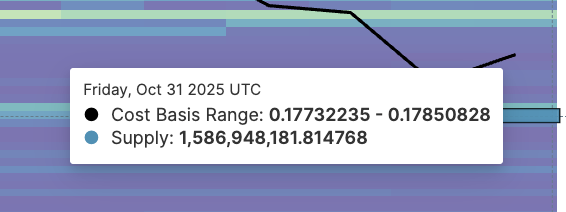
First Cluster Protecting The FloorFirst Cluster Protecting The Floor: Glassnode

This range represents the heaviest long-term holder supply, acting as a key buffer during past sell-offs.

Want more token insights like this? Sign up for Editor Harsh Notariya’s Daily Crypto Newsletter here.

The cost basis heatmap shows where most investors last bought their tokens. It highlights the price zones with heavy long-term holder concentration that act as support or resistance.
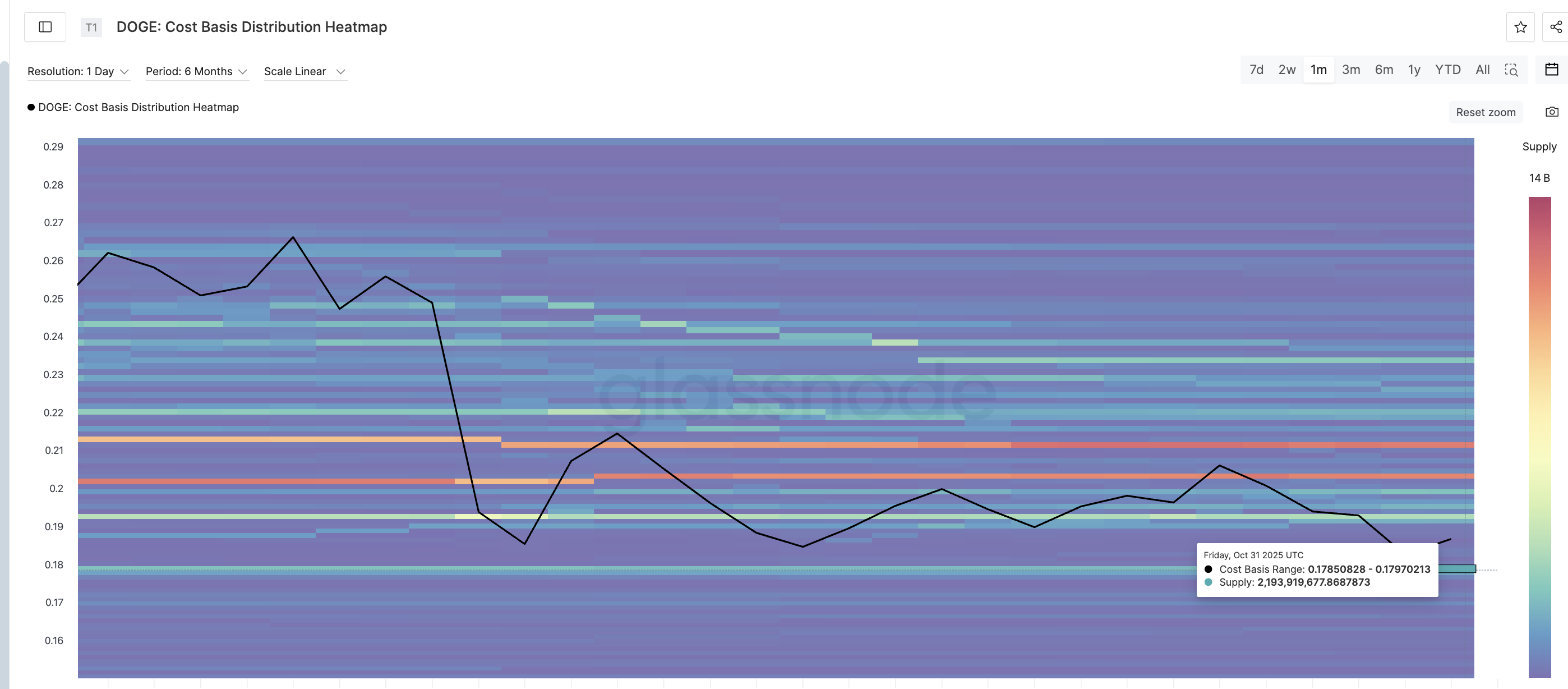
Bigger Dogecoin Support ClusterBigger Dogecoin Support Cluster: Glassnode

That buffer is weakening fast. According to Glassnode, Hodler Net Position Change — which tracks whether long-term wallets are adding or selling — flipped sharply negative on October 31. It dropped from an inflow of +8.2 million DOGE to an outflow of –22 million DOGE in just 24 hours. That’s a 367% reversal in holder behavior.
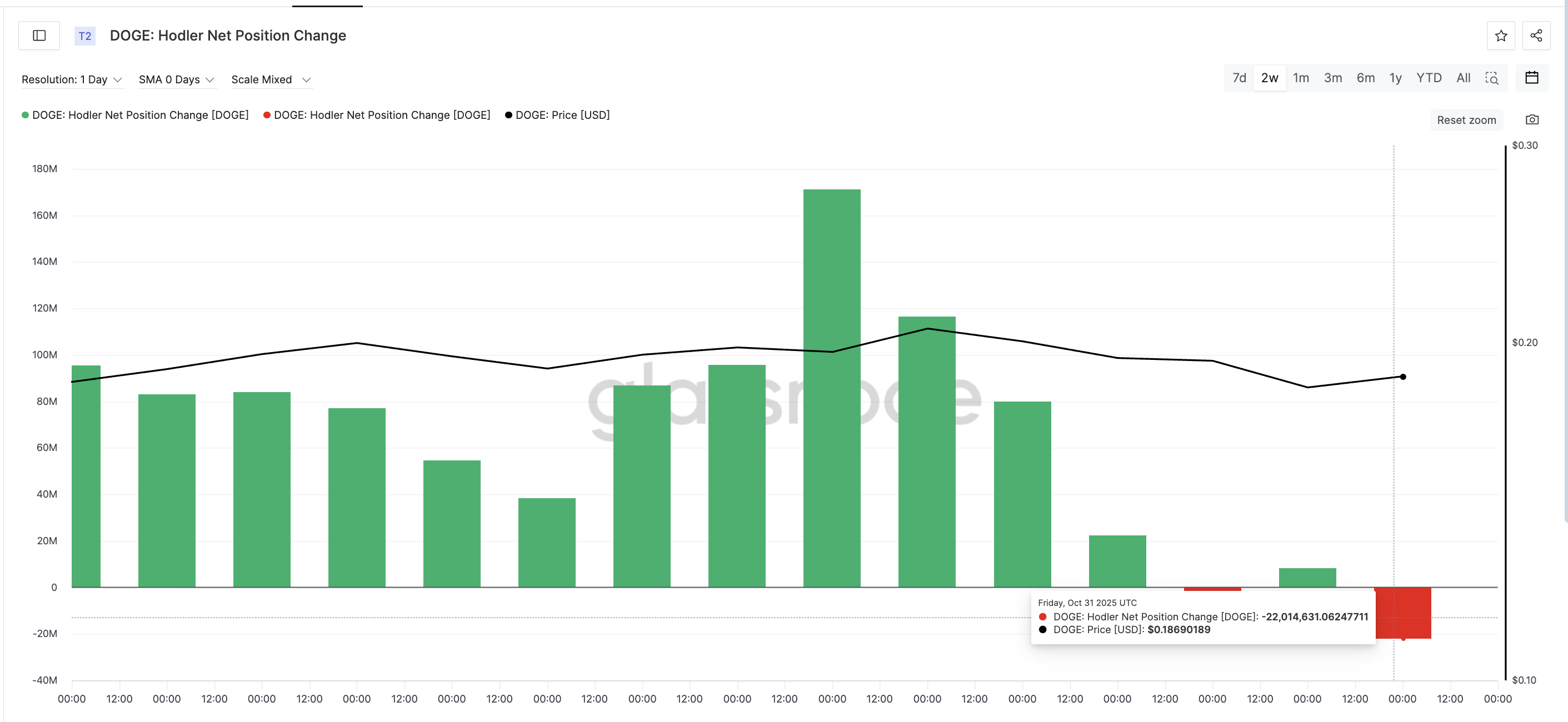
Long-Term DOGE Holders Keep SellingLong-Term DOGE Holders Keep Selling: Glassnode

This swing confirms that even older wallets are offloading their holdings. If this continues, it could thin out the $0.177–$0.179 cluster and expose Dogecoin’s strongest base since early October to further downside risk.

Below $0.17, the next significant cost-basis cluster doesn’t appear until $0.14, leaving a wide gap for potential losses. But more on that in the next section.

Looming Death Cross Could Accelerate the DOGE Price Breakdown

The DOGE price structure now reinforces the bearish on-chain story. After the 50-day exponential moving average (EMA) crossed below the 200-day EMA in late October, Dogecoin extended its decline — marking the first leg of its current downtrend. The EMA is a trend indicator that smooths out price data to show market direction.

Now, a second, stronger death cross is forming as the 100-day EMA approaches a drop below the 200-day EMA. Unlike the earlier crossover, this one carries more weight because both averages represent longer timeframes, reflecting sustained weakness rather than short-term volatility.

If this crossover confirms, it would signal deepening downside momentum and strengthen the bearish structure already in place. In that case, Dogecoin’s strongest support zone near $0.17, highlighted by its cost basis heatmap, could finally give way — opening the door to a fall toward $0.14. That would be a near 6% dip.
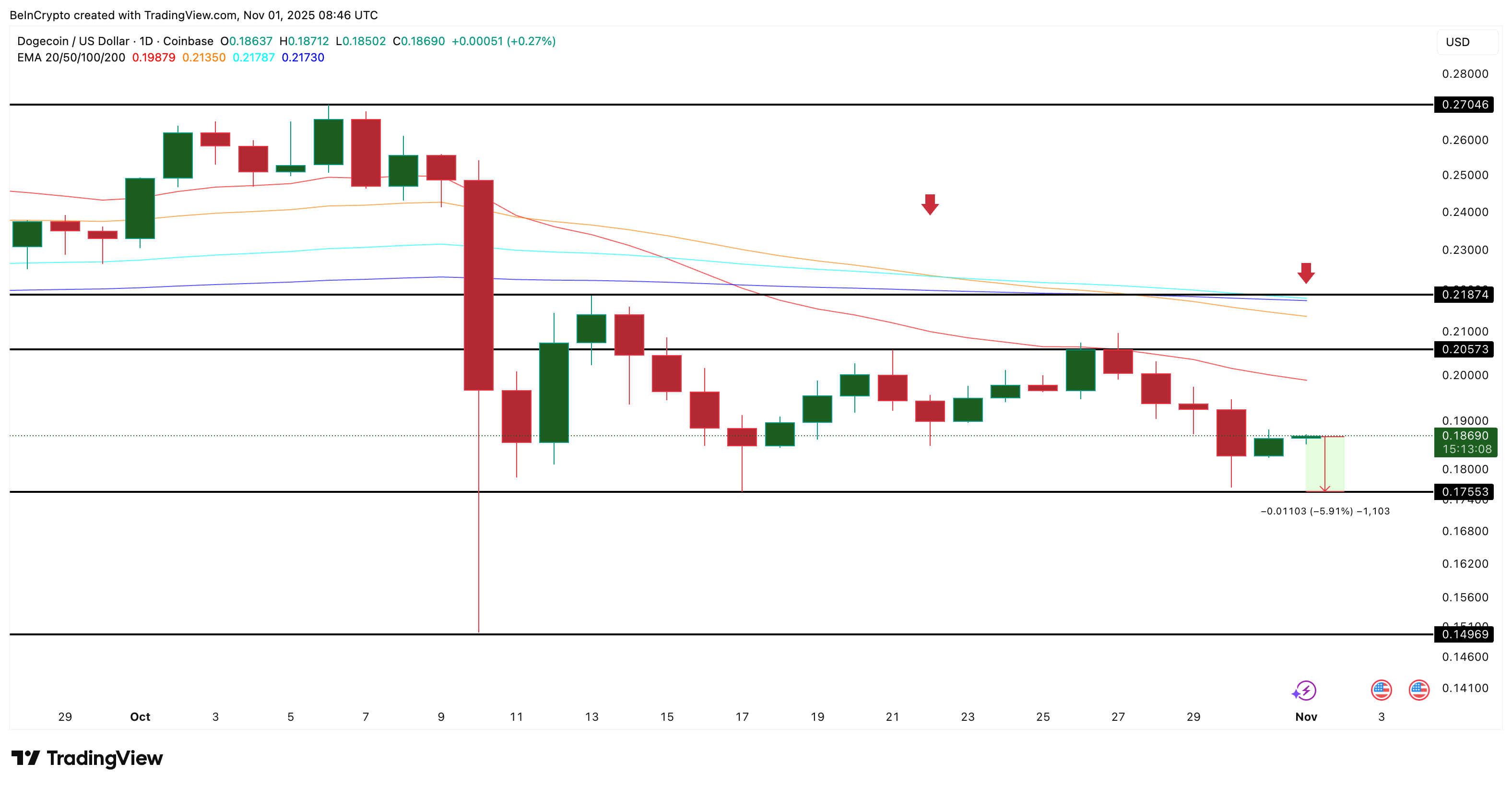
DOGE Price AnalysisDOGE Price Analysis: TradingView

Currently, DOGE trades near $0.18, capped by immediate resistances at $0.20 and $0.21. A daily close above $0.21, which hasn’t been tested since October 13, would be needed to invalidate this bearish bias.

Market Opportunity
DOGE Logo
DOGE Price(DOGE)
$0.13894
$0.13894$0.13894
-2.27%
USD
DOGE (DOGE) Live Price Chart
Disclaimer: The articles reposted on this site are sourced from public platforms and are provided for informational purposes only. They do not necessarily reflect the views of MEXC. All rights remain with the original authors. If you believe any content infringes on third-party rights, please contact service@support.mexc.com for removal. MEXC makes no guarantees regarding the accuracy, completeness, or timeliness of the content and is not responsible for any actions taken based on the information provided. The content does not constitute financial, legal, or other professional advice, nor should it be considered a recommendation or endorsement by MEXC.

You May Also Like

Trump’s Tactics Reignite Crypto’s SEC Dialogue

Trump’s Tactics Reignite Crypto’s SEC Dialogue

Prior to Donald Trump’s influence, cryptocurrency companies primarily encountered the Securities and Exchange Commission (SEC) through legal battles. Under the leadership of former SEC Chair Gary Gensler, the lack of clear guidance from the commission bred a climate of apprehension, leaving businesses in a perplexed state.Continue Reading:Trump’s Tactics Reignite Crypto’s SEC Dialogue
Share
Coinstats2025/09/18 04:08
UK Regulator Proposes New Crypto Rules to Protect Consumers

UK Regulator Proposes New Crypto Rules to Protect Consumers

UK’s FCA proposes crypto rules to boost transparency, protect consumers, and balance innovation with regulation; consultation open until 2026. The United Kingdom has taken a new step toward regulating the fast-growing crypto sector. On Wednesday, the Financial Conduct Authority (FCA) released a consultation paper that sets out how the existing financial rules should apply to […] The post UK Regulator Proposes New Crypto Rules to Protect Consumers appeared first on Live Bitcoin News.
Share
LiveBitcoinNews2025/09/18 15:30
FCA, crackdown on crypto

FCA, crackdown on crypto

The post FCA, crackdown on crypto appeared on BitcoinEthereumNews.com. The regulation of cryptocurrencies in the United Kingdom enters a decisive phase. The Financial Conduct Authority (FCA) has initiated a consultation to set minimum standards on transparency, consumer protection, and digital custody, in order to strengthen market confidence and ensure safer operations for exchanges, wallets, and crypto service providers. The consultation was published on May 2, 2025, and opened a public discussion on operational responsibilities and safeguarding requirements for digital assets (CoinDesk). The goal is to make the rules clearer without hindering the sector’s evolution. According to the data collected by our regulatory monitoring team, in the first weeks following the publication, the feedback received from professionals and operators focused mainly on custody, incident reporting, and insurance requirements. Industry analysts note that many responses require technical clarifications on multi-sig, asset segregation, and recovery protocols, as well as proposals to scale obligations based on the size of the operator. FCA Consultation: What’s on the Table The consultation document clarifies how to apply rules inspired by traditional finance to the crypto perimeter, balancing innovation, market integrity, and user protection. In this context, the goal is to introduce minimum standards for all firms under the supervision of the FCA, an essential step for a more transparent and secure sector, with measurable benefits for users. The proposed pillars Obligations towards consumers: assessment on the extension of the Consumer Duty – a requirement that mandates companies to provide “good outcomes” – to crypto services, with outcomes for users that are traceable and verifiable. Operational resilience: introduction of continuity requirements, incident response plans, and periodic testing to ensure the operational stability of platforms even in adverse scenarios. Financial Crime Prevention: strengthening AML/CFT measures through more stringent transaction monitoring and structured counterpart checks. Custody and safeguarding: definition of operational methods for the segregation of client assets, secure…
Share
BitcoinEthereumNews2025/09/18 05:40

