As the regulatory environment improves, traditional banks are restarting or expanding their digital asset custody product lines, making a widespread comeback. As early as October 2022, BNY Mellon (Bank of New York Mellon) launched its digital asset custody platform in the United States, holding and transferring BTC/ETH for selected clients. Recently, BNY Mellon has been conducting public trials in tokenized deposits and payment settlements to reduce settlement friction and promote programmable banking. This may involve BNY's Treasury Services division's approximately $2.5 trillion in daily payment processing and its approximately $55.8 trillion in assets under custody and administration. Just in mid-October, Citi Group announced that it is promoting institutional-grade crypto custody services and plans to launch related custody services in 2026 to cooperate with the improvement of the regulatory environment. This is driving significant inflows of institutional funds: by 2025, global crypto ETFs attracted $5.95 billion, and institutional Bitcoin holdings grew by 46%. Bank-grade custody services, through their strict regulatory frameworks and asset segregation advantages, are also participating in and changing the market landscape, spurring the expansion of tokenized deposits and stablecoin infrastructure. Citi's transformation may represent the attitude of traditional financial institutions towards the crypto market in recent years: from observation, piloting, and gradual progress, from payment and settlement on the test chain, to bank liabilities on the chain, and then to physical assets on the chain and native crypto asset custody. Citigroup executives have publicly stated that they believe stablecoins will expand from crypto trading tools to the mainstream economy, and that they view cryptocurrencies as part of mainstream financial infrastructure. A series of actions include: Launch of CIDAP platform: Clarifying Citi’s digital asset strategic framework. Collaboration with SDX (the wholly-owned digital asset subsidiary of the Swiss Stock Exchange SIX Group): Citi serves as tokenization agent + custodian, providing services for the tokenization of private equity/unlisted company shares. Deploy tokenized issuance/custody services: provide on-chain services for bonds, funds, and private equity assets. Citi is considering issuing its own stablecoin and is actively considering the custody and payment scenarios of the assets supported by the stablecoin. Collaborating with Payoneer to explore payment settlement business, Citi’s “Token Services” service has been used for cross-border, 24/7 transfers. Citi is developing a crypto asset custody service with the goal of launching it in 2026. This not only provides trusted custody for institutional clients, but also gradually connects the bank's traditional core business (deposits, settlement, custody, asset services) with tokenization, thereby seizing the entrance to the next generation of financial infrastructure. These businesses can be summarized as the main exploration paths of traditional banks in the field of encryption, mainly including: Institutional-grade custody: We provide cold/hot wallet custody or hybrid custody services under the compliance, audit, insurance, anti-money laundering (AML) and trust legal frameworks to meet the compliance needs of large asset managers, pension funds, and insurance companies. Tokenized assets are linked with custody and issuance: traditional assets (fund shares, government bonds, deposits) are tokenized and “custody + trusteeship + underwriting/market making” are integrated to provide complete on-chain asset services. Transaction and settlement infrastructure: Bringing internal clearing and inter-bank payments to the blockchain (programmable money) to shorten settlement cycles and reduce counterparty risk. Cooperation/white label/sub-custody model: Cooperate with encryption infrastructure providers such as Anchorage, Fireblocks, Coinbase Custody, NYDIG, etc., and implement products by combining the compliance and trust packaging of traditional banks with the on-chain technology of encryption manufacturers. When traditional banks enter and promote end-to-end crypto asset custody and asset tokenization, it is a signal that they have entered the "execution and implementation" stage. Continuing to refer to the changes in exchange reserves, BTC exchange reserves have fallen to their lowest level since 2018, decreasing by 668,000 BTC since November 2024. This trend may indicate that institutions are shifting from exchanges to self-custody/ETF models. Led by institutional custody, the custody market reached $683 billion, with banks/ETFs accounting for over 65%. What will we see? — The explosion of tokenized assets There will be an effective division of labor between large traditional custodial banks and crypto-native custodians. In the short term, a hybrid model of cooperation/white label/sub-custody will be adopted to take advantage of each other's strengths. In the short term, more and more major banks will announce or pilot custody products, and institutions will become more accepting of the combined service of "bank-level custody + third-party on-chain operation". Custody and settlement functions will be more closely integrated, partly dominated by a few large banks, and market stratification will gradually occur: large institutional funds will mainly flow into the compliance modules provided by banks/custodians; liquidity and innovation will still be provided by the native crypto ecosystem (DEX, lending agreements, etc.). What will the future look like? We will see an increasing number of compliant token products emerge. As regulations become clearer and technology matures, there will be more competition and mergers and acquisitions in the industry, and custody and clearing services may become more integrated: banks will be able to provide services ranging from funds (tokenized deposits) to assets (tokenized securities). In addition, large custodial banks occupy large institutional capital flows (pensions, sovereign wealth, ETF issuance and custody), and the integration of the four dimensions of custody, trading, payment, and settlement is advancing. Custody is not only safekeeping, but also a link in the overall financial service chain. Crypto-native services will also be integrated into it, retaining advantages in trading, DeFi access, and rapid innovation of products.As the regulatory environment improves, traditional banks are restarting or expanding their digital asset custody product lines, making a widespread comeback. As early as October 2022, BNY Mellon (Bank of New York Mellon) launched its digital asset custody platform in the United States, holding and transferring BTC/ETH for selected clients. Recently, BNY Mellon has been conducting public trials in tokenized deposits and payment settlements to reduce settlement friction and promote programmable banking. This may involve BNY's Treasury Services division's approximately $2.5 trillion in daily payment processing and its approximately $55.8 trillion in assets under custody and administration. Just in mid-October, Citi Group announced that it is promoting institutional-grade crypto custody services and plans to launch related custody services in 2026 to cooperate with the improvement of the regulatory environment. This is driving significant inflows of institutional funds: by 2025, global crypto ETFs attracted $5.95 billion, and institutional Bitcoin holdings grew by 46%. Bank-grade custody services, through their strict regulatory frameworks and asset segregation advantages, are also participating in and changing the market landscape, spurring the expansion of tokenized deposits and stablecoin infrastructure. Citi's transformation may represent the attitude of traditional financial institutions towards the crypto market in recent years: from observation, piloting, and gradual progress, from payment and settlement on the test chain, to bank liabilities on the chain, and then to physical assets on the chain and native crypto asset custody. Citigroup executives have publicly stated that they believe stablecoins will expand from crypto trading tools to the mainstream economy, and that they view cryptocurrencies as part of mainstream financial infrastructure. A series of actions include: Launch of CIDAP platform: Clarifying Citi’s digital asset strategic framework. Collaboration with SDX (the wholly-owned digital asset subsidiary of the Swiss Stock Exchange SIX Group): Citi serves as tokenization agent + custodian, providing services for the tokenization of private equity/unlisted company shares. Deploy tokenized issuance/custody services: provide on-chain services for bonds, funds, and private equity assets. Citi is considering issuing its own stablecoin and is actively considering the custody and payment scenarios of the assets supported by the stablecoin. Collaborating with Payoneer to explore payment settlement business, Citi’s “Token Services” service has been used for cross-border, 24/7 transfers. Citi is developing a crypto asset custody service with the goal of launching it in 2026. This not only provides trusted custody for institutional clients, but also gradually connects the bank's traditional core business (deposits, settlement, custody, asset services) with tokenization, thereby seizing the entrance to the next generation of financial infrastructure. These businesses can be summarized as the main exploration paths of traditional banks in the field of encryption, mainly including: Institutional-grade custody: We provide cold/hot wallet custody or hybrid custody services under the compliance, audit, insurance, anti-money laundering (AML) and trust legal frameworks to meet the compliance needs of large asset managers, pension funds, and insurance companies. Tokenized assets are linked with custody and issuance: traditional assets (fund shares, government bonds, deposits) are tokenized and “custody + trusteeship + underwriting/market making” are integrated to provide complete on-chain asset services. Transaction and settlement infrastructure: Bringing internal clearing and inter-bank payments to the blockchain (programmable money) to shorten settlement cycles and reduce counterparty risk. Cooperation/white label/sub-custody model: Cooperate with encryption infrastructure providers such as Anchorage, Fireblocks, Coinbase Custody, NYDIG, etc., and implement products by combining the compliance and trust packaging of traditional banks with the on-chain technology of encryption manufacturers. When traditional banks enter and promote end-to-end crypto asset custody and asset tokenization, it is a signal that they have entered the "execution and implementation" stage. Continuing to refer to the changes in exchange reserves, BTC exchange reserves have fallen to their lowest level since 2018, decreasing by 668,000 BTC since November 2024. This trend may indicate that institutions are shifting from exchanges to self-custody/ETF models. Led by institutional custody, the custody market reached $683 billion, with banks/ETFs accounting for over 65%. What will we see? — The explosion of tokenized assets There will be an effective division of labor between large traditional custodial banks and crypto-native custodians. In the short term, a hybrid model of cooperation/white label/sub-custody will be adopted to take advantage of each other's strengths. In the short term, more and more major banks will announce or pilot custody products, and institutions will become more accepting of the combined service of "bank-level custody + third-party on-chain operation". Custody and settlement functions will be more closely integrated, partly dominated by a few large banks, and market stratification will gradually occur: large institutional funds will mainly flow into the compliance modules provided by banks/custodians; liquidity and innovation will still be provided by the native crypto ecosystem (DEX, lending agreements, etc.). What will the future look like? We will see an increasing number of compliant token products emerge. As regulations become clearer and technology matures, there will be more competition and mergers and acquisitions in the industry, and custody and clearing services may become more integrated: banks will be able to provide services ranging from funds (tokenized deposits) to assets (tokenized securities). In addition, large custodial banks occupy large institutional capital flows (pensions, sovereign wealth, ETF issuance and custody), and the integration of the four dimensions of custody, trading, payment, and settlement is advancing. Custody is not only safekeeping, but also a link in the overall financial service chain. Crypto-native services will also be integrated into it, retaining advantages in trading, DeFi access, and rapid innovation of products.

From BNY Mellon to Citigroup, Crypto Custody Enters an Era of Institutional Expansion

2025/10/28 21:00
5 min read

As the regulatory environment improves, traditional banks are restarting or expanding their digital asset custody product lines, making a widespread comeback.

As early as October 2022, BNY Mellon (Bank of New York Mellon) launched its digital asset custody platform in the United States, holding and transferring BTC/ETH for selected clients. Recently, BNY Mellon has been conducting public trials in tokenized deposits and payment settlements to reduce settlement friction and promote programmable banking. This may involve BNY's Treasury Services division's approximately $2.5 trillion in daily payment processing and its approximately $55.8 trillion in assets under custody and administration.

Just in mid-October, Citi Group announced that it is promoting institutional-grade crypto custody services and plans to launch related custody services in 2026 to cooperate with the improvement of the regulatory environment.

This is driving significant inflows of institutional funds: by 2025, global crypto ETFs attracted $5.95 billion, and institutional Bitcoin holdings grew by 46%. Bank-grade custody services, through their strict regulatory frameworks and asset segregation advantages, are also participating in and changing the market landscape, spurring the expansion of tokenized deposits and stablecoin infrastructure.

Citi's transformation may represent the attitude of traditional financial institutions towards the crypto market in recent years: from observation, piloting, and gradual progress, from payment and settlement on the test chain, to bank liabilities on the chain, and then to physical assets on the chain and native crypto asset custody.

Citigroup executives have publicly stated that they believe stablecoins will expand from crypto trading tools to the mainstream economy, and that they view cryptocurrencies as part of mainstream financial infrastructure. A series of actions include:

  • Launch of CIDAP platform: Clarifying Citi’s digital asset strategic framework.

  • Collaboration with SDX (the wholly-owned digital asset subsidiary of the Swiss Stock Exchange SIX Group): Citi serves as tokenization agent + custodian, providing services for the tokenization of private equity/unlisted company shares.

  • Deploy tokenized issuance/custody services: provide on-chain services for bonds, funds, and private equity assets.

  • Citi is considering issuing its own stablecoin and is actively considering the custody and payment scenarios of the assets supported by the stablecoin.

  • Collaborating with Payoneer to explore payment settlement business, Citi’s “Token Services” service has been used for cross-border, 24/7 transfers.

  • Citi is developing a crypto asset custody service with the goal of launching it in 2026.

This not only provides trusted custody for institutional clients, but also gradually connects the bank's traditional core business (deposits, settlement, custody, asset services) with tokenization, thereby seizing the entrance to the next generation of financial infrastructure.

These businesses can be summarized as the main exploration paths of traditional banks in the field of encryption, mainly including:

  • Institutional-grade custody: We provide cold/hot wallet custody or hybrid custody services under the compliance, audit, insurance, anti-money laundering (AML) and trust legal frameworks to meet the compliance needs of large asset managers, pension funds, and insurance companies.

  • Tokenized assets are linked with custody and issuance: traditional assets (fund shares, government bonds, deposits) are tokenized and “custody + trusteeship + underwriting/market making” are integrated to provide complete on-chain asset services.

  • Transaction and settlement infrastructure: Bringing internal clearing and inter-bank payments to the blockchain (programmable money) to shorten settlement cycles and reduce counterparty risk.

  • Cooperation/white label/sub-custody model: Cooperate with encryption infrastructure providers such as Anchorage, Fireblocks, Coinbase Custody, NYDIG, etc., and implement products by combining the compliance and trust packaging of traditional banks with the on-chain technology of encryption manufacturers.

When traditional banks enter and promote end-to-end crypto asset custody and asset tokenization, it is a signal that they have entered the "execution and implementation" stage.

Continuing to refer to the changes in exchange reserves, BTC exchange reserves have fallen to their lowest level since 2018, decreasing by 668,000 BTC since November 2024. This trend may indicate that institutions are shifting from exchanges to self-custody/ETF models. Led by institutional custody, the custody market reached $683 billion, with banks/ETFs accounting for over 65%.

What will we see? — The explosion of tokenized assets

There will be an effective division of labor between large traditional custodial banks and crypto-native custodians. In the short term, a hybrid model of cooperation/white label/sub-custody will be adopted to take advantage of each other's strengths.

In the short term, more and more major banks will announce or pilot custody products, and institutions will become more accepting of the combined service of "bank-level custody + third-party on-chain operation".

Custody and settlement functions will be more closely integrated, partly dominated by a few large banks, and market stratification will gradually occur: large institutional funds will mainly flow into the compliance modules provided by banks/custodians; liquidity and innovation will still be provided by the native crypto ecosystem (DEX, lending agreements, etc.).

What will the future look like?

We will see an increasing number of compliant token products emerge. As regulations become clearer and technology matures, there will be more competition and mergers and acquisitions in the industry, and custody and clearing services may become more integrated: banks will be able to provide services ranging from funds (tokenized deposits) to assets (tokenized securities).

In addition, large custodial banks occupy large institutional capital flows (pensions, sovereign wealth, ETF issuance and custody), and the integration of the four dimensions of custody, trading, payment, and settlement is advancing. Custody is not only safekeeping, but also a link in the overall financial service chain. Crypto-native services will also be integrated into it, retaining advantages in trading, DeFi access, and rapid innovation of products.

Market Opportunity
ERA Logo
ERA Price(ERA)
$0.15
$0.15$0.15
+0.46%
USD
ERA (ERA) Live Price Chart
Disclaimer: The articles reposted on this site are sourced from public platforms and are provided for informational purposes only. They do not necessarily reflect the views of MEXC. All rights remain with the original authors. If you believe any content infringes on third-party rights, please contact service@support.mexc.com for removal. MEXC makes no guarantees regarding the accuracy, completeness, or timeliness of the content and is not responsible for any actions taken based on the information provided. The content does not constitute financial, legal, or other professional advice, nor should it be considered a recommendation or endorsement by MEXC.

You May Also Like

Tom Lee’s BitMine approaches 50% of goal to hold 5% Ethereum supply
Tom Lee’s BitMine approaches 50% of goal to hold 5% Ethereum supply

The post Tom Lee’s BitMine approaches 50% of goal to hold 5% Ethereum supply appeared on BitcoinEthereumNews.com. Key Takeaways Tom Lee’s Bitmine Immersion (BMNR) have reached nearly 50% of their goal to hold 5% of Ethereum’s total supply. BMNR has been steadily increasing its Ethereum holdings by buying during market dips, reflecting an institutional acquisition strategy. Tom Lee-led Bitmine Immersion (BMNR) is approaching 50% of its goal to hold 5% of Ethereum’s total supply. BMNR has been methodically increasing its Ethereum holdings through targeted purchases during market dips, aligning with Lee’s vision of positioning the company as a major institutional holder of the asset. Lee’s approach with BMNR mirrors strategies seen in other crypto-focused firms, emphasizing Ethereum as a key reserve asset amid growing regulatory clarity in the US. Ethereum remains a dominant blockchain network increasingly adopted by institutions for its smart contract capabilities and layer 2 scaling solutions. Source: https://cryptobriefing.com/tom-lee-bmnr-ethereum-treasury-strategy/
Share
BitcoinEthereumNews2025/10/03 08:46
Pippin (PIPPIN) Price Prediction 2026–2030: Can PIPPIN Hit $0.70 Soon?

Pippin (PIPPIN) Price Prediction 2026–2030: Can PIPPIN Hit $0.70 Soon?

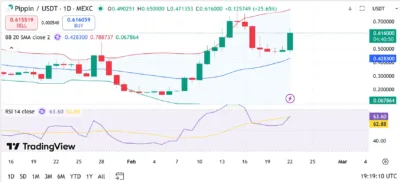
PIPPIN has surged sharply on the daily timeframe, printing a powerful bullish candle with over 25% gains. RSI is holding above 60, signaling strengthening momentum
Share
Coinstats2026/02/23 04:29
‘Love Island Games’ Season 2 Release Schedule—When Do New Episodes Come Out?

‘Love Island Games’ Season 2 Release Schedule—When Do New Episodes Come Out?

The post ‘Love Island Games’ Season 2 Release Schedule—When Do New Episodes Come Out? appeared on BitcoinEthereumNews.com. LOVE ISLAND GAMES — Episode 201 — Pictured: Ariana Madix — (Photo by: Ben Symons/PEACOCK via Getty Images) Ben Symons/PEACOCK via Getty Images We’ve got a text! It’s time for another season of Love Island Games. With fan-favorites returning in hopes of winning the $250,000 cash prize, read on to learn more about Love Island Games Season 2, including the release schedule so you don’t miss a second of drama. Love Island Games is a spinoff in the Love Island franchise that first premiered in 2023. The show follows a similar format to the original series, but with one major twist: all contestants are returning Islanders from previous seasons of Love Island from around the world, including the USA, UK, Australia and more. Another big difference is that games take on much more importance in Love Island Games than the mothership version, with the results “determining advantages, risks, and even who stays and who goes,” according to Peacock. Vanderpump Rules star Ariana Madix is taking over hosting duties for Love Island Games Season 2, replacing Love Island UK star Maya Jama who hosted the first season. Iain Stirling returns as the show’s narrator, while UK alum Maura Higgins will continue to host the Saturday show Love Island: Aftersun. ForbesWho’s In The ‘Love Island Games’ Season 2 Cast? Meet The IslandersBy Monica Mercuri Jack Fowler and Justine Ndiba were named the first-ever winners of Love Island Games in 2023. Justine had previously won Love Island USA Season 2 with Caleb Corprew, while Jack was a contestant on Love Island UK Season 4. In March 2024, Fowler announced on his Instagram story that he and Justine decided to remain “just friends.” The Season 2 premiere revealed the first couples of the season: Andrea Carmona and Charlie Georgios, Andreina Santos-Marte and Tyrique Hyde,…
Share
BitcoinEthereumNews2025/09/18 04:50