This article critically examines the application of semiclassical holography to the 'strange metal' phase in cuprates.This article critically examines the application of semiclassical holography to the 'strange metal' phase in cuprates.

Holography in Cuprates: Critical Review of Quantitative Claims

  • Prologue
  • Diagrammatic(s) Rules
  • Straight-forward Eikonal
  • Legacy Bosonization
  • Wonton Holography
  • Holographic Propagators
  • Strange Cuprates
  • Stranger Things
  • Epilogue

Strange Cuprates

The theories of both, finite- and zero-density, spinons have been extensively discussed in the context of the ’strange metal’ phase in the underdoped cuprates and other (arguably, even stranger) heavy-fermion compounds long before the advent of holography [3]. Once there, the applied holography quickly joined the quest into the properties of this phase that had long evaded a consistent and satisfactory explanation.

\ Instead of going after the NFL fermion propagator, however, many of the holographic proposals focused on reproducing the experimental data in the cuprates - and often times even claimed achieving a quantitative agreement.

\ In light of its intrinsically unsettled status one would have thought that it might be rather detrimental for any speculative approach to seek out not a mere qualitative but an actual quantitative, down to the number, agreement between its specific predictions and some preselected sets of experimental data. In fact, if such a quantitative agreement were indeed achieved one would have even more explaining to do (first and foremost, as to why an apriori approximate approach appears to be so unexpectedly accurate?).

\ The earlier discussion of some of the popular evidence in support of condensed matter holography as well as the debunking of a number of its specific predictions [26] can be found in [34]. However, the admirable persistence with which those predictions continued to be regularly cited in the subsequent holographic literature [35] suggests that the comments of [34] might have had been (most regretfully) overlooked.

\ In fact, there is more than a single reason for which semiclassical holography (or its improvement at the level of accounting for the matter back-reaction in the HartreeFock approximation) - thus far, the only practical way of performing the holographic calculations [26–29] - would not have been expected to provide any quantitatively accurate results in the first place. There are, of course, such obvious differences from the string-theoretical holographic constructions as a low physical value of N (which, in practice, often amounts to ’spin up/down’) and the lack of Lorentz, translational, and/or rotational (as well as any super-)symmetries.

\ Arguably, though, the most important is the fact that much of the condensed matter physics operates in the intermediate - as opposed to ultra-strong - interaction regime, while it is only the latter that is supposed to have a weakly coupled gravity as its bulk dual [26]. Indeed, most solids form under the condition that its potential (interaction) and kinetic energies on average balance each other out. This suggests that the ’bona fide’ strong-coupling regime could only become attainable in some sort of a ’flat band’ scenario where kinetic energy is completely quenched or, at least, significantly diminished.

\ In light of that, it is unsurprising that much of the recent effort towards implementing such mechanism has been centered on the SYK model and its variants [31] whose ’flat band’ nature facilitates the existence of a holographic dual. A viable candidate to this role was proposed in the form of the Jackiw-Teitelboim (JT) dilatonenhanced 1 + 1-dimensional gravity [31].

\ It is worth pointing out, though, that at the practical level all the holographic matching between the SYK and JT theories has been, so far, established within their low-energy sectors that are both controlled by a single soft Schwarzian mode (’boundary graviton’). So as far as the low-energy properties of the two models are concerned, they both allow for the same (effectively 0 + 1- dimensional) description in terms of either a fluctuating 1d boundary or Liouvillian-type large-N matrix quantum mechanics [31, 36]. This is not surprising given the intrinsically non-dynamical nature of 2d (and 3d) pure gravity. Such a caveat notwithstanding, the low-energy SYK-JT equivalence has been repeatedly and staunchly referred to as a genuine example of holographic correspondence between the 1+1-dimensional bulk and 0+1-dimensional boundary theories [31].

\ As to the general HV models (22) and corresponding vacuum metrics (26), the standard list of observables to be matched includes temperature-dependent specific heat

\

\ and frequency-dependent optical conductivity

\

\ determined by the bare scaling dimensions.

\
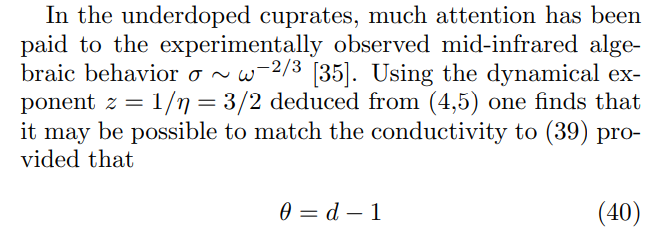
\ Incidentally, this value of the HV parameter was previously singled out on the basis of analyzing entanglement entropy [28]. Besides, it suggests the interpretation of d − θ as an effective number of dimensions orthogonal to the FS.

\ The other frequently invoked relation [26, 28, 29] is

\

\ in which case the first inequality in (27) is marginally satisfied as equality. Notably, in 2d it would only be consistent with (40) for z = 3/2.

\
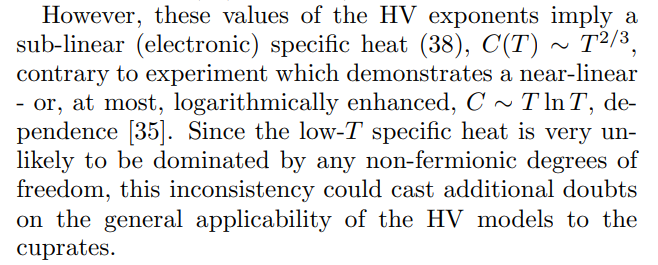
\ Also, from the beginning of the cuprates saga an even greater fixation has always been on the linear-T dependence of resistivity, also observed in a variety of other materials [35]. Of course, the conductivity scaling with frequency (39) does not readily translate into its temperature dependence, as it would be determined by a specific mechanism of momentum relaxation (i.e., Umklapp, phonons, and/or disorder).

\ To this end, the use of the memory matrix technique yielded a proper conductivity scaling [26, 35] in both limits of strong,

\
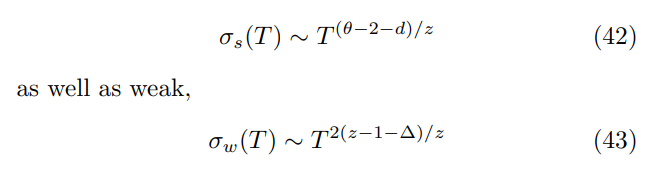
\ momentum-non-conserving scattering where ∆ is the dimension of the leading translation invariance-breaking 8 operator. The formulas (42) and (43) agree for ∆ = z + (d − θ)/2 which condition coincides with that of marginal fulfillment of the Harris criterion for the disorder scattering to become a relevant perturbation.

\ An alternate interpretation of the linear-T resistivity, σ(T ) ∼ 1/T , proposed in [26, 35] relates it to the FL-like entropy, S(T ) ∼ C(T ) ∼ T . This school of thought introduces the notion of inelastic ’Planckian’ scattering rate as a potentially single most important scale for thermalization/equilibration/information scrambling (albeit not a rate of momentum relaxation) in strongly interacting systems

\
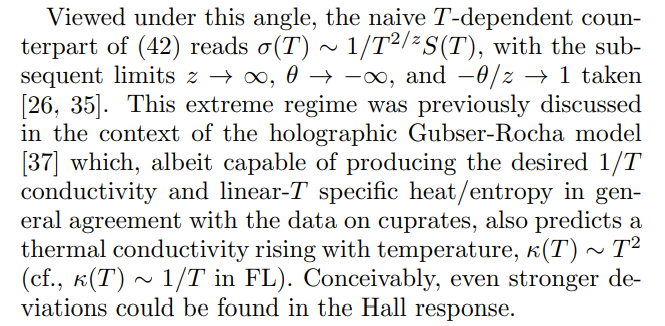
\ Interestingly, it is the (admittedly, unphysical) model of [38] that so far has managed to reproduce a longer list of the power-law dependencies found in the cuprates, as compared to the competing schemes [39]. Unfortunately, such a serendipitous success does not offer any immediate insight into the underlying mechanism of the NFL behavior in the cuprates.

\ Furthermore, contrasting the large-r and -τ asymptotics (31) of the HV holographic propagators against their eikonal/bosonization counterparts in search of some agreement suggests finite positive values of θ, contrary to the ’Planckian’ scenario. This observation might further reduce the chances of constructing a consistent HV holographic model of the strange metal phase in the cuprates.

\ In part, the deficiencies of the HV-based approach have been circumvented by the arrival of the ’second SYK wave’ [40] which utilizes the Hamiltonian obtained from the conventional combination of a kinetic (quadratic) and interaction (quartic) terms by randomizing the amplitudes of either one or both of these terms a la SY K. Making such randomization spatially non-uniform one opens a channel for non-conservation of momentum which then gives rise to the linear-T ’Planckian’ rate (on top of a constant).

\
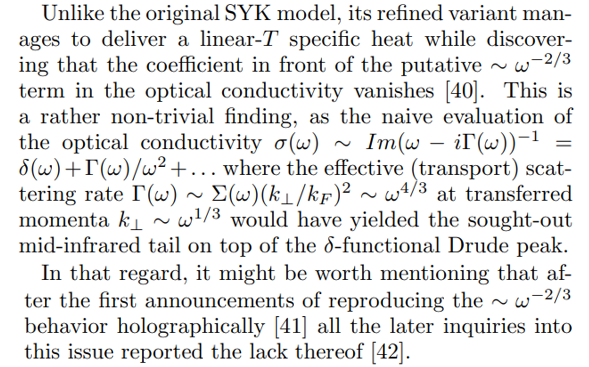
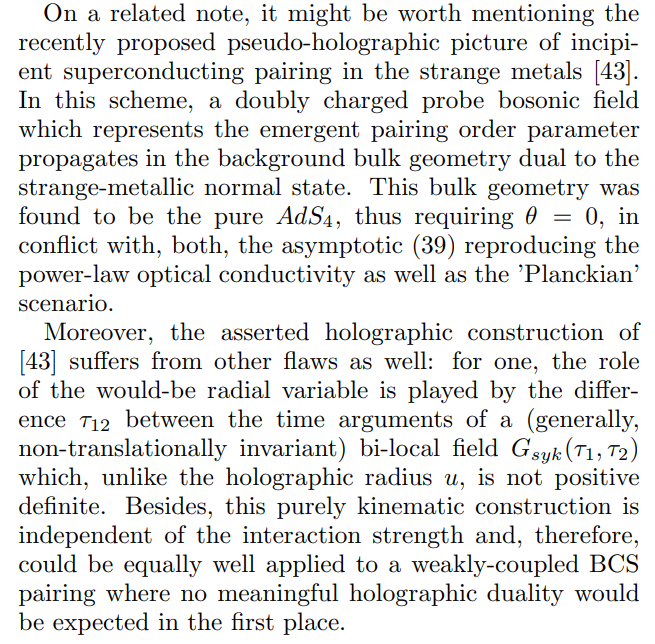
\ Of course, the very existence of different explanations (cf., for example, [35, 39] and [40]) for certain scaling laws observed in the cuprates may suggest that their ultimate interpretation is yet to be found. It would be, therefore, imperative to strive to extend the list of matching properties, akin to [38, 39] as the means of discriminating between the competing schemes.

\
\

:::info Author:

(1) D. V. Khveshchenko, Department of Physics and Astronomy, University of North Carolina, Chapel Hill, NC 27599.

:::


:::info This paper is available on arxiv under CC BY 4.0 DEED license.

:::

\

Market Opportunity
Metal Blockchain Logo
Metal Blockchain Price(METAL)
$0.17684
$0.17684$0.17684
+0.06%
USD
Metal Blockchain (METAL) Live Price Chart
Disclaimer: The articles reposted on this site are sourced from public platforms and are provided for informational purposes only. They do not necessarily reflect the views of MEXC. All rights remain with the original authors. If you believe any content infringes on third-party rights, please contact service@support.mexc.com for removal. MEXC makes no guarantees regarding the accuracy, completeness, or timeliness of the content and is not responsible for any actions taken based on the information provided. The content does not constitute financial, legal, or other professional advice, nor should it be considered a recommendation or endorsement by MEXC.

You May Also Like

Unprecedented Surge: Gold Price Hits Astounding New Record High

Unprecedented Surge: Gold Price Hits Astounding New Record High

BitcoinWorld Unprecedented Surge: Gold Price Hits Astounding New Record High While the world often buzzes with the latest movements in Bitcoin and altcoins, a traditional asset has quietly but powerfully commanded attention: gold. This week, the gold price has once again made headlines, touching an astounding new record high of $3,704 per ounce. This significant milestone reminds investors, both traditional and those deep in the crypto space, of gold’s enduring appeal as a store of value and a hedge against uncertainty. What’s Driving the Record Gold Price Surge? The recent ascent of the gold price to unprecedented levels is not a random event. Several powerful macroeconomic forces are converging, creating a perfect storm for the precious metal. Geopolitical Tensions: Escalating conflicts and global instability often drive investors towards safe-haven assets. Gold, with its long history of retaining value during crises, becomes a preferred choice. Inflation Concerns: Persistent inflation in major economies erodes the purchasing power of fiat currencies. Consequently, investors seek assets like gold that historically maintain their value against rising prices. Central Bank Policies: Many central banks globally are accumulating gold at a significant pace. This institutional demand provides a strong underlying support for the gold price. Furthermore, expectations around interest rate cuts in the future also make non-yielding assets like gold more attractive. These factors collectively paint a picture of a cautious market, where investors are looking for stability amidst a turbulent economic landscape. Understanding Gold’s Appeal in Today’s Market For centuries, gold has held a unique position in the financial world. Its latest record-breaking performance reinforces its status as a critical component of a diversified portfolio. Gold offers a tangible asset that is not subject to the same digital vulnerabilities or regulatory shifts that can impact cryptocurrencies. While digital assets offer exciting growth potential, gold provides a foundational stability that appeals to a broad spectrum of investors. Moreover, the finite supply of gold, much like Bitcoin’s capped supply, contributes to its perceived value. The current market environment, characterized by economic uncertainty and fluctuating currency values, only amplifies gold’s intrinsic benefits. It serves as a reliable hedge when other asset classes, including stocks and sometimes even crypto, face downward pressure. How Does This Record Gold Price Impact Investors? A soaring gold price naturally raises questions for investors. For those who already hold gold, this represents a significant validation of their investment strategy. For others, it might spark renewed interest in this ancient asset. Benefits for Investors: Portfolio Diversification: Gold often moves independently of other asset classes, offering crucial diversification benefits. Wealth Preservation: It acts as a robust store of value, protecting wealth against inflation and economic downturns. Liquidity: Gold markets are highly liquid, allowing for relatively easy buying and selling. Challenges and Considerations: Opportunity Cost: Investing in gold means capital is not allocated to potentially higher-growth assets like equities or certain cryptocurrencies. Volatility: While often seen as stable, gold prices can still experience significant fluctuations, as evidenced by its rapid ascent. Considering the current financial climate, understanding gold’s role can help refine your overall investment approach. Looking Ahead: The Future of the Gold Price What does the future hold for the gold price? While no one can predict market movements with absolute certainty, current trends and expert analyses offer some insights. Continued geopolitical instability and persistent inflationary pressures could sustain demand for gold. Furthermore, if global central banks continue their gold acquisition spree, this could provide a floor for prices. However, a significant easing of inflation or a de-escalation of global conflicts might reduce some of the immediate upward pressure. Investors should remain vigilant, observing global economic indicators and geopolitical developments closely. The ongoing dialogue between traditional finance and the emerging digital asset space also plays a role. As more investors become comfortable with both gold and cryptocurrencies, a nuanced understanding of how these assets complement each other will be crucial for navigating future market cycles. The recent surge in the gold price to a new record high of $3,704 per ounce underscores its enduring significance in the global financial landscape. It serves as a powerful reminder of gold’s role as a safe haven asset, a hedge against inflation, and a vital component for portfolio diversification. While digital assets continue to innovate and capture headlines, gold’s consistent performance during times of uncertainty highlights its timeless value. Whether you are a seasoned investor or new to the market, understanding the drivers behind gold’s ascent is crucial for making informed financial decisions in an ever-evolving world. Frequently Asked Questions (FAQs) Q1: What does a record-high gold price signify for the broader economy? A record-high gold price often indicates underlying economic uncertainty, inflation concerns, and geopolitical instability. Investors tend to flock to gold as a safe haven when they lose confidence in traditional currencies or other asset classes. Q2: How does gold compare to cryptocurrencies as a safe-haven asset? Both gold and some cryptocurrencies (like Bitcoin) are often considered safe havens. Gold has a centuries-long history of retaining value during crises, offering tangibility. Cryptocurrencies, while newer, offer decentralization and can be less susceptible to traditional financial system failures, but they also carry higher volatility and regulatory risks. Q3: Should I invest in gold now that its price is at a record high? Investing at a record high requires careful consideration. While the price might continue to climb due to ongoing market conditions, there’s also a risk of a correction. It’s crucial to assess your personal financial goals, risk tolerance, and consider diversifying your portfolio rather than putting all your capital into a single asset. Q4: What are the main factors that influence the gold price? The gold price is primarily influenced by global economic uncertainty, inflation rates, interest rate policies by central banks, the strength of the U.S. dollar, and geopolitical tensions. Demand from jewelers and industrial uses also play a role, but investment and central bank demand are often the biggest drivers. Q5: Is gold still a good hedge against inflation? Historically, gold has proven to be an effective hedge against inflation. When the purchasing power of fiat currencies declines, gold tends to hold its value or even increase, making it an attractive asset for preserving wealth during inflationary periods. To learn more about the latest crypto market trends, explore our article on key developments shaping Bitcoin’s price action. This post Unprecedented Surge: Gold Price Hits Astounding New Record High first appeared on BitcoinWorld.
Share
Coinstats2025/09/18 02:30
USD/CNH stays below 7.0000 – BBH

USD/CNH stays below 7.0000 – BBH

The post USD/CNH stays below 7.0000 – BBH appeared on BitcoinEthereumNews.com. USD/CNH remains under 7.0000 as China’s December inflation data showed headline CPI
Share
BitcoinEthereumNews2026/01/09 22:13
Ethereum Name Service price prediction 2025-2031: Is ENS a good investment?

Ethereum Name Service price prediction 2025-2031: Is ENS a good investment?

Key takeaways: The Ethereum Name Service is a network that enables crypto enthusiasts to rename their cryptocurrency addresses into something simpler, making them easier to remember. Renaming crypto addresses through ENS will enable users to recollect and write them quickly. Even though Ethereum Name Service is based on the Ethereum blockchain, it uses its cryptocurrency, […]
Share
Cryptopolitan2025/09/18 01:38