The PerSense framework, a model-agnostic, one-shot, training-free method for customized instance segmentation in dense pictures, is described in this portion of the article. A Few-Shot Object Counter (FSOC) is used to generate density maps, an Instance Detection Module (IDM) is used to identify potential prompts, a Point Prompt Selection Module (PPSM) is used for adaptive filtering, and a Vision-Language Model (VLM) is used for semantic class-label extraction.The PerSense framework, a model-agnostic, one-shot, training-free method for customized instance segmentation in dense pictures, is described in this portion of the article. A Few-Shot Object Counter (FSOC) is used to generate density maps, an Instance Detection Module (IDM) is used to identify potential prompts, a Point Prompt Selection Module (PPSM) is used for adaptive filtering, and a Vision-Language Model (VLM) is used for semantic class-label extraction.

PerSense Delivers Expert-Level Instance Recognition Without Any Training

2025/10/29 03:37

Abstract and 1. Introduction

  1. Related Work

  2. Method

    3.1 Class-label Extraction and Exemplar Selection for FSOC

    3.2 Instance Detection Module (IDM) and 3.3 Point Prompt Selection Module (PPSM)

    3.4 Feedback Mechanism

  3. New Dataset (PerSense-D)

  4. Experiments

  5. Conclusion and References

A. Appendix

\

3 Method

We introduce PerSense, a training-free and model-agnostic one-shot framework designed for personalized instance segmentation in dense images (Figure 3). Here, we describe the core components of our PerSense framework, including Class-label extraction using vision-language model (VLM) and exemplar selection for few-shot object counter (FSOC) (sec. 3.1), instance detection module (IDM) (sec. 3.2), point-prompt selection module (PPSM) (sec. 3.3), and the feedback mechanism (sec. 3.4).

3.1 Class-label Extraction and Exemplar Selection for FSOC

PerSense operates as a one-shot framework, wherein a support set is utilized to guide the personalized segmentation of an object in the query image that shares semantic similarity with the support object. Initially, input masking is applied to the support image using the coarse support mask to isolate the object of interest. The resulting input masked image is fed into the VLM with a custom prompt, "Name the object in the image?". The VLM generates a description of the object in the image, from which the noun is extracted, representing the class-label or the object’s name. Subsequently, the grounding detector is prompted with this class-label to facilitate personalized object detection in the query image. To enhance the prompt, we prefixed the term "all" with the class-label.

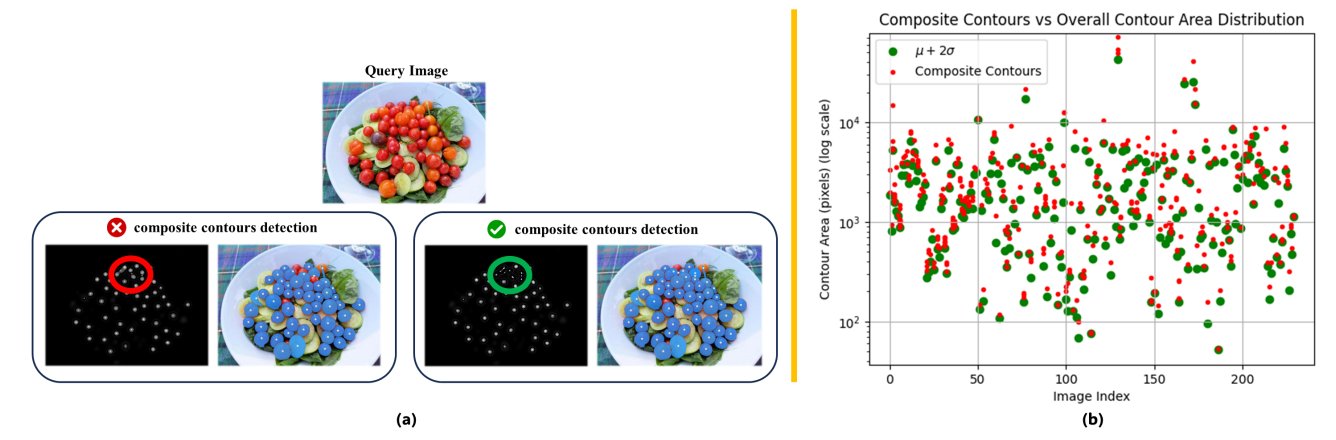
\ Figure 4: (a) Without the identification of composite contours, multiple instances of the object may be considered as single contour (red circle). Identification of composite contours (green circle) enables to precisely localize child contours, resulting in improved segmentation performance. (b) The plot highlights the existence of composite contours beyond µ + 2σ , of the contour area distribution, for 250 images in PerSense-D. Hence, these contours can be identified and detected as outliers.
\ Next, we begin by computing the similarity score between query and support features coming from the encoder. Utilizing this score along with detections from the grounding object detector, we extract the positive location prior. Specifically, we identify the bounding box with the highest detection confidence and proceed to locate the pixel-precise point with the maximum similarity score within this bounding box. This identified point serves as the positive location prior, which is subsequently fed to the decoder for segmentation. Additionally, we extract the bounding box surrounding the segmentation mask of the object. This process effectively refines the original bounding box provided by the grounding detector. The refined bounding box is then forwarded as an exemplar to the FSOC for generation of Density Map (DM).

3.2 Instance Detection Module (IDM)

The IDM begins by converting the DM from FSOC into a grayscale image, followed by the creation of a binary image using a pixel-level threshold of 30 (range 0 to 255). Morphological erosion operation using a 3 x 3 kernel is then applied to refine the boundaries and eliminate noise from the binary image. We deliberately used a small kernel to avoid damaging the original densities of true positives. Next, contours are identified in the eroded binary image, and for each contour, its area and center pixel coordinates are computed. The algorithm calculates the mean (µ) and standard deviation (σ) of all contour areas to assess the distribution of contour sizes. Subsequently, composite contours, which represent multiple objects in one contour, are detected using a threshold based on the distribution of contour sizes. This is necessary to identify the regions which are detected as one contour but they encapsulate multiple instances of the object of interest (Figure 4a). Such regions are scarce and can be detected as outliers, essentially falling beyond µ + 2σ considering the contour size distribution (Figure 4b). For each detected composite contour, distance transform is applied to expose child contours for ease of detection. Finally, the algorithm returns the center points obtained from all detected contours (parent and child) as candidate point prompts. In summary, through systematic analysis of the DM, IDM identifies regions of interest and generates candidate point prompts, which are subsequently forwarded to PPSM for final selection. See Appendix A.1 for pseudo-code of IDM.

3.3 Point Prompt Selection Module (PPSM)

The PPSM serves as a critical component in the PerSense pipeline, tasked with filtering candidate point prompts for final selection. For each candidate point prompt received from IDM, we compare the corresponding query-support similarity score using an adaptive threshold as:

\

\ where maxscore is the maximum value of query-support similarity score, the objectcount corresponds to the number of instances of the desired object present in the query image and the normconst is a normalization factor to make the threshold adaptive with reference to the object count. We used a normalization factor of √ 2. A fixed similarity threshold would struggle in this case as query-support similarity score varies significantly even with small intra-class variations. Moreover, for highly crowded images (objectcount > 50), the similarity score for positive location priors can vary widely, necessitating an adaptive threshold that accounts for the density (count) of the query image. To address this challenge, our adaptive threshold is based on the maximum query-support similarity score as well as the object count within the query image. In addition to this, PPSM leverages the complementary bounding box information from the grounding detector and ensures that the filtered point prompt lies within the bounding box coordinates. Finally, the selected point prompts are fed to the decoder for segmentation. See Appendix A.1 for pseudo-code of PPSM.

3.4 Feedback Mechanism

PerSense also incorporates a feedback mechanism to enhance the exemplar selection process for FSOC by leveraging the initial segmentation output from the decoder. Based on the mask scores provided by SAM, the top four candidates, from the initial segmentation output, are selected and forwarded as exemplars to FSOC in a feedback manner. This leads to improved accuracy of the DM and consequently enhances the segmentation performance. The quantitative analysis of this aspect is further discussed in sec. 5, which explicitly highlights the value added by the feedback mechanism. See Appendix A.1 for the overall pseudo-code of PerSense.

\

:::info Authors:

(1) Muhammad Ibraheem Siddiqui, Department of Computer Vision, Mohamed bin Zayed University of AI, Abu Dhabi (muhammad.siddiqui@mbzuai.ac.ae);

(2) Muhammad Umer Sheikh, Department of Computer Vision, Mohamed bin Zayed University of AI, Abu Dhabi;

(3) Hassan Abid, Department of Computer Vision, Mohamed bin Zayed University of AI, Abu Dhabi;

(4) Muhammad Haris Khan, Department of Computer Vision, Mohamed bin Zayed University of AI, Abu Dhabi.

:::


:::info This paper is available on arxiv under CC BY-NC-SA 4.0 Deed (Attribution-Noncommercial-Sharelike 4.0 International) license.

:::

\

Disclaimer: The articles reposted on this site are sourced from public platforms and are provided for informational purposes only. They do not necessarily reflect the views of MEXC. All rights remain with the original authors. If you believe any content infringes on third-party rights, please contact service@support.mexc.com for removal. MEXC makes no guarantees regarding the accuracy, completeness, or timeliness of the content and is not responsible for any actions taken based on the information provided. The content does not constitute financial, legal, or other professional advice, nor should it be considered a recommendation or endorsement by MEXC.

You May Also Like

SEC urges caution on crypto wallets in latest investor guide

SEC urges caution on crypto wallets in latest investor guide

The SEC’s Office of Investor Education and Assistance issued a bulletin warning retail investors about crypto asset custody risks. The guidance covers how investors
Share
Crypto.news2025/12/15 01:45
Crucial Fed Rate Cut: October Probability Surges to 94%

Crucial Fed Rate Cut: October Probability Surges to 94%

BitcoinWorld Crucial Fed Rate Cut: October Probability Surges to 94% The financial world is buzzing with a significant development: the probability of a Fed rate cut in October has just seen a dramatic increase. This isn’t just a minor shift; it’s a monumental change that could ripple through global markets, including the dynamic cryptocurrency space. For anyone tracking economic indicators and their impact on investments, this update from the U.S. interest rate futures market is absolutely crucial. What Just Happened? Unpacking the FOMC Statement’s Impact Following the latest Federal Open Market Committee (FOMC) statement, market sentiment has decisively shifted. Before the announcement, the U.S. interest rate futures market had priced in a 71.6% chance of an October rate cut. However, after the statement, this figure surged to an astounding 94%. This jump indicates that traders and analysts are now overwhelmingly confident that the Federal Reserve will lower interest rates next month. Such a high probability suggests a strong consensus emerging from the Fed’s latest communications and economic outlook. A Fed rate cut typically means cheaper borrowing costs for businesses and consumers, which can stimulate economic activity. But what does this really signify for investors, especially those in the digital asset realm? Why is a Fed Rate Cut So Significant for Markets? When the Federal Reserve adjusts interest rates, it sends powerful signals across the entire financial ecosystem. A rate cut generally implies a more accommodative monetary policy, often enacted to boost economic growth or combat deflationary pressures. Impact on Traditional Markets: Stocks: Lower interest rates can make borrowing cheaper for companies, potentially boosting earnings and making stocks more attractive compared to bonds. Bonds: Existing bonds with higher yields might become more valuable, but new bonds will likely offer lower returns. Dollar Strength: A rate cut can weaken the U.S. dollar, making exports cheaper and potentially benefiting multinational corporations. Potential for Cryptocurrency Markets: The cryptocurrency market, while often seen as uncorrelated, can still react significantly to macro-economic shifts. A Fed rate cut could be interpreted as: Increased Risk Appetite: With traditional investments offering lower returns, investors might seek higher-yielding or more volatile assets like cryptocurrencies. Inflation Hedge Narrative: If rate cuts are perceived as a precursor to inflation, assets like Bitcoin, often dubbed “digital gold,” could gain traction as an inflation hedge. Liquidity Influx: A more accommodative monetary environment generally means more liquidity in the financial system, some of which could flow into digital assets. Looking Ahead: What Could This Mean for Your Portfolio? While the 94% probability for a Fed rate cut in October is compelling, it’s essential to consider the nuances. Market probabilities can shift, and the Fed’s ultimate decision will depend on incoming economic data. Actionable Insights: Stay Informed: Continue to monitor economic reports, inflation data, and future Fed statements. Diversify: A diversified portfolio can help mitigate risks associated with sudden market shifts. Assess Risk Tolerance: Understand how a potential rate cut might affect your specific investments and adjust your strategy accordingly. This increased likelihood of a Fed rate cut presents both opportunities and challenges. It underscores the interconnectedness of traditional finance and the emerging digital asset space. Investors should remain vigilant and prepared for potential volatility. The financial landscape is always evolving, and the significant surge in the probability of an October Fed rate cut is a clear signal of impending change. From stimulating economic growth to potentially fueling interest in digital assets, the implications are vast. Staying informed and strategically positioned will be key as we approach this crucial decision point. The market is now almost certain of a rate cut, and understanding its potential ripple effects is paramount for every investor. Frequently Asked Questions (FAQs) Q1: What is the Federal Open Market Committee (FOMC)? A1: The FOMC is the monetary policymaking body of the Federal Reserve System. It sets the federal funds rate, which influences other interest rates and economic conditions. Q2: How does a Fed rate cut impact the U.S. dollar? A2: A rate cut typically makes the U.S. dollar less attractive to foreign investors seeking higher returns, potentially leading to a weakening of the dollar against other currencies. Q3: Why might a Fed rate cut be good for cryptocurrency? A3: Lower interest rates can reduce the appeal of traditional investments, encouraging investors to seek higher returns in alternative assets like cryptocurrencies. It can also be seen as a sign of increased liquidity or potential inflation, benefiting assets like Bitcoin. Q4: Is a 94% probability a guarantee of a rate cut? A4: While a 94% probability is very high, it is not a guarantee. Market probabilities reflect current sentiment and data, but the Federal Reserve’s final decision will depend on all available economic information leading up to their meeting. Q5: What should investors do in response to this news? A5: Investors should stay informed about economic developments, review their portfolio diversification, and assess their risk tolerance. Consider how potential changes in interest rates might affect different asset classes and adjust strategies as needed. Did you find this analysis helpful? Share this article with your network to keep others informed about the potential impact of the upcoming Fed rate cut and its implications for the financial markets! To learn more about the latest crypto market trends, explore our article on key developments shaping Bitcoin price action. This post Crucial Fed Rate Cut: October Probability Surges to 94% first appeared on BitcoinWorld.
Share
Coinstats2025/09/18 02:25
Bitcoin’s Battle with Market Pressures Sparks Concerns

Bitcoin’s Battle with Market Pressures Sparks Concerns

Throughout the weekend, Bitcoin exhibited a degree of stability. Yet, it is once again challenging the critical support level of $88,000.Continue Reading:Bitcoin
Share
Coinstats2025/12/15 01:35