Zashi Wallet will launch shielded ZEC purchases powered by NEAR Intents next week, allowing fully private swaps as Zcash rallies 16.55% while other cryptos crash. The post Private Shielded Zcash Purchases ‘Shipping Next Week’ on Zashi appeared first on Coinspeaker.Zashi Wallet will launch shielded ZEC purchases powered by NEAR Intents next week, allowing fully private swaps as Zcash rallies 16.55% while other cryptos crash. The post Private Shielded Zcash Purchases ‘Shipping Next Week’ on Zashi appeared first on Coinspeaker.

Private Shielded Zcash Purchases ‘Shipping Next Week’ on Zashi

Shielded Zcash ZEC $569.6 24h volatility: 18.5% Market cap: $9.30 B Vol. 24h: $2.31 B decentralized purchases are coming to Zashi Wallet, powered by NEAR Intents, according to Electric Coin Capital CEO Josh Swihart. This is a long-awaited feature that will allow users and investors to swap from other coins into fully private shielded ZEC, as the leading privacy coin surges in price.

The announcement came as a teasing post on Nov. 14, with Swihart’s promise of “shipping next week.” In the image, we can see a swap simulation of 1 BTC, valued at $96,432, for 170.30 ZEC, at the same nominal value, and a crossed shield next to Zcash’s logo.

Zashi implemented the “swap to ZEC via NEAR Intents” feature in the wallet app on Oct. 1, which uses the NEAR Protocol chain abstraction stack and Intents protocol to allow decentralized purchases of Zcash using a transparent address. Before that, the leading wallet had natively implemented NEAR Intents for the opposing route: swapping from shielded ZEC to other supported blockchains like NEAR, Solana, Bitcoin, Ethereum, and more.

Interestingly, the cross-pay feature was highlighted but also partially criticized by the prominent onchain investigator ZachXBT. “Zashi is an enjoyable wallet experience for privacy and fixes several UI/UX complaints I had for Monero,” Zach said, while also warning of potential information leakage due to the use of Zcash transparent addresses for refunds—the same used for the ZEC purchases.

Both Josh Swihart and Illia Polosukhin commented on the matter, saying additional shielded Zcash features were on the roadmap for both Zashi and NEAR Intents to fix these potential leaks.

ZEC Price Analysis Amid Crypto Crash

Nov. 14 started with a significant market crash that liquidated more than $1.34 billion in less than 24 hours, according to data from Coinglass. ZEC was among the largest liquidations, but, differently from everything else, Zcash had a larger liquidation from short positions—registering notable gains while other cryptocurrencies were crashing and liquidating a majority of longs.

In total, $17.20 million in ZEC were liquidated, with $10.3 million being from short positions. On the other hand, $1.16 billion of the $1.34 billion liquidations were from long positions, a pattern replicated by BTC, ETH, SOL, and most, if not all, of the other cryptocurrencies.
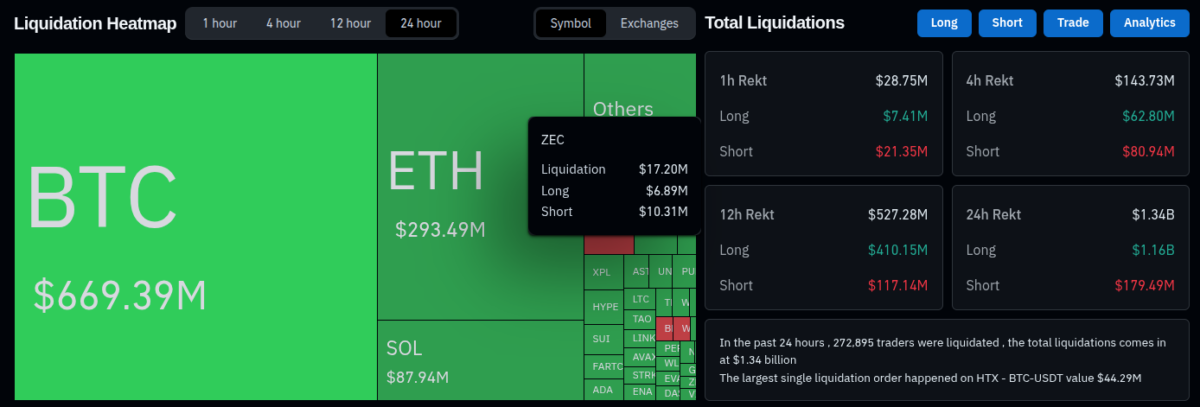
Liquidation heatmap and total liquidations in 24 hours, as of Nov. 14, 2025 | Source: Coinglass

Liquidation heatmap and total liquidations in 24 hours, as of Nov. 14, 2025 | Source: Coinglass

As of this writing, Zcash is trading at $572.88 and has a $9.34 billion market capitalization, ranked in the 14th position on CoinMarketCap and is currently the leading privacy coin by market cap. ZEC has accumulated 16.55% gains in the last 24 hours and 1,436% gains year-over-year, attracting support from different industry players as it crossed the 10x-gain mark.
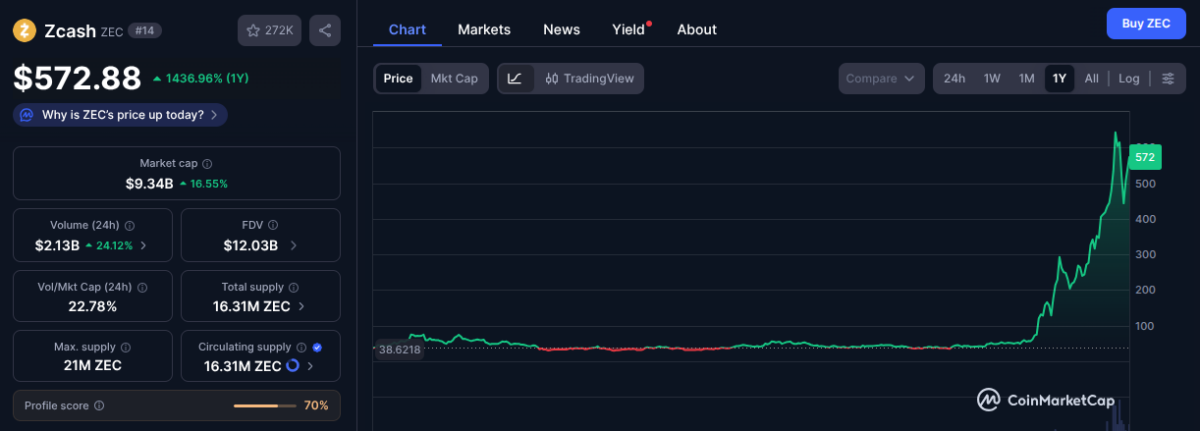
Zcash (ZEC) price and market data as of Nov. 14, 2025 | Source: CoinMarketCap

Zcash (ZEC) price and market data as of Nov. 14, 2025 | Source: CoinMarketCap

Zcash’s rally has been mostly attributed to its superior privacy features and improved user experience thanks to Zashi. Moreover, NEAR Intents has also been mentioned as a core contributor to ZEC’s success as a “universal liquidity layer” that allows people to easily buy and spend their coins privately—being praised by figures from different ecosystems, similarly to what happened to Zcash pre-rally, as Coinspeaker reported.

next

The post Private Shielded Zcash Purchases ‘Shipping Next Week’ on Zashi appeared first on Coinspeaker.

Market Opportunity
Ambire Wallet Logo
Ambire Wallet Price(WALLET)
$0.01627
$0.01627$0.01627
+1.11%
USD
Ambire Wallet (WALLET) Live Price Chart
Disclaimer: The articles reposted on this site are sourced from public platforms and are provided for informational purposes only. They do not necessarily reflect the views of MEXC. All rights remain with the original authors. If you believe any content infringes on third-party rights, please contact service@support.mexc.com for removal. MEXC makes no guarantees regarding the accuracy, completeness, or timeliness of the content and is not responsible for any actions taken based on the information provided. The content does not constitute financial, legal, or other professional advice, nor should it be considered a recommendation or endorsement by MEXC.

You May Also Like

The Channel Factories We’ve Been Waiting For

The Channel Factories We’ve Been Waiting For

The post The Channel Factories We’ve Been Waiting For appeared on BitcoinEthereumNews.com. Visions of future technology are often prescient about the broad strokes while flubbing the details. The tablets in “2001: A Space Odyssey” do indeed look like iPads, but you never see the astronauts paying for subscriptions or wasting hours on Candy Crush.  Channel factories are one vision that arose early in the history of the Lightning Network to address some challenges that Lightning has faced from the beginning. Despite having grown to become Bitcoin’s most successful layer-2 scaling solution, with instant and low-fee payments, Lightning’s scale is limited by its reliance on payment channels. Although Lightning shifts most transactions off-chain, each payment channel still requires an on-chain transaction to open and (usually) another to close. As adoption grows, pressure on the blockchain grows with it. The need for a more scalable approach to managing channels is clear. Channel factories were supposed to meet this need, but where are they? In 2025, subnetworks are emerging that revive the impetus of channel factories with some new details that vastly increase their potential. They are natively interoperable with Lightning and achieve greater scale by allowing a group of participants to open a shared multisig UTXO and create multiple bilateral channels, which reduces the number of on-chain transactions and improves capital efficiency. Achieving greater scale by reducing complexity, Ark and Spark perform the same function as traditional channel factories with new designs and additional capabilities based on shared UTXOs.  Channel Factories 101 Channel factories have been around since the inception of Lightning. A factory is a multiparty contract where multiple users (not just two, as in a Dryja-Poon channel) cooperatively lock funds in a single multisig UTXO. They can open, close and update channels off-chain without updating the blockchain for each operation. Only when participants leave or the factory dissolves is an on-chain transaction…
Share
BitcoinEthereumNews2025/09/18 00:09
Successful Medical Writing from Protocol to CTD Training Course: Understand International Guidelines and Standards (Mar 23rd – Mar 24th, 2026) – ResearchAndMarkets.com

Successful Medical Writing from Protocol to CTD Training Course: Understand International Guidelines and Standards (Mar 23rd – Mar 24th, 2026) – ResearchAndMarkets.com

DUBLIN–(BUSINESS WIRE)–The “Successful Medical Writing – from Protocol to CTD Training Course (Mar 23rd – Mar 24th, 2026)” training has been added to ResearchAndMarkets
Share
AI Journal2026/01/03 01:15
Italy passes law on AI outlining privacy and child access

Italy passes law on AI outlining privacy and child access

The post Italy passes law on AI outlining privacy and child access appeared on BitcoinEthereumNews.com. Italy has formally passed a sweeping new law to regulate artificial intelligence, becoming the first member of the European Union to roll out comprehensive legislation in step with the bloc’s landmark AI Act. The Italian Senate granted final approval after a year of debate, concluding what Prime Minister Giorgia Meloni’s government described as a decisive step in shaping how new technologies are deployed across the country. Italy sets tough penalties for offenders The legislation, ministers argue, lays out the boundaries for human-centric, transparent, and safe use of AI while balancing the need to foster innovation, cybersecurity, and economic growth. The law casts its net widely, and it stretches into healthcare, schools, the justice system, workplaces, sport, and the public sector. AI access for children under 14 has also been tightened, and it now requires parental consent. “This law brings innovation back within the perimeter of the public interest, steering AI toward growth, rights and full protection of citizens.” Alessio Butti, the undersecretary for digital transformation. Lawmakers also opted for a hard line on abuses. A new offence has been added to the criminal code covering the unlawful spread of AI-generated or manipulated content, such as deepfakes. Anyone found guilty faces between one and five years in prison if their actions cause harm. Using AI to commit fraud, identity theft, market manipulation, or money laundering will now be treated as an aggravating circumstance, raising potential sentences by a third. Judges remain the sole authority in legal rulings, though courts are empowered to demand rapid takedowns of illicit material. Government agencies to oversee its implementation Responsibility for enforcing the regime lies with the Agency for Digital Italy and the National Cybersecurity Agency, though existing financial watchdogs such as the Bank of Italy and Consob retain powers in their own spheres. The Department…
Share
BitcoinEthereumNews2025/09/18 06:05