Ripple has intensified its focus on institutional crypto infrastructure through its latest move into Ripple digital asset custody. The blockchain company announced the acquisition of Palisade. Palisade is a specialist in digital asset wallet and custody solutions. The acquisition, revealed on November 3, 2025, underscores Ripple’s ambition to become a one-stop platform for secure, compliant, and scalable digital finance operations. Ripple Digital Asset Custody Strengthened by Palisade Acquisition The acquisition of Palisade positions Ripple as the digital asset custodian at the heart of enterprise crypto operations. By integrating Palisade’s cutting-edge “wallet-as-a-service” technology, Ripple strengthens its ability to deliver secure transaction tools to businesses. Source: X This development follows Ripple’s year-long expansion strategy, marked by several strategic buyouts, including GTreasury and Hidden Road. Together, these acquisitions form a foundation for Ripple  custody to become a leader in institutional-grade crypto management. Overview of the Deal The Palisade acquisition introduces multi-party computation (MPC), zero-trust architecture, and multi-chain compatibility into Ripple’s custody framework. These advanced technologies significantly enhance Ripple custody.  They facilitate smooth, secure, and effective functions through various blockchain environments. The major networks that this integration supports include the XRP Ledger, Ethereum, and Solana and they serve to strengthen the institutional-grade infrastructure at Ripple. Also Read: Why XRP Still Matters in Ripple’s Strategy Despite RLUSD’s Growing Influence Ripple affirmed that the infrastructure of Palisade will be incorporated not only into Ripple Custody but also into Ripple Payments to enable the institutions to settle, liquidity, and treasury processes on the same unified platform. Ripple Strengthens Its Institutional Network With Ripple digital asset custody, institutions like DBS, Societe Generale–FORGE, BBVA, and Absa Bank have already adopted Ripple’s enterprise-grade solutions. Ripple President Monica Long emphasized that “secure digital asset custody unlocks the crypto economy,”, Describing the company’s technology as a bridge between traditional finance and decentralized networks. Her comments highlight how Ripple  custody is rapidly becoming essential for banks and corporates seeking trusted partners in crypto transactions. Building a Multi-Asset Financial Ecosystem Ripple digital asset custody is evolving into a cornerstone of the company’s broader multi-asset ecosystem. Earlier in October, Ripple launched Ripple Prime, a U.S.-based prime brokerage, leveraging its $1.25 billion Hidden Road acquisition.  This  followed the $1 billion purchase of GTreasury, which integrated digital settlements into legacy financial systems. These investments strengthen Ripple’s infrastructure for Ripple custody, merging traditional financial tools with blockchain-based innovation. Regulatory Momentum and Compliance Ripple digital asset custody operates within a strong regulatory foundation—Ripple holds over 75 global licenses, giving it significant credibility in compliance-sensitive markets.  By integrating Palisade’s secure wallet technology with Ripple’s strong compliance-first approach, Ripple custody sets a new benchmark in the industry. This combination positions it as a leading model for responsible innovation in the evolving world of crypto finance. U.S. Market Expansion Ripple recently launched a digital asset spot prime brokerage for U.S.-based institutional clients, reinforcing the strength of Ripple  custody. This move further supports regulated crypto trading and settlement services under Ripple’s expanding institutional framework. Michael Higgins, CEO of Ripple Prime and former Hidden Road executive, stated that Ripple’s new services will provide a “comprehensive suite” of tools tailored to institutional trading strategies.  Ripple’s Vision for 2025 and Beyond The timing of the announcement—just before Ripple’s annual Swell conference in New York—signals a major pivot in strategy. Ripple digital asset custody is now at the center of Ripple’s identity, positioning the firm as a full-service crypto financial platform. As traditional finance merges with blockchain-based systems, Ripple’s infrastructure could serve as a benchmark for regulated and transparent crypto integration. Conclusion Ripple’s acquisition of Palisade reaffirms its leadership in digital finance and institutional blockchain adoption. By embedding advanced wallet and custody technology into Ripple custody, the company is not just following the crypto evolution. With a clear regulatory edge, technological depth, and a growing institutional network, Ripple digital asset custody stands as a crucial component of the company’s mission to unify global finance under a secure, interoperable framework. Also Read: Ripple’s Middle East Expansion Signals New Era for XRP and RLUSD Appendix: Glossary of Key Terms Ripple Digital Asset Custody – Ripple’s secure infrastructure for storing and managing digital assets for institutions. Palisade – A digital wallet and custody provider acquired by Ripple. Multi-Party Computation – A cryptographic method enhancing transaction security. Zero-Trust Architecture – A framework that assumes no user or system is automatically trusted. Multi-Chain Compatibility – The ability to support multiple blockchain networks. Ripple Prime – Ripple’s institutional prime brokerage platform. Hidden Road – A digital asset firm acquired by Ripple for prime brokerage capabilities. Frequently Asked Questions Ripple Digital Asset Custody 1: What is Ripple digital asset custody? Ripple digital asset custody refers to Ripple’s institutional-grade infrastructure that enables secure storage, management, and transfer of cryptocurrencies and tokenized assets. 2: Why did Ripple acquire Palisade? Ripple acquired Palisade to enhance its custody technology, integrating MPC security, multi-chain support, and zero-trust systems into Ripple digital asset custody. 3: How does Ripple digital asset custody benefit institutions? It allows fintechs, banks, and corporates to perform settlements, treasury management, and cross-chain operations through a compliant and unified system. 4: What are Ripple’s other major acquisitions in 2025? In 2025, Ripple also acquired Hidden Road for $1.25 billion and GTreasury for $1 billion, expanding its Ripple digital asset custody and payments ecosystem. Read More: Ripple Acquires Palisade to Boost Digital Asset Custody and Institutional Crypto Services">Ripple Acquires Palisade to Boost Digital Asset Custody and Institutional Crypto ServicesRipple has intensified its focus on institutional crypto infrastructure through its latest move into Ripple digital asset custody. The blockchain company announced the acquisition of Palisade. Palisade is a specialist in digital asset wallet and custody solutions. The acquisition, revealed on November 3, 2025, underscores Ripple’s ambition to become a one-stop platform for secure, compliant, and scalable digital finance operations. Ripple Digital Asset Custody Strengthened by Palisade Acquisition The acquisition of Palisade positions Ripple as the digital asset custodian at the heart of enterprise crypto operations. By integrating Palisade’s cutting-edge “wallet-as-a-service” technology, Ripple strengthens its ability to deliver secure transaction tools to businesses. Source: X This development follows Ripple’s year-long expansion strategy, marked by several strategic buyouts, including GTreasury and Hidden Road. Together, these acquisitions form a foundation for Ripple  custody to become a leader in institutional-grade crypto management. Overview of the Deal The Palisade acquisition introduces multi-party computation (MPC), zero-trust architecture, and multi-chain compatibility into Ripple’s custody framework. These advanced technologies significantly enhance Ripple custody.  They facilitate smooth, secure, and effective functions through various blockchain environments. The major networks that this integration supports include the XRP Ledger, Ethereum, and Solana and they serve to strengthen the institutional-grade infrastructure at Ripple. Also Read: Why XRP Still Matters in Ripple’s Strategy Despite RLUSD’s Growing Influence Ripple affirmed that the infrastructure of Palisade will be incorporated not only into Ripple Custody but also into Ripple Payments to enable the institutions to settle, liquidity, and treasury processes on the same unified platform. Ripple Strengthens Its Institutional Network With Ripple digital asset custody, institutions like DBS, Societe Generale–FORGE, BBVA, and Absa Bank have already adopted Ripple’s enterprise-grade solutions. Ripple President Monica Long emphasized that “secure digital asset custody unlocks the crypto economy,”, Describing the company’s technology as a bridge between traditional finance and decentralized networks. Her comments highlight how Ripple  custody is rapidly becoming essential for banks and corporates seeking trusted partners in crypto transactions. Building a Multi-Asset Financial Ecosystem Ripple digital asset custody is evolving into a cornerstone of the company’s broader multi-asset ecosystem. Earlier in October, Ripple launched Ripple Prime, a U.S.-based prime brokerage, leveraging its $1.25 billion Hidden Road acquisition.  This  followed the $1 billion purchase of GTreasury, which integrated digital settlements into legacy financial systems. These investments strengthen Ripple’s infrastructure for Ripple custody, merging traditional financial tools with blockchain-based innovation. Regulatory Momentum and Compliance Ripple digital asset custody operates within a strong regulatory foundation—Ripple holds over 75 global licenses, giving it significant credibility in compliance-sensitive markets.  By integrating Palisade’s secure wallet technology with Ripple’s strong compliance-first approach, Ripple custody sets a new benchmark in the industry. This combination positions it as a leading model for responsible innovation in the evolving world of crypto finance. U.S. Market Expansion Ripple recently launched a digital asset spot prime brokerage for U.S.-based institutional clients, reinforcing the strength of Ripple  custody. This move further supports regulated crypto trading and settlement services under Ripple’s expanding institutional framework. Michael Higgins, CEO of Ripple Prime and former Hidden Road executive, stated that Ripple’s new services will provide a “comprehensive suite” of tools tailored to institutional trading strategies.  Ripple’s Vision for 2025 and Beyond The timing of the announcement—just before Ripple’s annual Swell conference in New York—signals a major pivot in strategy. Ripple digital asset custody is now at the center of Ripple’s identity, positioning the firm as a full-service crypto financial platform. As traditional finance merges with blockchain-based systems, Ripple’s infrastructure could serve as a benchmark for regulated and transparent crypto integration. Conclusion Ripple’s acquisition of Palisade reaffirms its leadership in digital finance and institutional blockchain adoption. By embedding advanced wallet and custody technology into Ripple custody, the company is not just following the crypto evolution. With a clear regulatory edge, technological depth, and a growing institutional network, Ripple digital asset custody stands as a crucial component of the company’s mission to unify global finance under a secure, interoperable framework. Also Read: Ripple’s Middle East Expansion Signals New Era for XRP and RLUSD Appendix: Glossary of Key Terms Ripple Digital Asset Custody – Ripple’s secure infrastructure for storing and managing digital assets for institutions. Palisade – A digital wallet and custody provider acquired by Ripple. Multi-Party Computation – A cryptographic method enhancing transaction security. Zero-Trust Architecture – A framework that assumes no user or system is automatically trusted. Multi-Chain Compatibility – The ability to support multiple blockchain networks. Ripple Prime – Ripple’s institutional prime brokerage platform. Hidden Road – A digital asset firm acquired by Ripple for prime brokerage capabilities. Frequently Asked Questions Ripple Digital Asset Custody 1: What is Ripple digital asset custody? Ripple digital asset custody refers to Ripple’s institutional-grade infrastructure that enables secure storage, management, and transfer of cryptocurrencies and tokenized assets. 2: Why did Ripple acquire Palisade? Ripple acquired Palisade to enhance its custody technology, integrating MPC security, multi-chain support, and zero-trust systems into Ripple digital asset custody. 3: How does Ripple digital asset custody benefit institutions? It allows fintechs, banks, and corporates to perform settlements, treasury management, and cross-chain operations through a compliant and unified system. 4: What are Ripple’s other major acquisitions in 2025? In 2025, Ripple also acquired Hidden Road for $1.25 billion and GTreasury for $1 billion, expanding its Ripple digital asset custody and payments ecosystem. Read More: Ripple Acquires Palisade to Boost Digital Asset Custody and Institutional Crypto Services">Ripple Acquires Palisade to Boost Digital Asset Custody and Institutional Crypto Services

Ripple Acquires Palisade to Boost Digital Asset Custody and Institutional Crypto Services

Ripple has intensified its focus on institutional crypto infrastructure through its latest move into Ripple digital asset custody. The blockchain company announced the acquisition of Palisade.

Palisade is a specialist in digital asset wallet and custody solutions. The acquisition, revealed on November 3, 2025, underscores Ripple’s ambition to become a one-stop platform for secure, compliant, and scalable digital finance operations.

Ripple Digital Asset Custody Strengthened by Palisade Acquisition

The acquisition of Palisade positions Ripple as the digital asset custodian at the heart of enterprise crypto operations. By integrating Palisade’s cutting-edge “wallet-as-a-service” technology, Ripple strengthens its ability to deliver secure transaction tools to businesses.
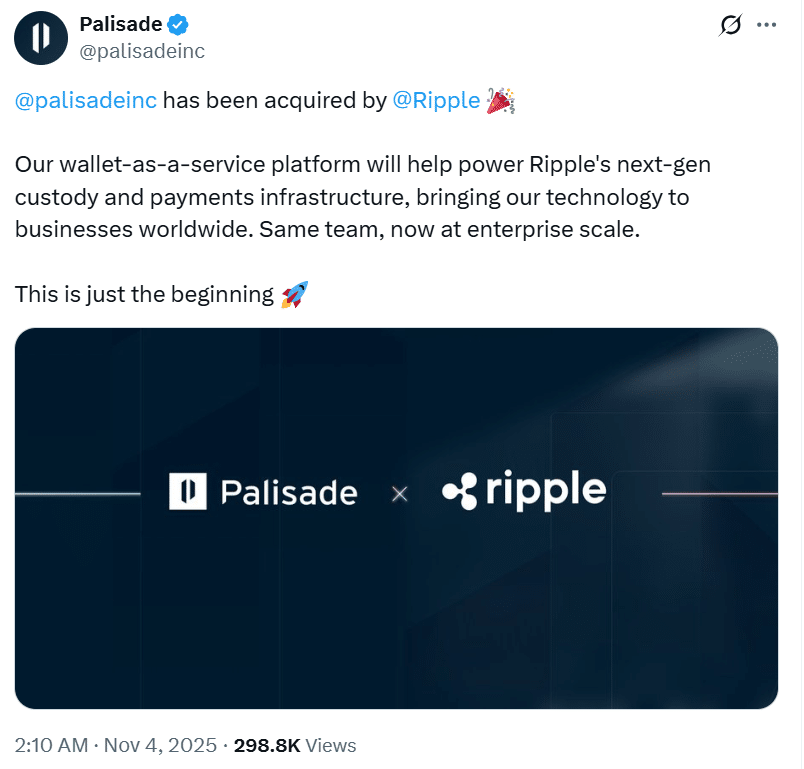
Ripple Digital Asset CustodySource: X

This development follows Ripple’s year-long expansion strategy, marked by several strategic buyouts, including GTreasury and Hidden Road. Together, these acquisitions form a foundation for Ripple  custody to become a leader in institutional-grade crypto management.

Overview of the Deal

The Palisade acquisition introduces multi-party computation (MPC), zero-trust architecture, and multi-chain compatibility into Ripple’s custody framework. These advanced technologies significantly enhance Ripple custody. 

They facilitate smooth, secure, and effective functions through various blockchain environments. The major networks that this integration supports include the XRP Ledger, Ethereum, and Solana and they serve to strengthen the institutional-grade infrastructure at Ripple.

Also Read: Why XRP Still Matters in Ripple’s Strategy Despite RLUSD’s Growing Influence

Ripple affirmed that the infrastructure of Palisade will be incorporated not only into Ripple Custody but also into Ripple Payments to enable the institutions to settle, liquidity, and treasury processes on the same unified platform.

Ripple Strengthens Its Institutional Network

With Ripple digital asset custody, institutions like DBS, Societe Generale–FORGE, BBVA, and Absa Bank have already adopted Ripple’s enterprise-grade solutions. Ripple President Monica Long emphasized that “secure digital asset custody unlocks the crypto economy,”,

Describing the company’s technology as a bridge between traditional finance and decentralized networks. Her comments highlight how Ripple  custody is rapidly becoming essential for banks and corporates seeking trusted partners in crypto transactions.

Building a Multi-Asset Financial Ecosystem

Ripple digital asset custody is evolving into a cornerstone of the company’s broader multi-asset ecosystem. Earlier in October, Ripple launched Ripple Prime, a U.S.-based prime brokerage, leveraging its $1.25 billion Hidden Road acquisition. 

This  followed the $1 billion purchase of GTreasury, which integrated digital settlements into legacy financial systems. These investments strengthen Ripple’s infrastructure for Ripple custody, merging traditional financial tools with blockchain-based innovation.

Regulatory Momentum and Compliance

Ripple digital asset custody operates within a strong regulatory foundation—Ripple holds over 75 global licenses, giving it significant credibility in compliance-sensitive markets. 

By integrating Palisade’s secure wallet technology with Ripple’s strong compliance-first approach, Ripple custody sets a new benchmark in the industry. This combination positions it as a leading model for responsible innovation in the evolving world of crypto finance.

U.S. Market Expansion

Ripple recently launched a digital asset spot prime brokerage for U.S.-based institutional clients, reinforcing the strength of Ripple  custody. This move further supports regulated crypto trading and settlement services under Ripple’s expanding institutional framework.

Michael Higgins, CEO of Ripple Prime and former Hidden Road executive, stated that Ripple’s new services will provide a “comprehensive suite” of tools tailored to institutional trading strategies. 

Ripple’s Vision for 2025 and Beyond

The timing of the announcement—just before Ripple’s annual Swell conference in New York—signals a major pivot in strategy. Ripple digital asset custody is now at the center of Ripple’s identity, positioning the firm as a full-service crypto financial platform.


As traditional finance merges with blockchain-based systems, Ripple’s infrastructure could serve as a benchmark for regulated and transparent crypto integration.

Conclusion

Ripple’s acquisition of Palisade reaffirms its leadership in digital finance and institutional blockchain adoption. By embedding advanced wallet and custody technology into Ripple custody, the company is not just following the crypto evolution.

With a clear regulatory edge, technological depth, and a growing institutional network, Ripple digital asset custody stands as a crucial component of the company’s mission to unify global finance under a secure, interoperable framework.

Also Read: Ripple’s Middle East Expansion Signals New Era for XRP and RLUSD

Appendix: Glossary of Key Terms

Ripple Digital Asset Custody – Ripple’s secure infrastructure for storing and managing digital assets for institutions.

Palisade – A digital wallet and custody provider acquired by Ripple.

Multi-Party Computation – A cryptographic method enhancing transaction security.

Zero-Trust Architecture – A framework that assumes no user or system is automatically trusted.

Multi-Chain Compatibility – The ability to support multiple blockchain networks.

Ripple Prime – Ripple’s institutional prime brokerage platform.

Hidden Road – A digital asset firm acquired by Ripple for prime brokerage capabilities.

Frequently Asked Questions Ripple Digital Asset Custody

1: What is Ripple digital asset custody?

Ripple digital asset custody refers to Ripple’s institutional-grade infrastructure that enables secure storage, management, and transfer of cryptocurrencies and tokenized assets.

2: Why did Ripple acquire Palisade?

Ripple acquired Palisade to enhance its custody technology, integrating MPC security, multi-chain support, and zero-trust systems into Ripple digital asset custody.

3: How does Ripple digital asset custody benefit institutions?

It allows fintechs, banks, and corporates to perform settlements, treasury management, and cross-chain operations through a compliant and unified system.

4: What are Ripple’s other major acquisitions in 2025?

In 2025, Ripple also acquired Hidden Road for $1.25 billion and GTreasury for $1 billion, expanding its Ripple digital asset custody and payments ecosystem.

Read More: Ripple Acquires Palisade to Boost Digital Asset Custody and Institutional Crypto Services">Ripple Acquires Palisade to Boost Digital Asset Custody and Institutional Crypto Services

Market Opportunity
Boost Logo
Boost Price(BOOST)
$0.001726
$0.001726$0.001726
-0.17%
USD
Boost (BOOST) Live Price Chart
Disclaimer: The articles reposted on this site are sourced from public platforms and are provided for informational purposes only. They do not necessarily reflect the views of MEXC. All rights remain with the original authors. If you believe any content infringes on third-party rights, please contact service@support.mexc.com for removal. MEXC makes no guarantees regarding the accuracy, completeness, or timeliness of the content and is not responsible for any actions taken based on the information provided. The content does not constitute financial, legal, or other professional advice, nor should it be considered a recommendation or endorsement by MEXC.

You May Also Like

CEO Sandeep Nailwal Shared Highlights About RWA on Polygon

CEO Sandeep Nailwal Shared Highlights About RWA on Polygon

The post CEO Sandeep Nailwal Shared Highlights About RWA on Polygon appeared on BitcoinEthereumNews.com. Polygon CEO Sandeep Nailwal highlighted Polygon’s lead in global bonds, Spiko US T-Bill, and Spiko Euro T-Bill. Polygon published an X post to share that its roadmap to GigaGas was still scaling. Sentiments around POL price were last seen to be bearish. Polygon CEO Sandeep Nailwal shared key pointers from the Dune and RWA.xyz report. These pertain to highlights about RWA on Polygon. Simultaneously, Polygon underlined its roadmap towards GigaGas. Sentiments around POL price were last seen fumbling under bearish emotions. Polygon CEO Sandeep Nailwal on Polygon RWA CEO Sandeep Nailwal highlighted three key points from the Dune and RWA.xyz report. The Chief Executive of Polygon maintained that Polygon PoS was hosting RWA TVL worth $1.13 billion across 269 assets plus 2,900 holders. Nailwal confirmed from the report that RWA was happening on Polygon. The Dune and https://t.co/W6WSFlHoQF report on RWA is out and it shows that RWA is happening on Polygon. Here are a few highlights: – Leading in Global Bonds: Polygon holds 62% share of tokenized global bonds (driven by Spiko’s euro MMF and Cashlink euro issues) – Spiko U.S.… — Sandeep | CEO, Polygon Foundation (※,※) (@sandeepnailwal) September 17, 2025 The X post published by Polygon CEO Sandeep Nailwal underlined that the ecosystem was leading in global bonds by holding a 62% share of tokenized global bonds. He further highlighted that Polygon was leading with Spiko US T-Bill at approximately 29% share of TVL along with Ethereum, adding that the ecosystem had more than 50% share in the number of holders. Finally, Sandeep highlighted from the report that there was a strong adoption for Spiko Euro T-Bill with 38% share of TVL. He added that 68% of returns were on Polygon across all the chains. Polygon Roadmap to GigaGas In a different update from Polygon, the community…
Share
BitcoinEthereumNews2025/09/18 01:10
Why Are Disaster Recovery Services Essential for SMBs?

Why Are Disaster Recovery Services Essential for SMBs?

Small and medium-sized businesses operate in an environment where downtime, data loss, or system failure can quickly turn into an existential threat. Unlike large
Share
Techbullion2026/01/14 01:16
The Android OS Architecture:  Part 1 — What an Operating System Actually Does

The Android OS Architecture: Part 1 — What an Operating System Actually Does

An operating system acts as the central coordinator between hardware and software, managing processes, memory, security, hardware access, and the user interface
Share
Hackernoon2026/01/14 00:32