SEI Price Dips Sharply: Is it Time to Accumulate or Cut Losses?
The post SEI Price Dips Sharply: Is it Time to Accumulate or Cut Losses? appeared first on Coinpedia Fintech News
SEI has entered a crucial phase as price action tests major structural levels following weeks of sustained sell pressure. Despite the broader market showing signs of stabilization, SEI price continues to hover near its yearly lows, sparking debate over its long-term viability. Network fundamentals remain intact, with strong throughput, growing ecosystem integrations, and a focus on high-performance trading infrastructure. Yet, investor confidence appears tested as liquidity thins and speculative momentum fades—leaving the market to decide whether SEI is oversold or losing ground in a competitive Layer-1 landscape.
Top Factors Preventing SEI’s Price From Gaining Momentum
Despite SEI’s strong network fundamentals, several underlying factors continue to limit its price recovery. One major concern is the decline in trading liquidity, as reduced market participation has amplified even minor sell-offs, keeping SEI under consistent pressure. Additionally, ecosystem growth has lagged behind expectations—with relatively few flagship DeFi or NFT projects launching on the network, organic demand for SEI remains subdued.
Another headwind comes from ongoing token unlocks, which introduce new supply into the market and dampen upward momentum. At the same time, investor capital has rotated toward larger, more established assets like Bitcoin, Ethereum, and Solana, leaving mid-cap projects like SEI struggling to attract fresh inflows. Finally, waning investor interest in Layer-1 narratives has contributed to overall fatigue across this segment, forcing SEI to prove its real-world utility before it can regain market attention.
What Could Trigger a Rebound for SEI
While sentiment around SEI has cooled, several developments could shift momentum back in its favor. The first catalyst could come from renewed ecosystem expansion—if the network attracts more liquidity protocols, DEX integrations, or real-world trading platforms, it could reignite interest in SEI’s unique positioning as a trading-focused Layer-1 chain.
Another potential turning point lies in strategic partnerships and developer traction. Increased activity from builders and cross-chain collaborations within the Cosmos ecosystem could strengthen SEI’s long-term value proposition. A clear rise in on-chain usage or TVL would likely validate the project’s technical advantages and help rebuild market confidence.
Lastly, a broader market rotation into high-performance Layer-1s could play to SEI’s strengths. As traders seek faster, more efficient alternatives for decentralized trading, Sei Network’s architecture could emerge as a preferred choice—positioning SEI as one of the few tokens capable of outperforming once liquidity and sentiment return.
Will the SEI Price Rebound to $0.5?
SEI’s price action has entered a critical zone as broader crypto markets consolidate ahead of major macro events. After months of steady decline, the token now trades near its long-term support, sparking debate between bearish exhaustion and early accumulation. Despite strong network fundamentals, investor sentiment remains cautious amid low liquidity and competitive pressures in the Layer-1 space. The coming weeks could be decisive in determining whether SEI’s consolidation signals a bottom or an extended phase of stagnation.
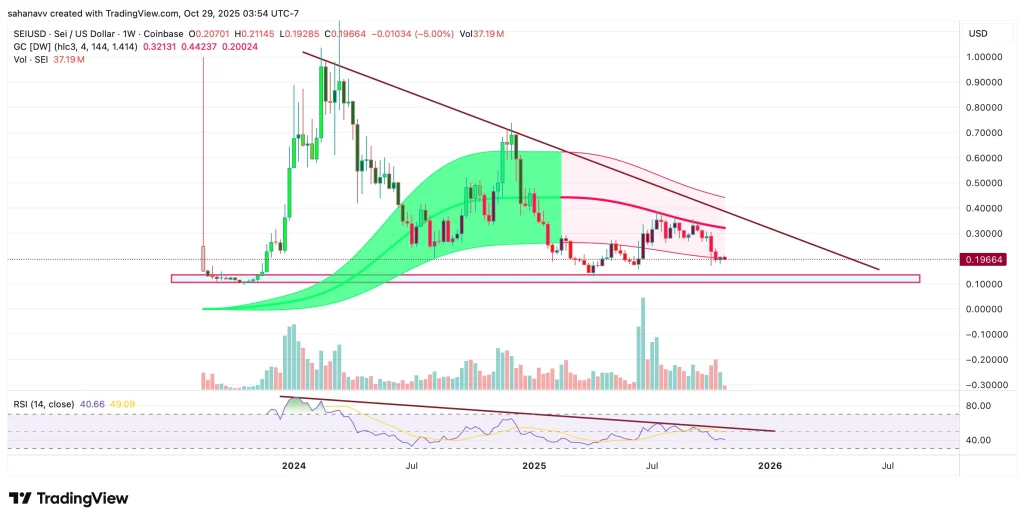
The weekly chart shows SEI testing the lower band of the Gaussian Channel, indicating an oversold zone where reversals often occur. The RSI hovers near 40, suggesting weakening bearish momentum but not yet signalling a clear recovery. If price rebounds from the channel’s lower boundary, SEI could retest the mid-channel resistance near $0.30, confirming early accumulation. However, a breakdown below the channel with RSI slipping further could reinforce bearish sentiment, potentially driving the token toward the next major support around $0.12.
Collectively, the short-term SEI price weakness reflects market fatigue, while the project’s focus on trading infrastructure and efficiency continues to set it apart in a crowded Layer-1 landscape. If Sei Network succeeds in attracting new dApps, partnerships, and liquidity, current levels could represent an attractive entry for long-term investors. However, sustained ecosystem stagnation may limit upside potential, leaving SEI struggling to reclaim broader market attention.
You May Also Like

Trust Wallet’s Decisive Move: Full Compensation for $7M Hack Victims

Cashing In On University Patents Means Giving Up On Our Innovation Future