AdaMix introduces a mixture-of-adapters approach to parameter-efficient fine-tuning that consistently beats state-of-the-art baselines across major NLP benchmarks. Tested on GLUE, E2E, WebNLG, and DART, AdaMix not only matches but often outperforms full model fine-tuning with BERT, RoBERTa, and GPT-2. Its advantage extends to few-shot learning, where AdaMix narrows the performance gap with full prompt-based fine-tuning, delivering strong results with fewer labeled examples.AdaMix introduces a mixture-of-adapters approach to parameter-efficient fine-tuning that consistently beats state-of-the-art baselines across major NLP benchmarks. Tested on GLUE, E2E, WebNLG, and DART, AdaMix not only matches but often outperforms full model fine-tuning with BERT, RoBERTa, and GPT-2. Its advantage extends to few-shot learning, where AdaMix narrows the performance gap with full prompt-based fine-tuning, delivering strong results with fewer labeled examples.

Smarter Fine-Tuning for NLU and NLG Tasks

2025/10/01 19:00

Abstract and 1. Introduction

  1. Background

    2.1 Mixture-of-Experts

    2.2 Adapters

  2. Mixture-of-Adaptations

    3.1 Routing Policy

    3.2 Consistency regularization

    3.3 Adaptation module merging and 3.4 Adaptation module sharing

    3.5 Connection to Bayesian Neural Networks and Model Ensembling

  3. Experiments

    4.1 Experimental Setup

    4.2 Key Results

    4.3 Ablation Study

  4. Related Work

  5. Conclusions

  6. Limitations

  7. Acknowledgment and References

Appendix

A. Few-shot NLU Datasets B. Ablation Study C. Detailed Results on NLU Tasks D. Hyper-parameter

4 Experiments

4.1 Experimental Setup

Dataset. We perform experiments on a wide range of tasks including eight natural language understanding (NLU) tasks in the General Language Understanding Evaluation (GLUE) benchmark (Wang et al., 2019) and three natural language generation (NLG) tasks, namely, E2E (Novikova et al., 2017), WebNLG (Gardent et al., 2017) and DART (Nan et al., 2020). For the NLU and NLG tasks, we follow the same setup as (Houlsby et al., 2019) and (Li and Liang, 2021; Hu et al., 2021), respectively.

\ Baselines. We compare AdaMix to full model fine-tuning and several state-of-the-art parameterefficient fine-tuning (PEFT) methods, namely, Pfeiffer Adapter (Pfeiffer et al., 2021), Houlsby Adapter (Houlsby et al., 2019), BitFit (Zaken et al., 2021), Prefix-tuning (Li and Liang, 2021), UNIPELT (Mao et al., 2021) and LoRA (Hu et al., 2021). We use BERT-base (Devlin et al., 2019) and RoBERTa-large (Liu et al., 2019) as encoders for NLU tasks (results in Table 1 and Table 2), and GPT-2 (Brown et al., 2020) for NLG tasks (results in Table 3).

\ AdaMix implementation details. We implement AdaMix in Pytorch and use Tesla V100 gpus for experiments with detailed hyper-parameter configurations presented in Section D in Appendix. AdaMix with adapters uses a dimension of 16 and 48 using BERT-base and RoBERTa-large encoders following the setup of (Hu et al., 2021; Mao et al., 2021) for fair comparison. AdaMix with LoRA uses rank r = 4 following the setup of (Hu et al., 2021) to keep the same number of adaptation parameters during inference. The number of adaptation modules in AdaMix is set to 4 for all the tasks and encoders unless otherwise specified. The impact of adapter dimension and number of adaptation modules for NLU tasks are investigated in Table 9 and 10. For most of the experiments and ablation analysis, we report results from AdaMix with adapters for NLU tasks. For demonstrating the generalizability of our framework, we report results from AdaMix with LoRA (Hu et al., 2021) as the underlying PEFT mechanism for NLG tasks.

\

4.2 Key Results

4.2.1 NLU Tasks

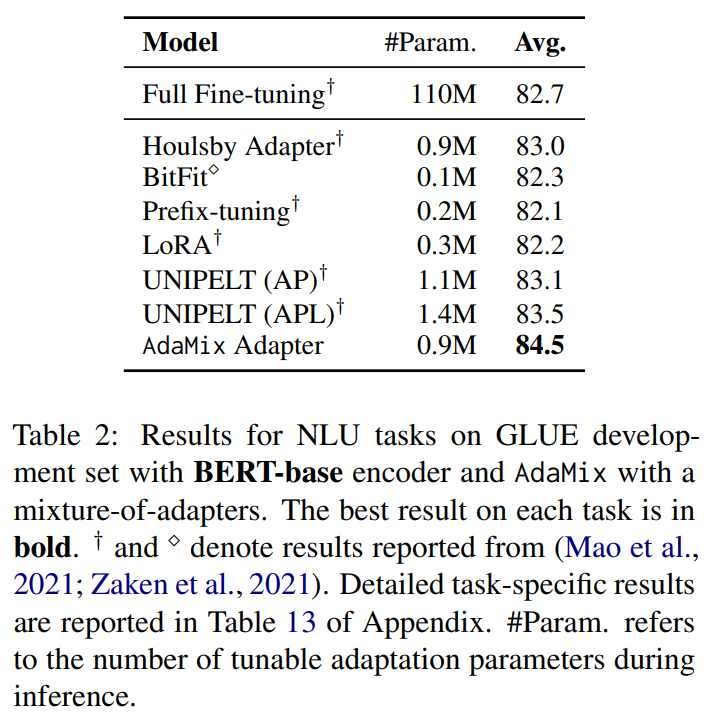
\ Tables 1 and 2 show the performance comparison among PEFT models with RoBERTa-large and BERT-base encoders respectively. Fully fine-tuned

\ \ Table 1: Results for NLU tasks on GLUE development set with RoBERTa-large encoder. The best result on each task is in bold and “-” denotes missing measure. AdaMix with a mixture of adapters outperforms all competing methods as well as fully fine-tuned large model with only 0.23% tunable parameters.† denotes results reported from (Hu et al., 2021). Mcc refers to Matthews correlation coefficient, and Pearson refers to Pearson correlation. #Param. denotes the number of tunable adaptation parameters used during inference.
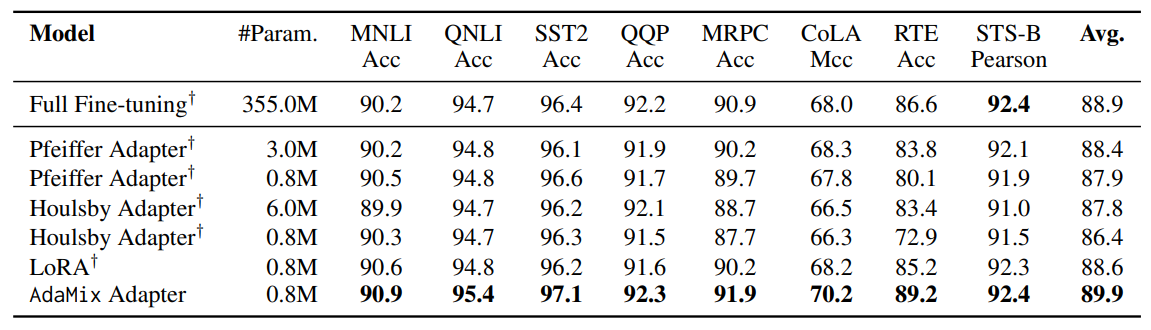
\ \ RoBERTa-large and BERT-base provide the ceiling performance. We observe AdaMix with a mixture-of-adapters to significantly outperform other state-of-the-art baselines on most tasks with different encoders. AdaMix with adapters is the only PEFT method which outperforms full model fine-tuning on all the tasks and on average score.

\ \
\ \ 4.2.2 NLG Tasks

\ AdaMix leverages mixture of adaptations to improve over underlying PEFT method as demonstrated in Table 3 for E2E NLG i.e. AdaMix with LoRA and AdaMix with adapters outperform LoRA (Hu et al., 2021) and adapters (Houlsby et al., 2019) respectively. We report results on DART and WebNLG in Tables 4 and 5 in Appendix.

\ 4.2.3 Few-shot NLU

\ In contrast to the fully supervised setting in the above experiments, we also perform few-shot experiments on six GLUE tasks following the same setup (e.g., shots, train and test splits) and evaluation as in (Wang et al., 2021). Detailed experimental configuration presented in Section A of Appendix. AdaMix uses a mixture-of-adapters with prompt-based fine-tuning (Gao et al., 2021).

\ Table 6 shows the performance comparison among different PEFT methods with |K| = 30 labeled examples with RoBERTa-large as frozen encoder. We observe significant performance gap for most PEFT methods with full model promptbased fine-tuning i.e. with all model parameters being updated. AdaMix with adapters outperforms full model tuning performance for few-shot NLU similar to that in the fully supervised setting. Note that AdaMix and LiST (Wang et al., 2021) use similar adapter design with prompt-based fine-tuning.

\

:::info Authors:

(1) Yaqing Wang, Purdue University (wang5075@purdue.edu);

(2) Sahaj Agarwal, Microsoft (sahagar@microsoft.com);

(3) Subhabrata Mukherjee, Microsoft Research (submukhe@microsoft.com);

(4) Xiaodong Liu, Microsoft Research (xiaodl@microsoft.com);

(5) Jing Gao, Purdue University (jinggao@purdue.edu);

(6) Ahmed Hassan Awadallah, Microsoft Research (hassanam@microsoft.com);

(7) Jianfeng Gao, Microsoft Research (jfgao@microsoft.com).

:::


:::info This paper is available on arxiv under CC BY 4.0 DEED license.

:::

\

Market Opportunity
FINE Logo
FINE Price(FINE)
$0,0000000007994
$0,0000000007994$0,0000000007994
+%0,83
USD
FINE (FINE) Live Price Chart
Disclaimer: The articles reposted on this site are sourced from public platforms and are provided for informational purposes only. They do not necessarily reflect the views of MEXC. All rights remain with the original authors. If you believe any content infringes on third-party rights, please contact service@support.mexc.com for removal. MEXC makes no guarantees regarding the accuracy, completeness, or timeliness of the content and is not responsible for any actions taken based on the information provided. The content does not constitute financial, legal, or other professional advice, nor should it be considered a recommendation or endorsement by MEXC.

You May Also Like

The Channel Factories We’ve Been Waiting For
The Channel Factories We’ve Been Waiting For

The post The Channel Factories We’ve Been Waiting For appeared on BitcoinEthereumNews.com. Visions of future technology are often prescient about the broad strokes while flubbing the details. The tablets in “2001: A Space Odyssey” do indeed look like iPads, but you never see the astronauts paying for subscriptions or wasting hours on Candy Crush.  Channel factories are one vision that arose early in the history of the Lightning Network to address some challenges that Lightning has faced from the beginning. Despite having grown to become Bitcoin’s most successful layer-2 scaling solution, with instant and low-fee payments, Lightning’s scale is limited by its reliance on payment channels. Although Lightning shifts most transactions off-chain, each payment channel still requires an on-chain transaction to open and (usually) another to close. As adoption grows, pressure on the blockchain grows with it. The need for a more scalable approach to managing channels is clear. Channel factories were supposed to meet this need, but where are they? In 2025, subnetworks are emerging that revive the impetus of channel factories with some new details that vastly increase their potential. They are natively interoperable with Lightning and achieve greater scale by allowing a group of participants to open a shared multisig UTXO and create multiple bilateral channels, which reduces the number of on-chain transactions and improves capital efficiency. Achieving greater scale by reducing complexity, Ark and Spark perform the same function as traditional channel factories with new designs and additional capabilities based on shared UTXOs.  Channel Factories 101 Channel factories have been around since the inception of Lightning. A factory is a multiparty contract where multiple users (not just two, as in a Dryja-Poon channel) cooperatively lock funds in a single multisig UTXO. They can open, close and update channels off-chain without updating the blockchain for each operation. Only when participants leave or the factory dissolves is an on-chain transaction…
Share
BitcoinEthereumNews2025/09/18 00:09
XRP Price Prediction: Can Ripple Rally Past $2 Before the End of 2025?

XRP Price Prediction: Can Ripple Rally Past $2 Before the End of 2025?

The post XRP Price Prediction: Can Ripple Rally Past $2 Before the End of 2025? appeared first on Coinpedia Fintech News The XRP price has come under enormous pressure
Share
CoinPedia2025/12/16 19:22
BlackRock boosts AI and US equity exposure in $185 billion models

BlackRock boosts AI and US equity exposure in $185 billion models

The post BlackRock boosts AI and US equity exposure in $185 billion models appeared on BitcoinEthereumNews.com. BlackRock is steering $185 billion worth of model portfolios deeper into US stocks and artificial intelligence. The decision came this week as the asset manager adjusted its entire model suite, increasing its equity allocation and dumping exposure to international developed markets. The firm now sits 2% overweight on stocks, after money moved between several of its biggest exchange-traded funds. This wasn’t a slow shuffle. Billions flowed across multiple ETFs on Tuesday as BlackRock executed the realignment. The iShares S&P 100 ETF (OEF) alone brought in $3.4 billion, the largest single-day haul in its history. The iShares Core S&P 500 ETF (IVV) collected $2.3 billion, while the iShares US Equity Factor Rotation Active ETF (DYNF) added nearly $2 billion. The rebalancing triggered swift inflows and outflows that realigned investor exposure on the back of performance data and macroeconomic outlooks. BlackRock raises equities on strong US earnings The model updates come as BlackRock backs the rally in American stocks, fueled by strong earnings and optimism around rate cuts. In an investment letter obtained by Bloomberg, the firm said US companies have delivered 11% earnings growth since the third quarter of 2024. Meanwhile, earnings across other developed markets barely touched 2%. That gap helped push the decision to drop international holdings in favor of American ones. Michael Gates, lead portfolio manager for BlackRock’s Target Allocation ETF model portfolio suite, said the US market is the only one showing consistency in sales growth, profit delivery, and revisions in analyst forecasts. “The US equity market continues to stand alone in terms of earnings delivery, sales growth and sustainable trends in analyst estimates and revisions,” Michael wrote. He added that non-US developed markets lagged far behind, especially when it came to sales. This week’s changes reflect that position. The move was made ahead of the Federal…
Share
BitcoinEthereumNews2025/09/18 01:44