TLDR Solana (SOL) dropped to $192 on Thursday, falling below the $200 mark and erasing a recent rally to $253 Grayscale’s spot SOL ETF faces its first approval deadline on October 10, with five more applications pending through October 2025 Institutions hold less than 1% of SOL’s supply compared to 16% of Bitcoin and 7% [...] The post Solana (SOL) Price: Drops Below $200 Ahead of October ETF Decision Deadline appeared first on CoinCentral.TLDR Solana (SOL) dropped to $192 on Thursday, falling below the $200 mark and erasing a recent rally to $253 Grayscale’s spot SOL ETF faces its first approval deadline on October 10, with five more applications pending through October 2025 Institutions hold less than 1% of SOL’s supply compared to 16% of Bitcoin and 7% [...] The post Solana (SOL) Price: Drops Below $200 Ahead of October ETF Decision Deadline appeared first on CoinCentral.

Solana (SOL) Price: Drops Below $200 Ahead of October ETF Decision Deadline

TLDR

  • Solana (SOL) dropped to $192 on Thursday, falling below the $200 mark and erasing a recent rally to $253
  • Grayscale’s spot SOL ETF faces its first approval deadline on October 10, with five more applications pending through October 2025
  • Institutions hold less than 1% of SOL’s supply compared to 16% of Bitcoin and 7% of Ethereum, creating potential for growth
  • Daily active addresses on Solana network declined 25% this month, showing weaker user engagement
  • SOL’s RSI indicator sits at 40.54, confirming bearish momentum but historically this level has signaled recovery opportunities

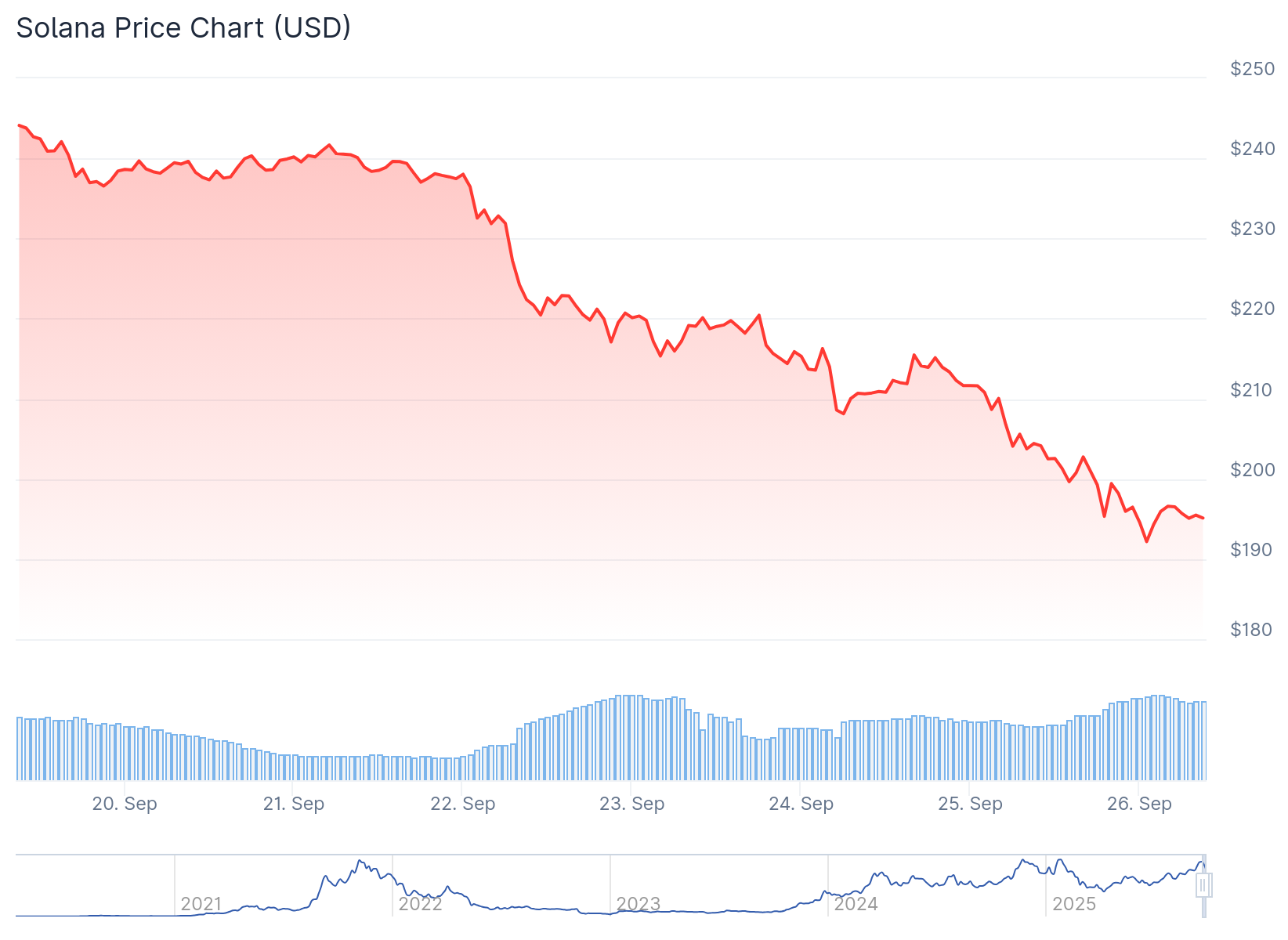
Solana dropped to $192 on Thursday, sliding below the psychologically important $200 level. The move erased gains from a recent rally that pushed SOL to an eight-month high of $253.
Solana (SOL) PriceSolana (SOL) Price

The 19% decline happened in just one week. The rapid reversal has shifted market attention to upcoming catalysts that could influence price direction.

A key date approaches on October 10. Grayscale’s spot SOL exchange-traded fund faces its first approval deadline from the Securities and Exchange Commission.

The decision could determine whether institutional capital begins flowing into Solana. This would mirror the pattern seen with Bitcoin and Ethereum over the past year.

The REX Osprey Staking SOL ETF launched in July but offers a different structure. A pure spot product from Grayscale would allow more direct institutional participation.

Five other applications await review by regulators. Bitwise, 21Shares, VanEck, Grayscale, and Canary have proposals with a final deadline of October 16, 2025.

The lineup shows growing institutional interest in bringing SOL into mainstream investment vehicles. Asset managers see potential in the current market positioning.

Institutional Allocation Gap Creates Opportunity

Pantera Capital recently called SOL “next in line for its institutional moment.” The firm pointed to under-allocation relative to other major cryptocurrencies.

Institutions hold around 16% of Bitcoin’s supply and 7% of Ethereum’s supply. Less than 1% of SOL’s supply is institutionally owned.

Companies like Stripe and PayPal have expanded their Solana integrations. This infrastructure development could support institutional adoption if ETF approval occurs.

Prediction markets show mixed sentiment about SOL’s prospects. Polymarket assigns just a 41% probability of SOL reaching a new all-time high in 2025.

Network Activity Shows Decline

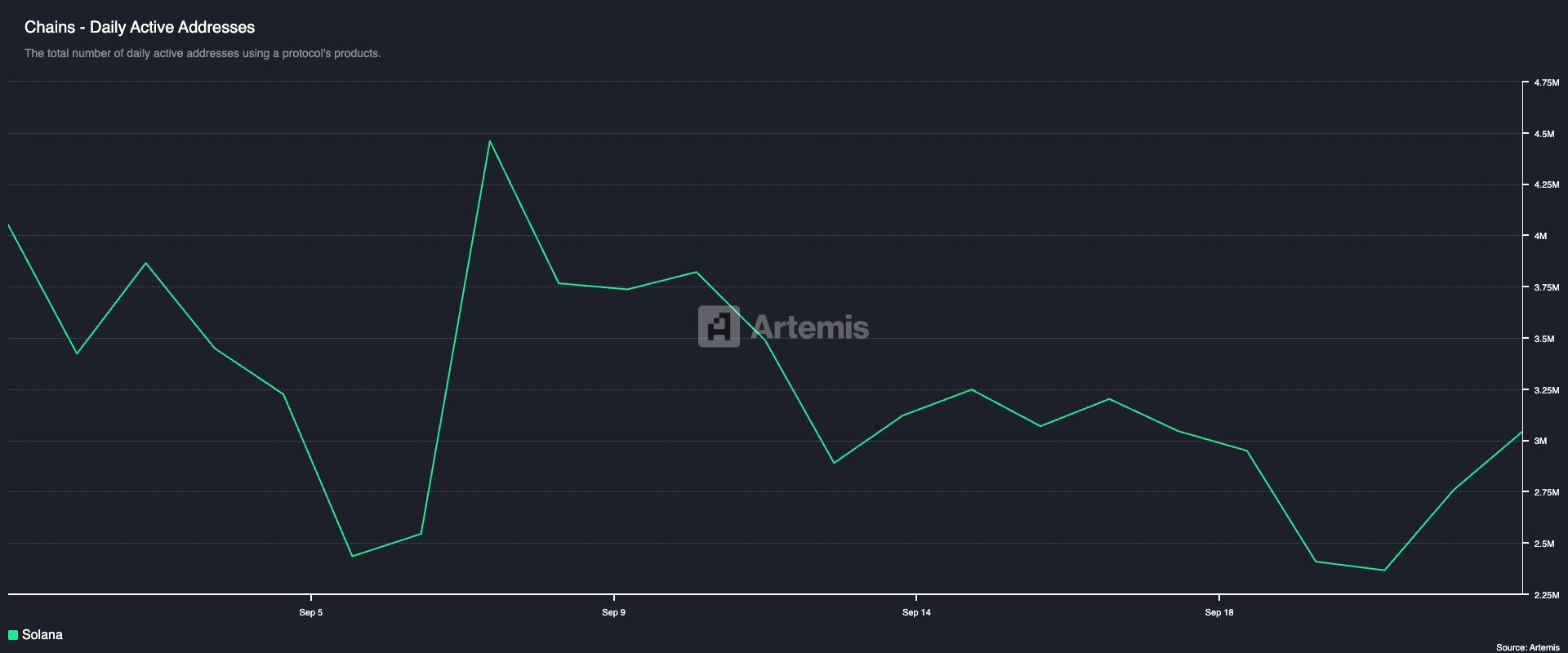
On-chain data reveals concerning trends for network usage. Daily active addresses interacting with Solana protocols dropped 25% this month to 3.04 million.
Source; Artemis

Daily active addresses represent unique wallets sending, receiving, or interacting with applications. A decline signals weaker user engagement and lower network activity.

SOL historically performed well in September over the past four years. The token gained 29% in 2021, 5.38% in 2022, 8.22% in 2023, and 12.5% in 2024.

This year breaks that pattern. SOL peaked at $253.51 on September 18 but has since fallen roughly 17%.
Source: TradingView

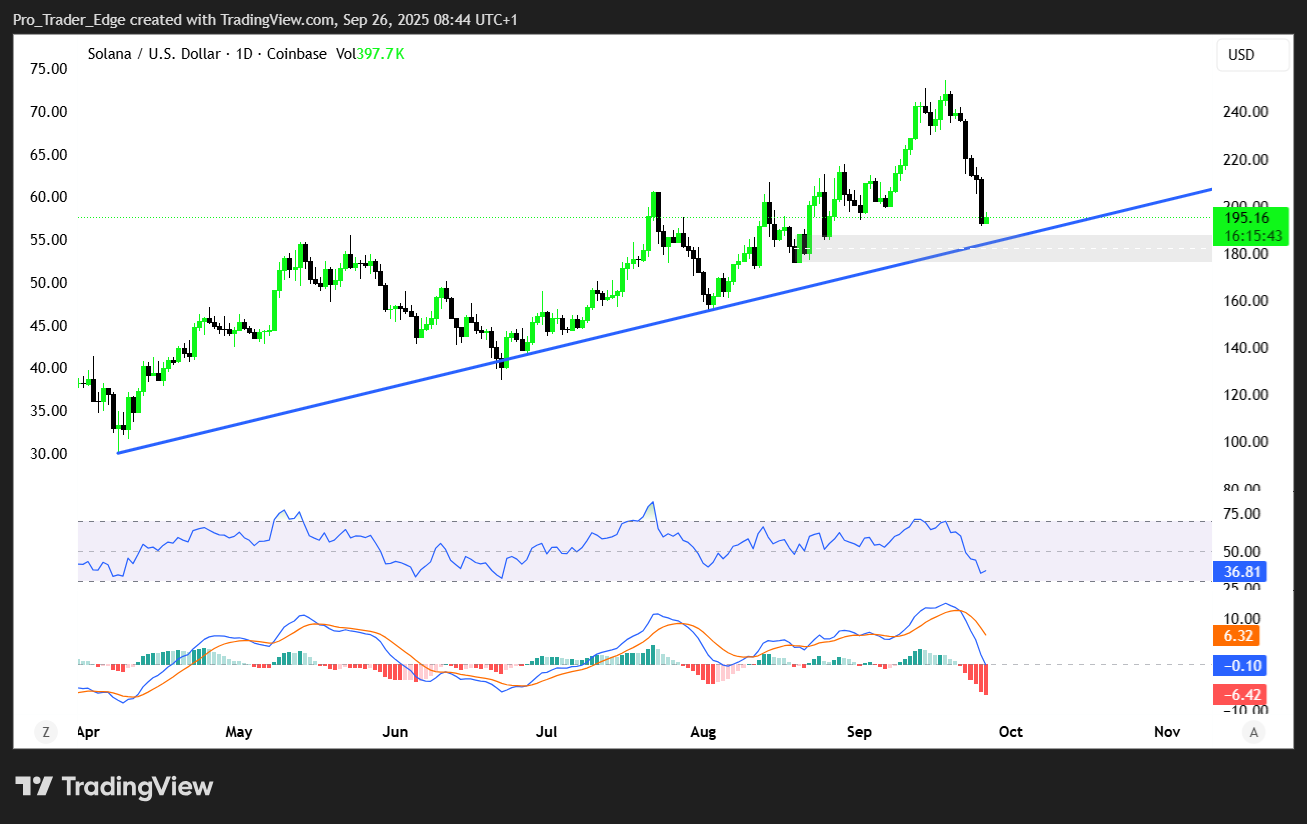
Technical indicators confirm the bearish momentum. SOL’s Relative Strength Index sits at 40.54 on the daily chart.

RSI readings above 70 suggest overbought conditions while readings below 30 indicate oversold levels. The current reading shows selling pressure outweighs buying momentum.

However, the RSI level has historically marked turning points for SOL. Since April 2025, similar readings below 30 on the four-hour chart have preceded recoveries four out of five times.

SOL continues to form higher highs and higher lows on longer timeframes. The current correction is testing the demand zone between $200 and $185.

This area overlaps with the 0.50-0.618 Fibonacci retracement band. Technical analysts often watch this region for potential bounces.

If SOL loses the $185 level, the next support zone sits between $170 and $156. Such a move would weaken trend strength and likely invite deeper selling pressure.

The October ETF decision deadline approaches as SOL tests key technical levels at $195.55 support, with potential further declines to $171.88 if bearish pressure continues.

The post Solana (SOL) Price: Drops Below $200 Ahead of October ETF Decision Deadline appeared first on CoinCentral.

Market Opportunity
Solana Logo
Solana Price(SOL)
$142,96
$142,96$142,96
-0,37%
USD
Solana (SOL) Live Price Chart
Disclaimer: The articles reposted on this site are sourced from public platforms and are provided for informational purposes only. They do not necessarily reflect the views of MEXC. All rights remain with the original authors. If you believe any content infringes on third-party rights, please contact service@support.mexc.com for removal. MEXC makes no guarantees regarding the accuracy, completeness, or timeliness of the content and is not responsible for any actions taken based on the information provided. The content does not constitute financial, legal, or other professional advice, nor should it be considered a recommendation or endorsement by MEXC.

You May Also Like

Taiko Makes Chainlink Data Streams Its Official Oracle

Taiko Makes Chainlink Data Streams Its Official Oracle

The post Taiko Makes Chainlink Data Streams Its Official Oracle appeared on BitcoinEthereumNews.com. Key Notes Taiko has officially integrated Chainlink Data Streams for its Layer 2 network. The integration provides developers with high-speed market data to build advanced DeFi applications. The move aims to improve security and attract institutional adoption by using Chainlink’s established infrastructure. Taiko, an Ethereum-based ETH $4 514 24h volatility: 0.4% Market cap: $545.57 B Vol. 24h: $28.23 B Layer 2 rollup, has announced the integration of Chainlink LINK $23.26 24h volatility: 1.7% Market cap: $15.75 B Vol. 24h: $787.15 M Data Streams. The development comes as the underlying Ethereum network continues to see significant on-chain activity, including large sales from ETH whales. The partnership establishes Chainlink as the official oracle infrastructure for the network. It is designed to provide developers on the Taiko platform with reliable and high-speed market data, essential for building a wide range of decentralized finance (DeFi) applications, from complex derivatives platforms to more niche projects involving unique token governance models. According to the project’s official announcement on Sept. 17, the integration enables the creation of more advanced on-chain products that require high-quality, tamper-proof data to function securely. Taiko operates as a “based rollup,” which means it leverages Ethereum validators for transaction sequencing for strong decentralization. Boosting DeFi and Institutional Interest Oracles are fundamental services in the blockchain industry. They act as secure bridges that feed external, off-chain information to on-chain smart contracts. DeFi protocols, in particular, rely on oracles for accurate, real-time price feeds. Taiko leadership stated that using Chainlink’s infrastructure aligns with its goals. The team hopes the partnership will help attract institutional crypto investment and support the development of real-world applications, a goal that aligns with Chainlink’s broader mission to bring global data on-chain. Integrating real-world economic information is part of a broader industry trend. Just last week, Chainlink partnered with the Sei…
Share
BitcoinEthereumNews2025/09/18 03:34
Kalshi Prediction Markets Are Pulling In $1 Billion Monthly as State Regulators Loom

Kalshi Prediction Markets Are Pulling In $1 Billion Monthly as State Regulators Loom

The post Kalshi Prediction Markets Are Pulling In $1 Billion Monthly as State Regulators Loom appeared on BitcoinEthereumNews.com. In brief Kalshi reached $1 billion in monthly volume and now dominates 62% of the global prediction market industry, surpassing Polymarket’s 37% share. Four states including Massachusetts have filed lawsuits claiming Kalshi operates as an unlicensed sportsbook, with Massachusetts seeking to permanently bar the platform. Kalshi operates under federal CFTC regulation as a designated contract market, arguing this preempts state gambling laws that require separate licensing. Prediction market Kalshi just topped $1 billion in monthly volume as state regulators nip at its heels with lawsuits alleging that it’s an unregistered sports betting platform. “Despite being limited to only American customers, Kalshi has now risen to dominate the global prediction market industry,” the company said in a press release. “New data scraped from publicly available activity metrics details this rise.” The publicly available data appears on a Dune Analytics dashboard that’s been tracking prediction market notional volume. The data show that Kalshi now accounts for roughly 62% of global prediction market volume, Polymarket for 37%, and the rest split between Limitless and Myriad, the prediction market owned by Decrypt parent company Dastan. Trading volume on Kalshi skyrocketed in August, not coincidentally at the start of the NFL season and as the prediction market pushes further into sports.  But regulators in Maryland, Nevada, and New Jersey have all issued cease-and-desist orders, arguing Kalshi’s event contracts amount to unlicensed sports betting. Each case has spilled into federal court, with judges issuing preliminary rulings but no final decisions yet. Last week, Massachusetts went further, filing a lawsuit that calls Kalshi’s sports contracts “illegal and unsafe sports wagering.” The 43-page Massachusetts lawsuit seeks to stop the company from allowing state residents on its platform—much the way Coinbase has had to do with its staking offerings in parts of the United States. Massachusetts Attorney General…
Share
BitcoinEthereumNews2025/09/19 09:21
[Pastilan] End the confidential fund madness

[Pastilan] End the confidential fund madness

UPDATE RULES. Former Commission on Audit commissioner Heidi Mendoza speaks during a public forum.
Share
Rappler2026/01/16 14:02