The US Treasury Department has on Wednesday imposed the highly anticipated sanctions on Vladimir Putin’s Russia, striking directly at the country’s energy sector after what officials described as a lack of genuine effort toward peace in Ukraine, after over nine months of trying to gently ease White House “friend” Putin into the decision. According to […]The US Treasury Department has on Wednesday imposed the highly anticipated sanctions on Vladimir Putin’s Russia, striking directly at the country’s energy sector after what officials described as a lack of genuine effort toward peace in Ukraine, after over nine months of trying to gently ease White House “friend” Putin into the decision. According to […]

Trump orders sweeping new sanctions targeting Russia’s energy sector

2025/10/23 05:27
3 min read

The US Treasury Department has on Wednesday imposed the highly anticipated sanctions on Vladimir Putin’s Russia, striking directly at the country’s energy sector after what officials described as a lack of genuine effort toward peace in Ukraine, after over nine months of trying to gently ease White House “friend” Putin into the decision.

According to the Department of the Treasury’s Office of Foreign Assets Control (OFAC), the decision is meant to cut off critical funding for the Kremlin’s war and cripple Moscow’s ability to raise revenue.

Treasury Secretary Scott Bessent said it was time “to stop the killing and for an immediate ceasefire.” Scott added that “given President Putin’s refusal to end this senseless war, Treasury is sanctioning Russia’s two largest oil companies that fund the Kremlin’s war machine.

The Treasury said it is prepared to take further action if necessary to support President Trump’s effort to end yet another war. We encourage our allies to join us and adhere to these sanctions.”

OFAC targets Rosneft and Lukoil under executive order 14024

The OFAC announcement named Rosneft Oil Company and Lukoil OAO as the main entities now facing restrictions. Both companies are central to Russia’s oil and gas industry.

Rosneft, described as a vertically integrated energy company, handles everything from exploration, extraction, and refining to transport and sales of petroleum and natural gas. Lukoil manages production, refining, and global distribution of oil and gas products.

The two companies have been designated under Executive Order 14024 for operating in Russia’s energy sector. OFAC also included several subsidiaries of Rosneft and Lukoil in the sanctions list.

Any entity owned 50% or more, whether directly or indirectly, by either of the companies is now blocked, even if not specifically named. The Annex 1 document released by Treasury lists all affected subsidiaries.

All property and interests belonging to these designated or blocked persons that are located in the United States or controlled by US persons are now frozen. They must be reported to OFAC, and unless explicitly licensed, US individuals or companies are prohibited from engaging in any transactions with these entities.

Strict penalties and global banking exposure

The Treasury warned that violations of these sanctions could bring civil or criminal penalties against the Russian companies. OFAC’s Economic Sanctions Enforcement Guidelines clarify that even unintentional breaches fall under strict liability.

Both US and foreign persons face consequences if they participate in prohibited transactions involving blocked persons or assets, said the Treasury.

Foreign financial institutions were also put on notice, with Secretary Scott saying that any bank or intermediary that facilitates significant transactions or services tied to Russia’s military-industrial base now risks being sanctioned.

If a foreign financial institution knowingly carries out or facilitates transactions on behalf of sanctioned persons, OFAC may restrict or prohibit correspondent or payable-through accounts within the United States. Such penalties could effectively cut foreign banks off from the American financial system.

The Treasury said the strength of its sanction regime depends not only on adding names to the Specially Designated Nationals (SDN) List, but also on removing them when appropriate. Officials said the ultimate goal of sanctions “is not to punish, but to bring about a positive change in behavior.” Those affected can file petitions for removal through OFAC’s official process.

Lastly, OFAC said that anyone listed under Executive Order 14024 could face additional export restrictions enforced by the Department of Commerce’s Bureau of Industry and Security (BIS).

Want your project in front of crypto’s top minds? Feature it in our next industry report, where data meets impact.

Disclaimer: The articles reposted on this site are sourced from public platforms and are provided for informational purposes only. They do not necessarily reflect the views of MEXC. All rights remain with the original authors. If you believe any content infringes on third-party rights, please contact service@support.mexc.com for removal. MEXC makes no guarantees regarding the accuracy, completeness, or timeliness of the content and is not responsible for any actions taken based on the information provided. The content does not constitute financial, legal, or other professional advice, nor should it be considered a recommendation or endorsement by MEXC.

You May Also Like

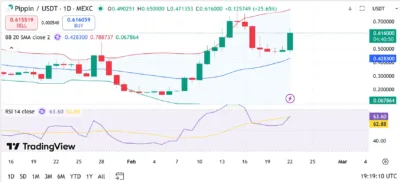
Pippin (PIPPIN) Price Prediction 2026–2030: Can PIPPIN Hit $0.70 Soon?
Pippin (PIPPIN) Price Prediction 2026–2030: Can PIPPIN Hit $0.70 Soon?

PIPPIN has surged sharply on the daily timeframe, printing a powerful bullish candle with over 25% gains. RSI is holding above 60, signaling strengthening momentum
Share
Coinstats2026/02/23 04:29
Will Cardano Reach $10 by 2030? Analysts Break Down ADA’s Growth Cycles

Will Cardano Reach $10 by 2030? Analysts Break Down ADA’s Growth Cycles

The post Will Cardano Reach $10 by 2030? Analysts Break Down ADA’s Growth Cycles appeared first on Coinpedia Fintech News Cardano (ADA) is trading at $0.9024 with a market cap of $32.91 billion. Experts say ADA has the potential to climb much higher, with some placing long-term targets as high as $10. The token continues to benefit from stronger visibility, rising liquidity, and increasing inflows from both institutional and retail markets. Can Cardano Hit $10 …
Share
CoinPedia2025/09/18 17:19
Crypto whale loses $6M to sneaky phishing scheme targeting staked Ethereum

Crypto whale loses $6M to sneaky phishing scheme targeting staked Ethereum

The post Crypto whale loses $6M to sneaky phishing scheme targeting staked Ethereum appeared on BitcoinEthereumNews.com. A crypto whale lost more than $6 million in staked Ethereum (stETH) and Aave-wrapped Bitcoin (aEthWBTC) after approving malicious signatures in a phishing scheme on Sept. 18, according to blockchain security firm Scam Sniffer. According to the firm, the attackers disguised their move as a routine wallet confirmation through “Permit” signatures, which tricked the victim into authorizing fund transfers without triggering obvious red flags. Yu Xian, founder of blockchain security company SlowMist, noted that the victim did not recognize the danger because the transaction required no gas fees. He wrote: “From the victim’s perspective, he just clicked a few times to confirm the wallet’s pop-up signature requests, didn’t spend a single penny of gas, and $6.28 million was gone.” How Permit exploits work Permit approvals were originally designed to simplify token transfers. Instead of submitting an on-chain approval and paying fees, a user can sign an off-chain message authorizing a spender. That efficiency, however, has created a new attack surface for malicious players. Once a user signs such a permit, attackers can combine two functions—Permit and TransferFrom—to drain assets directly. Because the authorization takes place off-chain, wallet dashboards show no unusual activity until the funds move. As a result, the assets are gone when the approval executes on-chain, and tokens are redirected to the attacker’s wallet. This loophole has made permit exploits increasingly attractive for malicious actors, who can siphon millions without needing complex hacks or high-cost gas wars. Phishing losses The latest theft highlights a wider trend of escalating phishing campaigns. Scam Sniffer reported that in August alone, attackers stole $12.17 million from more than 15,200 victims. That figure represented a 72% jump in losses compared with July. According to the firm, the most significant share of August’s damages came from three large accounts that accounted for nearly half…
Share
BitcoinEthereumNews2025/09/19 02:31