Highlights: VanEck’s Form 8-A filing makes its Solana ETF a step closer to launch. Since October 28, Solana ETFs have received net inflows of $370 million. VanEck’s Solana ETF includes an investor-yield staking policy. Leading investment firm VanEck has submitted a crucial Form 8-A to the U.S. Securities and Exchange Commission (SEC) for its Solana ETF. The filing represents the last step prior to the ETF’s possible launch. This move indicates that VanEck is prepared to offer the much-awaited Solana-based exchange-traded fund (ETF) to U.S. investors. VanEck’s Solana ETF Set to Launch Soon The submission of Form 8-A is the usual step taken in the ETF launching process, and it indicates the near availability of the product. Additionally, the filing comes after VanEck’s last update to its S-1 registration, which not just proposed a management fee of 0.30% but also outlined the staking strategy in detail. BREAKING: @vaneck_us has filed a Form 8-A with the SEC for its @Solana spot ETF, a step that typically comes right before launch. These filings are usually followed by trading beginning the next day. pic.twitter.com/uhMEU183gO — SolanaFloor (@SolanaFloor) November 13, 2025 The staking strategy, which is a collaboration with SOL Strategies, is set to provide investors with yields. VanEck is positioning the Solana ETF as an attractive option for both institutional and retail investors. Solana has emerged as a standout asset among cryptocurrency ETFs so far. The launch of the first Solana ETF on October 28 was a turning point in the market as substantial inflows followed. Spot Solana ETFs are still of interest to the market and have had continuous inflows for the last 13 days, according to Sosovalue data. On Thursday, the inflow amounted to $1.5 million, which shows that the investors’ demand is very strong. Source: Farside Investors The total net inflows of the two active Solana ETFs, which are Bitwise’s BSOL and Grayscale’s GSOL, have reached an impressive $370 million. Moreover, the first week of trading saw almost $200 million, demonstrating Solana’s attractiveness. Institutional Interest in Solana ETFs The demand for Solana-based investment products has been fueled by institutional interest. Analysts consider that such demand will continue due to the emergence of more Solana-related ETFs. Furthermore, this would be a big opportunity to gain entry into the developing cryptocurrency investment industry with VanEck. The inflows witnessed in Solana ETFs demonstrate a larger trend in the crypto ETF market. Other ETFs, including Bitcoin and Ethereum funds, have recently received outflows, but the Solana ETFs have continued to break ground. Solana is attracting attention among investors due to its ability to provide returns despite the volatile market environment. ETF Expansion Accelerates Across the Market Vaneck’s Solana ETF has coincided with the growth of the overall crypto ETF in the market. Other major players in the industry, such as Canary Capital, filed to launch the Mog Coin ETF. These funds give investors a chance to take part in the crypto market through regulated channels. NEW: @CanaryFunds files for a MOG ETF. pic.twitter.com/IUBkL4mF3E — James Seyffart (@JSeyff) November 12, 2025 The U.S. crypto ETF market has more than a dozen active funds as of November 2025. With the upcoming launch of VanEck’s Solana ETF, the company is set to play a vital role in the development of crypto ETFs. Meanwhile, Solana’s native token has seen subdued market activity recently, declining by 8% and 30% on the weekly and monthly charts, respectively. As of this writing, the altcoin is trading around $140 with a market cap of $77 billion. eToro Platform Best Crypto Exchange Over 90 top cryptos to trade Regulated by top-tier entities User-friendly trading app 30+ million users 9.9 Visit eToro eToro is a multi-asset investment platform. The value of your investments may go up or down. Your capital is at risk. Don’t invest unless you’re prepared to lose all the money you invest. This is a high-risk investment, and you should not expect to be protected if something goes wrong. Highlights: VanEck’s Form 8-A filing makes its Solana ETF a step closer to launch. Since October 28, Solana ETFs have received net inflows of $370 million. VanEck’s Solana ETF includes an investor-yield staking policy. Leading investment firm VanEck has submitted a crucial Form 8-A to the U.S. Securities and Exchange Commission (SEC) for its Solana ETF. The filing represents the last step prior to the ETF’s possible launch. This move indicates that VanEck is prepared to offer the much-awaited Solana-based exchange-traded fund (ETF) to U.S. investors. VanEck’s Solana ETF Set to Launch Soon The submission of Form 8-A is the usual step taken in the ETF launching process, and it indicates the near availability of the product. Additionally, the filing comes after VanEck’s last update to its S-1 registration, which not just proposed a management fee of 0.30% but also outlined the staking strategy in detail. BREAKING: @vaneck_us has filed a Form 8-A with the SEC for its @Solana spot ETF, a step that typically comes right before launch. These filings are usually followed by trading beginning the next day. pic.twitter.com/uhMEU183gO — SolanaFloor (@SolanaFloor) November 13, 2025 The staking strategy, which is a collaboration with SOL Strategies, is set to provide investors with yields. VanEck is positioning the Solana ETF as an attractive option for both institutional and retail investors. Solana has emerged as a standout asset among cryptocurrency ETFs so far. The launch of the first Solana ETF on October 28 was a turning point in the market as substantial inflows followed. Spot Solana ETFs are still of interest to the market and have had continuous inflows for the last 13 days, according to Sosovalue data. On Thursday, the inflow amounted to $1.5 million, which shows that the investors’ demand is very strong. Source: Farside Investors The total net inflows of the two active Solana ETFs, which are Bitwise’s BSOL and Grayscale’s GSOL, have reached an impressive $370 million. Moreover, the first week of trading saw almost $200 million, demonstrating Solana’s attractiveness. Institutional Interest in Solana ETFs The demand for Solana-based investment products has been fueled by institutional interest. Analysts consider that such demand will continue due to the emergence of more Solana-related ETFs. Furthermore, this would be a big opportunity to gain entry into the developing cryptocurrency investment industry with VanEck. The inflows witnessed in Solana ETFs demonstrate a larger trend in the crypto ETF market. Other ETFs, including Bitcoin and Ethereum funds, have recently received outflows, but the Solana ETFs have continued to break ground. Solana is attracting attention among investors due to its ability to provide returns despite the volatile market environment. ETF Expansion Accelerates Across the Market Vaneck’s Solana ETF has coincided with the growth of the overall crypto ETF in the market. Other major players in the industry, such as Canary Capital, filed to launch the Mog Coin ETF. These funds give investors a chance to take part in the crypto market through regulated channels. NEW: @CanaryFunds files for a MOG ETF. pic.twitter.com/IUBkL4mF3E — James Seyffart (@JSeyff) November 12, 2025 The U.S. crypto ETF market has more than a dozen active funds as of November 2025. With the upcoming launch of VanEck’s Solana ETF, the company is set to play a vital role in the development of crypto ETFs. Meanwhile, Solana’s native token has seen subdued market activity recently, declining by 8% and 30% on the weekly and monthly charts, respectively. As of this writing, the altcoin is trading around $140 with a market cap of $77 billion. eToro Platform Best Crypto Exchange Over 90 top cryptos to trade Regulated by top-tier entities User-friendly trading app 30+ million users 9.9 Visit eToro eToro is a multi-asset investment platform. The value of your investments may go up or down. Your capital is at risk. Don’t invest unless you’re prepared to lose all the money you invest. This is a high-risk investment, and you should not expect to be protected if something goes wrong.

VanEck Solana ETF Nears Launch with SEC Filing

Highlights:

  • VanEck’s Form 8-A filing makes its Solana ETF a step closer to launch.
  • Since October 28, Solana ETFs have received net inflows of $370 million.
  • VanEck’s Solana ETF includes an investor-yield staking policy.

Leading investment firm VanEck has submitted a crucial Form 8-A to the U.S. Securities and Exchange Commission (SEC) for its Solana ETF. The filing represents the last step prior to the ETF’s possible launch. This move indicates that VanEck is prepared to offer the much-awaited Solana-based exchange-traded fund (ETF) to U.S. investors.

VanEck’s Solana ETF Set to Launch Soon

The submission of Form 8-A is the usual step taken in the ETF launching process, and it indicates the near availability of the product. Additionally, the filing comes after VanEck’s last update to its S-1 registration, which not just proposed a management fee of 0.30% but also outlined the staking strategy in detail.

The staking strategy, which is a collaboration with SOL Strategies, is set to provide investors with yields. VanEck is positioning the Solana ETF as an attractive option for both institutional and retail investors.

Solana has emerged as a standout asset among cryptocurrency ETFs so far. The launch of the first Solana ETF on October 28 was a turning point in the market as substantial inflows followed. Spot Solana ETFs are still of interest to the market and have had continuous inflows for the last 13 days, according to Sosovalue data. On Thursday, the inflow amounted to $1.5 million, which shows that the investors’ demand is very strong.
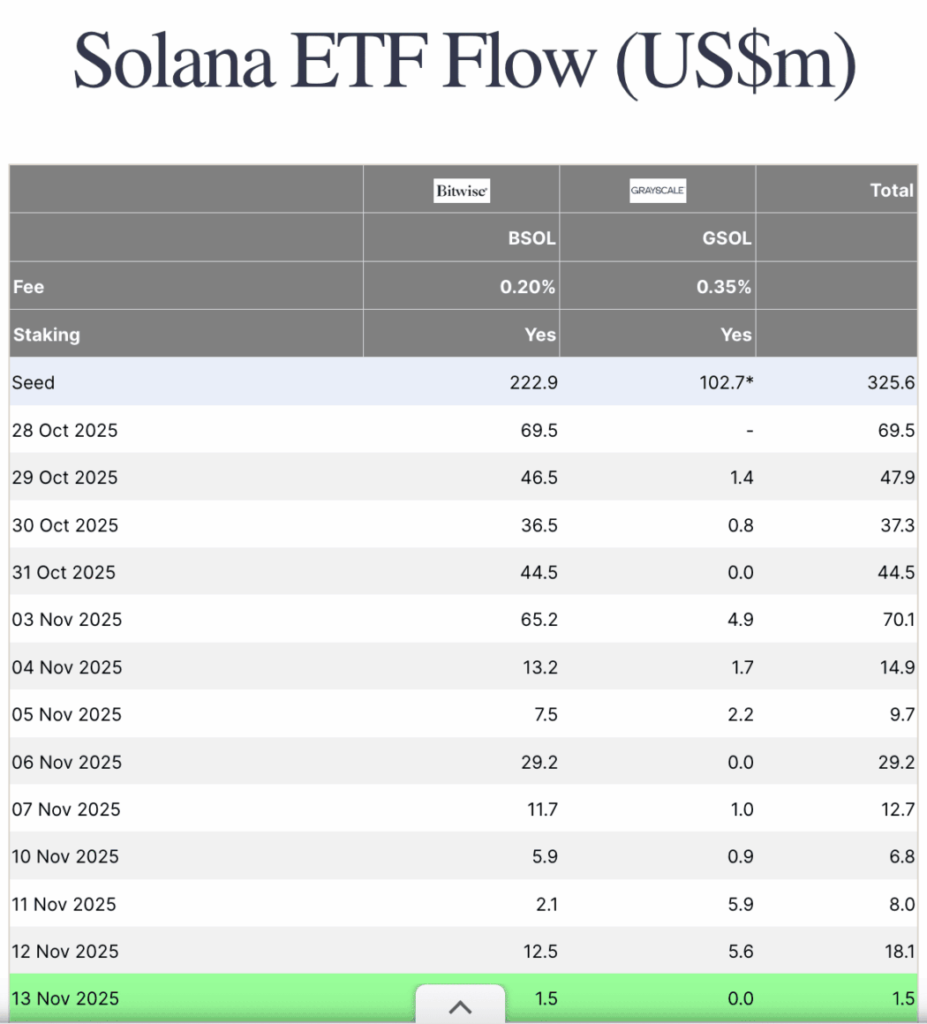
Source: Farside Investors

The total net inflows of the two active Solana ETFs, which are Bitwise’s BSOL and Grayscale’s GSOL, have reached an impressive $370 million. Moreover, the first week of trading saw almost $200 million, demonstrating Solana’s attractiveness.

Institutional Interest in Solana ETFs

The demand for Solana-based investment products has been fueled by institutional interest. Analysts consider that such demand will continue due to the emergence of more Solana-related ETFs. Furthermore, this would be a big opportunity to gain entry into the developing cryptocurrency investment industry with VanEck.

The inflows witnessed in Solana ETFs demonstrate a larger trend in the crypto ETF market. Other ETFs, including Bitcoin and Ethereum funds, have recently received outflows, but the Solana ETFs have continued to break ground. Solana is attracting attention among investors due to its ability to provide returns despite the volatile market environment.

ETF Expansion Accelerates Across the Market

Vaneck’s Solana ETF has coincided with the growth of the overall crypto ETF in the market. Other major players in the industry, such as Canary Capital, filed to launch the Mog Coin ETF. These funds give investors a chance to take part in the crypto market through regulated channels.

The U.S. crypto ETF market has more than a dozen active funds as of November 2025. With the upcoming launch of VanEck’s Solana ETF, the company is set to play a vital role in the development of crypto ETFs.

Meanwhile, Solana’s native token has seen subdued market activity recently, declining by 8% and 30% on the weekly and monthly charts, respectively. As of this writing, the altcoin is trading around $140 with a market cap of $77 billion.

eToro Platform

Best Crypto Exchange

  • Over 90 top cryptos to trade
  • Regulated by top-tier entities
  • User-friendly trading app
  • 30+ million users
9.9
Visit eToro

eToro is a multi-asset investment platform. The value of your investments may go up or down. Your capital is at risk. Don’t invest unless you’re prepared to lose all the money you invest. This is a high-risk investment, and you should not expect to be protected if something goes wrong.


Market Opportunity
FORM Logo
FORM Price(FORM)
$0.3408
$0.3408$0.3408
+2.21%
USD
FORM (FORM) Live Price Chart
Disclaimer: The articles reposted on this site are sourced from public platforms and are provided for informational purposes only. They do not necessarily reflect the views of MEXC. All rights remain with the original authors. If you believe any content infringes on third-party rights, please contact service@support.mexc.com for removal. MEXC makes no guarantees regarding the accuracy, completeness, or timeliness of the content and is not responsible for any actions taken based on the information provided. The content does not constitute financial, legal, or other professional advice, nor should it be considered a recommendation or endorsement by MEXC.

You May Also Like

Trust Wallet’s Decisive Move: Full Compensation for $7M Hack Victims

Trust Wallet’s Decisive Move: Full Compensation for $7M Hack Victims

BitcoinWorld Trust Wallet’s Decisive Move: Full Compensation for $7M Hack Victims In a significant move for cryptocurrency security, Trust Wallet has committed
Share
bitcoinworld2025/12/26 17:40
Cashing In On University Patents Means Giving Up On Our Innovation Future

Cashing In On University Patents Means Giving Up On Our Innovation Future

The post Cashing In On University Patents Means Giving Up On Our Innovation Future appeared on BitcoinEthereumNews.com. “It’s a raid on American innovation that would deliver pennies to the Treasury while kneecapping the very engine of our economic and medical progress,” writes Pipes. Getty Images Washington is addicted to taxing success. Now, Commerce Secretary Howard Lutnick is floating a plan to skim half the patent earnings from inventions developed at universities with federal funding. It’s being sold as a way to shore up programs like Social Security. In reality, it’s a raid on American innovation that would deliver pennies to the Treasury while kneecapping the very engine of our economic and medical progress. Yes, taxpayer dollars support early-stage research. But the real payoff comes later—in the jobs created, cures discovered, and industries launched when universities and private industry turn those discoveries into real products. By comparison, the sums at stake in patent licensing are trivial. Universities collectively earn only about $3.6 billion annually in patent income—less than the federal government spends on Social Security in a single day. Even confiscating half would barely register against a $6 trillion federal budget. And yet the damage from such a policy would be anything but trivial. The true return on taxpayer investment isn’t in licensing checks sent to Washington, but in the downstream economic activity that federally supported research unleashes. Thanks to the bipartisan Bayh-Dole Act of 1980, universities and private industry have powerful incentives to translate early-stage discoveries into real-world products. Before Bayh-Dole, the government hoarded patents from federally funded research, and fewer than 5% were ever licensed. Once universities could own and license their own inventions, innovation exploded. The result has been one of the best returns on investment in government history. Since 1996, university research has added nearly $2 trillion to U.S. industrial output, supported 6.5 million jobs, and launched more than 19,000 startups. Those companies pay…
Share
BitcoinEthereumNews2025/09/18 03:26
Trust Wallet Hack Hits $7M: CZ Hints at Possible Insider Role

Trust Wallet Hack Hits $7M: CZ Hints at Possible Insider Role

CZ hinted at possible insider involvement in the Trust Wallet incident while assuring users that their funds would be reimbursed.
Share
CryptoPotato2025/12/26 16:48