Author: Castle Labs Compiled by AididiaoJP, Foresight News What is Resolv Resolv is an overcollateralized, interest-earning stablecoin protocol that mints USR and RLP. The USR stablecoin earns interest through delta-neutral strategies; RLP is a liquidity token that earns leveraged returns by assuming the risks inherent in these strategies. USR and RLP users earn income from the liquidity staking income generated by ETH liquidity staking tokens (LST) and the funding rate obtained from shorting ETH on centralized exchanges. Resolv now has its own governance token, RESOLV, which can be staked to earn rewards. The token’s airdrop was not well received by the market, and many long positions were quickly liquidated, causing the TVL to drop by more than 50% from its all-time high (ATH) within a few months. Then the Resolv team started announcing new partnerships, strategies, and protocol integrations, as well as fee switches (and token buybacks), and the price and TVL rebounded from recent lows. Resolv Buyback Program Last week, the Resolv Foundation launched a program to buy back RESOLV tokens, using revenue from the protocol on a weekly basis. But where does this revenue come from? The protocol earns 10% from interest paid to the staking pool, as well as incentives from external participants like EtherFi, thanks to their fee switch enabled in July. To date, the project has generated over $22 million in interest for its depositors, and since the fee switch went live, the protocol has accumulated $226,000 in fees, 75% of which has been used to buy back RESOLV. Benefits of the Program Not only are buybacks effective for token price growth because they reduce the circulating supply, but they are also important for what they represent to the community: the protocol is sacrificing some of the revenue that would have been earned by the team in favor of the project’s token. These repurchased tokens will then be allocated to future initiatives to drive ecosystem development, effectively re-entering the protocol’s economics. Supporting their tokens for the long term through buybacks is a reliable way to increase trust among community members and plan for the future of the token, effectively retaining more supply in the long term. Final Thoughts Redirecting a small portion of proceeds toward staking and buybacks is a necessary step to support a token that has yet to find its purpose, as stakeholders currently have no say in the future of the protocol. While this move makes sense, I have some concerns about how these buybacks are executed. Weekly buybacks don't always align with market conditions (such as liquidity, volume, and spreads), so they could end up filling pending orders during price increases and provide limited support to prices when needed. On the other hand, there are ways to improve this, such as developing a strategy that uses market maker (limit) orders to support prices when necessary, such as during cyclical declines, prolonged downturns, or when low liquidity conditions cause prices to fall. Fluid and Raydium have already used this strategy.Author: Castle Labs Compiled by AididiaoJP, Foresight News What is Resolv Resolv is an overcollateralized, interest-earning stablecoin protocol that mints USR and RLP. The USR stablecoin earns interest through delta-neutral strategies; RLP is a liquidity token that earns leveraged returns by assuming the risks inherent in these strategies. USR and RLP users earn income from the liquidity staking income generated by ETH liquidity staking tokens (LST) and the funding rate obtained from shorting ETH on centralized exchanges. Resolv now has its own governance token, RESOLV, which can be staked to earn rewards. The token’s airdrop was not well received by the market, and many long positions were quickly liquidated, causing the TVL to drop by more than 50% from its all-time high (ATH) within a few months. Then the Resolv team started announcing new partnerships, strategies, and protocol integrations, as well as fee switches (and token buybacks), and the price and TVL rebounded from recent lows. Resolv Buyback Program Last week, the Resolv Foundation launched a program to buy back RESOLV tokens, using revenue from the protocol on a weekly basis. But where does this revenue come from? The protocol earns 10% from interest paid to the staking pool, as well as incentives from external participants like EtherFi, thanks to their fee switch enabled in July. To date, the project has generated over $22 million in interest for its depositors, and since the fee switch went live, the protocol has accumulated $226,000 in fees, 75% of which has been used to buy back RESOLV. Benefits of the Program Not only are buybacks effective for token price growth because they reduce the circulating supply, but they are also important for what they represent to the community: the protocol is sacrificing some of the revenue that would have been earned by the team in favor of the project’s token. These repurchased tokens will then be allocated to future initiatives to drive ecosystem development, effectively re-entering the protocol’s economics. Supporting their tokens for the long term through buybacks is a reliable way to increase trust among community members and plan for the future of the token, effectively retaining more supply in the long term. Final Thoughts Redirecting a small portion of proceeds toward staking and buybacks is a necessary step to support a token that has yet to find its purpose, as stakeholders currently have no say in the future of the protocol. While this move makes sense, I have some concerns about how these buybacks are executed. Weekly buybacks don't always align with market conditions (such as liquidity, volume, and spreads), so they could end up filling pending orders during price increases and provide limited support to prices when needed. On the other hand, there are ways to improve this, such as developing a strategy that uses market maker (limit) orders to support prices when necessary, such as during cyclical declines, prolonged downturns, or when low liquidity conditions cause prices to fall. Fluid and Raydium have already used this strategy.

With the fee switch activated and weekly buybacks, Resolv is more than just an Ehena imitation.

2025/09/05 15:00

Author: Castle Labs

Compiled by AididiaoJP, Foresight News

What is Resolv

Resolv is an overcollateralized, interest-earning stablecoin protocol that mints USR and RLP. The USR stablecoin earns interest through delta-neutral strategies; RLP is a liquidity token that earns leveraged returns by assuming the risks inherent in these strategies.

USR and RLP users earn income from the liquidity staking income generated by ETH liquidity staking tokens (LST) and the funding rate obtained from shorting ETH on centralized exchanges.

Resolv now has its own governance token, RESOLV, which can be staked to earn rewards. The token’s airdrop was not well received by the market, and many long positions were quickly liquidated, causing the TVL to drop by more than 50% from its all-time high (ATH) within a few months.
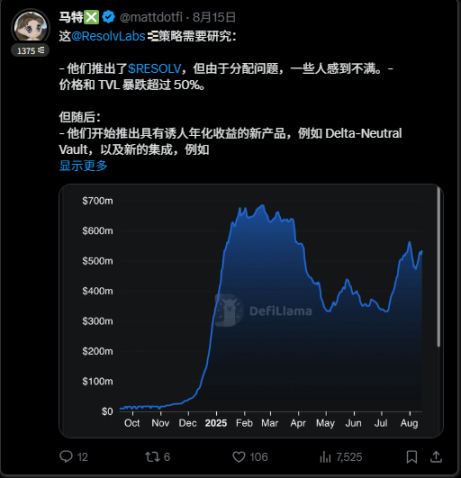
Then the Resolv team started announcing new partnerships, strategies, and protocol integrations, as well as fee switches (and token buybacks), and the price and TVL rebounded from recent lows.

Resolv Buyback Program

Last week, the Resolv Foundation launched a program to buy back RESOLV tokens, using revenue from the protocol on a weekly basis.
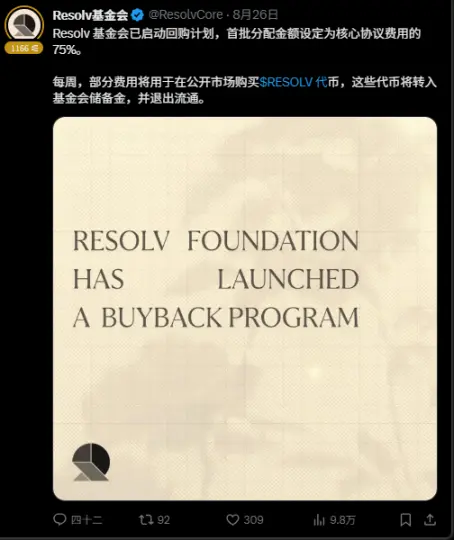
But where does this revenue come from? The protocol earns 10% from interest paid to the staking pool, as well as incentives from external participants like EtherFi, thanks to their fee switch enabled in July.
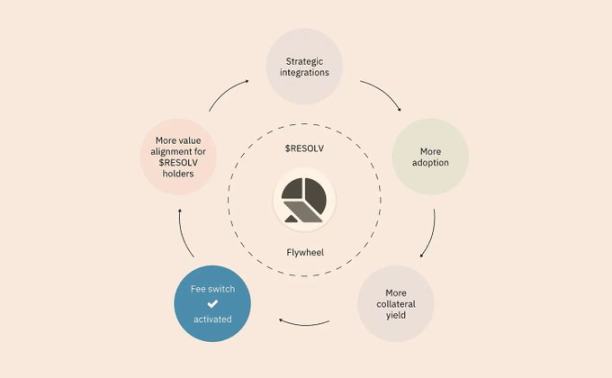
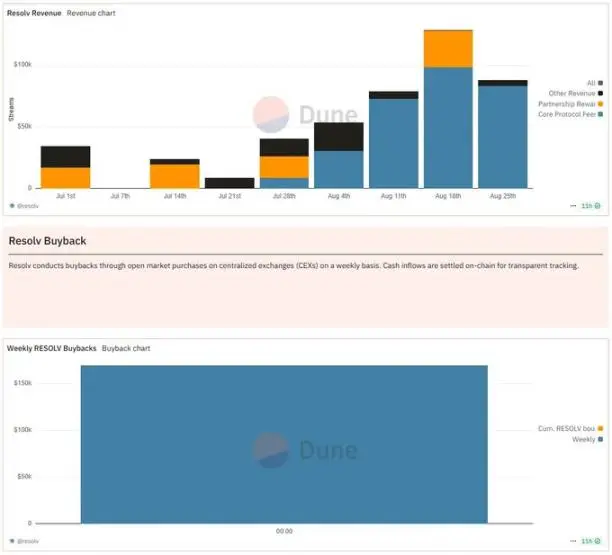
To date, the project has generated over $22 million in interest for its depositors, and since the fee switch went live, the protocol has accumulated $226,000 in fees, 75% of which has been used to buy back RESOLV.

Benefits of the Program

Not only are buybacks effective for token price growth because they reduce the circulating supply, but they are also important for what they represent to the community: the protocol is sacrificing some of the revenue that would have been earned by the team in favor of the project’s token.

These repurchased tokens will then be allocated to future initiatives to drive ecosystem development, effectively re-entering the protocol’s economics.

Supporting their tokens for the long term through buybacks is a reliable way to increase trust among community members and plan for the future of the token, effectively retaining more supply in the long term.
Final Thoughts

Redirecting a small portion of proceeds toward staking and buybacks is a necessary step to support a token that has yet to find its purpose, as stakeholders currently have no say in the future of the protocol.

While this move makes sense, I have some concerns about how these buybacks are executed. Weekly buybacks don't always align with market conditions (such as liquidity, volume, and spreads), so they could end up filling pending orders during price increases and provide limited support to prices when needed.
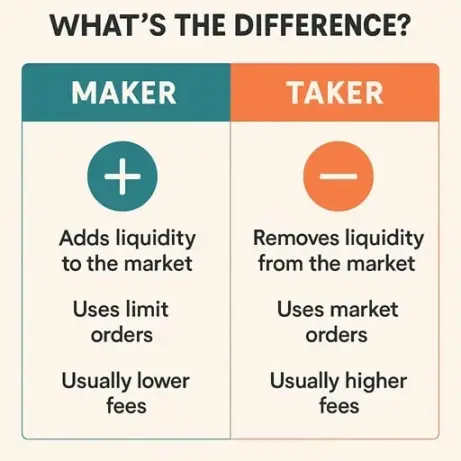
On the other hand, there are ways to improve this, such as developing a strategy that uses market maker (limit) orders to support prices when necessary, such as during cyclical declines, prolonged downturns, or when low liquidity conditions cause prices to fall. Fluid and Raydium have already used this strategy.

Market Opportunity
Threshold Logo
Threshold Price(T)
$0.00941
$0.00941$0.00941
-0.42%
USD
Threshold (T) Live Price Chart
Disclaimer: The articles reposted on this site are sourced from public platforms and are provided for informational purposes only. They do not necessarily reflect the views of MEXC. All rights remain with the original authors. If you believe any content infringes on third-party rights, please contact service@support.mexc.com for removal. MEXC makes no guarantees regarding the accuracy, completeness, or timeliness of the content and is not responsible for any actions taken based on the information provided. The content does not constitute financial, legal, or other professional advice, nor should it be considered a recommendation or endorsement by MEXC.

You May Also Like

What Does Coinbase’s New Move Mean for Crypto and Finance?

What Does Coinbase’s New Move Mean for Crypto and Finance?

The post What Does Coinbase’s New Move Mean for Crypto and Finance? appeared on BitcoinEthereumNews.com. The most prominent cryptocurrency exchange in the United States, Coinbase, revealed a significant step on October 3rd by applying for national trust company status with the Office of the Comptroller of the Currency (OCC). This initiative aims to consolidate oversight for new product developments under a centralized federal structure, streamlining the integration of cryptocurrencies with […] Continue Reading:What Does Coinbase’s New Move Mean for Crypto and Finance? Source: https://en.bitcoinhaber.net/what-does-coinbases-new-move-mean-for-crypto-and-finance
Share
BitcoinEthereumNews2025/10/04 14:32
Tesla, Inc. (TSLA) Stock: Rises as Battery Cell Investment Expands at German Gigafactory

Tesla, Inc. (TSLA) Stock: Rises as Battery Cell Investment Expands at German Gigafactory

  TLDR TSLA trades near $485 after news of higher battery investment in Germany • Tesla targets up to 8 GWh of annual battery cell output by 2027 • Total cell factory
Share
Coincentral2025/12/17 04:37
‘One Battle After Another’ Hits Peak Popularity With 97% Rotten Tomatoes Score

‘One Battle After Another’ Hits Peak Popularity With 97% Rotten Tomatoes Score

The post ‘One Battle After Another’ Hits Peak Popularity With 97% Rotten Tomatoes Score appeared on BitcoinEthereumNews.com. ‘One Battle After Another’ is already being tipped for Oscar success Warner Bros It tends to take time to build interest in movies, even ones which seem to be sure-fire successes. In the era of social media, many movie fans want to read reviews from their counterparts rather than mainstream outlets. As a result, all but the biggest franchises usually only gain traction once they have been released. There are however exceptions to this rule and one is on the verge of release. Called One Battle After Another, it stars Leonardo DiCaprio as a washed-up delusional revolutionary who lives off grid with his teenage daughter. When one of his old enemies resurfaces and his daughter is abducted, the movie turns into a game of cat and mouse with car chases aplenty as well as the involvement of militias and mysterious organizations. The plot has a hint of 80s action extravaganza Commando but is actually loosely based on a book written by American author Thomas Pynchon. The movie hits a timely note as Pynchon is famous for sending up nefarious quasi-government organisations in his novels and director Paul Thomas Anderson continues that theme on screen. It has been seen as a political commentary and DiCaprio was a natural fit. His role combines the paranoia he portrayed in Howard Hughes biopic The Aviator with the comedic chases from his crime comedy Catch Me If You Can. DiCaprio is supported by an equally heavyweight cast led by Benicio del Toro as his accomplice and Sean Penn as his nemesis. One Battle After Another premiered in Los Angeles on September 8 and was met with universal acclaim. It has a critics’ rating of 97% on review aggregator Rotten Tomatoes but doesn’t yet have a single score from audiences as the film won’t be released…
Share
BitcoinEthereumNews2025/09/19 06:41