China has defended its new export restrictions on rare earth materials as “legitimate defensive actions,” after U.S. President Donald Trump threatened to double tariffs on Chinese goods to 100% and cancel his long-planned meeting with Xi Jinping, their first in six years. The decision of course reignited tensions between both governments just weeks after they […]China has defended its new export restrictions on rare earth materials as “legitimate defensive actions,” after U.S. President Donald Trump threatened to double tariffs on Chinese goods to 100% and cancel his long-planned meeting with Xi Jinping, their first in six years. The decision of course reignited tensions between both governments just weeks after they […]

Xi and Trump clash over rare earth restrictions

2025/10/12 23:15
4 min read

China has defended its new export restrictions on rare earth materials as “legitimate defensive actions,” after U.S. President Donald Trump threatened to double tariffs on Chinese goods to 100% and cancel his long-planned meeting with Xi Jinping, their first in six years.

The decision of course reignited tensions between both governments just weeks after they claimed to have reached a “basic consensus” during talks in Madrid.

On Sunday, Beijing’s Commerce Ministry accused the U.S. of violating the trade truce by introducing new export restrictions since the September meeting. The ministry said, “Willful threats of high tariffs are not the right way to get along with China,” insisting the country “does not want a trade war, but is not afraid of one.”

Washington had recently expanded its chip export rules to block Beijing’s access to advanced semiconductors and software. Trump responded by declaring that his government would apply 100% tariffs and extend curbs to “any and all critical software.”

Xi and Trump clash over rare earth restrictions

The latest escalation came after China unveiled broad global controls on products containing even traces of rare earths, materials essential to artificial intelligence, electric vehicles, and weapons manufacturing.

Trump fired back by threatening to walk away from the upcoming Asia-Pacific summit in Gyeongju, South Korea, where he and Xi were expected to meet later this month. He said Beijing’s rare earth policy would “hold the world captive,” a remark that triggered a $2 trillion plunge in global stock markets.

Beijing viewed the truce sealed in Geneva and reinforced in London earlier this year as an agreement to halt any new restrictions on vital shipments. Xi’s government now considers that understanding broken.

Zhou Mi, a senior researcher at the Chinese Academy of International Trade and Economic Cooperation, said, “We will not be intimidated by such coercive and unilateral actions of power politics. Our actions have clearly shown this.”

Both sides appear to be leaving room for compromise. Trump’s tariffs are due to take effect on November 1, just before China’s new curbs begin the following week, coinciding with the expiration of their last temporary deal that capped tariffs at 145%.

Beijing expands curbs and targets shipping fees

Within hours of tightening the export controls, China announced it would start charging U.S. ships docking at Chinese ports from October 14, mirroring a new American fee on Chinese vessels entering U.S. ports that takes effect the same day.

The Commerce Ministry called the step “necessary passive defensive actions,” accusing Washington of “seriously undermining the atmosphere of the economic and trade talks.” The Center for Strategic and International Studies reported that the U.S. makes up just 0.1% of global shipbuilding compared to China’s 53.3% share.

Trade officials from both sides have met several times this year (in Geneva, London, and Stockholm) to draft a trade framework. The most recent discussions in Madrid in September produced a tentative deal on the divestment of Chinese-owned TikTok, ahead of the U.S. deadline to either sell its American unit or shut it down.

On September 19, Trump and Xi spoke by phone to finalize the next steps, agreeing to meet at the Asia-Pacific summit. However, after China tightened its export curbs, Trump publicly threatened to cancel the meeting.

Analysts at Hutong Research said, “Washington’s fear of China is strategic, not economic. A disruption in rare earth flows threatens defense production capacity, a core pillar of U.S. global power projection and, by extension, dollar stability.”

China accounts for about 70% of the global supply and has repeatedly used the critically needed minerals as a bargaining chip in trade discussions.

Don’t just read crypto news. Understand it. Subscribe to our newsletter. It's free.

Market Opportunity
Xi Token Logo
Xi Token Price(XI)
$0.001236
$0.001236$0.001236
-4.70%
USD
Xi Token (XI) Live Price Chart
Disclaimer: The articles reposted on this site are sourced from public platforms and are provided for informational purposes only. They do not necessarily reflect the views of MEXC. All rights remain with the original authors. If you believe any content infringes on third-party rights, please contact service@support.mexc.com for removal. MEXC makes no guarantees regarding the accuracy, completeness, or timeliness of the content and is not responsible for any actions taken based on the information provided. The content does not constitute financial, legal, or other professional advice, nor should it be considered a recommendation or endorsement by MEXC.

You May Also Like

Pippin (PIPPIN) Price Prediction 2026–2030: Can PIPPIN Hit $0.70 Soon?

Pippin (PIPPIN) Price Prediction 2026–2030: Can PIPPIN Hit $0.70 Soon?

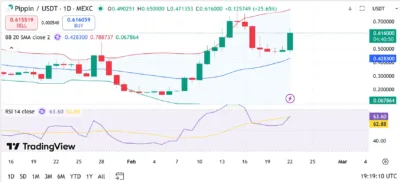
PIPPIN has surged sharply on the daily timeframe, printing a powerful bullish candle with over 25% gains. RSI is holding above 60, signaling strengthening momentum
Share
Coinstats2026/02/23 04:29
Will Cardano Reach $10 by 2030? Analysts Break Down ADA’s Growth Cycles

Will Cardano Reach $10 by 2030? Analysts Break Down ADA’s Growth Cycles

The post Will Cardano Reach $10 by 2030? Analysts Break Down ADA’s Growth Cycles appeared first on Coinpedia Fintech News Cardano (ADA) is trading at $0.9024 with a market cap of $32.91 billion. Experts say ADA has the potential to climb much higher, with some placing long-term targets as high as $10. The token continues to benefit from stronger visibility, rising liquidity, and increasing inflows from both institutional and retail markets. Can Cardano Hit $10 …
Share
CoinPedia2025/09/18 17:19
Crypto whale loses $6M to sneaky phishing scheme targeting staked Ethereum

Crypto whale loses $6M to sneaky phishing scheme targeting staked Ethereum

The post Crypto whale loses $6M to sneaky phishing scheme targeting staked Ethereum appeared on BitcoinEthereumNews.com. A crypto whale lost more than $6 million in staked Ethereum (stETH) and Aave-wrapped Bitcoin (aEthWBTC) after approving malicious signatures in a phishing scheme on Sept. 18, according to blockchain security firm Scam Sniffer. According to the firm, the attackers disguised their move as a routine wallet confirmation through “Permit” signatures, which tricked the victim into authorizing fund transfers without triggering obvious red flags. Yu Xian, founder of blockchain security company SlowMist, noted that the victim did not recognize the danger because the transaction required no gas fees. He wrote: “From the victim’s perspective, he just clicked a few times to confirm the wallet’s pop-up signature requests, didn’t spend a single penny of gas, and $6.28 million was gone.” How Permit exploits work Permit approvals were originally designed to simplify token transfers. Instead of submitting an on-chain approval and paying fees, a user can sign an off-chain message authorizing a spender. That efficiency, however, has created a new attack surface for malicious players. Once a user signs such a permit, attackers can combine two functions—Permit and TransferFrom—to drain assets directly. Because the authorization takes place off-chain, wallet dashboards show no unusual activity until the funds move. As a result, the assets are gone when the approval executes on-chain, and tokens are redirected to the attacker’s wallet. This loophole has made permit exploits increasingly attractive for malicious actors, who can siphon millions without needing complex hacks or high-cost gas wars. Phishing losses The latest theft highlights a wider trend of escalating phishing campaigns. Scam Sniffer reported that in August alone, attackers stole $12.17 million from more than 15,200 victims. That figure represented a 72% jump in losses compared with July. According to the firm, the most significant share of August’s damages came from three large accounts that accounted for nearly half…
Share
BitcoinEthereumNews2025/09/19 02:31