

2026-04-04 Saturday
Crypto News in Nigeria
Explore the hottest crypto news and market updates tailored for Nigeria

Chainlink (LINK) Price Prediction 2026, 2027-2030
In this Chainlink (LINK) price prediction 2026, 2027-2030, we will analyze the price patterns of LINK by using accurate trader-friendly technical analysis indicators
Share
Author: Thenewscrypto2026/02/03 02:04

Pump.fun (PUMP) Price Prediction 2026, 2027-2030
In this Pump.fun (PUMP) price prediction for 2026, 2027-2030, we will analyze the price patterns of PUMP by using accurate trader-friendly technical analysis indicators
Share
Author: Thenewscrypto2026/01/13 14:54

North Korean Crypto Hacks Expose Security Flaws
North Korean crypto hacking activities
Share
Author: coinlineup2025/12/04 12:45

EtherZilla’s Masterstroke: Acquires $10M Stake in AI Platform Karus for Explosive Growth
BitcoinWorld EtherZilla’s Masterstroke: Acquires $10M Stake in AI Platform Karus for Explosive Growth In a move that signals a bold fusion of blockchain and artificial intelligence, Nasdaq-listed EtherZilla (ETHZilla) has made a decisive play. The company, known for its Ethereum-centric investments, has just announced a major strategic acquisition. EtherZilla acquires a $10 million stake in the artificial intelligence platform Karus, securing a 20% ownership position. This deal isn’t […] This post EtherZilla’s Masterstroke: Acquires $10M Stake in AI Platform Karus for Explosive Growth first appeared on BitcoinWorld.
Share
Author: bitcoinworld2025/12/04 12:45

Russia Advocates Bitcoin Mining in National Economic Strategy
The post Russia Advocates Bitcoin Mining in National Economic Strategy appeared on BitcoinEthereumNews.com. Key Points: Russia includes Bitcoin mining in economic strategy with $1.3 billion investments. Oreshkin emphasizes mining as an “undervalued export project.” Foreign trade settlements influence Russia’s currency exchange market. Maxim Oreshkin, Russia’s presidential economic advisor, called for Bitcoin mining to be integrated into the nation’s economic framework, emphasizing its significant impact at the ‘Calling!’ investment forum in Moscow. This inclusion could address foreign trade issues under sanctions, potentially stabilizing the ruble and fostering a regulated Bitcoin market as Russia advances regulatory frameworks by 2026. Bitcoin Mining: A $1.3 Billion Commitment to Russia’s Economy Maxim Oreshkin has articulated the significance of Bitcoin mining within Russia’s economic framework at the “Calling!” investment forum in Moscow. He urged for its recognition as an integral part of the national balance, highlighting an investment of $1.3 billion in mining infrastructure by Russian companies. As Oreshkin himself stated: The government’s gradual inclusion of cryptocurrency trading aims to mitigate impacts from international sanctions. Import and export transactions using cryptocurrencies are becoming more prevalent, affecting Russia’s foreign exchange market. This suggests a targeted strategy to leverage untapped resources for economic resilience. Market reactions have been mixed, with particular interest from industries exploring crypto’s financial advantages amid sanctions. Oreshkin’s position as a key advisor lends weight to these strategic shifts. With reports of softened stances from the Bank of Russia, institutional involvement in the crypto sector seems imminent. Russia’s Crypto Strategy Amidst Sanctions and Market Volatility Did you know? In the past year, Russia officially recognized Bitcoin mining as a key sector despite sanctions. This move emphasizes the value of mining, akin to traditional resource exports. Bitcoin, trading at $93,416.86 with a market cap of $1.86 trillion (CoinMarketCap), has seen price changes over 30 days (12.64%) and 90 days (16.05%). Notably, its 24-hour trading volume reached $73.69 billion, reflecting…
Share
Author: BitcoinEthereumNews2025/12/04 12:40

Game-Changer: Crypto Derivatives Platform Ostium Secures $20M in Major Funding Round
BitcoinWorld Game-Changer: Crypto Derivatives Platform Ostium Secures $20M in Major Funding Round The institutional crypto landscape just got a significant boost. Ostium, a promising crypto derivatives platform founded by Harvard University alumni, has successfully closed a massive $20 million Series A funding round. This major capital injection signals strong investor confidence in the future of sophisticated digital asset trading tools. But what does this mean for the […] This post Game-Changer: Crypto Derivatives Platform Ostium Secures $20M in Major Funding Round first appeared on BitcoinWorld.
Share
Author: bitcoinworld2025/12/04 12:40

Tron sees $931.7M stablecoin inflow in last 24 hours
The post Tron sees $931.7M stablecoin inflow in last 24 hours appeared on BitcoinEthereumNews.com. Key Takeaways Tron recorded $931.7 million in stablecoin inflows in the past 24 hours. This inflow highlights Tron’s dominance as an infrastructure for stablecoin transactions, especially for USDT and USDC. Tron recorded $931.7 million in stablecoin inflows over the past 24 hours, marking another remarkable day for the blockchain platform that has become a dominant network for stablecoin activities, according to data from Artemis. The massive inflow reinforces Tron’s position as a key infrastructure for digital dollar transactions, particularly for assets like USDT and USDC. The network has consistently led in stablecoin supply changes in recent months. Tether has been minting new USDT directly on Tron to support the network’s growing utility in global web3 finance. Recent activity has helped establish Tron as a foundational layer for stablecoin circulation, with the platform regularly surpassing other networks in daily stablecoin movement. Source: https://cryptobriefing.com/tron-stablecoin-inflow-june-2024/
Share
Author: BitcoinEthereumNews2025/12/04 12:37

Dogecoin’s Historical Cycles Hint at Potential Accumulation and Upside
The post Dogecoin’s Historical Cycles Hint at Potential Accumulation and Upside appeared on BitcoinEthereumNews.com. Dogecoin historical cycles feature accumulation phases followed by parabolic rallies and corrections, with the current RSI near 30 signaling oversold conditions and potential upward momentum. Analysts observe patterns from past surges exceeding 21,000% to inform future trends. Dogecoin’s market shows repeated accumulation periods, mirroring cycles since 2014 that led to significant gains. Recent RSI levels around 30 indicate oversold territory, often preceding price stabilization. Daily trading volume exceeds $1 billion, supported by a robust community, highlighting sustained market interest. Explore Dogecoin historical cycles and RSI signals for insights into potential price movements. Discover accumulation patterns and community-driven trends that shape its future in 2025. Stay informed on crypto dynamics today. What Are Dogecoin’s Historical Price Cycles? Dogecoin historical cycles consist of three primary phases: accumulation, parabolic rallies, and corrective downtrends, observed since its inception in 2014. Each cycle begins with extended consolidation, where prices stabilize after previous peaks, building investor interest gradually. For instance, the first cycle saw a remarkable 5,800% increase, setting the foundation for Dogecoin’s volatile yet resilient market behavior. These patterns provide traders with frameworks to predict breakouts, though external factors like regulatory changes can influence outcomes. How Do Technical Indicators Like RSI Affect Dogecoin’s Short-Term Movements? The Relative Strength Index (RSI) for Dogecoin currently lingers around the low 30s, entering oversold territory that historically signals exhaustion in selling pressure. This level often leads to temporary stabilizations, as seen in prior instances where RSI below 30 preceded minor relief rallies. Supporting data from exchange volumes shows a recent intraday drop from $0.15 to $0.137–$0.138, accompanied by 1.56 billion tokens traded—six times the average daily volume—indicating possible algorithmic activity rather than retail panic. Experts from platforms like Bitcoinsensus emphasize that such RSI readings, combined with resistance at $0.1383, suggest weakening downward momentum but caution against immediate reversals without…
Share
Author: BitcoinEthereumNews2025/12/04 12:34

BlackRock’s Fink and Coinbase’s Armstrong Signal a New Era as Global Banks Pilot Crypto
Coinbase CEO Brian Armstrong says some of the world’s largest banks are testing digital asset projects through Coinbase, signaling a sharp institutional turn. The post BlackRock’s Fink and Coinbase’s Armstrong Signal a New Era as Global Banks Pilot Crypto appeared first on Crypto News Australia.
Share
Author: Cryptonews AU2025/12/04 12:33

Upbit Crypto Deposit And Withdrawal Services Resume In Phases
The post Upbit Crypto Deposit And Withdrawal Services Resume In Phases appeared on BitcoinEthereumNews.com. Essential Update: Upbit Crypto Deposit And Withdrawal Services Resume In Phases Skip to content Home Crypto News Essential Update: Upbit Crypto Deposit and Withdrawal Services Resume in Phases Source: https://bitcoinworld.co.in/upbit-resumes-crypto-deposit-withdrawal-services/
Share
Author: BitcoinEthereumNews2025/12/04 12:31

Taiwan Targets Mid-2026 Launch for Domestic Stablecoin Under New Regulatory Framework
Financial regulator says New Taiwan dollar-pegged token could debut in June or July pending legislative approval
Share
Author: Blockhead2025/12/04 12:30

Injective (INJ) Price Forecast: Is $8 the Next Key Resistance in December?
Injective (INJ) is one of the standout tokens focused on Web3 and interoperability as it approaches its key resistance zone, which has been gaining traction. With improving market sentiment and rising trading activity, traders now await whether INJ can push toward the $8 level in December, potentially setting the stage for a stronger bullish continuation. […]
Share
Author: Tronweekly2025/12/04 12:30

Top 5 List of Best Dedicated Server Providers in Hong Kong
Hong Kong is a strategic hub for digital business in Asia, yet the region’s unique connectivity challenges, regulatory landscape, and proximity to China mean that not all dedicated server hosting is created equal. Businesses here face real barriers: unpredictable latency to mainland China, bandwidth bottlenecks during peak hours, and the ever-present risk of DDoS attacks […] The post Top 5 List of Best Dedicated Server Providers in Hong Kong appeared first on TechBullion.
Share
Author: Techbullion2025/12/04 12:29
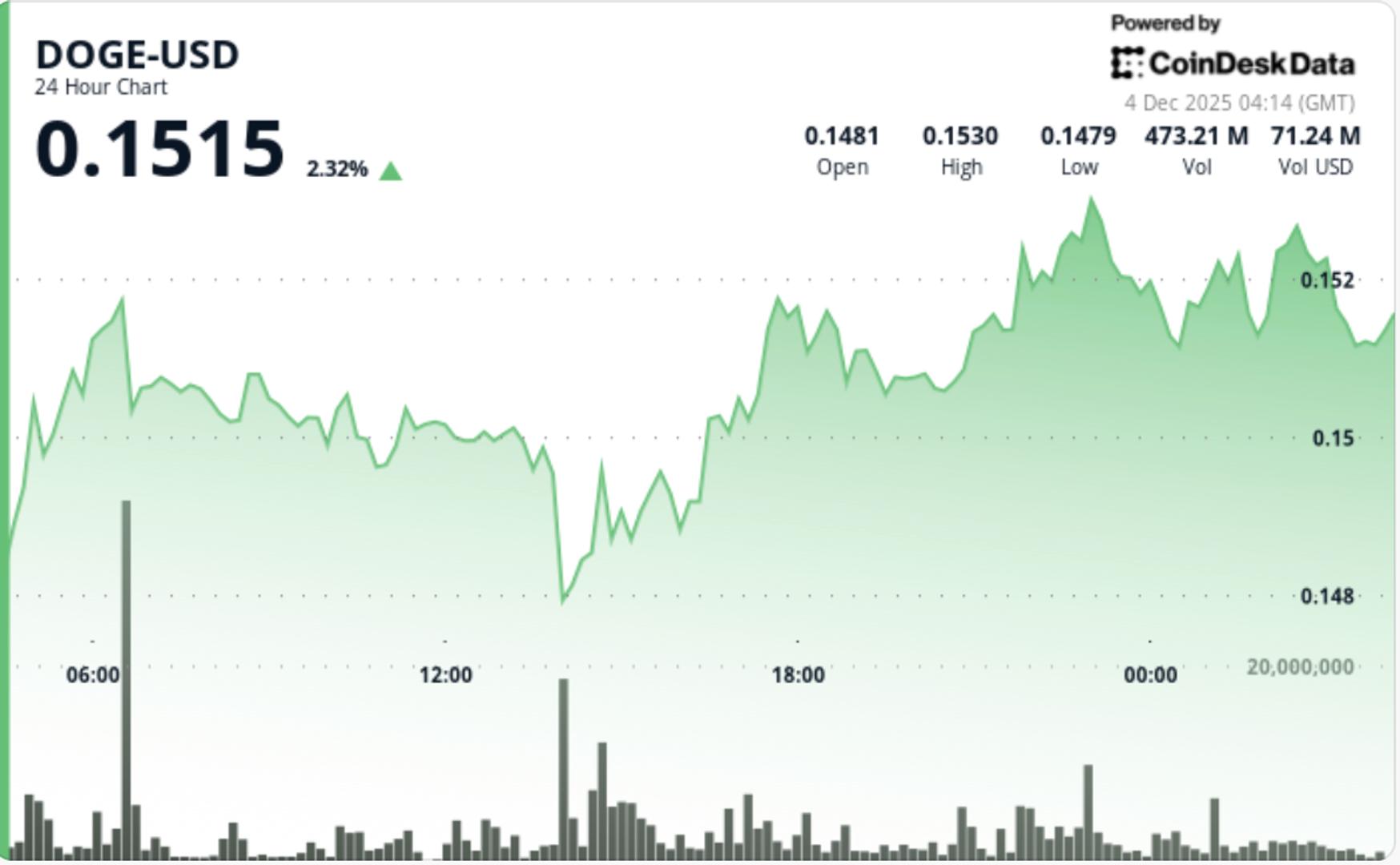
Dogecoin Reclaims Bullish Structure as Whale Activity Hits 2-Month Low
Markets
Share
Share this article
Copy linkX (Twitter)LinkedInFacebookEmail
Share
Author: Coindesk2025/12/04 12:26

Newly developed Tropical Depression Wilma, shear line to dump rain
Tropical Depression Wilma is the Philippines' 23rd tropical cyclone for 2025, and the first for December
Share
Author: Rappler2025/12/04 12:25

Eni signs 10-year LNG supply deal with Turkey’s Botas
Italian energy company Eni has signed a long-term liquefied natural gas (LNG) sale agreement with Turkey’s state-owned pipeline operator Petroleum Pipeline Corporation (Botas). Eni will supply 0.4 million tonnes per annum (mtpa) of LNG to Turkey for 10 years, starting in 2028, it said in a statement. Ankara is a major importer of Russian natural […]
Share
Author: Agbi2025/12/04 12:24

Pound Sterling softens below 1.3350 on renewed US Dollar demand
The post Pound Sterling softens below 1.3350 on renewed US Dollar demand appeared on BitcoinEthereumNews.com. The GBP/USD pair loses ground to around 1.3330 during the Asian trading hours on Thursday. The major pair retreats from nearly a two-month high amid renewed US Dollar (USD) demand. However, the rising bets of a Federal Reserve (Fed) rate cut next week might cap its downside. Traders will take more cues from the US weekly Initial Jobless Claims report later on Thursday. Weaker US economic data this week, including Manufacturing PMI and ADP Employment Change, have cemented the case for a rate reduction from the US central bank at the December meeting. This, in turn, could weigh on the Greenback and create a tailwind for the major pair. Traders are currently pricing in an 89% probability of a quarter-point rate cut next week, according to the CME FedWatch tool, with an expected 89 basis points (bps) of easing by the end of next year. US President Donald Trump said on Tuesday he plans to announce his choice to succeed Jerome Powell as head of the Fed early next year. Reuters reported that White House economic adviser Kevin Hassett has emerged as the frontrunner to be the next Fed chair. Hassett is seen as a close ally who supports Trump’s call for quicker and deeper interest rate reduction to stimulate the economy, which might undermine the USD. On the other hand, the UK Autumn November budget has reinforced bets for a December rate cut from the Bank of England (BoE), which could weigh on the Cable. UK Prime Minister Keir Starmer emphasized the need to bring inflation and interest rates down to boost business investment and economic growth. A majority of analysts expect the UK central bank to cut interest rates to 3.75% in December, with markets pricing in a 90% chance. Elesewhere, BoE policymaker Catherine Mann said on Wednesday that US Dollar…
Share
Author: BitcoinEthereumNews2025/12/04 12:23

Putin's economic advisors have called for the inclusion of cryptocurrencies in Russia's national trade books.
PANews reported on December 4th that, according to Vedomosti and RBC, Maxim Oreshkin, economic advisor to the Russian president, stated that cryptocurrencies should be included in the national balance of payments, calling Bitcoin mining an "undervalued export project." He pointed out that Russian companies have already invested over $1.3 billion in mining infrastructure and are using cryptocurrencies for import and export settlements, having a real impact on the foreign exchange market. The Russian government is gradually pushing for the inclusion of crypto trade within the regulatory framework to address foreign trade needs under sanctions.
Share
Author: PANews2025/12/04 12:23
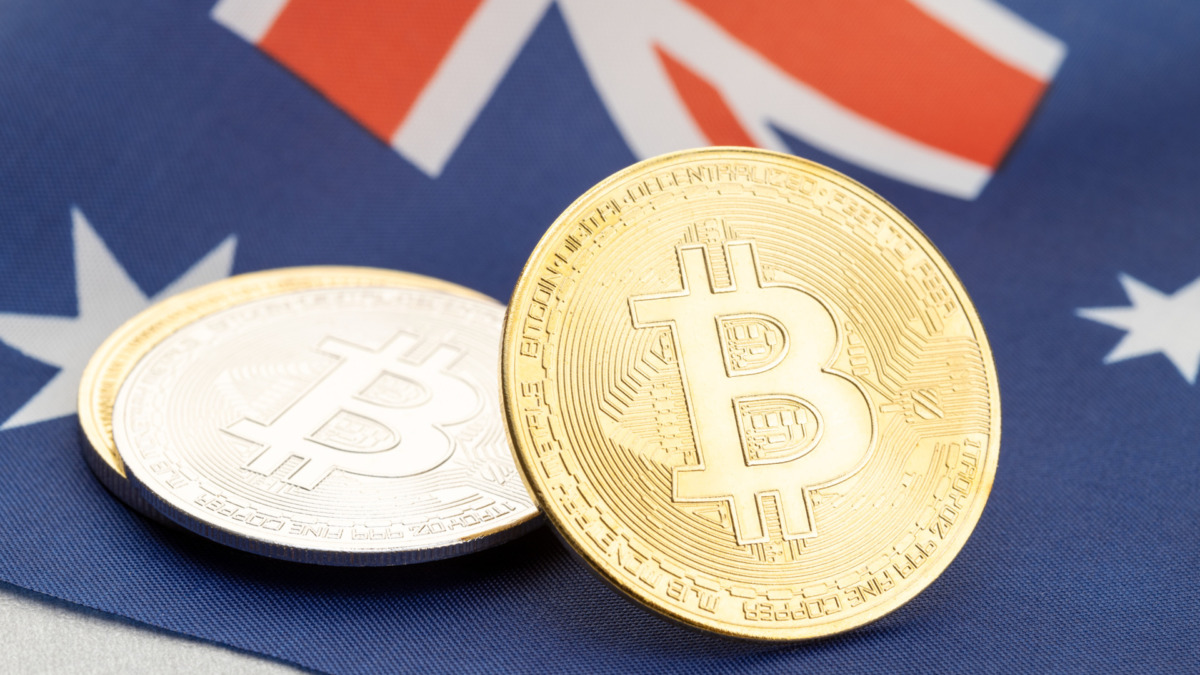
Aussie Bitcoin Lobby Slams ABC Over ‘One-Sided’ Hit Piece, Citing Policy Breaches
Australia's ABIB formally complained to the ABC over a column claiming Bitcoin has "no useful purpose." ABIB demands corrections, arguing the piece uses outdated tropes. The post Aussie Bitcoin Lobby Slams ABC Over ‘One-Sided’ Hit Piece, Citing Policy Breaches appeared first on Crypto News Australia.
Share
Author: Cryptonews AU2025/12/04 12:22
AERO Price Faces Further Declines Amid Bearish Charts, $0.474 Support in Sight
The post AERO Price Faces Further Declines Amid Bearish Charts, $0.474 Support in Sight appeared on BitcoinEthereumNews.com. Aerodrome Finance’s AERO token has experienced a persistent downtrend following its merger with Velodrome Finance under Dromos Labs on November 13. The weekly chart shows a bearish close below $0.717, with key supports at $0.474. Traders should watch for potential selling opportunities on bounces toward $1, as RSI and OBV indicate ongoing selling pressure. Aerodrome Finance AERO merger integrates dominant protocols on Base and Optimism. The merger aims to enhance technical developments, but market confidence remains low amid price declines. Current price analysis reveals bearish momentum, with targets at $0.474 supported by declining OBV since August. Aerodrome Finance AERO faces bearish pressure post-merger with Velodrome. Analyze charts for downtrend signals and key supports at $0.474. Stay informed on crypto trends—explore more insights today. (148 characters) What is the current price trend for Aerodrome Finance AERO? Aerodrome Finance AERO is currently in a bearish downtrend on higher timeframes, with the token closing below $0.717 on the weekly chart, confirming the end of recovery hopes. Short-term targets of $0.82 and $0.74 have been met, and prices have pushed lower, driven by bearish indicators like RSI and OBV. This structure suggests further declines unless a strong reversal occurs above $0.74 with increased volume. How has the Aerodrome Finance merger impacted AERO’s market performance? The merger between Aerodrome Finance and Velodrome Finance, announced under Dromos Labs on November 13, combined leading trading protocols on the Base and Optimism networks, aiming to streamline operations and foster innovation. However, despite the promised roadmap of technical advancements, it has not yet boosted investor sentiment, as evidenced by AERO’s continued price depreciation. According to data from TradingView, the token’s weekly session reflected a bearish push, closing below key support levels. Expert analysts, including those from on-chain metrics platforms, note that while the integration could enhance liquidity in the…
Share
Author: BitcoinEthereumNews2025/12/04 12:22

WTI rises to near $59 as Ukraine attacks Russian energy facilities
The post WTI rises to near $59 as Ukraine attacks Russian energy facilities appeared on BitcoinEthereumNews.com. West Texas Intermediate (WTI) futures on NYMEX trade 0.25% higher to near 59.00 during the Asian trading session on Thursday. The Oil price gains as Ukraine’s attack on the Druzhba oil pipeline, situated in Russia’s central Tambov region that supplies energy products to Hungary and Slovakia, has raised supply concerns at times when Moscow’s major oil companies Rosneft and Lukoil are already facing the burden of sanctions. Though the Oil price trades higher during Asian trading hours, it is still inside Wednesday’s trading range. The Oil price rose on Wednesday as well after peace talks between top envoys of the United States (US) and Russia failed to make a breakthrough. Trump said that special envoy Steve Witkoff and his son-in-law Jared Kushner had a “very good meeting” on Tuesday with Russian President Vladimir Putin. The Kremlin said Putin accepted some US proposals, although the meetings did not yield a breakthrough, CNN reported. Going forward, the major trigger for the Oil price will be the monetary policy announcement by the Federal Reserve (Fed) next week, in which the US central bank is expected to cut interest rates by 25 basis points (bps) to 3.50%-3.75%. According to the CME FedWatch tool, the probability of the Fed cutting interest rates by 25 basis points (bps) to 3.50%-3.75% in the December policy meeting is 89%. This will be the third interest rate cut by the Fed in a row. Lower interest rates by the Fed bode well for the Oil demand outlook. WTI Oil FAQs WTI Oil is a type of Crude Oil sold on international markets. The WTI stands for West Texas Intermediate, one of three major types including Brent and Dubai Crude. WTI is also referred to as “light” and “sweet” because of its relatively low gravity and sulfur content respectively. It…
Share
Author: BitcoinEthereumNews2025/12/04 12:20

BONK.fun adjusts fee distribution to enhance BNKK's strategic buying of BONK.
PANews reported on December 4th that, according to an announcement from BONK.fun, the platform will allocate 51% of its transaction fees to buy BONK using BNKK DAT, effective immediately. This allocation will be transferred from the original Buy/Burn (35%), SBR (4%), and BONKrewards (2%), plus the existing 10%, to support BNKK in building a strategic BONK reserve, with the goal of accumulating 5% of the circulating supply of BONK. The official statement indicated that this adjustment will not affect net buying pressure, nor will it impact community marketing and operational budgets.
Share
Author: PANews2025/12/04 12:19

Solana Eyes 25% Rally After ETF Inflows Soar Past $650M
Solana’s ETF inflows exceed $651M, sparking a bullish outlook as analysts predict a potential 25% price rally. Solana price has seen a notable increase recently, driven by a surge in ETF inflows. The cryptocurrency’s institutional demand has gained strength, with Solana ETF inflows surpassing $650 million. This surge has sparked expectations that Solana price […] The post Solana Eyes 25% Rally After ETF Inflows Soar Past $650M appeared first on Live Bitcoin News.
Share
Author: LiveBitcoinNews2025/12/04 12:15

Hunting 2025’s Best 1000X Altcoins? Between PEPE, BONK, and Apeing, Only One Is Grabbing the Spotlight for the Explosive Upside
Are traders missing the boat while they stare at charts, or is the next big meme coin quietly preparing to explode? The memecoin arena is buzzing as Apeing, PEPE, and BONK capture headlines, and “crypto news today” reflects the frenzy. With Bitcoin facing scrutiny over money laundering, risk-tolerant traders are flocking to high-volatility altcoins. PEPE […] The post Hunting 2025’s Best 1000X Altcoins? Between PEPE, BONK, and Apeing, Only One Is Grabbing the Spotlight for the Explosive Upside appeared first on Live Bitcoin News.
Share
Author: LiveBitcoinNews2025/12/04 12:15

Bitcoin 2026 Outlook: Ripple CEO Brad Garlinghouse Predicts $180,000
The post Bitcoin 2026 Outlook: Ripple CEO Brad Garlinghouse Predicts $180,000 appeared on BitcoinEthereumNews.com. The post Bitcoin 2026 Outlook: Ripple CEO Brad Garlinghouse Predicts $180,000 appeared first on Coinpedia Fintech News Ripple CEO Brad Garlinghouse has made one of the biggest Bitcoin predictions of the year. Speaking at Binance Blockchain Week during a panel with Solana Foundation President Lily Liu and Binance CEO Richard Teng, Garlinghouse said he expects Bitcoin to reach $180,000 by December 31, 2026. The panel brought together three major industry leaders to discuss what the crypto landscape may look like in 2026. With Bitcoin swinging sharply, billions in liquidations, and mixed ETF activity, their views drew strong attention. What the Leaders Said on Stage When asked where Bitcoin will be by the end of next year, the answers varied. Richard Teng kept his response simple. He said he could not give a number and focuses on long-term growth, not short-term volatility. Lily Liu gave a clearer view and said she expects Bitcoin to be above $100,000. Brad Garlinghouse went even further. He predicted $180,000 by the end of 2026, making the most specific and ambitious call of the panel. The Shock Crash That Hit Crypto This Month These predictions came just as Bitcoin faced one of its worst moves of the year. On December 1, Bitcoin fell $5,000 in just 3 hours. More than $200 billion was wiped from the market, and close to $700 million in leveraged positions were liquidated. There was no crypto-related catalyst. Instead, the trigger came from traditional markets. The Yen Carry Trade Unwinds Japan’s government bond yields surged to their highest levels since before 2008. This sudden spike began unwinding the massive Yen Carry Trade, a decades-long strategy where investors borrowed cheap Japanese money to buy assets like tech stocks, US Treasuries, and Bitcoin. As yields rose, the yen strengthened and leveraged positions became unprofitable.…
Share
Author: BitcoinEthereumNews2025/12/04 12:12

Unlock Rewards: Firelight’s New XRP Staking Protocol Launches on Flare Network
BitcoinWorld Unlock Rewards: Firelight’s New XRP Staking Protocol Launches on Flare Network The DeFi landscape just got more exciting for XRP holders. Firelight has officially launched its XRP staking protocol on the Flare network, creating new opportunities to earn rewards with your digital assets. This move bridges the world of XRP with Flare’s smart contract capabilities, potentially unlocking significant value for the community. What is Firelight’s New […] This post Unlock Rewards: Firelight’s New XRP Staking Protocol Launches on Flare Network first appeared on BitcoinWorld.
Share
Author: bitcoinworld2025/12/04 12:10

CNN Partners With Prediction Market Kalshi to Bring Real-Time Probabilities Into Its Reporting
CNN partnered with Kalshi to integrate real-time prediction market odds into its news coverage via live tickers and analysis. The post CNN Partners With Prediction Market Kalshi to Bring Real-Time Probabilities Into Its Reporting appeared first on Crypto News Australia.
Share
Author: Cryptonews AU2025/12/04 12:09

$41M Pours Into First LINK ETF: Will Chainlink Finally Break Its ATH?
The post $41M Pours Into First LINK ETF: Will Chainlink Finally Break Its ATH? appeared on BitcoinEthereumNews.com. The Grayscale Chainlink Trust ETF ($GLNK) launched on Tuesday, attracting approximately $41.5 million in its first day and marking a milestone for altcoin ETFs in the U.S. Institutional demand for cryptocurrency exposure is expanding beyond Bitcoin and Ethereum. As a result, many investors are now watching to see if LINK can reach new all-time highs. Sponsored Sponsored ETF Launch Reflects Rising Institutional Interest The Grayscale Chainlink Trust ETF, trading under the ticker $GLNK on NYSE Arca, is the first spot Chainlink ETF for US investors. According to SoSoValue data, as of Dec 3, it saw $40.90 million in net inflows on its debut, with total net assets reaching $67.55 million and $8.45 million in volume. The ETF closed up 7.74% at $12.81 per share. Grayscale converted its existing Chainlink Trust, first launched in February 2021, into this ETF. This move aligns with the company’s broader strategy and provides institutions with direct exposure to LINK through traditional accounts. At the time of reporting, LINK, Chainlink’s native token, was priced at $14.66. Grayscale CEO Peter Mintzberg noted the launch was “a clear signal of broader market demand for Chainlink exposure,” pointing to increased institutional interest in oracle network tokens. With its strong first day, $GLNK has become one of the top-performing new crypto ETFs, launching amid rising market activity and regulatory changes. LINK Technical Breakout and Whale Activity Technical analysts have seen a critical pattern shift in LINK’s price structure as the ETF debuted. The token broke out of a month-long downward channel. Many observers now believe this could help drive LINK past 2021 highs, as institutional flows through $GLNK may be a catalyst for new records. Sponsored Sponsored On-chain data highlights major whale accumulation before and after the ETF launch. Lookonchain reported that 39 new wallets withdrew 9.94 million LINK, worth…
Share
Author: BitcoinEthereumNews2025/12/04 12:07

Crypto is now legally ‘property’ in the UK – What it means for you
The post Crypto is now legally ‘property’ in the UK – What it means for you appeared on BitcoinEthereumNews.com. The UK has finally done it — digital assets now legally count as property. It sounds technical, almost boring, until you realize what it brings. Overnight, crypto in Britain moves from “interesting experiment” to something you can actually defend in a court of law. And while early reactions look optimistic, there’s more to the story than you think. A new legal foundation for owning crypto in the UK With the Property (Digital Assets etc.) Act now in force, crypto-tokens, stablecoins, and even NFTs can be treated as property in the same way as other personal assets. Until now, courts recognized this on a case-by-case basis, which meant ownership depended heavily on interpretation. Parliament has now made it explicit. This clarity matters. Source: X It means digital assets can be owned, inherited, or recovered if stolen, and handled properly during insolvency. Everyday users get the kind of protection they expect with traditional assets, while institutions get the certainty they need to build serious products. AMBCrypto previously reported how other major jurisdictions are making similar selective shifts. Case in point, Russia is opening tightly controlled channels for crypto investments even while keeping everyday use restricted. Countries aren’t embracing crypto outright, but they are formalizing the rules so they can manage it on their own terms. Initial reactions are positive. One user on X posted, “This is a much bigger milestone than people realize. Once a major economy legally classifies crypto as property, the entire institutional landscape changes.” Another said, “Huge move — legal recognition is the foundation every industry needs.” There’s more… With MiCA about to reshape how assets move across borders, the UK needed to lock in its own framework or risk losing competitiveness to the EU. For large funds, this clarity ends an 18-month legal freeze where they couldn’t scale…
Share
Author: BitcoinEthereumNews2025/12/04 12:06

Axis Secures $5M Funding: A Game-Changer for On-Chain Yield?
BitcoinWorld Axis Secures $5M Funding: A Game-Changer for On-Chain Yield? In a significant boost for the decentralized finance (DeFi) sector, the quantitative yield protocol Axis has successfully closed a major funding round. The news that Axis secures $5M funding from a consortium of heavyweight investors signals strong institutional confidence in the future of on-chain yield generation. This capital injection is poised to accelerate the launch […] This post Axis Secures $5M Funding: A Game-Changer for On-Chain Yield? first appeared on BitcoinWorld.
Share
Author: bitcoinworld2025/12/04 12:05
Malaysia Intensifies Crackdown on Illegal Bitcoin Mining with Drones and Taskforce
The post Malaysia Intensifies Crackdown on Illegal Bitcoin Mining with Drones and Taskforce appeared on BitcoinEthereumNews.com. Illegal Bitcoin mining in Malaysia involves unauthorized operations that steal electricity, causing over $1.1 billion in damages to the national utility. Authorities now use drones and sensors to detect heat signatures and unusual power usage from hidden rigs in abandoned buildings, with a new taskforce formed to combat this growing issue. Malaysian officials deploy drones to scan rooftops for excessive heat from mining rigs in vacant properties. Ground teams use handheld devices to identify spikes in electricity consumption linked to illegal setups. Over five years, 14,000 sites have been raided, with damages exceeding $1.1 billion according to the Energy Ministry. Discover how Malaysia is cracking down on illegal Bitcoin mining operations stealing billions in power. Learn about drone surveillance and the new taskforce—stay informed on crypto regulations today. What is the Crackdown on Illegal Bitcoin Mining in Malaysia? Illegal Bitcoin mining in Malaysia refers to unauthorized cryptocurrency extraction activities that siphon electricity from the grid without payment, leading to significant financial losses for the state utility. Authorities have intensified efforts using advanced technology like drones to detect heat emissions from rigs hidden in abandoned structures. This crackdown addresses a surge in operations fueled by Bitcoin’s volatile price, with over 3,000 cases reported in 2025 alone. How Are Drones and Sensors Being Used to Combat Illegal Bitcoin Mining in Malaysia? Drones equipped with thermal imaging sweep urban and rural areas, targeting rooftops of deserted homes, empty shops, and unused industrial sites for abnormal heat patterns indicative of nonstop mining rigs. These devices validate blockchain transactions by performing trillions of computations per second, consuming vast electricity—often masked by deceptive tactics like fake bird sounds from speakers to drown out fan noise. On the ground, police carry portable sensors to pinpoint irregular power draws, enabling swift raids. Reports from Bloomberg and the Financial…
Share
Author: BitcoinEthereumNews2025/12/04 12:04
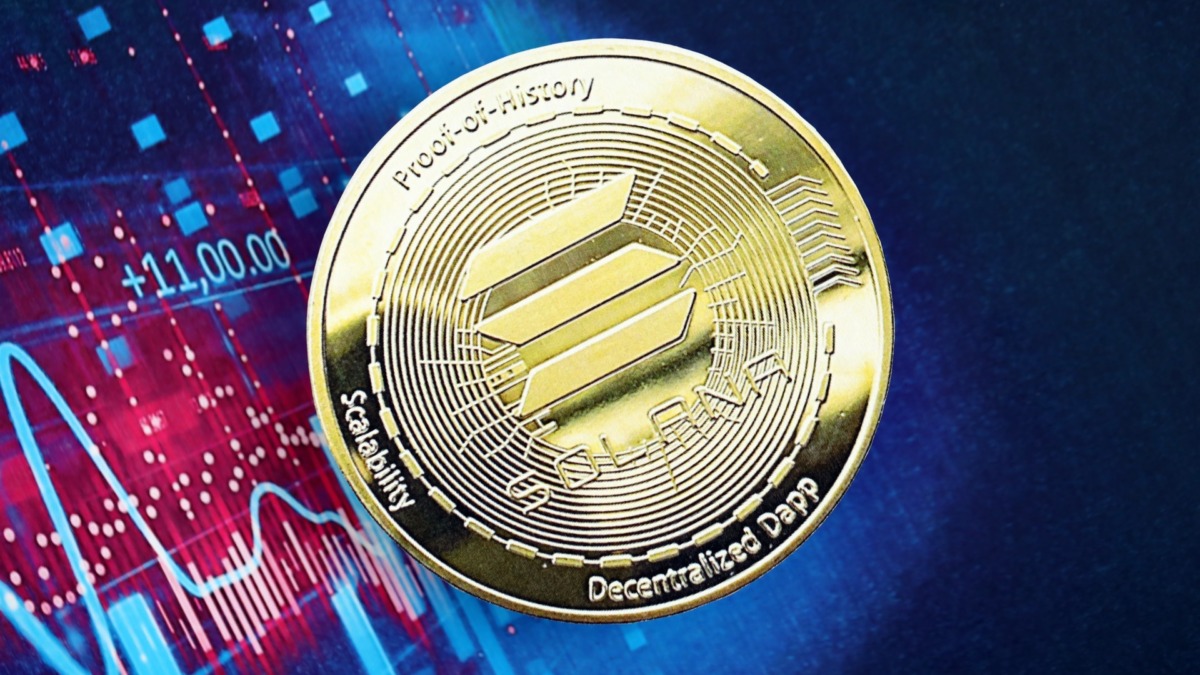
Solana Mobile to Launch SKR Token in January 2026, Powering Its Expanding Device Ecosystem
Solana Mobile will launch its native SKR token in Jan 2026. It will govern the platform with initial 10% inflation designed to incentivise early adoption. The post Solana Mobile to Launch SKR Token in January 2026, Powering Its Expanding Device Ecosystem appeared first on Crypto News Australia.
Share
Author: Cryptonews AU2025/12/04 12:02

UAE beats US on crypto rules, says CEO of Trump-backed site
The US is still playing catch-up with the UAE on crypto regulation, according to the CEO of Trump family-backed World Liberty Financial (WLF), even as Washington races to reposition itself as more crypto-friendly. US president Donald Trump has reversed his country’s previously hostile stance, set under Joe Biden, and ordered regulators to build a unified […]
Share
Author: Agbi2025/12/04 12:01

Marcos: We have a plan vs ‘abuse and entitlement’ in government
President Ferdinand R. Marcos Jr. launches on November 24 the Department of Public Works and Highways (DPWH) Transparency Portal to provide the public access to comprehensive information on government infrastructure projects nationwide.
Share
Author: Rappler2025/12/04 12:01

XRP Update: Market Analyst Highlights Major Support Zones at $2 and $1.20
XRP is again in the spotlight, as market analyst Ali (@ali_charts) has pinpointed two pivotal support areas, which could define the asset’s price action going into the next market cycle. Though volatility continues to be the name of the game for most major altcoins, these levels provide some clarity for traders on the extent of […]
Share
Author: Tronweekly2025/12/04 12:00

$1.57bn share sale hands Vodafone majority control of Safaricom
Vodafone Kenya's investors are set to take control of Safaricom after a proposed KES 204.3 billion ($1.57 billion) share transaction that lifts their combined stake to 55%.
Share
Author: Techcabal2025/12/04 11:59

Connecticut orders Kalshi, Robinhood to halt sports betting
The post Connecticut orders Kalshi, Robinhood to halt sports betting appeared on BitcoinEthereumNews.com. Connecticut has taken action against several major trading platforms after finding that their sports-related markets crossed a legal line. Summary Connecticut ordered Kalshi, Robinhood, and Crypto.com to stop offering unlicensed sports event contracts. Regulators say the platforms lack age checks, security standards, and consumer protections required in the state. Kalshi challenged the order in federal court, while Robinhood cited CFTC oversight and Crypto.com has yet to respond. Connecticut moved to block several fast-growing prediction market platforms from offering sports-related contracts in the state, setting up the latest clash over where trading ends and gambling begins. The action was announced on Dec. 3, 2025, in a cease-and-desist order released by the Connecticut Department of Consumer Protection. State says platforms acted outside gaming rules The department said Kalshi, Robinhood Derivatives, and Crypto.com have been offering “sports event contracts” that function like unlicensed sports wagers. According to the order, only DraftKings, FanDuel, and Fanatics are permitted to offer sports betting in Connecticut, and all three operate under rules designed to protect customers, verify age, and prevent insider activity. In its announcement, the agency said the three platforms advertised their services as legal even though state law takes a different view. Officials warned that these markets expose users to financial and personal-data risks because they are not examined by regulators and do not follow the technical standards required of licensed operators. The order also notes that some wagers involve events where the outcome may already be known by insiders, which Connecticut prohibits. Regulators also raised concerns about wagers offered to people under 21 and to those on the state’s Voluntary Self-Exclusion List. All three companies were instructed to stop offering sports-linked contracts to residents and to allow customers to withdraw funds without delay. Continued activity could lead to penalties or criminal charges under the…
Share
Author: BitcoinEthereumNews2025/12/04 11:58

Coinbase Explains Why Bitcoin Price Dumps With Whale Selling Pressure
The post Coinbase Explains Why Bitcoin Price Dumps With Whale Selling Pressure appeared on BitcoinEthereumNews.com. Bitcoin’s latest drop stems from structural strains, Coinbase Institutional explained, as weakening trend signals, thinning liquidity, whale selling and ETF outflows pressured the market despite normally supportive easing monetary conditions. Market Volatility Rises as Bitcoin Breaks Support With Liquidity Compression Coinbase Institutional, a division of crypto exchange Coinbase (Nasdaq: COIN), explained on social media platform […] Source: https://news.bitcoin.com/coinbase-explains-why-bitcoin-price-dumps-with-whale-selling-pressure/
Share
Author: BitcoinEthereumNews2025/12/04 11:57

Bitcoin ETF Shock: US Spot Funds Snap 5-Day Inflow Streak with $14.9M Net Outflow
BitcoinWorld Bitcoin ETF Shock: US Spot Funds Snap 5-Day Inflow Streak with $14.9M Net Outflow The US spot Bitcoin ETF market just delivered a surprising twist. After five consecutive days of positive momentum, these popular investment vehicles recorded net outflows of $14.9 million on December 3rd. This sudden shift raises important questions for investors tracking the pulse of institutional cryptocurrency adoption. What does this reversal mean for the broader Bitcoin […] This post Bitcoin ETF Shock: US Spot Funds Snap 5-Day Inflow Streak with $14.9M Net Outflow first appeared on BitcoinWorld.
Share
Author: bitcoinworld2025/12/04 11:55

UnionBank Adopts AWS Generative AI for Data Analytics
Union Bank of the Philippines (UnionBank) has integrated Amazon Web Services (AWS) to enhance its data analytics capabilities. The bank has implemented Amazon Quick Suite to allow business users to access and analyse data using natural language queries. The initiative aims to address operational bottlenecks where business units previously relied heavily on technical data teams to [...] The post UnionBank Adopts AWS Generative AI for Data Analytics appeared first on Fintech News Philippines.
Share
Author: Fintechnews2025/12/04 11:53

Data: ETH total contract open interest increased by 6.59% in the past 24 hours.
PANews reported on December 4th that, according to CoinGlass data, the total open interest of ETH futures contracts increased by 6.59% in the past 24 hours, currently standing at $39 billion. The top three open interest providers are Binance, CME, and Gate, with Binance holding $8.23 billion, CME $6.28 billion, and Gate $3.74 billion.
Share
Author: PANews2025/12/04 11:52

Another Attempt To Block State Laws Fails Amid Bipartisan Resistance
The post Another Attempt To Block State Laws Fails Amid Bipartisan Resistance appeared on BitcoinEthereumNews.com. AI Regulation Showdown: Another Attempt To Block State Laws Fails Amid Bipartisan Resistance Skip to content Home AI News AI Regulation Showdown: Another Attempt to Block State Laws Fails Amid Bipartisan Resistance Source: https://bitcoinworld.co.in/state-ai-regulation-block-fails/
Share
Author: BitcoinEthereumNews2025/12/04 11:49
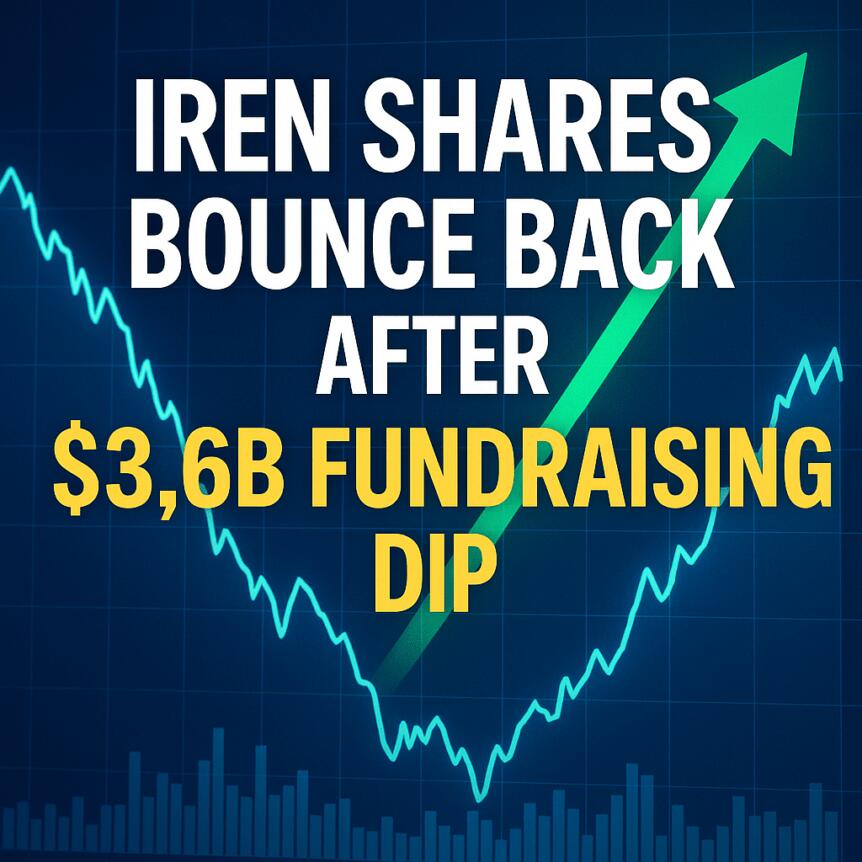
IREN Shares Bounce Back After $3.6B Fundraising Dip
IREN Shares Rebound Amid Capital Raising Plans in AI-Fueled Mining Shift Shares of IREN surged on Wednesday following an announcement that the Bitcoin mining company plans to raise $3.6 billion through a combination of share sales and convertible debt offerings. This strategic move aims to fund the deployment of computer hardware to meet burgeoning artificial [...]
Share
Author: Crypto Breaking News2025/12/04 11:45

Essential Update: Upbit Crypto Deposit and Withdrawal Services Resume in Phases
BitcoinWorld Essential Update: Upbit Crypto Deposit and Withdrawal Services Resume in Phases Attention, crypto traders in South Korea and beyond! Upbit, one of the nation’s leading cryptocurrency exchanges, has announced a significant operational update. The platform is set to resume its crypto deposit and withdrawal services in a carefully managed, phased approach. This move follows a comprehensive system check and marks a crucial step towards restoring full […] This post Essential Update: Upbit Crypto Deposit and Withdrawal Services Resume in Phases first appeared on BitcoinWorld.
Share
Author: bitcoinworld2025/12/04 11:45

Today’s Wordle #1629 Hints And Answer For Thursday, December 4
The post Today’s Wordle #1629 Hints And Answer For Thursday, December 4 appeared on BitcoinEthereumNews.com. How to solve today’s Wordle. SOPA Images/LightRocket via Getty Images It’s Thor’s Day here at your favorite daily Wordle guide, and around here on Thursdays, we find out the answer to the Wordle Wednesday riddle before we solve the Wordle itself. Here was yesterday’s: I’m surrounded by water, but I never drink. I can swim for miles, but I never breath. I have only one eye, but I never blink. What am I? The answer: A submarine. We all live in a yellow submarine, after all. Okay, Wordle time! Looking for Wednesday’s Wordle? Check out our guide right here. Today’s Bonus Wordle Now that we can create our own custom Wordles, I’m including a bonus Wordle with each daily Wordle guide. These can be 4 to 7 letters long. Hopefully this is a fun extra challenge. Click the link below to play the Wordle I hand-crafted for you. Play Puzzles & Games on Forbes Today’s Bonus Custom Wordle. The Wordle: This custom Wordle is 6 letters long. The hint: Represents something, often indirectly or visually. The clue: This Wordle has a double letter. Yesterday’s bonus Wordle answer was: FOUR How To Solve Today’s Wordle How To Play Wordle Wordle game website displayed on a phone screen is seen in this illustration photo taken in Poland on August 6, 2024. (Photo by Jakub Porzycki/NurPhoto via Getty Images) NurPhoto via Getty Images Wordle is a daily word puzzle game where your goal is to guess a hidden five-letter word in six tries or fewer. After each guess, the game gives feedback to help you get closer to the answer: Green: The letter is in the word and in the correct spot. Yellow: The letter is in the word, but in the wrong spot. Gray: The letter is not in the word at…
Share
Author: BitcoinEthereumNews2025/12/04 11:44
MicroStrategy Curbs Bitcoin Buys Amid 2025 Drawdown as Price Aligns with Production Costs
The post MicroStrategy Curbs Bitcoin Buys Amid 2025 Drawdown as Price Aligns with Production Costs appeared on BitcoinEthereumNews.com. MicroStrategy has shifted from aggressive Bitcoin accumulation to a conservative treasury strategy focused on liquidity amid Bitcoin’s significant 2025 drawdown. Monthly purchases dropped from 134,000 BTC in late 2024 to just 9,100 BTC in November 2025, signaling preparation for potential market challenges while maintaining substantial holdings. MicroStrategy’s Bitcoin buys plummeted in 2025, reflecting a cautious approach to treasury management. The firm built a $1.4 billion cash reserve to cover dividends and debt for up to 24 months. Bitcoin’s current price aligns closely with its estimated production cost of around $92,300, indicating fair value according to industry models. MicroStrategy Bitcoin strategy evolves to conservative liquidity focus amid 2025 market volatility. Explore holdings, reserves, and Bitcoin valuation insights for informed investment decisions—stay ahead in crypto trends. What is MicroStrategy’s Bitcoin Strategy in 2025? MicroStrategy’s Bitcoin strategy has transitioned from aggressive purchasing to a more conservative, liquidity-oriented treasury management approach. This shift occurs during Bitcoin’s largest drawdown of 2025, with the company reducing monthly acquisitions significantly to build financial buffers. By prioritizing cash reserves, MicroStrategy aims to navigate market uncertainties while holding a substantial Bitcoin portfolio valued in the tens of billions. How Has MicroStrategy Adjusted Its Bitcoin Purchases? MicroStrategy’s Bitcoin buying activity has declined sharply throughout 2025, as reported by data analytics firm CryptoQuant. The company’s monthly purchases peaked at 134,000 BTC in late 2024 but fell to 9,100 BTC in November 2025, with only 135 BTC acquired so far this month. This reduction underscores a strategic pivot toward preserving liquidity rather than expanding holdings aggressively. On November 17, 2025, MicroStrategy made its largest purchase since July, acquiring 8,178 BTC for about $835.5 million. This brought its total holdings to 649,870 BTC, valued at approximately $58.7 billion at the time. The move highlights a selective approach, balancing opportunity with caution in a…
Share
Author: BitcoinEthereumNews2025/12/04 11:43

$135 Million in Ethereum Sold by BlackRock Amid Crypto Market Resurgence
The post $135 Million in Ethereum Sold by BlackRock Amid Crypto Market Resurgence appeared on BitcoinEthereumNews.com. BlackRock is not holding back on its rapid Ethereum-selling streak, even despite the massive crypto market resurgence witnessed over the last day. Data from on-chain monitoring firm Lookonchain has revealed another huge Ethereum deposit from the firm. Amid the strong crypto price rebounds, BlackRock has again moved a massive 44,140 ETH, worth about $135.36 million, to Coinbase Prime in a suspected sell-off attempt on Wednesday, December 3. The latest Ethereum deposit from BlackRock has happened in four batches of 10,000 ETH and a single 4,140 ETH transfer, bringing the total amount of ETH deposited today to 44,140. You Might Also Like While the move has sparked discussions across the crypto community, it marks the latest in about a month-long streak of crypto sell-offs from the leading asset manager’s Ethereum ETF wallet. While BlackRock has repeatedly pulled large amounts of its holdings to Coinbase since last month, the move comes as no major surprise. However, the crypto ecosystem is increasingly getting curious about the motive behind the rapid sell-off. BlackRock maintains selling streak Although speculators had earlier assumed that BlackRock’s steady Bitcoin and Ethereum dump-offs were a response to the prolonged market downturn seen throughout November, BlackRock has not yet slowed down on the move despite the ongoing crypto market rally. Over the last day, Ethereum has surged by over 7%, finally reclaiming its multi-week high of $3,100 amid the broad crypto market resurgence that has seen leading cryptocurrencies record high price gains in the last 24 hours. Notably, the continued selling streak from BlackRock has further invalidated speculations that it has only embarked on the aggressive selling streak to hedge against the prolonged crypto market rally. Contrary to the assumptions, the leading asset manager has accelerated its Bitcoin and Ethereum deposits even as crypto markets flip bullish again, instead of…
Share
Author: BitcoinEthereumNews2025/12/04 11:42

The merger of Columbus Circle Capital and ProCap BTC has been approved, and the company will be renamed ProCap Financial.
PANews reported on December 4th that, according to GlobeNewswire, shareholders of Columbus Circle Capital Corp I (NASDAQ: BRR) have formally approved the proposed merger with Bitcoin financial services company ProCap BTC. The merger is expected to be completed on December 5th, and the merged company will be renamed ProCap Financial, Inc., and will continue to trade on the Nasdaq Global Market under the ticker symbol "BRR". ProCap BTC has raised over $750 million and aims to build a Bitcoin financial services platform serving 1 billion users.
Share
Author: PANews2025/12/04 11:40

Stunning Surge: Crypto M&A Volume Shatters Records at $12.9 Billion This Year
BitcoinWorld Stunning Surge: Crypto M&A Volume Shatters Records at $12.9 Billion This Year Hold onto your digital wallets. The cryptocurrency landscape is undergoing a seismic shift, not just in prices, but in its very structure. New data reveals a stunning surge in consolidation, with crypto M&A volume hitting an unprecedented $12.9 billion this year. This represents a fivefold increase from 2023, signaling a powerful move towards maturity and […] This post Stunning Surge: Crypto M&A Volume Shatters Records at $12.9 Billion This Year first appeared on BitcoinWorld.
Share
Author: bitcoinworld2025/12/04 11:35
U.S. Regulators May Accelerate GENIUS Act Guidelines for Stablecoins Toward 2026
The post U.S. Regulators May Accelerate GENIUS Act Guidelines for Stablecoins Toward 2026 appeared on BitcoinEthereumNews.com. The GENIUS Act, passed on July 18, 2025, establishes a framework for U.S. stablecoin regulation, requiring 1:1 backing with dollars or equivalents like Treasury bills. Regulators must issue guidelines by July 2026 to ensure compliance, audits for large issuers, and market stability, fostering innovation while protecting consumers. GENIUS Act mandates 1:1 reserves for stablecoins using U.S. dollars or liquid assets to maintain value stability. Annual audits are required for stablecoin issuers exceeding $50 billion in market supply to promote transparency. Implementation guidelines from agencies like the FDIC are targeted for finalization by early 2026, with a one-year rulemaking period post-passage. Discover how the GENIUS Act shapes U.S. stablecoin regulation for safer digital payments. Learn key requirements, timelines, and expert insights on compliance. Stay ahead in crypto with our analysis. What is the GENIUS Act in Stablecoin Regulation? The GENIUS Act is a landmark U.S. legislation passed on July 18, 2025, that provides a comprehensive regulatory framework for payment stablecoins. It requires issuers to maintain reserves at a 1:1 ratio with U.S. dollars or highly liquid equivalents, such as U.S. Treasury bills, to ensure stability and consumer protection. This act aims to integrate stablecoins into the broader financial system while addressing risks through oversight and audits. How Will Regulators Implement the GENIUS Act Guidelines? During a House Financial Services Committee hearing on December 2, 2025, Republican Representative Bryan Steil urged regulators to expedite guidelines for the GENIUS Act’s implementation. The act sets a deadline of one year from passage, targeting July 2026, with possible extensions into 2027. Agencies like the Federal Reserve, FDIC, and OCC must complete rulemaking processes to finalize rules on liquidity, capital requirements, and issuer oversight. FDIC Acting Chair Travis Hill stated during the hearing that the agency has initiated work on these rules, planning to issue a…
Share
Author: BitcoinEthereumNews2025/12/04 11:34

BlackRock Forecasts Accelerated Bitcoin Adoption By 2026
The post BlackRock Forecasts Accelerated Bitcoin Adoption By 2026 appeared on BitcoinEthereumNews.com. Stunning Prediction: BlackRock Forecasts Accelerated Bitcoin Adoption By 2026 Skip to content Home Crypto News Stunning Prediction: BlackRock Forecasts Accelerated Bitcoin Adoption by 2026 Source: https://bitcoinworld.co.in/blackrock-bitcoin-adoption-2026/
Share
Author: BitcoinEthereumNews2025/12/04 11:31
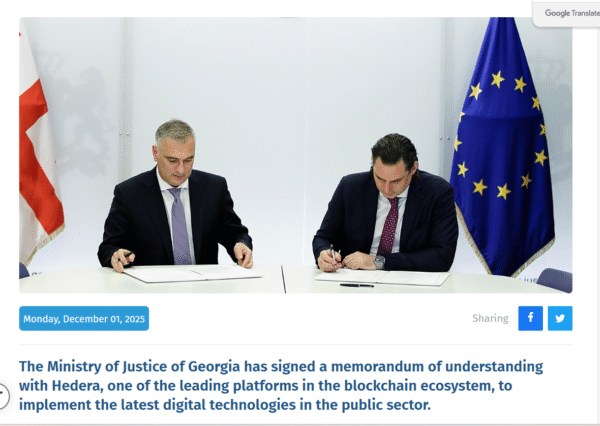
Georgia Partners with Hedera to Explore On-Chain Land Registry
Georgia signs an MoU with Hedera to explore moving its land registry on-chain. This will enhance property rights and enable real estate tokenization. The public blockchain network Hedera secured a major government partnership. Georgia is considering putting the country’s land registry on-chain. This exploration additionally contains tokenizing real estate. Ministry of Justice Signs Cooperation Memorandum […] The post Georgia Partners with Hedera to Explore On-Chain Land Registry appeared first on Live Bitcoin News.
Share
Author: LiveBitcoinNews2025/12/04 11:30

Corporate ETH Accumulation Stalls: The Startling 81% Slowdown in 3 Months
BitcoinWorld Corporate ETH Accumulation Stalls: The Startling 81% Slowdown in 3 Months Institutional interest in Ethereum, once a roaring trend, has hit a surprising roadblock. New data reveals a dramatic cooling period, with corporate ETH accumulation plummeting by a staggering 81% in just three months. This sharp reversal signals a potential shift in how major companies view crypto treasury strategies. Let’s unpack what’s behind this slowdown and […] This post Corporate ETH Accumulation Stalls: The Startling 81% Slowdown in 3 Months first appeared on BitcoinWorld.
Share
Author: bitcoinworld2025/12/04 11:30

USD/CAD rebounds above mid-1.3900s but faces upside resistance
The post USD/CAD rebounds above mid-1.3900s but faces upside resistance appeared on BitcoinEthereumNews.com. The USD/CAD pair attracts some buyers during the Asian session on Thursday, and for now, seems to have snapped a two-day losing streak back closer to the 1.3940-1.3935 region, or a nearly one-month low, touched last week. Spot prices, however, lack bullish conviction and currently trade around the 1.3960-1.3965 area, up 0.10% for the day, amid mixed cues. The US Dollar (USD) attempts a modest recovery from its lowest level since late October, touched on Wednesday, and turns out to be a key factor offering some support to the USD/CAD pair. Any meaningful USD appreciation, however, seems elusive amid bets that the US Federal Reserve (Fed) will lower borrowing costs again next week. The expectations were reaffirmed by the dismal US ADP report, which showed that private-sector employers unexpectedly shed 32,000 jobs in November. The data points to a weakening US labor market and comes on top of signs of a slowdown in the world’s largest economy, which backs the case for further policy easing by the Fed. This marks a significant divergence in comparison to the Bank of Canada’s (BoC) hawkish signal, stating that it is likely finished cutting for now. Apart from this, some follow-through recovery in Crude Oil prices could underpin the commodity-linked Loonie and contribute to capping further gains for the USD/CAD pair. Traders now look to Thursday’s US economic docket, featuring Challenger Job Cuts and the usual Weekly Initial Jobless Claims. Apart from this, the Canada Ivey PMI might provide some impetus later during the North American session. The market focus, however, will remain on the release of the US Personal Consumption Expenditure (PCE) Price Index and the monthly Canadian jobs report. This, in turn, will play a key role in determining the next leg of a directional move for the USD/CAD pair. Canadian Dollar…
Share
Author: BitcoinEthereumNews2025/12/04 11:29

Asia Market Open: Bitcoin Steadies Around $93K, Stocks Drift After Weak US Prints Reinforce Fed Cut Outlook
Bitcoin held near $93,000 in Asian trading on Thursday, while regional stocks made a lacklustre start as soft US data reinforced expectations that the
Share
Author: CryptoNews2025/12/04 11:29

Solana Mobile to launch SKR token in January
The post Solana Mobile to launch SKR token in January appeared on BitcoinEthereumNews.com. Solana Mobile is preparing to launch its SKR token in January, marking the start of a new phase for its open mobile ecosystem. Summary New SKR token launches in January with a model built around staking, rewards, and community security. Seeker phone adoption is rising, with strong activity from builders and early users. The Guardians network aims to decentralize device verification and app review starting in 2026. In a Nov. 3 announcement on X, Solana Mobile introduced SKR as a tool to help users support builders, secure devices, and take part in shaping the mobile platform. At launch, SKR will act as a coordination layer for the Seeker phone ecosystem. Users can stake the token to Guardians, who handle device checks, review new apps, and enforce community rules. A token built for growth, security, and community coordination The token runs on a fixed supply of 10 billion SKR. The distribution includes 30% for airdrops, 25% for growth and partnerships, 10% for liquidity and launch, 10% for the community treasury, 15% for Solana Mobile, and 10% for Solana (SOL) Labs. Its inflation schedule moves in a straight line, starting at 10% in year one, then shrinking by 25% each year until it reaches a steady 2% terminal rate. The model is meant to reward early users who stake and help secure the network. Anyone with a Seeker device can activate a Genesis Token, issued as a soulbound NFT through the Seed Vault wallet, to take part in early airdrop rounds and other rewards. Seeker momentum and the rise of the Guardians network Solana Mobile’s hardware push has gathered steady traction since the Seeker phone rollout began on Aug. 4. The device shipped more than 150,000 pre-orders worldwide and arrived with the next version of the dApp Store, built-in key storage, and…
Share
Author: BitcoinEthereumNews2025/12/04 11:28

There is uncertainty on how far we can eventually raise interest rates
The post There is uncertainty on how far we can eventually raise interest rates appeared on BitcoinEthereumNews.com. Bank of Japan (BoJ) Governor Kazuo Ueda said on Thursday, “there is uncertainty on how far we can eventually raise interest rates.” Additional comments We are working on narrowing our estimate on neutral interest rate, will disclose findings if we can successfully do so. For now, we have to work with our current estimate set in a fairly wide range. There is uncertainty on how far we can eventually raise interest rates. Current monetary conditions still accommodative. Govt’s economic package likely to push up economic growth. Package will likely work both ways in terms of impact on inflation. Market reaction At the time of writing, USD/JPY is inching 0.09% higher on the day to trade at 155.46. Bank of Japan FAQs The Bank of Japan (BoJ) is the Japanese central bank, which sets monetary policy in the country. Its mandate is to issue banknotes and carry out currency and monetary control to ensure price stability, which means an inflation target of around 2%. The Bank of Japan embarked in an ultra-loose monetary policy in 2013 in order to stimulate the economy and fuel inflation amid a low-inflationary environment. The bank’s policy is based on Quantitative and Qualitative Easing (QQE), or printing notes to buy assets such as government or corporate bonds to provide liquidity. In 2016, the bank doubled down on its strategy and further loosened policy by first introducing negative interest rates and then directly controlling the yield of its 10-year government bonds. In March 2024, the BoJ lifted interest rates, effectively retreating from the ultra-loose monetary policy stance. The Bank’s massive stimulus caused the Yen to depreciate against its main currency peers. This process exacerbated in 2022 and 2023 due to an increasing policy divergence between the Bank of Japan and other main central banks, which opted to…
Share
Author: BitcoinEthereumNews2025/12/04 11:26
Japanese Yen set to gain vs USD on BoJ hike bets, dovish Fed outlook
The post Japanese Yen set to gain vs USD on BoJ hike bets, dovish Fed outlook appeared on BitcoinEthereumNews.com. The Japanese Yen (JPY) is trading with a positive bias during the Asian session on Thursday and looking to build on the previous day’s gains against a broadly weaker US Dollar (USD). Traders ramped up their bets for an imminent interest rate hike by the Bank of Japan (BoJ) following Governor Kazuo Ueda’s remarks earlier this week. Moreover, a survey showed on Wednesday a modest expansion of private sector output in Japan for the eighth straight month in November and backs the case for further BoJ policy normalization. This, in turn, might continue to underpin the JPY. Meanwhile, prospects for BoJ tightening, along with a reflationary push by new Prime Minister Sanae Takaichi, keep super-long-dated Japanese government bonds (JGB) under pressure. The resultant narrowing of the rate differential between Japan and other major economies could further benefit the lower-yielding JPY. The USD, on the other hand, languishes near its lowest level since late October amid rising bets for another interest rate cut by the Federal Reserve (Fed) next week. This, in turn, suggests that the path of least resistance for the USD/JPY pair is to the downside. Japanese Yen bulls have the upper hand amid firming BoJ rate hike expectations Bank of Japan Governor Kazuo Ueda gave the clearest hint so far of an impending rate hike and said on Monday that the central bank would consider the pros and cons of raising its policy rate at its December 18-19 meeting. Ueda added that real interest rates were deeply negative, and another hike would still leave borrowing costs low. Japan’s S&P Global Composite PMI was finalized at 52.0 for November, marking the strongest reading since August. It also signaled an eighth consecutive month of private-sector expansion amid a quicker rise in services and a slower contraction in manufacturing. Moreover, business…
Share
Author: BitcoinEthereumNews2025/12/04 11:23

Crypto Billionaire Changpeng Zhao Urges Parents To 'Protect' Kids By Making Sure Their Coins Aren't Stuck If The 'Worst Happens'
Binance (CRYPTO: BNB) co-founder Changpeng “CZ” Zhao stressed on Wednesday the importance of securing children’s access to cryptocurread more
Share
Author: Coinstats2025/12/04 11:23
Bitcoin Price Nears Key Support Level, Mirroring Early 2022 Patterns
The post Bitcoin Price Nears Key Support Level, Mirroring Early 2022 Patterns appeared on BitcoinEthereumNews.com. The Bitcoin True Market Mean represents the average cost basis of all active coins excluding miners, currently near $96.1K, serving as a critical support level. Bitcoin’s price has dipped toward this zone over two weeks but held above it, echoing early 2022 patterns and avoiding a deep bear market for now. Bitcoin price stability: Trading just above the True Market Mean, with over 25% of supply underwater, yet net realized cap change remains positive at +$8.69B monthly. Derivatives market reset: Futures open interest and leverage have declined, with funding rates neutral, reducing downside pressure from overextended positions. ETF outflows impact: U.S. Bitcoin ETFs saw net outflows in November, signaling lighter spot demand and increased exposure to macro shocks, per Glassnode data. Discover how the Bitcoin True Market Mean is holding as a key support amid recent declines. Explore ETF flows, derivatives resets, and investor signals in this in-depth analysis for informed crypto strategies. What is the Bitcoin True Market Mean? The Bitcoin True Market Mean is a key on-chain metric that calculates the average acquisition cost of all actively held Bitcoin addresses, excluding those associated with miners to focus on genuine holder behavior. According to Glassnode, this level acts as a pivotal threshold, distinguishing mild bearish phases from severe downturns. Currently, with Bitcoin’s spot price hovering near $96.1K, the metric highlights a support zone where price has consolidated after a two-week slide, preventing a deeper capitulation similar to past cycles. How Are Bitcoin ETF Outflows Affecting Current Market Dynamics? U.S. Bitcoin ETFs, which drove significant inflows earlier in the year, have shifted to net outflows on a three-day average basis throughout November, according to Glassnode insights. This reversal indicates waning institutional demand, leaving Bitcoin’s price more vulnerable to external macroeconomic pressures like interest rate decisions or global events. Short sentences…
Share
Author: BitcoinEthereumNews2025/12/04 11:22

Japan’s Kihara: Concerned about forex move
The post Japan’s Kihara: Concerned about forex move appeared on BitcoinEthereumNews.com. Japanese Chief Cabinet Secretary Minoru Kihara said in a statement on Thursday, he is “concerned about forex move.” Additional quotes Recent Yen moves are somewhat rapid, one-sided. Important for currencies to move in a stable manner, reflecting fundamentals. Take appropriate action for excessive, disorderly FX moves. Even more important to communicate with the market, home and overseas to buy JGBs. What’s important in JGB management policy is to smooth issuance of JGB while keeping mid- and long-term necessary cost low. Market reaction USD/JPY is off the high following the Japanese jawboning. At the press time, the pair trades 0.04% higher on the day at 155.34. Japanese Yen Price Today The table below shows the percentage change of Japanese Yen (JPY) against listed major currencies today. Japanese Yen was the weakest against the Australian Dollar. USD EUR GBP JPY CAD AUD NZD CHF USD 0.04% 0.09% 0.08% 0.07% -0.06% 0.09% 0.04% EUR -0.04% 0.05% 0.04% 0.03% -0.11% 0.04% 0.02% GBP -0.09% -0.05% -0.02% -0.02% -0.16% -0.00% -0.03% JPY -0.08% -0.04% 0.02% -0.00% -0.15% -0.02% -0.02% CAD -0.07% -0.03% 0.02% 0.00% -0.13% -0.01% -0.01% AUD 0.06% 0.11% 0.16% 0.15% 0.13% 0.15% 0.12% NZD -0.09% -0.04% 0.00% 0.02% 0.00% -0.15% -0.03% CHF -0.04% -0.02% 0.03% 0.02% 0.01% -0.12% 0.03% The heat map shows percentage changes of major currencies against each other. The base currency is picked from the left column, while the quote currency is picked from the top row. For example, if you pick the Japanese Yen from the left column and move along the horizontal line to the US Dollar, the percentage change displayed in the box will represent JPY (base)/USD (quote). Source: https://www.fxstreet.com/news/japans-kihara-concerned-about-forex-move-202512040218
Share
Author: BitcoinEthereumNews2025/12/04 11:20

USDC on Starknet: Circle’s Game-Changing Move for Faster Ethereum Transactions
BitcoinWorld USDC on Starknet: Circle’s Game-Changing Move for Faster Ethereum Transactions The world of decentralized finance just got a major speed boost. In a pivotal move for Ethereum scalability, Circle has officially launched its USDC stablecoin and Cross-Chain Transfer Protocol on the Starknet network. This integration isn’t just another listing; it’s a strategic bridge designed to supercharge how we use digital dollars for everything from DeFi […] This post USDC on Starknet: Circle’s Game-Changing Move for Faster Ethereum Transactions first appeared on BitcoinWorld.
Share
Author: bitcoinworld2025/12/04 11:20

A New Era For Crypto
The post A New Era For Crypto appeared on BitcoinEthereumNews.com. Revolutionary Franklin Templeton SOL ETF Launches On NYSE Arca: A New Era For Crypto Skip to content Home Crypto News Revolutionary Franklin Templeton SOL ETF Launches on NYSE Arca: A New Era for Crypto Source: https://bitcoinworld.co.in/franklin-templeton-sol-etf-launch/
Share
Author: BitcoinEthereumNews2025/12/04 11:19

Tonik Raises US$12M to Scale Lending Operations
Tonik Financial, the parent company of the Philippines’ first licensed digital-only bank, Tonik Digital Bank, has raised US$12 million in a Pre-Series C financing round. Diligent Capital Partners led the investment round. They were joined by Plio Limited, existing shareholder Altara Capital, and the Tonik management team. According to the company, the fresh capital will [...] The post Tonik Raises US$12M to Scale Lending Operations appeared first on Fintech News Philippines.
Share
Author: Fintechnews2025/12/04 11:19

Ethereum Surges Above $3,200 as Traders Eye a Stronger Bullish Extension
Ethereum price started a fresh increase above $3,120. ETH is now attempting to clear the $3,250 resistance and might accelerate higher. Ethereum started a fresh increase above the $3,000 and $3,120 levels. The price is trading above $3,150 and the 100-hourly Simple Moving Average. There is a bullish trend line forming with support at $3,120 on the hourly chart of ETH/USD (data feed via Kraken). The pair could continue to move up if it settles above the $3,250 zone. Ethereum Price Eyes More Gains Ethereum price managed to stay above $2,880 and started a fresh increase, like Bitcoin. ETH price gained strength for a move above the $2,950 and $3,000 resistance levels. The bulls even pumped the price above $3,120. However, the price is now testing a key barrier at $3,250. A high was formed at $3,239 and the price is now consolidating above the 23.6% Fib retracement level of the recent move from the $2,718 swing low to the $3,239 low. Ethereum price is now trading above $3,150 and the 100-hourly Simple Moving Average. If there is another upward move, the price could face resistance near the $3,250 level. The next key resistance is near the $3,265 level. The first major resistance is near the $3,320 level. A clear move above the $3,320 resistance might send the price toward the $3,450 resistance. An upside break above the $3,450 region might call for more gains in the coming days. In the stated case, Ether could rise toward the $3,500 resistance zone or even $3,540 in the near term. Downside Correction In ETH? If Ethereum fails to clear the $3,250 resistance, it could start a fresh decline. Initial support on the downside is near the $3,160 level. The first major support sits near the $3,120 zone and the trend line. A clear move below the $3,120 support might push the price toward the $3,050 support. Any more losses might send the price toward the $2,980 region and the 50% Fib retracement level of the recent move from the $2,718 swing low to the $3,239 low in the near term. The next key support sits at $2,920 and $2,880. Technical Indicators Hourly MACD – The MACD for ETH/USD is gaining momentum in the bullish zone. Hourly RSI – The RSI for ETH/USD is now above the 50 zone. Major Support Level – $3,120 Major Resistance Level – $3,250
Share
Author: NewsBTC2025/12/04 11:18
Georgia Explores Onchain Land Registry Using Hedera Blockchain
The post Georgia Explores Onchain Land Registry Using Hedera Blockchain appeared on BitcoinEthereumNews.com. Georgia is exploring an onchain land registry using Hedera blockchain technology through a new memorandum of understanding with the Ministry of Justice. This initiative aims to enhance the integrity and traceability of property records, potentially including real estate tokenization, building on the country’s pioneering blockchain experiments since 2017. Georgia’s Ministry of Justice signed an MoU with Hedera to investigate blockchain integration for national land records. The collaboration focuses on testing Hedera’s architecture for secure, tamper-resistant property data storage. This builds on Georgia’s history, including over 100,000 property entries verified on Bitcoin blockchain in 2017 and ongoing CBDC research with Ripple. Discover how Georgia’s partnership with Hedera advances onchain land registry for secure property records. Explore tokenization potential and blockchain’s role in public administration. Stay informed on crypto innovations today. What is Georgia’s Exploration of Onchain Land Registry with Hedera? Georgia’s onchain land registry with Hedera involves a memorandum of understanding signed between the Ministry of Justice and Hedera to evaluate blockchain technology for modernizing the country’s property records system. This step aims to improve data integrity, traceability, and efficiency in real estate management without immediate full implementation. By leveraging Hedera’s distributed ledger, officials seek to create a more secure foundation for legal and economic transactions tied to land ownership. How Does Tokenized Real Estate Fit into Georgia’s Blockchain Plans? Tokenized real estate represents a key focus in Georgia’s discussions with Hedera, where property titles could be converted into digital assets on the blockchain for easier transfer and verification. This approach would reduce reliance on centralized servers, minimizing risks of tampering or errors in ownership records. According to reports from the Ministry of Justice, initial assessments will involve joint teams of government experts and Hedera technical specialists to outline the necessary legal frameworks and technical integrations. Historical data shows Georgia’s early…
Share
Author: BitcoinEthereumNews2025/12/04 11:16

Revolutionary NEAR AI Cloud Unveiled: Near Protocol’s Bold Leap into Private AI
BitcoinWorld Revolutionary NEAR AI Cloud Unveiled: Near Protocol’s Bold Leap into Private AI In a move set to reshape the intersection of blockchain and artificial intelligence, Near Protocol has just unveiled its groundbreaking NEAR AI Cloud and a complementary Private Chat feature. This announcement signals a major step towards a more private and user-centric digital future. For anyone invested in the crypto space, this development isn’t just another […] This post Revolutionary NEAR AI Cloud Unveiled: Near Protocol’s Bold Leap into Private AI first appeared on BitcoinWorld.
Share
Author: bitcoinworld2025/12/04 11:15

Major European Banks Launch Qivalis to Issue Euro Stablecoin by Mid-2026
Amsterdam-based venture aims to challenge U.S. dominance in digital payments as regulatory framework takes shape
Share
Author: Blockhead2025/12/04 11:15

Bitcoin And Stablecoins Settle Visa-Scale Volumes
The post Bitcoin And Stablecoins Settle Visa-Scale Volumes appeared on BitcoinEthereumNews.com. Bitcoin (BTC) and US dollar–pegged stablecoins are emerging as a global alternative for moving value across borders without banks and card networks, as the Bitcoin network’s settlement volume begins to rival the world’s largest payment giants. Bitcoin settled $6.9 trillion worth of payments over the past 90 days, which is “on par with or above Visa and Mastercard,” according to blockchain data platform Glassnode’s digital asset research report for the fourth quarter of 2025, published on Wednesday. Over the same period, Visa processed $4.25 trillion in payment volume and Mastercard $2.63 trillion, for a combined $6.88 trillion, according to the report. “Activity is migrating off-chain as flows move to #ETFs and brokers, but Bitcoin and #stablecoins continue to dominate on-chain settlement,” Glassnode said on X. Bitcoin, Visa, Mastercard, transfer volume comparison. Source: Glassnode Related: Bank of America backs 1%–4% crypto allocation, opens door to Bitcoin ETFs Bitcoin’s economic settlement still small next to cards Once internal transfers between addresses controlled by the same entity are stripped out, Bitcoin’s “economic” settlement is closer to $870 billion per quarter, or about $7.8 billion per day, Glassnode estimated. The firm said the numbers still show Bitcoin’s growing role as a “globally relevant settlement network, bridging both institutional and retail transaction flows.” This figure pales in comparison to Visa’s $39.7 billion daily average transaction volume, or Mastercard’s $26.2 billion, the lion’s share of which is used for consumer retail spending and daily needs. In contrast, Bitcoin’s settlement volume is mainly attributed to trading, remittances, and store-of-value investment, as global merchant adoption remains low. Merchants accepting Bitcoin payments. Source: BTCmap.org Worldwide, only 20,599 merchants accept Bitcoin payments according to BTCmap, compared to Visa’s 175 million global merchant locations. Related: Bitcoin traders hit peak unrealized pain as ETFs start to turn positive Stablecoins move $225 billion…
Share
Author: BitcoinEthereumNews2025/12/04 11:12

AI Regulation Showdown: Another Attempt to Block State Laws Fails Amid Bipartisan Resistance
BitcoinWorld AI Regulation Showdown: Another Attempt to Block State Laws Fails Amid Bipartisan Resistance In a significant development for the cryptocurrency and tech communities, another attempt to prevent states from regulating artificial intelligence has been defeated. This latest failure marks a crucial moment in the ongoing battle between federal preemption and state-level innovation in technology governance. For those following regulatory trends that could impact blockchain and AI integration, this […] This post AI Regulation Showdown: Another Attempt to Block State Laws Fails Amid Bipartisan Resistance first appeared on BitcoinWorld.
Share
Author: bitcoinworld2025/12/04 11:10

BlackRock’s 2026 AI Report Is Bullish on Digital Assets, Bearish on U.S. Economy
The post BlackRock’s 2026 AI Report Is Bullish on Digital Assets, Bearish on U.S. Economy appeared on BitcoinEthereumNews.com. Blackrock, the world’s largest asset manager, laid out its vision for 2026 and — reading past its bearish outlook for U.S. bonds and the world’s largest economy — it’s a bullish blueprint for institutional crypto adoption. U.S. federal debt will swell past $38 trillion, setting the tone for a market outlook defined by fragility and the failure of traditional hedges, according to the report. For crypto that’s good news, because this economic environment will lead to accelerated digital asset adoption among the Wall Street behemoths. More government borrowing “… creates vulnerabilities to shocks such as bond yield spikes tied to fiscal concerns or policy tensions between managing inflation and debt servicing costs,” the report said. The warning on long-term U.S. Treasuries, the traditional backbone of finance, is a signal AI-driven leverage and government debt is likely to make the financial system more fragile, and may compel institutions to turn to alternative assets like bitcoin BTC$94,062.28 as a hedge against fiscal failure. The institutional flood of money into crypto, exemplified by the BlackRock’s $100 billion in bitcoin ETF allocations, its top revenue source, promises to take digital assets to all-time highs next year, with some analysts forecasting the largest cryptocurrency will climb to more than $200,000. This is all part of a “modest but meaningful step toward a tokenized financial system,” which provides the decentralized infrastructure to handle the private credit and asset management institutions seek. CEO Larry Fink described tokenization as the next generation of financial markets. The world’s largest asset manager’s report says it clearly: where government debt fails, the digital economy begins. As for stablecoins, digital assets whose value is pegged to a real-world asset like the dollar or gold, they “are no longer niche, they’re becoming the bridge between traditional finance and digital liquidity,” said Samara Cohen,…
Share
Author: BitcoinEthereumNews2025/12/04 11:09

Japan’s 30-Year Bond Yields Reach Record High Amid Fiscal Concerns
The post Japan’s 30-Year Bond Yields Reach Record High Amid Fiscal Concerns appeared on BitcoinEthereumNews.com. Key Points: Record 3.445% yield on Japan’s 30-year bond; impact on investor demand. BOJ rate hike anticipation pressures market. Concerns about fiscal stimulus and borrowing costs. Japan’s 30-year government bond yield reached a new peak of 3.445% on December 4, 2025, coinciding with a 700 billion yen bond auction by the Ministry of Finance. This record yield suggests anticipation of a Bank of Japan rate hike and fiscal expansion, influencing investor behavior and government borrowing costs. Record Bond Yields Trigger Market Dynamics Japan’s Ministry of Finance planned to auction 700 billion yen of 30-year bonds as yields rose to 3.445%. Economist Takayuki Miyajima indicated speculation on a potential Bank of Japan rate hike and fiscal expansion contributed to the shift. The yield hike is set amid announced auctions, with high yields expected to support demand despite market pressures. Potential for Bank of Japan rate hikes has driven yields at multi-year highs, indicating shifting borrowing costs and fiscal decision impacts. Prime Minister Sanae Takaichi’s fiscal stimulus plan also pressures yields upwards, contributing to fiscal outlook shifts. “While speculation about a Bank of Japan rate hike and concerns about fiscal expansion are driving selling pressure, the upcoming 30-year bond auction is expected to see a smooth result due to high yields supporting demand,” noted Takayuki Miyajima, Economist at Sony Financial Group. Market analysts like Shoki Omori from Mizuho Securities suggest “weak demand” for the 30-year auction, despite high yields. Meanwhile, Sony Financial’s Miyajima forecasts smooth auction outcomes due to current return rates. Fiscal Stimulus and Regulatory Shifts in Focus Did you know? In December 2025, Japan’s 30-year bond yield surpassed its previous record of 3.41%, highlighting fiscal pressure comparable to past monetary expansions. Ethereum’s market statistics showed its price at $3,225.00, with a market dominance of 12.18% as of December 4, 2025.…
Share
Author: BitcoinEthereumNews2025/12/04 11:07

$1.69 Trillion Franklin Templeton Unveils Brand New Solana ETF SOEZ
The post $1.69 Trillion Franklin Templeton Unveils Brand New Solana ETF SOEZ appeared on BitcoinEthereumNews.com. Franklin Templeton, the $1.69 trillion asset manager that keeps showing up in every corner of the digital asset market this cycle, launched a new Solana ETF with a ticker that instantly became the headline: SOEZ. The firm announced it today, making it clear they know exactly what they are doing with this naming. After all, branding a Solana product as “SOEZ” in a market where Solana emerged as the most meme-coded large-cap chain in the industry, is borderline engineered for attention. And it worked straight away. The point here is not just that another big player is releasing another SOL vehicle. Solana’s got a bunch of ETFs listed on the NYSE, CBOE and NASDAQ — BSOL, GSOL, TSOL, FSOL, VSOL and SOLC — and they have already racked up a cool $929.7 million in net assets as of Dec. 2. They produced $45.77 million in daily net inflow on the same day, which is an unusually strong print for a sector that spent most of late November moving in uneven cycles. You Might Also Like What has changed now is Franklin’s presence because fund managers see Franklin ETFs as a basic investment, and that can move money that is currently spread across smaller companies. What does this mean for Solana (SOL)? If existing SOL products are already hovering near a billion in combined net assets without a big name like Franklin Templeton, then the next logical question is how fast a Franklin-branded vehicle can climb once platforms start listing it and automated allocators switch on. The memetic ticker adds a second layer: retail reacts to anything that feels culturally native to Solana. If that is the case, SOEZ could well be up there with the fastest-growing ETFs of late 2025. Source: https://u.today/169-trillion-franklin-templeton-unveils-brand-new-solana-etf-soez
Share
Author: BitcoinEthereumNews2025/12/04 11:06
Trump’s Gentile Commutation Fuels Speculation on Slim SBF Pardon Odds in Crypto Cases
The post Trump’s Gentile Commutation Fuels Speculation on Slim SBF Pardon Odds in Crypto Cases appeared on BitcoinEthereumNews.com. President Trump commuted the sentence of David Gentile, a private equity executive convicted of defrauding investors, releasing him after just 12 days and waiving his restitution obligations. Meanwhile, Sam Bankman-Fried’s chances of a pardon remain slim at around 2-4% on prediction markets like Polymarket and Kalshi, highlighting Trump’s selective clemency in fraud cases. Trump’s commutation freed Gentile from a seven-year fraud sentence, eliminating fines and victim restitution tied to his $1.6 billion scheme at GPB Capital. Gentile’s release underscores concerns over executive overreach in financial crime pardons, sparing him from repaying thousands of defrauded investors. Prediction markets show low odds for SBF’s pardon, at 2% on Polymarket and 4% on Kalshi by year-end, reflecting his ties to political opponents and massive FTX fraud conviction. Discover how Trump’s commutation of David Gentile’s fraud sentence impacts crypto figures like SBF seeking pardons. Low odds persist amid selective clemency—explore the implications for financial accountability today. What is the significance of Trump’s commutation for David Gentile? Trump’s commutation of David Gentile’s sentence represents a notable use of presidential clemency in a high-stakes financial fraud case, freeing the former GPB Capital CEO after he served only 12 days of a seven-year term. This action not only shortens his imprisonment but also eliminates outstanding fines, restitution, and forfeiture requirements, effectively shielding him from repaying victims who lost millions in the scheme. While not a full pardon, it preserves the conviction but ends further penalties, sparking debates on justice in white-collar crimes. How does David Gentile’s case differ from other Trump pardons? Gentile’s commutation stands out among Trump’s recent clemency grants due to its financial implications for victims and the rapid release timeline. As founder of GPB Capital, Gentile raised approximately $1.6 billion from investors through misleading representations of the fund’s performance, leading to convictions for securities…
Share
Author: BitcoinEthereumNews2025/12/04 11:04

What You Need To Know About The Dec 3 Upgrade
The post What You Need To Know About The Dec 3 Upgrade appeared on BitcoinEthereumNews.com. Essential Bitcoin World System Maintenance: What You Need To Know About The Dec 3 Upgrade Skip to content Home Crypto News Essential Bitcoin World System Maintenance: What You Need to Know About the Dec 3 Upgrade Source: https://bitcoinworld.co.in/bitcoin-world-system-maintenance-december/
Share
Author: BitcoinEthereumNews2025/12/04 11:01

Globe and BPI Test ‘Silent’ Authentication to Replace OTPs
Globe and the Bank of the Philippine Islands (BPI) have completed a Proof of Concept (POC) for Silent Network Authentication (SNA), a verification method designed to replace One-Time Passwords (OTPs). The initiative aims to reduce scams associated with SMS codes while streamlining the user experience. SNA is part of “G Verify,” Globe’s portfolio of network-powered [...] The post Globe and BPI Test ‘Silent’ Authentication to Replace OTPs appeared first on Fintech News Philippines.
Share
Author: Fintechnews2025/12/04 11:01
Glassnode report: Market structure is fragile, potentially mirroring the eve of the 2022 crash.
summary Bitcoin is stable above the True Market Mean, but the broader market structure is now similar to that of the first quarter of 2022, with more than 25% of the supply operating at a loss. Capital momentum remains positive, supporting consolidation, although well below the peak expected in mid-2025. The 0.75–0.85 quantile range (USD 96.1K–USD 106K) is a key area for restoring market structure; a break below this level would increase downside risk. ETF fund flows have turned negative, and the cumulative trading volume difference (CVD) in the spot market has declined, indicating that demand is weakening. The decline in futures open interest and the reset of funding rates to neutral reflect a risk-averse stance. The options market is characterized by compressed implied volatility (IV), softened skewness, and a shift in fund flows from put options to cautious call option selling. Options appear to be undervalued, with realized volatility exceeding implied volatility, putting pressure on traders shorting Gamma (short-gamma). Overall, the market remains fragile, and unless a macroeconomic shock disrupts the balance, it will depend on whether it can hold onto key cost base areas. On-chain insights Bottoming out or collapsing? Over the past two weeks, Bitcoin's price has fallen and found support near a key valuation anchor known as the True Market Mean—the cost basis for all non-dormant coins (excluding miners). This level typically marks the dividing line between a mild bearish phase and a deep bear market. While prices have recently stabilized above this threshold, the broader market structure is increasingly echoing the dynamics of the first quarter of 2022. This similarity becomes even clearer when using the Supply Quantiles Cost Basis Model (which tracks the cost basis of supply clusters held by top buyers). Since mid-November, spot prices have fallen below the 0.75 quantile and are currently trading around $96.1K, leaving more than 25% of supply at a loss. This creates a fragile balance between the risk of top buyers capitulating and the potential for sellers to tire and form a bottom. However, the current structure remains highly sensitive to macroeconomic shocks until the market can reclaim the 0.85 quantile (approximately $106.2K) as support. Pain is dominant Based on this structural perspective, we can magnify the supply situation of top buyers by using "Total Supply in Loss" to measure the degree of dominance of losses, i.e., unrealized pain. The indicator’s 7-day simple moving average (7D-SMA) climbed to 7.1 million BTC last week—the highest level since September 2023—highlighting that the more than two-year bull market price expansion is now facing two shallow bottoming phases. The current loss-making supply size (between 5 million and 7 million BTC) bears a striking resemblance to the sideways market of early 2022, further reinforcing this similarity. This comparison underscores once again that the true market mean is a key threshold distinguishing between a mild bearish phase and the transition to a more defined bear market. The kinetic energy is still positive. Despite strong similarities to the first quarter of 2022, the capital inflows into Bitcoin remained slightly positive, which helps explain the support near the real market average and the subsequent rebound to above $90,000. This capital momentum can be measured by the net change in realized cap, which is currently at a level of +$8.69 billion per month—well below the peak of $64.3 billion per month in July 2025, but still positive. As long as capital momentum remains above zero, the real market average can continue to serve as a consolidation zone and a potential bottoming area, rather than the start of a deeper decline. Long-term holders' profit margins decline The continued presence of positive capital inflows implies that new demand can still absorb profit-taking by long-term investors. The long-term holder SOPR (30-day SMA, a measure of the ratio of spot price to cost basis for active long-term holders) has remained above 1 (currently at 1.43) despite a sharp decline in prices. This emerging margin trend echoes the structure of Q1 2022: long-term holders continue to sell at profits, but margins are narrowing. Despite stronger demand momentum compared to early 2022, persistently low liquidity forces bulls to hold above the real market mean until a new wave of demand enters the market. Off-chain insights ETF demand weakens Turning to the spot market, net inflows into US Bitcoin ETFs deteriorated significantly, with its 3-day average firmly slipping into negative territory throughout November. This marks a break from the sustained inflows that supported prices earlier this year, reflecting a cooling of new capital allocation. The widespread outflows of funds across issuers indicate that institutional participants have adopted a more cautious stance as market conditions weaken. The spot market is currently facing a backdrop of weakening demand, which has diminished immediate buyer support, making prices more sensitive to external shocks and macroeconomic drivers. Spot buying weakened Amid deteriorating demand for ETFs, the cumulative volume difference (CVD) has also declined on major exchanges, with Binance and aggregated trading platforms continuing to show a negative trend. This indicates a steady increase in sell pressure driven by short sellers, with traders crossing bid-ask spreads to mitigate risk rather than accumulate positions. Even Coinbase, often seen as a bellwether for the strength of US buying, has flattened out, suggesting a general retreat in confidence in the spot market. With ETF flows and spot CVDs shifting towards a defensive stance, the market now relies on a weaker demand base, making prices more vulnerable to sustained declines and macro-driven volatility. Open interest continued to decline This weakening demand extended to the derivatives market, with futures open interest steadily declining throughout late November. While the unwinding was gradual, it was persistent, erasing much of the speculative positions accumulated during the previous upward trend. With no meaningful new leverage entering the market, traders appeared reluctant to express directional conviction, instead adopting a conservative, risk-averse stance as prices fell. Derivatives are characterized by significantly lighter leverage, indicating a marked lack of speculative intent and reducing the likelihood of sharp volatility driven by liquidation. Neutral funding rates signify a reset With open interest continuing to contract, perpetual funding rates have cooled to a broadly neutral level, fluctuating around zero for most of late November. This marks a significant shift from the high positive funding rates observed during previous expansion periods, indicating that excess long positions have been largely liquidated. Importantly, the period of mild negative funding rates was also brief and short-lived, suggesting that traders did not actively build short positions despite price declines. This neutral to slightly negative funding structure suggests a more balanced derivatives market with a lack of crowded long positions, reducing downside vulnerability and potentially laying the groundwork for a more constructive positioning when demand begins to stabilize. Implied volatility (IV) fully reset Turning to the options market, implied volatility (IV) provides a clear window into how traders price in future uncertainty. Tracking implied volatility is useful as it reflects market expectations for future price movements. After high readings last week, implied volatility has reset and is trending lower. Price struggled to break through the 92K resistance level, and the rebound lacked follow-through momentum, prompting volatility sellers to re-enter the market, pushing implied volatility lower across the board. Short-term contracts decreased from 57% to 48%. The proportion of medium-term contracts decreased from 52% to 45%. Long-term contracts decreased from 49% to 47%. This continued decline suggests that traders believe the likelihood of a sharp downturn has decreased and anticipate a calmer environment in the near term. This reset also marks a shift towards a more neutral stance, as the market emerges from last week's heightened caution. The bearish skew has eased. After examining implied volatility, skewness helps clarify how traders assess downside and upside risk. It measures the difference between the implied volatility of put and call options. When skewness is positive, traders pay a premium for downside protection; when skewness is negative, they pay more for upside exposure. The direction of skewness is just as important as its level. For example, an 8% short-term skewness conveys a very different message if it decreases from 18% over two days rather than increasing from a negative value. The short-term skewness moved from 18.6% on Monday (during the drop to 84.5K driven by the Japanese bond narrative) to 8.4% on the rebound. This suggests that the initial reaction was exaggerated. Longer-term contracts adjusted more slowly, indicating that traders are willing to chase short-term upside, but their sustainability remains uncertain. Fear subsided Fund flow data shows a stark contrast between the past seven days and the subsequent rebound. Earlier this week, activity was primarily driven by put option buying, reflecting fears of a repeat of the August 2024 price action, linked to concerns about the unwinding of potential Japanese carry trades. Having experienced this risk before, the market was already sensing how far such a spread could go and the subsequent recovery that would typically follow. Once prices stabilized, the flow of funds shifted rapidly: the rebound brought a decisive tilt towards call option activity, almost perfectly reversing the pattern seen during periods of stress. It's worth noting that traders are still holding net long Gamma positions at current levels, and this could continue until December 26th (the largest expiry date this year). Such positions typically suppress price volatility. Once that expiry date has passed, the positions will reset, and the market will enter 2026 with a new set of dynamics. Evolution of the premium on a $100,000 call option Watching the call option premium at a strike price of $100,000 helps clarify how traders are treating this key psychological level. On the right side of the chart, the call option selling premium remains higher than the call option buying premium, and the gap has widened during the rally over the past 48 hours. This widening suggests that conviction in reclaiming $100,000 remains limited. This level is likely to attract resistance, especially given the pattern of implied volatility compression on the upside and reconstruction on the downside. This pattern reinforces the mean-reverting behavior of implied volatility within its current range. The premium overview also shows that traders did not establish aggressive breakout positions ahead of the FOMC meeting. Instead, fund flows reflect a more cautious stance, with upside being sold rather than chased. Therefore, the recent recovery lacks the conviction typically required to challenge the important $100,000 level. Volatility is underestimated When we combine the reset of implied volatility with the sharp two-way swings this week, the result is a negative volatility risk premium. A volatility risk premium is typically positive because traders demand compensation for the risk of a surge in volatility. Without this premium, traders shorting volatility cannot monetize the risk they bear. At current levels, implied volatility is lower than realized volatility, meaning that the volatility in option pricing is less than the volatility actually delivered in the market. This creates a favorable environment for long Gamma positions, as every price swing could potentially generate profit, provided the actual volatility exceeds the expectation implied by the option price. in conclusion Bitcoin continues to trade in a structurally fragile environment, with on-chain weakness and shrinking demand intertwined with a more cautious derivatives landscape. Prices have temporarily stabilized above the "real market mean," but the broader structure is currently highly similar to that of Q1 2022: over 25% of supply is underwater, realized losses have increased, and sensitivity to macroeconomic shocks has risen. While significantly weaker than earlier this year, positive capital momentum remains one of the few constructive signs preventing a deeper market collapse. Off-chain indicators reinforce this defensive tone. ETF flows have turned to net outflows, the spot CVD indicator has declined, and futures open interest continues to decrease in an orderly manner. Funding rates are near neutral, reflecting neither bullish sentiment nor aggressive short-selling pressure. In the options market, implied volatility is compressing, skewness is softening, fund flows are reversing, and options are currently priced low relative to realized volatility, conveying caution rather than a renewed risk appetite. Looking ahead, holding within the 0.75-0.85 quantile range (US$96.1K-106K) is crucial for stabilizing the market structure and reducing downside vulnerability before year-end. Conversely, the "real market mean" remains the most likely area for a bottom to form, unless negative macroeconomic catalysts disrupt the market's already delicate balance. Source: Glassnode Authors: CryptoVizArt, Chris Beamish, Antoine Colpaert, Glassnode Original Title: Echoes of Early 2022
Share
Author: PANews2025/12/04 11:00
Strategy Eyes Bitcoin Lending Partnerships With Big Banks
Strategy CEO Phong Le signaled the company may eventually lend part of its bitcoin holdings once large US banks fully enter the market with institutional-grade custody and lending infrastructure, while stressing that the core strategy remains to “buy and hold bitcoin.” Building A Dollar Buffer Around A Bitcoin Core Speaking on Bloomberg Crypto on December […]
Share
Author: Bitcoinist2025/12/04 11:00

While Meme-Coins Sink, This Crypto Gives You Real Chances for Profit
As cryptocurrency markets in 2026 continue to navigate volatility and speculation, an increasingly clear divide separates two worlds. On one side, meme-coins, often subject to fleeting hype cycles and sudden crashes, see confidence erode after repeated sell-offs. On the other, a structured sector is attracting capital and attention in a growing manner: that of tokenized […]
Share
Author: Cryptopolitan2025/12/04 11:00

High-Leverage Disaster: Crypto Trader Plunges Into Losses, Risks Liquidation on $34M Shorts
One of the most notable on-chain crypto traders, known as 0xFC78, has had his fortunes crucially reversed due to suffering his two recent high-leverage trades.
Share
Author: Blockchainreporter2025/12/04 11:00
SEC Warns Issuers on Risks of High-Leverage Bitcoin ETFs
The post SEC Warns Issuers on Risks of High-Leverage Bitcoin ETFs appeared on BitcoinEthereumNews.com. The U.S. Securities and Exchange Commission (SEC) has warned issuers of high-leveraged exchange-traded funds (ETFs), including proposed crypto ETFs, about potential risks such as amplified losses for investors. The regulator has paused reviews until these concerns are addressed, affecting nine issuers like ProShares. SEC Halts ETF Reviews: The agency sent letters to nine fund issuers, pausing approvals for products offering over 200% leveraged exposure to assets like crypto. Leveraged ETFs use debt to magnify returns and losses, making them riskier than standard funds that simply track asset prices. Recent crypto ETF surge includes spot Bitcoin and Ethereum funds managing over $122 billion in assets, with BlackRock’s iShares Bitcoin Trust leading at $70 billion according to CoinGlass data. SEC issues warnings on leveraged crypto ETFs over investor risks. Learn how regulators are scrutinizing high-leverage products amid booming crypto fund approvals. Stay informed on market developments. What Are the SEC’s Concerns with Leveraged Crypto ETFs? Leveraged crypto ETFs aim to provide amplified exposure to cryptocurrency prices, but the SEC has raised significant concerns about their risks. In letters sent to issuers, the regulator highlighted that products offering more than 200% leveraged exposure could lead to substantial investor losses during market volatility. This pause in reviews ensures issuers address these issues before any new funds launch on U.S. exchanges. How Do Leveraged ETFs Differ from Traditional Ones? Leveraged ETFs employ financial derivatives and debt to multiply an investor’s position in an underlying asset, such as Bitcoin or Ethereum, potentially boosting returns in favorable markets. However, this mechanism also compounds losses, making these funds unsuitable for long-term holding and more prone to erosion from daily rebalancing. According to financial experts, traditional ETFs simply mirror asset performance without such amplification, offering a safer way for investors to gain crypto exposure. Data from recent launches shows…
Share
Author: BitcoinEthereumNews2025/12/04 10:58

NVIDIA and AWS Strengthen Partnership with Advanced AI and Cloud Integrations
The post NVIDIA and AWS Strengthen Partnership with Advanced AI and Cloud Integrations appeared on BitcoinEthereumNews.com. Terrill Dicki Dec 02, 2025 17:05 NVIDIA and AWS have expanded their collaboration, integrating new technologies to enhance AI infrastructure and cloud capabilities, promising more efficient, scalable solutions for global enterprises. NVIDIA and Amazon Web Services (AWS) have announced an expansion of their strategic partnership, focusing on advanced technology integrations aimed at boosting AI infrastructure and cloud capabilities. This development was unveiled at the AWS re:Invent conference, highlighting the integration of NVIDIA’s NVLink Fusion with AWS’s custom silicon, including the next-generation Trainium4 chips. This collaboration is expected to enhance performance and accelerate the deployment of cloud-scale AI capabilities, according to NVIDIA’s official blog. Technological Advancements The expanded partnership will see AWS supporting NVIDIA NVLink Fusion, a platform designed for custom AI infrastructure. This support will facilitate the deployment of AWS’s custom-designed silicon, such as Trainium4 chips for AI model training, and Graviton CPUs for various workloads. The integration aims to increase performance and reduce time-to-market for AWS’s cloud-scale AI capabilities. Additionally, AWS plans to integrate Trainium4 with NVIDIA’s MGX rack architecture, marking the beginning of a multigenerational collaboration between the two tech giants. AWS has already implemented MGX racks at scale with NVIDIA GPUs, and the integration of NVLink Fusion is set to streamline deployment and system management across AWS platforms. AI Infrastructure and Global Reach NVIDIA and AWS are committed to deploying sovereign AI clouds globally, bringing advanced AI capabilities to various industries while meeting local regulatory requirements. The launch of AWS AI Factories will provide customers with dedicated infrastructure for harnessing advanced AI services, allowing them to maintain data control and comply with regulations. For public sector organizations, AWS AI Factories will transform the supercomputing and AI landscape, integrating AWS’s reliable cloud infrastructure with NVIDIA’s advanced GPUs and computing platforms.…
Share
Author: BitcoinEthereumNews2025/12/04 10:57

How VCs Are Crowning AI Winners Before They Prove Themselves
The post How VCs Are Crowning AI Winners Before They Prove Themselves appeared on BitcoinEthereumNews.com. Venture Capital’s Daring Kingmaking Strategy: How VCs Are Crowning AI Winners Before They Prove Themselves Skip to content Home AI News Venture Capital’s Daring Kingmaking Strategy: How VCs Are Crowning AI Winners Before They Prove Themselves Source: https://bitcoinworld.co.in/vc-kingmaking-strategy-ai-startups/
Share
Author: BitcoinEthereumNews2025/12/04 10:55

Canary Capital’s Spot Hedera (HBAR) ETF Goes Live on Vanguard
Canary Capital’s spot HBAR exchange-traded fund is now available on Vanguard Group’s brokerage platform, giving investors a regulated way to gain exposure to Hedera’s native token through one of the world’s largest investment managers. Vanguard manages about $11 trillion in global assets. It serves more than 50 million clients worldwide, making today’s rollout the first […] The post Canary Capital’s Spot Hedera (HBAR) ETF Goes Live on Vanguard appeared first on CoinChapter.
Share
Author: Coinstats2025/12/04 10:55

Revolutionary Franklin Templeton SOL ETF Launches on NYSE Arca: A New Era for Crypto
BitcoinWorld Revolutionary Franklin Templeton SOL ETF Launches on NYSE Arca: A New Era for Crypto A seismic shift just hit Wall Street. The Franklin Templeton SOL ETF has officially begun trading on the NYSE Arca under the ticker symbol SOEZ. This isn’t just another fund launch; it’s a powerful validation of Solana’s blockchain technology and a clear signal that institutional demand for crypto exposure is moving beyond Bitcoin. For investors, […] This post Revolutionary Franklin Templeton SOL ETF Launches on NYSE Arca: A New Era for Crypto first appeared on BitcoinWorld.
Share
Author: bitcoinworld2025/12/04 10:55

35M SHIB burned in 24 hours – Is Shiba Inu ready for a breakout?
The post 35M SHIB burned in 24 hours – Is Shiba Inu ready for a breakout? appeared on BitcoinEthereumNews.com. Shiba Inu’s [SHIB] ecosystem turns energetic after the burn rate jumps 1,822%, removing more than 35 million SHIB in 24 hours. The sharp reduction in circulating supply attracts traders who monitor periods where supply tightens while demand starts building. Moreover, the surging burns align with improving market participation, which strengthens expectations of short-term stability for SHIB. The supply drop creates natural pressure on sellers because reduced tokens increase the cost, pushing the price downward. However, the market waits to confirm if burn activity maintains its pace, since isolated spikes rarely shift long-term direction. The current surge, therefore, injects momentum into SHIB’s recovery narrative as price approaches a critical breakout region. Can Shibarium’s renewed progress calm SHIB’s shaken sentiment? SHIB has regained visibility as the team steps up efforts to resolve the Shibarium exploit that previously disrupted the ecosystem Confidence is strengthened by tracking stolen funds through KuCoin and collaborating with agencies like the FBI and INTERPOL, signaling firm operational commitment. This transparency reassures holders who questioned the project’s resilience during three months of uncertainty, as markets tend to favor assets that demonstrate accountability, especially when sentiment remains fragile. However, investors still monitor the resolution timeline closely since credibility depends on consistent progress rather than announcements alone. The improved communication now supports SHIB’s technical structure, which already shows signs of early recovery. SHIB pushes toward a breakout At press time, SHIB was trading at 0.00000868 and was pressing directly against the descending channel’s upper trendline, which has capped every rally since September. The immediate resistance sits at around 0.00000890, followed by 0.00001023, which marks the most important breakout level because the price rejected this zone twice. Moreover, 0.00000798 holds as intraday support, while 0.00000770 anchors the broader structure. The MACD strengthened as the histogram turned green, and both lines curled upward,…
Share
Author: BitcoinEthereumNews2025/12/04 10:54
BlackRock’s Larry Fink Calls Bitcoin an Asset of Fear, Highlights Long-Term Potential
The post BlackRock’s Larry Fink Calls Bitcoin an Asset of Fear, Highlights Long-Term Potential appeared on BitcoinEthereumNews.com. Bitcoin as an asset of fear refers to its role as a hedge against global uncertainties, as described by BlackRock CEO Larry Fink. He highlights how Bitcoin prices react to events like trade agreements or geopolitical settlements, dropping when fear subsides. This positions it as a portfolio diversifier amid concerns over financial security and asset debasement. Bitcoin’s price sensitivity: It declines during periods of reduced global fear, such as recent trade talks or potential Ukraine resolutions. Larry Fink’s evolution from skeptic to advocate underscores Bitcoin’s maturation as a legitimate investment. BlackRock’s iShares Bitcoin Trust (IBIT) has amassed over $70 billion in assets since its January 2024 launch, leading in volume and market cap among U.S. Bitcoin ETFs, per firm data. Discover why BlackRock’s Larry Fink views Bitcoin as an asset of fear and a vital hedge. Explore its volatility, ETF success, and future in tokenization for smarter crypto investing today. What is Bitcoin as an Asset of Fear? Bitcoin as an asset of fear describes its function as a safe haven for investors anxious about physical and financial security, according to BlackRock CEO Larry Fink. He explained during the New York Times DealBook Summit that Bitcoin’s value often rises amid global tensions but falls when fears ease, such as after trade agreements with China or hints of Ukraine settlements. This dynamic underscores Bitcoin’s role as a barometer for macroeconomic unease, driven by long-term worries over government deficits and currency debasement. How Has Larry Fink’s Perspective on Bitcoin Evolved? Larry Fink’s journey from Bitcoin skeptic to proponent illustrates the cryptocurrency’s growing acceptance in traditional finance. In 2017, he famously dismissed Bitcoin as primarily an index for money laundering, reflecting widespread industry doubts at the time. Today, Fink acknowledges that his early views were shortsighted, crediting Bitcoin’s development into a robust financial…
Share
Author: BitcoinEthereumNews2025/12/04 10:52

Confident Move: Charles Schwab CEO Predicts Bitcoin and Ethereum Trading by 2026
BitcoinWorld Confident Move: Charles Schwab CEO Predicts Bitcoin and Ethereum Trading by 2026 Get ready for a seismic shift in the financial landscape. Rick Wurster, the CEO of the colossal brokerage firm Charles Schwab, has made a bold and confident prediction. He believes the company will be ready to support direct trading of Bitcoin (BTC) and Ethereum (ETH) for its massive client base by the first half of […] This post Confident Move: Charles Schwab CEO Predicts Bitcoin and Ethereum Trading by 2026 first appeared on BitcoinWorld.
Share
Author: bitcoinworld2025/12/04 10:50

Fanatics And Crypto.com Launch Revolutionary Prediction Market Platform
The post Fanatics And Crypto.com Launch Revolutionary Prediction Market Platform appeared on BitcoinEthereumNews.com. Game-Changer: Fanatics And Crypto.com Launch Revolutionary Prediction Market Platform Skip to content Home Crypto News Game-Changer: Fanatics and Crypto.com Launch Revolutionary Prediction Market Platform Source: https://bitcoinworld.co.in/fanatics-crypto-com-prediction-market-platform-2/
Share
Author: BitcoinEthereumNews2025/12/04 10:49

Solana spot ETF saw a net outflow of $32.19 million yesterday.
PANews reported on December 4th that, according to SoSoValue data, the Franklin Solana Cash ETF (SOEZ) was listed on the NYSE Arca on December 3rd (Eastern Time), becoming the 7th Solana Cash ETF in the United States. Trading volume on the first day was $120,000, with no net inflows, and total assets reached $2.4 million. On the same day, Solana Cash ETFs saw a total net outflow of $32.19 million, with 21Shares' TSOL experiencing a net outflow of $41.79 million, while Bitwise's BSOL recorded a net inflow of $5.57 million. As of now, the total assets of the Solana spot ETF are $915 million, and its net assets account for 1.15% of the total market capitalization of SOL.
Share
Author: PANews2025/12/04 10:48

NYT ‘Pips’ Hints, Answers, And Walkthrough For Thursday, December 4
The post NYT ‘Pips’ Hints, Answers, And Walkthrough For Thursday, December 4 appeared on BitcoinEthereumNews.com. Another day, another trio of Pips puzzles to solve. The Easy Pips even gave me a bit of trouble today. And, of course, the Hard Pips is yet another letter from the alphabet. Let’s lay some dominoes down, shall we? Looking for Wednesday’s Pips? Read our guide right here. How To Play Pips In Pips, you have a grid of multicolored boxes. Each colored area represents a different “condition” that you have to achieve. You have a select number of dominoes that you have to spend filling in the grid. You must use every domino and achieve every condition properly to win. There are Easy, Medium and Difficult tiers. Here’s an example of a difficult tier Pips: Pips example Screenshot: Erik Kain Play Puzzles & Games on Forbes As you can see, the grid has a bunch of symbols and numbers with each color. On the far left, the three purple squares must not equal one another (hence the equal sign crossed out). The two pink squares next to that must equal a total of 0. The zig-zagging blue squares all must equal one another. You click on dominoes to rotate them, and will need to since they have to be rotated to fit where they belong. Not shown on this grid are other conditions, such as “less than” or “greater than.” If there are multiple tiles with > or < signs, the total of those tiles must be greater or less than the listed number. It varies by grid. Blank spaces can have anything. The various possible conditions are: = All pips must equal one another in this group. ≠ All pips must not equal one another in this group. > The pip in this tile (or tiles) must be greater than the listed number. < The pip in…
Share
Author: BitcoinEthereumNews2025/12/04 10:47
UK Classifies Crypto as Property: Potential Legal Safeguards for Digital Assets
The post UK Classifies Crypto as Property: Potential Legal Safeguards for Digital Assets appeared on BitcoinEthereumNews.com. The UK’s Property (Digital Assets etc.) Act 2025 legally classifies digital assets like crypto, stablecoins, and NFTs as property, providing clear ownership rights and court protections. This ends case-by-case interpretations, enabling secure inheritance, recovery from theft, and insolvency handling, boosting institutional confidence in the UK crypto market. Legal Recognition: Digital assets now qualify as personal property under UK law, similar to traditional assets. This framework supports ownership, transfer, and dispute resolution for cryptocurrencies and tokens. Early adoption could attract over $10 billion in institutional investments, according to financial analysts’ estimates. Discover how the UK Property (Digital Assets etc.) Act revolutionizes crypto ownership with legal protections. Explore implications for investors and businesses today. What is the UK’s Property (Digital Assets etc.) Act and how does it treat digital assets as property? The UK’s Property (Digital Assets etc.) Act establishes a comprehensive legal foundation by explicitly recognizing digital assets, including cryptocurrencies, stablecoins, and non-fungible tokens (NFTs), as a form of personal property. This legislation, now in force, addresses previous ambiguities where courts handled such assets on an ad hoc basis, often leading to inconsistent outcomes. By integrating digital assets into the existing property law framework, the Act ensures they can be owned, inherited, sold, or recovered through standard legal processes, providing much-needed certainty for users and institutions alike. Prior to this Act, the absence of statutory clarity created hurdles for financial institutions and everyday investors dealing with disputes over stolen or lost digital holdings. Now, with this explicit classification, the UK aligns its legal system with the evolving nature of blockchain-based assets. This move not only safeguards individual rights but also positions the UK as a competitive hub for digital finance innovation. Source: X How does this new law impact crypto ownership and institutional adoption in the UK? The Act transforms how…
Share
Author: BitcoinEthereumNews2025/12/04 10:46
Charles Schwab to Launch Bitcoin and Ethereum Trading in 2026
The post Charles Schwab to Launch Bitcoin and Ethereum Trading in 2026 appeared on BitcoinEthereumNews.com. Charles Schwab plans to add spot trading for Bitcoin and Ethereum in the first half of 2026, CEO Rick Wurster said on Wednesday at the Reuters Next conference in New York. He said the firm will test the product with employees and then a small group of clients. Staged Crypto Rollout and Deal-Making Focus The rollout will be staged before it reaches all investors, according to Wurster. Schwab will start with internal trials. Access will then expand in steps, beginning with a limited client pilot. Schwab is also preparing for more dealmaking, Wurster said. He told Reuters the firm will keep an eye on mergers and acquisitions. The deal can add capabilities that appeal to clients and create value at scale. When asked about acquisitions in crypto, Wurster signaled openness but set conditions. He said Schwab would consider buying a crypto company if the opportunity is right and the price is right. Wurster did not name any specific firm or say talks are underway. Spot Bitcoin Pricing in Focus The planned launch of spot Bitcoin trading raised concerns about pricing. Eric Balchunas, an ETF analyst at Bloomberg, flagged fees as the key issue for Schwab’s spot Bitcoin plan. He noted Schwab already offers free trading for stocks and ETFs. Balchunas said pricing below 50 basis points could pressure crypto exchanges, in his view. He also pointed to crypto ETFs, which can trade with tight spreads, though they still carry expense ratios. Schwab last month announced it would buy private shares platform Forge Global for $660 million. Wurster linked the deal to investor demand for access to pre-IPO companies. The acquisition is aimed at expanding what Schwab clients can trade beyond public markets. Wurster also described stronger activity late in the year. He said Schwab’s daily average trades were higher in…
Share
Author: BitcoinEthereumNews2025/12/04 10:45

Solana Mobile to roll out native taken in January
Solana Mobile says its SKR token, tied to its Seeker phone, will launch early next year, with a total supply of 10 billion tokens. Solana is set to roll out the awaited native token tied to its latest mobile phone model, Seeker, at the start of 2026, which is set to be the governance token of the company’s mobile ecosystem.Solana Mobile said in an X post on Wednesday that the “SKR” token will have a total supply of 10 billion tokens, with 30% allocated for airdrops and 25% put aside for growth and partnerships.An additional 10% of the token’s supply will be for liquidity, 10% for a community treasury, 15% for Solana Mobile and 10% for Solana Labs, the mobile arm’s parent company.Read more
Share
Author: Coinstats2025/12/04 10:19

Connecticut Orders Kalshi, Robinhood, and Crypto.com to Halt 'Unlicensed' Online Gambling
State regulators have issued cease-and-desist letters alleging that the platforms offered illegal sports-event contracts to Connecticut users.
Share
Author: Coinstats2025/12/04 10:10
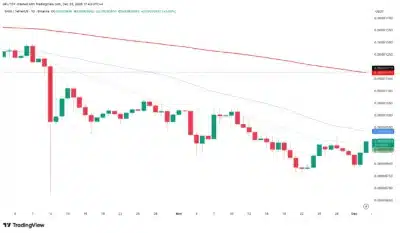
Shiba Inu’s Unexpected Rally Defies Market Sentiment, Posting 11% Gain
SHIB posts 11% rally despite market fear and uncertainty. Shiba Inu nears key resistance levels, targeting 200-day SMA. Meme coin’s unexpected surge sparks renewed optimism among investors. Shiba Inu (SHIB), Ethereum’s leading meme coin, has kicked off December with a significant price surge, defying the broader market’s gloomy outlook. After weeks of low liquidity and diminishing sentiment, SHIB has posted an 11% gain over the past 10 days, reaching a price of $0.00000899. This move marks a notable reversal after a long period of stagnation, catching the attention of both investors and analysts alike. What makes this recovery particularly remarkable is the backdrop of ongoing market uncertainty. The Fear and Greed Index remains firmly in the “fear” territory at 22, showing extreme fear levels of 16 earlier this week. Despite this, SHIB has managed to climb higher, suggesting that its recent price action is more driven by chart mechanics than investor sentiment. This shift indicates a potential technical reversal for the token. The SHIB price pattern reveals a structure that is not typical but has often appeared in assets that linger under their moving averages for extended periods. Currently, SHIB is testing the key resistance levels set by the 23-day Simple Moving Average (SMA) at $0.00000863 and the 50-day SMA at $0.00000934. These moving averages are converging into a crucial zone, with the potential to either halt SHIB’s momentum or propel it higher, depending on the strength of the next market impulse. Source: Tradinfview Also Read: XRP Spot Bubble Map Shows Cooling State Amid $89,000,000 XRP Purchase – What’s Next? Potential for Further Upside: 200-Day Moving Average in Sight The 200-day moving average, located at $0.00001175, is now the ultimate target for SHIB’s recovery. Achieving this level would signify a 30% increase in SHIB’s price, and more notably, it would result in the deletion of one zero from its current price. This possibility has reignited hope among SHIB holders who had been doubtful about a strong rebound. While the path to this 200-day moving average is not without challenges, SHIB’s recent momentum suggests that a continued rise is plausible. As long as the price can hold above the $0.00000800 level, the upward movement toward the 200-day SMA appears to be a realistic goal. This could mark a significant turning point for the meme coin, as it challenges the negative sentiment that had dominated the market in recent months. Also Read: Georgia Moves Toward Onchain Land Registry After New MoU With Hedera Network The post Shiba Inu’s Unexpected Rally Defies Market Sentiment, Posting 11% Gain appeared first on 36Crypto.
Share
Author: Coinstats2025/12/04 09:37

Ozak AI Price Prediction Suggests It Could Surge Faster Than Solana Did in 2021
Ozak AI is rapidly becoming one of the most talked-about emerging cryptocurrencies in the market, with analysts comparing its explosive potential to Solana’s legendary 2021 breakout—yet many believe Ozak AI could move even faster. While Solana climbed from early obscurity to one of the top altcoins within a single year,
Share
Author: Thenewscrypto2025/12/03 22:50

XBO.com Expands Spot Trading With Tokenized Global Stocks
XBO.com, a digital financial platform and cryptocurrency exchange of the future generation, has made an announcement about the deployment of tokenized equities on its Spot Trading platform. Through tokenized pairings, users are able to purchase and sell a variety of assets, including NVIDIA, Apple, Tesla, Microsoft, Google, Amazon, and Meta,
Share
Author: Thenewscrypto2025/12/03 22:00

Analyst Charts Show Ozak AI’s Profit Trajectory Could Outpace BNB’s 2018–2021 Surge by 420%
The crypto market is paying attention to Ozak AI ($OZ), as analysts estimate that its profit potential could surpass even Binance Coin’s phenomenal 420% surge. As the presale rounds gain traction, investors are keeping a careful eye on this AI-powered platform that combines DePIN technology, which can scan blockchain and
Share
Author: Thenewscrypto2025/12/03 21:42

Concordium and x402 Bring Verified AI Payments On-Chain
Concordium is integrating age and identity verification into AI-driven transactions in collaboration with the x402 protocol. The alliance allows AI agents and apps to independently initiate, validate, and finalize Stablecoin payments in a compliant and privacy-preserving manner by combining x402’s pay-to-access process with Concordium’s native ID layer. This helps the
Share
Author: Thenewscrypto2025/12/03 21:28



