Blockchain, at its core, is a decentralized distributed database or ledger. So, how does the "blockchain ledger" keep records? In current blockchain projects, there are two mainstream accountingBlockchain, at its core, is a decentralized distributed database or ledger. So, how does the "blockchain ledger" keep records? In current blockchain projects, there are two mainstream accounting
Learn/Cryptocurrency Knowledge/Basic Concepts/What Is Uns...put (UTXO)?

What Is Unspent Transaction Output (UTXO)?

Sep 21, 2026MEXC
0m
SynFutures
F$0.003741-0.08%
HAI
HAI$0.001441+3.66%
BOB
BOB$0.005215-1.41%


Blockchain, at its core, is a decentralized distributed database or ledger. So, how does the "blockchain ledger" keep records? In current blockchain projects, there are two mainstream accounting methods: The Account Balance Model (represented by Ethereum), and the Unspent Transaction Output (UTXO) Model (represented by Bitcoin). Understanding UTXO helps in comprehending the accounting logic behind Bitcoin's blockchain.

UTXO, which stands for Unspent Transaction Output, can be understood as the fundamental unit in Bitcoin transactions. For example, if Bob receives a Bitcoin payment and doesn't spend it, that Bitcoin becomes a UTXO. The UTXO model is similar to having a wallet where each UTXO is like a one-time-use paper bill. Each UTXO (paper bill) represents a specific amount of money, and by adding up all the UTXOs (paper bills), you can determine a user's balance.

In each transaction, whole integer multiples of UTXOs are used. For example, you can use 1 UTXO, 2 UTXOs, but you can't use fractions like 0.5 UTXO (similar to not being able to use half a paper bill). When a transaction occurs, the existing UTXOs (old paper bills) are consumed, and new UTXOs (new paper bills) are created. For example:In the morning, you go to buy coffee and a pastry, which costs $5. You hand the cashier a $10 bill. This $10 bill, represented as one UTXO, is given to the merchant. The merchant then gives you $5 in change, and at this point, you receive a new UTXO (a new $5 bill).

If this transaction occurs on a blockchain using the UTXO model, how would it operate? To understand this, we can abstract three transfer scenarios with examples, omitting miner fees for simplicity:

1.Two-Person Transactions


Let's assume Bob receives 10 BTC, so he has a UTXO of 10 BTC associated with his Bitcoin address. Now, Bob needs to transfer 2 BTC to Alice. In this case, the 10 BTC UTXO will be spent as a whole (the old paper bill is used up). 2 BTC (new paper bill) will be sent to Alice, and the remaining 8 BTC (new paper bill) will be returned to Bob as change. In other words, the original 10 BTC existed as a single UTXO, but during the transaction, this UTXO (the old paper bill) was destroyed and no longer exists. Instead, it was replaced by two new UTXOs (new paper bills): one belonging to Bob with a value of 8 BTC (which is the change returned to Bob), and the other belonging to Alice with a value of 2 BTC. In the future, Alice can use this UTXO as a balance to transfer to others.


If Alice wants to transfer those 2 BTC to Frank and to prevent Alice from double-spending those 2 BTC (which is akin to the well-known double-spending attack), miners need to verify that the UTXO has not been used in other transactions. If this UTXO has already been spent in a prior transaction, miners will reject the execution of this new transaction.

2. Multi-Party Transactions


Let's go through two examples to deepen our understanding. (1) One Address Transfers to Three Addresses (2) Three Addresses Transfer to One Address. Let's refer to these four addresses as A, B, C, and D. Scenario ① A transfers to B, C, and D. Scenario ② A, B, and C transfer to D. Initially, Address A has 10 BTC while B, C, and D have 0 BTC.

In scenario (1), Address A initially has one 10 BTC UTXO and wants to transfer 2 BTC to each of the addresses B, C, and D.


First, the original 10 BTC UTXO from A is entirely spent, and 2 BTC is sent to each of the addresses B, C, and D. The remaining 4 BTC is returned to A as change. At this point, the previous 10 BTC UTXO no longer exists and becomes four new UTXOs, one belonging to A valued at 4 BTC, and the other three belonging to B, C, and D, all valued at 2 BTC. After the transfer occurs, there is 1 UTXO of 4 BTC in Address A, 1 UTXO of 2 BTC in Address B, 1 UTXO of 2 BTC in Address C, and 1 UTXO of 2 BTC in Address D.

Now, let's simulate scenario (2), where A, B, and C each transfer 2 BTC to D.


The UTXO of 4 BTC at Address A will be spent as a whole, of which 2 BTC is transferred to D and 2 BTC is given as change to itself. The UTXO of 2 BTC in Address B is transferred to D, and the UTXO of 2 BTC in Address C is transferred to D. After the transfers have occurred, there will be 1 UTXO of 2 BTC in Address A, none at Address B, none at Address C, and 4 UTXOs of 2 BTC at Address D (1 of which is left over from the transfer happening in scenario ① and the rest are from scenario ②).

3. Two-Person Transaction, One Person has Multiple UTXOs


Suppose A has multiple UTXOs, which are 1 BTC UTXO, 2 BTC UTXO, 3 BTC UTXO, and 4 BTC UTXO, and B has no BTC. At this point, A needs to transfer 2.5 BTC to B. How does the UTXO model work?


At this point, the UTXO of 2 BTC in Address A will be transferred directly to B. The UTXO of 1 BTC will be spent as a whole, of which 0.5 BTC will be transferred to B, and 0.5 BTC will be given back as change. After the transfer, there are still 0.5 BTC UTXO, 3 BTC UTXO and 4 BTC UTXO in Address A. B has 2 BTC UTXO and 0.5 BTC UTXO.

In cryptocurrencies that utilize the UTXO model, if a user mistakenly enters an incorrect contract address, it is highly likely that the funds will be irrecoverable. This is because UTXOs do not store additional information about the transaction's outgoing state, and once a cryptocurrency transaction is completed, the corresponding UTXO no longer exists in the database. In essence, the system assumes that you have already spent the funds, and this action cannot be undone. Furthermore, if the contract address is incompatible or incorrect, it can lead to erroneous inputs, meaning the recipient cannot properly receive the cryptocurrency. As a result, it is very probable that the cryptocurrency will be unrecoverable.

We can see that: ① UTXOs record events rather than final states. ② Each UTXO represents a specific quantity of Bitcoin, and the sum of all UTXOs determines the account balance. ③ A UTXO is a Bitcoin transaction output. ④ A complete transaction consists of transaction outputs (senders) and transaction inputs (recipients). Transaction outputs can be referred to as Outputs, and transaction inputs can be referred to as Inputs. After a transaction is completed, any newly generated UTXOs are recorded in the Bitcoin ledger and can be used for further transactions. UTXOs, as the cornerstone of Bitcoin transactions, offer advantages such as security, privacy, and scalability. They serve as the foundational transaction framework for numerous blockchain projects.

The following tokens listed on MEXC use the UTXO model:


ADA, AE, AVAX, BCH, BCHA, BEAM, BHD, BSV, BTC, BTCV, BTM, BTM2, CHIA, CKB, DASH, DOGE, FIRO, HC, HNS, HYDRA, IOEX, KAS(KASPA), LBC, LBTC, LTC, MASS, PAC, PLCU, PSL, QTUM, RVN, SC, SYS, UT, WIT, XRD, XVG, ZEL, ZEN


If there is an error in transferring the cryptocurrency mentioned above, we will be unable to assist in recovering it. Please make sure to enter the correct deposit address before initiating any deposits!


Oportunidad de mercado
Logo de SynFutures
Precio de SynFutures(F)
$0.003741
$0.003741$0.003741
+3.42%
USD
Gráfico de precios en vivo de SynFutures (F)

Artículos populares

Ver más
Cómo operar una OPV en MEXC: Elegir el producto adecuado antes, durante y después de la cotización

Cómo operar una OPV en MEXC: Elegir el producto adecuado antes, durante y después de la cotización

Una IPO consta de tres etapas, no de un solo momento. Antes de la cotización, Pre-IPO Launchpad ofrece exposición basada en eventos, mientras que los futuros de Pre-IPO negocian expectativas de valora
Cómo elegir entre Stocks reales, Stocks tokenizados, contratos de acciones y ETFs

Cómo elegir entre Stocks reales, Stocks tokenizados, contratos de acciones y ETFs

La exposición a una empresa estadounidense puede obtenerse a través de varios vehículos diferentes: una acción en efectivo, un ETF, una Acción Tokenizada respaldada por activos, o un derivado de accio
Prima, Descuento y Error de Seguimiento en Productos Vinculados a Acciones

Prima, Descuento y Error de Seguimiento en Productos Vinculados a Acciones

Un producto vinculado a acciones puede hacer referencia a la misma empresa o índice de referencia, aunque difiera de este en precio de mercado, total rentabilidad, comisiones, liquidez y estructura le
Por qué los productos vinculados a acciones pueden operar de manera diferente cuando los mercados de EE. UU. están cerrados

Por qué los productos vinculados a acciones pueden operar de manera diferente cuando los mercados de EE. UU. están cerrados

Un producto vinculado a acciones puede seguir de cerca una acción estadounidense subyacente mientras el mercado de efectivo principal está activo, y luego comportarse de manera diferente cuando ese me

Noticias en tendencia

Ver más
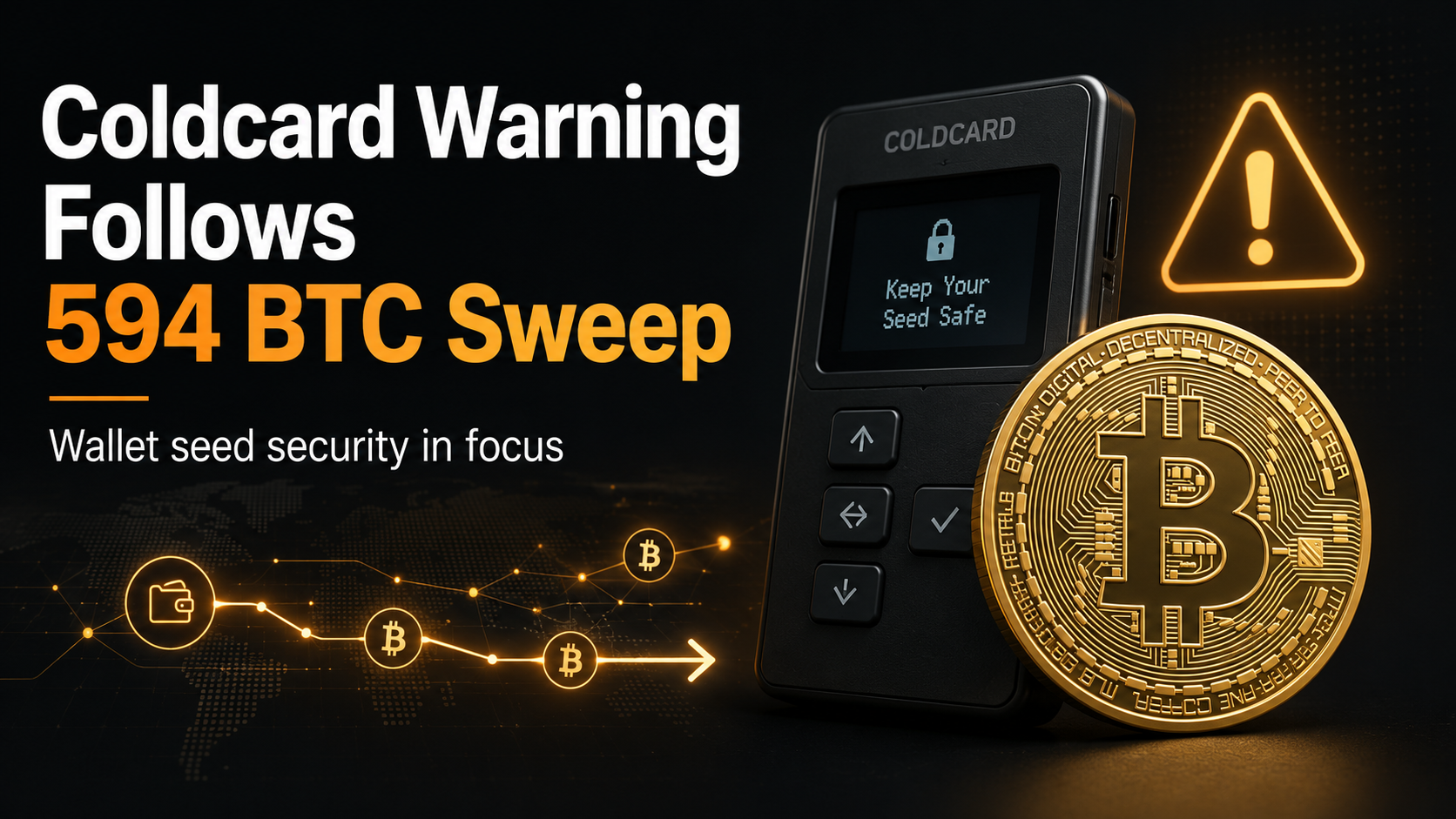
Advertencia de Coldcard Mk3 tras el barrido de 38 millones de dólares en Bitcoin, pero la causa sigue sin confirmarse

Advertencia de Coldcard Mk3 tras el barrido de 38 millones de dólares en Bitcoin, pero la causa sigue sin confirmarse

El fabricante de carteras frías de Bitcoin, Coinkite, ha advertido a los usuarios sobre un problema en la generación de semillas que afecta a los dispositivos Coldcard, incluidas todas las versiones d

Bitget abandona Japón: los servicios para residentes japoneses finalizan el 31 de diciembre de 2026

Bitget abandona Japón: los servicios para residentes japoneses finalizan el 31 de diciembre de 2026

Bitget pondrá fin a los servicios para los usuarios en Japón el 31 de diciembre de 2026. Los usuarios afectados deben cerrar las posiciones abiertas y retirar los activos antes de la fecha límite.

Mastercard completa la adquisición de BVNK por hasta 1.800 millones de dólares: las stablecoins entran en el núcleo de los pagos globales

Mastercard completa la adquisición de BVNK por hasta 1.800 millones de dólares: las stablecoins entran en el núcleo de los pagos globales

Mastercard completó su adquisición del proveedor de infraestructura de stablecoin BVNK el 3 de agosto de 2026, tras anunciar la transacción en marzo.

La relación entre el volumen de operaciones al contado de DEX y CEX alcanza el 24 % mientras se debilita la actividad de los exchanges centralizados

La relación entre el volumen de operaciones al contado de DEX y CEX alcanza el 24 % mientras se debilita la actividad de los exchanges centralizados

La relación entre el volumen al contado de los exchanges descentralizados y el volumen al contado de los exchanges centralizados alcanzó el 24,14 % en julio de 2026, según la serie de datos actual de

Artículos relacionados

Ver más
El Índice de Miedo y Codicia Crypto Cae a Miedo Extremo: Qué Significa y Cómo Deben Responder los Inversores

El Índice de Miedo y Codicia Crypto Cae a Miedo Extremo: Qué Significa y Cómo Deben Responder los Inversores

A fecha de 28 de mayo de 2026, el índice de miedo y codicia crypto ha caído bruscamente hasta 22, situando al mercado de nuevo en una zona de Miedo Extremo. Las redes sociales están inundadas de alert
¿Qué es el halving de Bitcoin? Guía completa del evento cíclico clave de las criptomonedas

¿Qué es el halving de Bitcoin? Guía completa del evento cíclico clave de las criptomonedas

El halving de Bitcoin es uno de los eventos más significativos y esperados en el mundo de las criptomonedas. Para los recién llegados al espacio cripto, entender qué es el halving y por qué es importa
Qué es un contrato inteligente: la guía definitiva sobre automatización en blockchain para principiantes

Qué es un contrato inteligente: la guía definitiva sobre automatización en blockchain para principiantes

Un contrato inteligente es un programa informático o protocolo de transacción que ejecuta, controla o documenta automáticamente eventos y acciones de acuerdo con términos y condiciones predefinidos. C
¿Qué son las criptomonedas? ¿Cómo funcionan las criptomonedas? Guía completa para principiantes en activos digitales

¿Qué son las criptomonedas? ¿Cómo funcionan las criptomonedas? Guía completa para principiantes en activos digitales

¡Bienvenido a tu puerta de entrada al emocionante mundo de las criptomonedas! Ya sea que hayas escuchado sobre el meteórico aumento de precio de Bitcoin o tengas curiosidad por las monedas digitales q


Regístrate en MEXC
Regístrate y recibe hasta 10.000 USDT en bonos
What's Your Wall Street DNA?
What's Your Wall Street DNA?What's Your Wall Street DNA?
6 personas. Everyone wins a share of $30K in NVDAX.