U.S. Stock Perps Are Coming: Why Kalshi and Coinbase Want In
Overview
The U.S. derivatives market may be approaching an important structural shift as Kalshi and Coinbase Derivatives both move to introduce perpetual futures linked to individual U.S. stocks. The proposals matter because perpetual futures are no longer being treated only as a crypto-native trading product. Instead, two major U.S. platforms are attempting to adapt the format to equities such as Apple, Nvidia and Tesla, potentially bringing continuous leveraged stock-price exposure into a regulated domestic market.
The appeal is straightforward. Perpetual futures provide long or short exposure without a fixed expiry date, eliminating the need to roll contracts and allowing traders to maintain positions as long as margin requirements are satisfied. However, single-stock perpetual futures are significantly more complicated than crypto perps because they reference securities. That places them within a regulatory structure involving both the SEC and CFTC, while also raising questions about leverage, price discovery, market surveillance and what happens when the derivative continues trading while the underlying stock market is closed.
The real significance of the Kalshi and Coinbase filings is therefore broader than product competition. They represent an early test of whether one of crypto’s most successful market structures can be transplanted into traditional finance without importing the excessive leverage, weak reference pricing and fragmented liquidity that have historically created problems in offshore perpetual markets.
Key Takeaways
- Kalshi and Coinbase Derivatives are both pursuing perpetual futures linked to individual U.S. equities.
- The products would provide synthetic stock-price exposure without direct share ownership.
- The lack of expiry makes perpetuals operationally simpler than traditional futures, but funding and basis risk become more important.
- SEC and CFTC oversight is central because single-stock perpetuals sit between securities and derivatives regulation.
- The larger question is whether crypto-native market design can be adapted successfully to regulated U.S. equities.
Why Are Kalshi and Coinbase Pursuing Stock Perpetuals Now?
The Timing Reflects a Broader Shift in U.S. Market Structure
Kalshi and Coinbase are moving at a moment when the boundary between crypto and traditional financial infrastructure is becoming less distinct. U.S. regulators and major financial firms are increasingly experimenting with tokenized securities, extended-hours trading, blockchain settlement and new derivatives structures. In that environment, perpetual futures are a logical next test because the format already has a proven user base in crypto markets and solves a practical problem faced by active traders: maintaining continuous exposure without repeatedly rolling expiring contracts.
Coinbase’s filing covers cash-settled futures linked to individual equities and ETFs, including perpetual structures, while Kalshi has submitted products tied to a range of major U.S. stocks. The simultaneous activity suggests that both firms see a commercial opportunity in bringing crypto-style trading mechanics to traditional assets. Importantly, neither filing should be interpreted as proof that these products are already broadly available. Regulatory approval, contract design and investor-access rules remain critical parts of the process.
For Coinbase, stock perpetuals would extend its broader strategy beyond spot crypto and conventional digital-asset derivatives. For Kalshi, the move builds on its earlier entry into regulated perpetual futures. The competition is therefore not merely about adding another contract type; it is about which platform can establish a compliant framework for a product category that could eventually sit between equity trading, futures and 24/7 digital markets.
What Are Single-Stock Perpetual Futures?
They Provide Price Exposure Without Share Ownership
Single-stock perpetual futures are derivatives designed to track the value of an individual equity without giving the trader legal ownership of the underlying shares. A trader can go long if they expect Nvidia or Tesla to rise, or short if they expect the stock to decline, but the position does not provide voting rights, shareholder status or the same legal claims associated with owning the actual security.
This distinction is especially important because perpetuals can easily be confused with tokenized stocks. A tokenized equity may, depending on its structure, represent ownership or contractual economic rights linked to a real security. A perpetual contract is different: it is primarily a synthetic instrument whose value depends on the reference price of the underlying stock. The trader owns the derivative position, not the company.
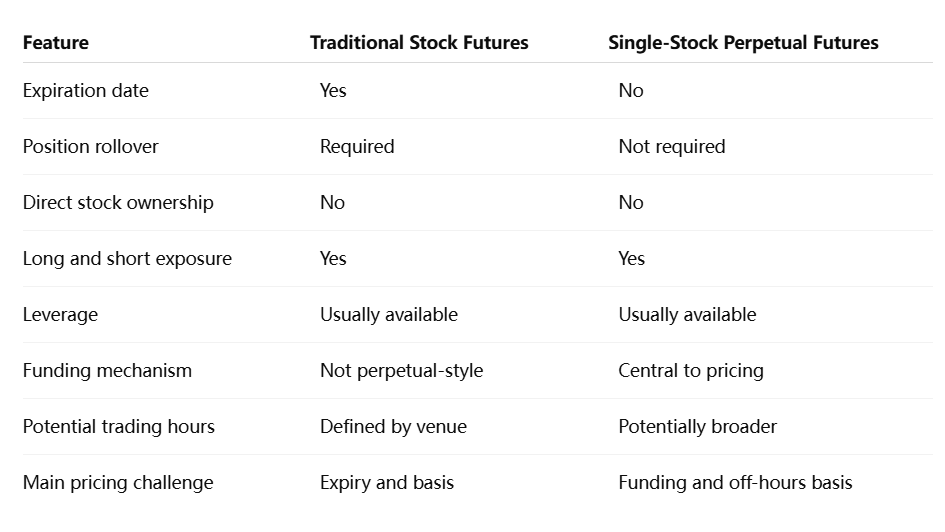
The absence of a fixed maturity date is what makes the structure unusual in traditional markets. Conventional futures expire, forcing traders to close or roll positions. Perpetuals can remain open indefinitely, provided margin requirements are maintained and funding costs are paid. That simplicity helped make the format dominant in crypto derivatives and is one reason platforms believe it could appeal to active equity traders as well.
How Do They Differ From Traditional Stock Futures?
Why Do Both the SEC and CFTC Matter?
Single-Stock Perpetuals Sit at the Intersection of Two Regulatory Regimes
The regulatory complexity is one of the most important differences between stock perpetuals and crypto perpetuals. Individual equities are securities, while futures contracts are derivatives. When the derivative references a single security, the product can enter the U.S. security-futures framework, where both the SEC and CFTC have roles in oversight.
That means product approval involves more than proving that the exchange can operate a futures contract. Regulators may need to assess margin requirements, investor protections, clearing arrangements, manipulation risk and the relationship between derivative activity and the underlying equity market. This dual-agency framework also makes it more difficult for U.S. platforms simply to copy the high-leverage, 24/7 perpetual model common on offshore crypto exchanges.
The key issue is market integrity. If a single-stock perpetual becomes liquid enough, activity in the derivative can influence expectations around the underlying share price, particularly outside regular trading hours. Regulators therefore need confidence that the contract’s reference-price methodology, surveillance systems and liquidation mechanisms remain robust even when the cash equity market is closed.
Why Could 24/7 Stock Perpetuals Matter?
Continuous Trading Could Change How Investors React to News
The most obvious potential advantage is continuous access. Traditional U.S. stock markets operate within defined trading sessions, even though pre-market and after-hours access have expanded. A perpetual market could potentially remain open at times when the underlying equity is not trading, allowing investors to react immediately to earnings surprises, geopolitical developments or company-specific news.
This could be particularly attractive to global traders who already operate in crypto markets around the clock. Instead of waiting for Nasdaq or NYSE to reopen, they could express a directional view through a derivative immediately. In that sense, stock perpetuals could function as an off-hours price-discovery venue.
The challenge is that price discovery becomes less reliable when the underlying market is closed. A Tesla perpetual may move sharply over a weekend after major news, but the actual Tesla share price remains unavailable until the cash market reopens. The derivative price therefore represents expectations, not an official market print. When the underlying market resumes, the two prices may converge quickly, creating significant basis volatility.
Off-Hours Trading Could Increase Basis Risk
This is one of the most important risks in the entire product design. Perpetual contracts depend on a credible reference price. During normal market hours, that can be anchored to active trading in the underlying stock. Outside those hours, the reference becomes more complicated because the actual security may not have a continuously observable market price.
Platforms will therefore need strong methodologies for mark prices, funding calculations and liquidation thresholds. If those systems are weak, traders could be liquidated based on distorted or thinly traded derivatives pricing rather than genuine changes in the underlying company’s market value. The opportunity for 24/7 access is therefore inseparable from the challenge of maintaining reliable pricing when the primary market is unavailable.
Why Would Traders Choose Stock Perpetuals?
No Expiry Simplifies Long-Term Position Management
The lack of maturity dates removes one of the recurring operational burdens of traditional futures trading. A trader who wants to maintain a directional position for several months does not need to close the current contract and reopen exposure in the next expiry. That can reduce friction, particularly for active participants already comfortable with perpetual funding.
However, this convenience is not free. Funding payments can accumulate over time, meaning the cost of holding a perpetual may become significant even if the position remains profitable on price alone. Long-term traders therefore need to consider funding just as traditional futures traders consider roll costs.
The product may ultimately be most attractive to active traders, hedgers and tactical participants rather than investors seeking traditional long-term equity ownership. That reinforces the distinction between a perpetual contract and owning the underlying stock.
What Risks Could Single-Stock Perpetual Futures Create?
Leverage, Liquidation and Basis Risk Could Amplify Equity Volatility
Individual stocks can already move sharply around earnings, regulatory events or company announcements. When leverage is added, relatively small moves in the underlying can produce much larger gains or losses at the account level. A trader using five or ten times leverage may face liquidation after a move that would be manageable for an unleveraged shareholder.
That becomes even more important outside normal stock-market hours, when liquidity may be thinner and pricing less anchored. A heavily leveraged perpetual market could produce liquidations based on temporary price dislocations that disappear once the underlying exchange reopens. For this reason, leverage caps and mark-price methodology may become as important as headline access.
There is also a broader market-structure risk. If perpetual liquidity fragments across several platforms, the same stock could effectively trade at different synthetic prices depending on venue. Deep liquidity and standardized pricing will therefore be necessary if these products are to become credible rather than merely speculative.
MEXC View: TradFi Is Borrowing Crypto’s Market Design
The most important development is not that U.S. stocks are becoming crypto assets. It is that market structures first popularized in crypto are being adapted to traditional finance. Perpetual futures demonstrated that traders value continuous exposure, flexible long-short positioning and the absence of contract expiry. Kalshi and Coinbase are now testing whether those characteristics can be brought into a more regulated equity environment.
From a market perspective, the next indicators to watch are not simply approval announcements. Funding formulas, trading hours, maximum leverage, market-maker participation and off-hours liquidity will determine whether these contracts become serious financial instruments. If they can maintain reliable pricing and deep liquidity while operating within U.S. regulatory standards, single-stock perpetuals could become one of the clearest examples of crypto market design influencing mainstream derivatives.
The key risk is that the format’s convenience could also import the weaknesses of crypto derivatives, particularly excessive leverage and unstable liquidation dynamics. The success of the product will therefore depend less on whether the U.S. allows perpetuals and more on how the final market structure is designed.
Single-Stock Perpetual Futures Could Become TradFi’s Next Crypto Export
The simultaneous push by Kalshi and Coinbase suggests that single-stock perpetual futures are no longer a fringe idea. The structure solves genuine problems for active traders by removing contract expiry and potentially extending stock-price exposure beyond traditional market hours. At the same time, the product introduces regulatory and market-design challenges that are far more complex than those faced by ordinary crypto perpetuals.
The central issue is whether continuous trading can remain closely anchored to an underlying security that does not itself trade continuously. Funding rates, mark prices, liquidation systems and cross-market surveillance will determine whether the product provides useful price discovery or simply creates another highly leveraged speculative layer around U.S. equities.
If regulators and platforms can solve those problems, the significance would extend well beyond Kalshi or Coinbase. It would show that perpetual futures, one of the most distinctive innovations of crypto market structure, can be adapted to regulated traditional assets. That could reshape how traders access equities and further narrow the line between crypto-native and conventional derivatives markets.
Sources
https://www.cftc.gov/IndustryOversight/IndustryFilings/TradingOrganizationProducts
https://www.sec.gov/rules-regulations/self-regulatory-organization-rulemaking/coin
https://www.coinbase.com/derivatives
Risk Disclaimer: This article is for reference only and does not constitute investment advice. The cryptocurrency market is highly volatile. Please make decisions cautiously based on your individual circumstances.
אולי תאהב גם

Solana Eyes 250ms Slots—Is 200ms Next?

SEC Innovation Exemption: How Tokenized Stocks Can Trade Onchain