

- קנייה/מכירה מהירהקנה ומכור באמצעות כרטיסים ותשלומים ניידים
- P2Pסחור עם תשלומים מקומיים במחירים הטובים ביותר
- הפקדת פיאטהפקדה ב BRL, COP, EUR ועוד
- העברה בנקאית גלובליתקנה ומכור דרך בנקים מקומיים
- MEXC Cardבזבז את הקריפטו שלך ברחבי העולם
- USDT-Mחוזים עתידיים תמידיים מוסדרים ב-USDT
- USDC-Mחוזים עתידיים תמידיים מוסדרים ב‑USDC
- USD1-MPerpetual Futures settled in USD1
- Coin-Mחוזים עתידיים תמידיים המוסדרים במטבעות קריפטו אחרים
- Futures Earnהרווח על היתרה ושחרר ריבית שנתית גבוהה יותר ככל שאתה סוחר
- מסחר בגרידנצלו את התנודתיות באמצעות מסחר אוטומטי
- העתקת מסחר באמצעות AIAI-Masters חדשים ומשופרים עם התאמת סגנון מדויקת
- מסחר דמודמיין מסחר בחוזי Futures ללא סיכון
- סקירת עתידגלו את הכלים, המוצרים והתכונות של החוזים עתידיים
- OIL Futures24/7 access to top liquidity & leveraged trading
- BTC FuturesMarket's lowest fees and high leverage
- ETH FuturesMarket's lowest fees and high leverage
- MEXC Earnהרוויח APR גבוה על הקריפטו שלך
- החזק והרוויחהחזק נכסים והרוויח ריבית יומית
- Futures Earnהרווח על היתרה ושחרר ריבית שנתית גבוהה יותר ככל שאתה סוחר
- On-Chain EarnEasy staking. Real on-chain yield
- הלוואות MEXCהשאל מיידית בריביות תחרותיות
- מרכז תגמוליםהתחל עם בונוסים של $10,000
- Event CenterHigher rewards, 0 fees
- הזמן והרוויחהזמן חברים והרוויח 140 USDT לכל אחד
- $500K BTC CarnivalWin up to 1 BTC & more!
- Launchpadקבל גישה לטוקנים מובילים מוקדם או בהנחה
- איירדרופ+הפקד וסחור כדי לדרוש איירדרופים חדשים
- קיקסטארטרהחזק MX כדי להרוויח טוקנים חדשים
- 0 FeesTrade hot futures, enjoy limited 0 fees
- חוזים עתידיים של M-Dayסחור בחוזים עתידיים וקבל תגמולים יומיים
- Futures Loss Coverage PlanGet triple protection and win $5,000 in XAUT
- תוכנית הפניותהזמן חברים ושחרר עמלות החל מ 40%
- תוכנית שותפיםעמלות שותפים ברמה גבוהה של עד 70%
- MEXC VVIPM-Score into Wealth, 10+ Elite Benefits Upgrading
- MEXC × TradingViewConnect MEXC to trade directly on TradingView
- חדשות קריפטועקוב אחר כותרות הקריפטו האחרונות
- הכרזותהישאר מעודכן בכל מה שקורה ב‑MEXC
- ללמודיסודות קריפטו חזקים לכל מתחיל
- MEXC מוסדיפתרונות מותאמים ללקוחות מוסדיים
USDC Revenue: Where Does Every Dollar Actually Go?
Circle's latest explanation of USDC revenue gives the market a clearer view of how stablecoin economics look after distribution and operating costs are included. During the first half of 2026, Circle said it generated approximately $1.4 billion in revenue and reserve income. Around $819 million went to distribution partners and transaction costs, while another $473 million supported licenses, banking relationships, settlement liquidity, compliance, product development and blockchain integrations. Circle said roughly seven cents of every revenue dollar ultimately remained as net profit.
The figure sounds unusually low until the layers underneath it are separated. Seven cents is not the yield paid to USDC holders, and it does not mean Circle captures only 7% of gross reserve income before expenses. The $819 million category also covers distribution partners and transaction costs collectively rather than representing one payment to Coinbase or another platform.
The disclosure arrives as newer stablecoins compete through free minting, redemption and aggressive revenue-sharing arrangements. That makes the central USDC revenue question less about how much reserve income Circle earns and more about how much of that income must be shared or reinvested to maintain distribution, liquidity, banking access and regulatory infrastructure. Stablecoin competition is increasingly becoming a contest over who absorbs those costs and who captures the remaining economics.
Key Takeaways
- Circle reported approximately $1.4 billion in first-half 2026 revenue and reserve income.
- Roughly $0.59 of every revenue dollar went to distribution partners and transaction costs.
- About $0.34 supported banking, liquidity, compliance, licenses and product infrastructure.
- Circle said approximately $0.07 per dollar remained as net profit.
- Stablecoin competition increasingly depends on distribution economics rather than token technology alone.
The $1 USDC Revenue Breakdown
Circle's disclosure can be understood most easily by following one dollar of revenue through the business.
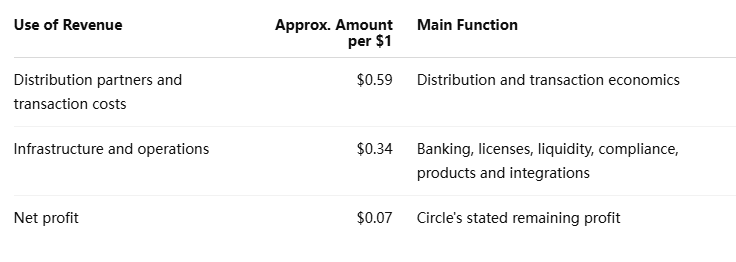
The table shows why the seven-cent headline needs context. Circle is describing the amount remaining after substantial partner payments and operating investment. It is not saying that USDC reserves generate only seven cents of gross economics per dollar of revenue.
MEXC's October 19 stablecoin market update also covers Circle's disclosure and the debate around zero-fee stablecoin competition.
Does Circle Really Keep Only 7 Cents Per Dollar?
According to Circle's first-half 2026 breakdown, approximately seven cents of each revenue dollar remained as net profit. That is an accounting outcome after distribution and operating costs rather than a fixed economic property of USDC.
The distinction matters because the number can move in several directions. Higher interest rates can increase reserve income. Larger USDC circulation can expand the reserve base. Partner agreements can become more or less expensive. Compliance, banking and liquidity costs can also change as Circle expands into new products and jurisdictions.
The seven-cent figure should therefore be treated as a snapshot of the current model, not as a permanent stablecoin margin.
Why Distribution Takes Such a Large Share
USDC may be issued by Circle, but users frequently encounter it through other companies. Exchanges, wallets, banks, fintech platforms and payment applications determine where USDC is available and how easily customers can hold or use it. Those relationships give distributors economic leverage.
A stablecoin's usefulness increases when it is available across more financial interfaces. That means distribution is not simply advertising. It helps create liquidity, accessibility and network effects.
The trade-off is straightforward:
- more revenue sharing can attract stronger distribution;
- stronger distribution can increase circulation;
- larger circulation can increase reserve income;
- higher partner costs can reduce the amount retained by the issuer;
- weaker incentives can make competing stablecoins more attractive to platforms.
The resulting model can grow quickly while still producing relatively thin retained margins.
Circle's $819 million category also needs to be read carefully. It includes distribution partners and transaction costs, so it cannot be treated as a direct measure of what one company such as Coinbase received.
Zero-Fee Competition Changes Where the Cost Sits
A stablecoin can advertise free minting or redemption, but the underlying financial infrastructure still has a cost. Banking relationships need to be maintained. Liquidity must be available when customers redeem. Compliance operations need staff and systems. Licenses carry ongoing obligations.
Zero fees therefore change who absorbs the cost rather than automatically eliminating it.
One issuer may subsidize redemption in order to accelerate adoption. Another may give a larger share of reserve income to exchanges or wallets. A third may operate in fewer jurisdictions and maintain a lighter compliance footprint.
Those choices can create genuine cost advantages, but they also make direct comparisons difficult because two stablecoins may be optimizing for different things.
Can Zero-Fee Stablecoins Undercut USDC?
Yes, particularly if they can combine lower explicit fees with stronger partner economics. Exchanges and fintech platforms have an incentive to support a stablecoin that generates more revenue for them, especially if users can mint and redeem the asset without additional friction.
The harder question is whether that model remains attractive at scale. A stablecoin supporting large institutional balances and frequent redemptions needs dependable banking, sufficient liquidity and operational resilience. Those functions become harder to subsidize indefinitely as circulation grows.
A zero-fee model is therefore most compelling when lower prices come from a genuinely lower cost structure rather than temporary incentives alone.
$36 Trillion in Volume Is a Different Metric
Circle says USDC processed more than $36 trillion in onchain transaction volume during the first half of 2026. It also reported more than $315 billion in minting and redemption activity, equal to approximately $1.7 billion per day. Circle further stated that USDC accounted for roughly 77% of global stablecoin transaction volume in June.
Those figures are useful measures of activity, but they should not be treated as equivalent to company revenue.
One USDC can move repeatedly between exchanges, wallets, DeFi applications and treasury accounts. Every transfer can add to onchain transaction volume even though the same underlying capital is being reused. This makes transaction volume fundamentally different from revenue or reserve balances.
The same distinction applies to market share. Transaction-volume share measures how actively a token moves, not how much stablecoin supply it represents.
For USDC revenue, the more important variables are average circulating balances, reserve yields, distribution agreements and the cost of supporting minting and redemption.
What Determines Stablecoin Profitability?
Stablecoin profitability is shaped by several variables that can move in opposite directions.
Higher circulation expands the reserve base. Higher short-term interest rates can increase income from those reserves. Better operating efficiency can reduce the share of revenue required for banking, compliance and technical infrastructure.
But growth can also become expensive. Distribution partners may demand more favorable economics as they gain bargaining power. Competitors can force issuers to offer stronger incentives. Expanding across more jurisdictions can increase compliance and licensing costs.
A larger stablecoin therefore does not automatically produce a more profitable issuer.
The economic outcome depends on whether additional balances generate enough incremental income to cover the distribution and infrastructure needed to acquire and retain them.
The Stablecoin Moat May Sit Outside the Token
Stablecoin smart contracts are becoming easier to reproduce. The harder layers are banking access, regulatory approvals, redemption liquidity, integrations and distribution.
Circle's own cost structure supports that interpretation. A large share of USDC revenue either goes to partners that distribute the stablecoin or is reinvested into the surrounding financial infrastructure.
That does not prove Circle's model is the most efficient one. A newer issuer may operate with lower costs or use a more aggressive revenue-sharing model to gain market share. But any competitor seeking comparable scale eventually has to solve similar questions around liquidity, redemption and financial access.
This shifts the competitive debate away from token creation and toward network economics.
MEXC View: Stablecoin Distribution Is Becoming Its Own Market
The stablecoin industry is increasingly developing a second layer of competition around the token itself. Issuers are not only competing for users; they are competing for the exchanges, wallets, banks and payment companies that determine which stablecoins those users encounter.
That means distribution can become a market in its own right. Platforms can negotiate for a share of reserve income, while issuers decide how much economics they are willing to surrender in exchange for access to customers and balances.
Circle's disclosure makes that trade-off visible. The company is generating substantial revenue, but most of the value is either shared with its network or reinvested in maintaining it.
The next phase of stablecoin competition may therefore be defined by distribution efficiency: how much an issuer must spend to acquire one additional dollar of durable circulation and how much profit remains once that balance is integrated into the broader financial system.
Risks and Limitations
- Circle's figures are company-reported. The October explanation also serves as a defense of Circle's model in the zero-fee competition debate.
- The seven-cent margin is historical. Interest rates, circulation, partner agreements and operating expenses can materially change future margins.
- Distribution costs may shift. Large exchanges and fintech platforms can gain or lose bargaining power over time.
- Transaction volume is not revenue. The $36 trillion figure reflects broad onchain activity rather than equivalent commercial monetization.
- Zero-fee competitors may genuinely operate differently. Lower costs, narrower regulatory footprints or temporary subsidies can make direct comparisons difficult.
- Circulation does not guarantee profit growth. Larger supply can still produce weak economics if distribution and infrastructure costs rise faster.
USDC Revenue Shows Distribution Is Now the Real Contest
USDC revenue provides a useful reminder that stablecoins are not simply reserve portfolios attached to tokens. Circle's first-half 2026 breakdown suggests that approximately 59 cents of every revenue dollar went to distribution partners and transaction costs, while another 34 cents supported infrastructure and operations. Only around seven cents remained as net profit.
That structure explains why zero-fee competition matters. A rival can challenge USDC by giving more economics to distributors, removing customer fees or operating with a leaner infrastructure model. But the comparison becomes meaningful only when liquidity, banking access, compliance and redemption reliability are considered alongside price.
Circle's current model could prove durable if its spending creates integrations and balances that competitors cannot easily displace. It could also become expensive if partner payments rise or if falling interest rates reduce the pool of reserve income available to share.
The most useful indicators to watch next are therefore not only USDC supply and transaction volume. Reserve yields, distribution costs, redemption activity, operating expenses and the ability of zero-fee competitors to retain balances after incentives normalize will provide a clearer picture of whether USDC's economics remain sustainable. Stablecoin competition is increasingly being decided around the token rather than inside it.
Sources
MEXC internal link used:
https://www.mexc.com/learn/article/mexc-on-chain-daily-report-polygon-labs-acquires-coinme-to-expand-into-stablecoin-payments
Circle — The Economics of USDC and Why Our Partners Win:
https://www.circle.com/blog/the-economics-of-usdc-and-why-our-partners-win
Risk Disclaimer: This article is for reference only and does not constitute investment advice. The cryptocurrency market is highly volatile. Please make decisions cautiously based on your individual circumstances.



תגובות
ניתן לבחור רק תגובות ואימוג'ים מוגדרים מראש