कैटेगरी की लिस्ट
कैंसिल करें

FAQ on Index Price, Fair Price, and Last Price

In MEXC Futures trading, index price, fair price, and last price are three core price references. Each serves a different purpose in pricing, risk control, and trade execution. This article explains the definitions, calculation logic, and practical usage of these three prices.

1. Index Price: Basics and Calculation


1.1 What Is the Index Price?


The index price is the weighted average price of the underlying asset across major spot exchanges. All MEXC Futures use prices from leading exchanges as index sources. The index price updates continuously as the underlying asset price changes, reflecting the asset's true market value.

The index price is designed to reduce risks caused by price volatility and market manipulation by providing a more stable pricing reference. It represents the fair market value across the broader market.

1.2 How Is the Index Price Calculated?


The index price is calculated as follows:

Index Price = (Weight % of Exchange A × Asset Price on Exchange A) + (Weight % of Exchange B × Asset Price on Exchange B) + … + (Weight % of Exchange N × Asset Price on Exchange N)

Where:
  • Weight % of Exchange i = Weight of Exchange i / Total Weight
  • Total Weight = Weight of Exchange A + Weight of Exchange B + … + Weight of Exchange N

MEXC periodically updates index components and their weights. In cases of extreme market conditions or abnormal price deviations, MEXC may implement additional protective measures, including but not limited to adjusting index components and weights.

1.3 What Protection Mechanisms Apply to the Index Price?


To ensure index price fairness, MEXC applies the following protection mechanisms:

Delayed Data Exclusion: If an exchange's market data updates slowly over an extended period or shows abnormal price deviations, its data will be excluded from index calculation. Once data quality returns to normal, it may be re-included.

Price Deviation Protection: If a Spot price from a specific exchange deviates by more than ±1% from the median price of all included exchanges, MEXC will exclude that exchange's price from the calculation. This rule does not apply when fewer than three exchange prices are available. During extreme market conditions, MEXC may adjust the deviation threshold for certain trading pairs or exempt them from this rule.

2. Fair Price: Basics and Calculation


2.1 What Is the Fair Price?


The fair price is calculated using the index price and a moving average of the basis. To enhance Futures market stability and reduce unnecessary liquidations during abnormal volatility, MEXC Futures use a uniquely designed fair price marking system.

Instead of using the last price, the system marks positions based on the fair price. This prevents unnecessary deviations between in-market prices and the index caused by manipulation or low liquidity, thereby avoiding unnecessary liquidations. The fair price is a core risk-control mechanism designed to protect traders.

2.2 How Is the Fair Price Calculated?


The fair price is calculated as:

Fair Price = Median (Funding Premium, Mid-Price Basis Fair Price, Last Price)

Where:
  • Funding Premium = Index Price × [1 + Latest Funding Rate × (Hours Until Next Funding / Funding Interval Hours)]
  • Mid-Price Basis Fair Price = Index Price + Basis Moving Average (specified period) = Index Price + Moving Average [(Best Bid + Best Ask) / 2 − Index Price]
  • Last Price = The most recent Futures trade price, updated in real time.

2.3 What Trading Data Does the Fair Price Affect?


The fair price only affects liquidation price and unrealized PNL. It does not affect realized PNL. This means that after an order is filled, you may immediately see positive or negative unrealized PNL due to a slight difference between the fair price and the execution price. This is normal and does not indicate an actual loss. Traders should focus on the liquidation price based on the fair price to avoid premature liquidation.

3. Last Price: Basics


3.1 What Is the Last Price?


The last price is the most recent execution price in the MEXC Futures order book. It directly reflects real-time trading activity on the MEXC platform and represents the actual price of the latest matched trade between buyers and sellers.

The last price directly determines the execution price of market orders. While it has the highest immediacy, it is also the most susceptible to large orders or insufficient market depth, which can cause sharp price fluctuations.

4. Key Differences Between Index Price, Fair Price, and Last Price


Comparison
Index Price
Fair Price
Last Price
Core Definition
Weighted average price across major exchanges
Smoothed price based on index price and basis moving average
Real-time execution price on MEXC
Primary Function
Anchor fair market value and prevent single-platform manipulation
Calculate unrealized PNL and trigger liquidation
Execute trades and calculate realized PNL
Trader Impact
Indirect; forms the basis of fair price
Directly affects unrealized PNL and position safety
Directly affects actual entry and exit prices
Price Characteristics
Relatively stable, reflects market-wide trend
Smoothed, filters short-term volatility
Most immediate, but also most volatile

5. How to Switch Between Index Price, Fair Price, and Last Price on MEXC


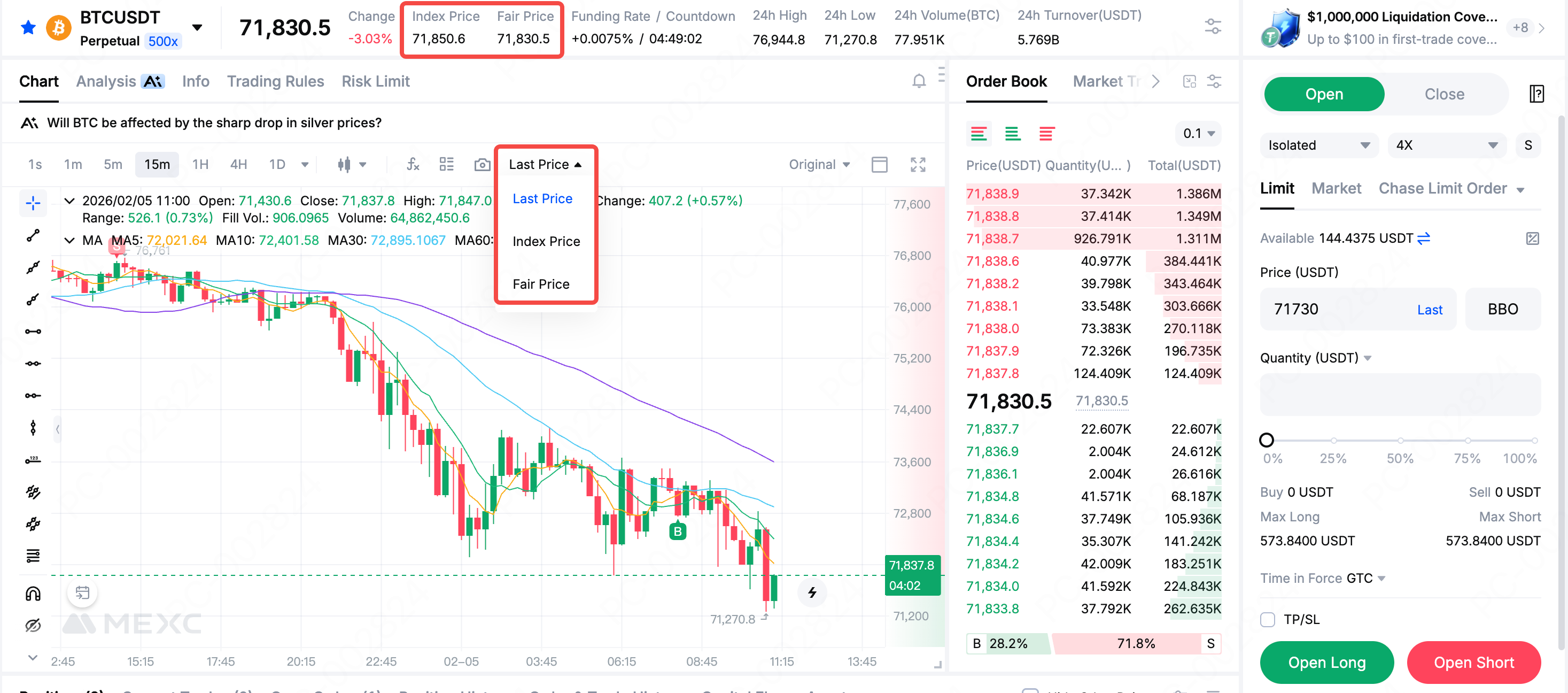
5.1 How to Switch Price Display on MEXC Web?


Steps:
1) Open the MEXC Futures trading page.
2) Hover over Last Price/Index Price/Fair Price ▼ above the candlestick chart.
3) Select the price type you want from the dropdown menu.
You can also view real-time index price and fair price next to the trading pair.


5.2 How to Switch Price Display on the MEXC App?


Steps:
1) Open the MEXC App and tap Futures at the bottom.
2) On the Futures trading page, tap the candlestick icon.
3) On the candlestick trading page, tap Last Price/Index Price/Fair Price ▼ above the chart.
4) Select the desired price type to complete the switch.


6. Why Does a Loss Appear Immediately After Opening a Position?


This occurs because your entry price is based on the last price, while unrealized PNL is calculated using the fair price. When there is a small difference between the two, unrealized gains or losses may appear immediately.

This does not mean you have actually lost funds. It is normal Futures trading behavior caused by different pricing references. Traders should focus on the liquidation price based on the fair price, not solely on last price fluctuations.

7. Which Price Is Used to Calculate the Liquidation Price?


Liquidation is based on the fair price, not the last price. This design protects traders from brief abnormal price spikes. Even if the last price on the chart momentarily touches the liquidation level, the position will not be liquidated as long as the fair price remains within a safe range. Therefore, traders should always monitor the distance between the fair price and the liquidation price.

8. Can the Index Price Be Manipulated?


In theory, it is extremely difficult. Since the index price is derived from a weighted average across multiple major exchanges, manipulating it would require deploying a massive amount of capital simultaneously across several large exchanges, an extremely costly and impractical endeavor.

In addition, MEXC's price protection mechanisms (such as excluding deviating or delayed data sources) further increase the difficulty of manipulation and effectively protect traders.

9. What Does a Large Gap Between the Last Price and Fair Price Indicate?


A significant difference between the last price and the fair price usually indicates:
  • Extreme market volatility: Intense market sentiment (panic or euphoria) drives the last price rapidly, while the fair price lags due to its smoothing mechanism.
  • Insufficient liquidity: Low liquidity on a platform makes the last price more susceptible to large orders.
This is an important warning signal for traders, indicating elevated market risk and potential severe slippage.


FAQ on Index Price, Fair Price, and Last Price

In MEXC Futures trading, index price, fair price, and last price are three core price references. Each serves a different purpose in pricing, risk control, and trade execution. This article explains the definitions, calculation logic, and practical usage of these three prices.

1. Index Price: Basics and Calculation


1.1 What Is the Index Price?


The index price is the weighted average price of the underlying asset across major spot exchanges. All MEXC Futures use prices from leading exchanges as index sources. The index price updates continuously as the underlying asset price changes, reflecting the asset's true market value.

The index price is designed to reduce risks caused by price volatility and market manipulation by providing a more stable pricing reference. It represents the fair market value across the broader market.

1.2 How Is the Index Price Calculated?


The index price is calculated as follows:

Index Price = (Weight % of Exchange A × Asset Price on Exchange A) + (Weight % of Exchange B × Asset Price on Exchange B) + … + (Weight % of Exchange N × Asset Price on Exchange N)

Where:
  • Weight % of Exchange i = Weight of Exchange i / Total Weight
  • Total Weight = Weight of Exchange A + Weight of Exchange B + … + Weight of Exchange N

MEXC periodically updates index components and their weights. In cases of extreme market conditions or abnormal price deviations, MEXC may implement additional protective measures, including but not limited to adjusting index components and weights.

1.3 What Protection Mechanisms Apply to the Index Price?


To ensure index price fairness, MEXC applies the following protection mechanisms:

Delayed Data Exclusion: If an exchange's market data updates slowly over an extended period or shows abnormal price deviations, its data will be excluded from index calculation. Once data quality returns to normal, it may be re-included.

Price Deviation Protection: If a Spot price from a specific exchange deviates by more than ±1% from the median price of all included exchanges, MEXC will exclude that exchange's price from the calculation. This rule does not apply when fewer than three exchange prices are available. During extreme market conditions, MEXC may adjust the deviation threshold for certain trading pairs or exempt them from this rule.

2. Fair Price: Basics and Calculation


2.1 What Is the Fair Price?


The fair price is calculated using the index price and a moving average of the basis. To enhance Futures market stability and reduce unnecessary liquidations during abnormal volatility, MEXC Futures use a uniquely designed fair price marking system.

Instead of using the last price, the system marks positions based on the fair price. This prevents unnecessary deviations between in-market prices and the index caused by manipulation or low liquidity, thereby avoiding unnecessary liquidations. The fair price is a core risk-control mechanism designed to protect traders.

2.2 How Is the Fair Price Calculated?


The fair price is calculated as:

Fair Price = Median (Funding Premium, Mid-Price Basis Fair Price, Last Price)

Where:
  • Funding Premium = Index Price × [1 + Latest Funding Rate × (Hours Until Next Funding / Funding Interval Hours)]
  • Mid-Price Basis Fair Price = Index Price + Basis Moving Average (specified period) = Index Price + Moving Average [(Best Bid + Best Ask) / 2 − Index Price]
  • Last Price = The most recent Futures trade price, updated in real time.

2.3 What Trading Data Does the Fair Price Affect?


The fair price only affects liquidation price and unrealized PNL. It does not affect realized PNL. This means that after an order is filled, you may immediately see positive or negative unrealized PNL due to a slight difference between the fair price and the execution price. This is normal and does not indicate an actual loss. Traders should focus on the liquidation price based on the fair price to avoid premature liquidation.

3. Last Price: Basics


3.1 What Is the Last Price?


The last price is the most recent execution price in the MEXC Futures order book. It directly reflects real-time trading activity on the MEXC platform and represents the actual price of the latest matched trade between buyers and sellers.

The last price directly determines the execution price of market orders. While it has the highest immediacy, it is also the most susceptible to large orders or insufficient market depth, which can cause sharp price fluctuations.

4. Key Differences Between Index Price, Fair Price, and Last Price


Comparison
Index Price
Fair Price
Last Price
Core Definition
Weighted average price across major exchanges
Smoothed price based on index price and basis moving average
Real-time execution price on MEXC
Primary Function
Anchor fair market value and prevent single-platform manipulation
Calculate unrealized PNL and trigger liquidation
Execute trades and calculate realized PNL
Trader Impact
Indirect; forms the basis of fair price
Directly affects unrealized PNL and position safety
Directly affects actual entry and exit prices
Price Characteristics
Relatively stable, reflects market-wide trend
Smoothed, filters short-term volatility
Most immediate, but also most volatile

5. How to Switch Between Index Price, Fair Price, and Last Price on MEXC


5.1 How to Switch Price Display on MEXC Web?


Steps:
1) Open the MEXC Futures trading page.
2) Hover over Last Price/Index Price/Fair Price ▼ above the candlestick chart.
3) Select the price type you want from the dropdown menu.
You can also view real-time index price and fair price next to the trading pair.


5.2 How to Switch Price Display on the MEXC App?


Steps:
1) Open the MEXC App and tap Futures at the bottom.
2) On the Futures trading page, tap the candlestick icon.
3) On the candlestick trading page, tap Last Price/Index Price/Fair Price ▼ above the chart.
4) Select the desired price type to complete the switch.


6. Why Does a Loss Appear Immediately After Opening a Position?


This occurs because your entry price is based on the last price, while unrealized PNL is calculated using the fair price. When there is a small difference between the two, unrealized gains or losses may appear immediately.

This does not mean you have actually lost funds. It is normal Futures trading behavior caused by different pricing references. Traders should focus on the liquidation price based on the fair price, not solely on last price fluctuations.

7. Which Price Is Used to Calculate the Liquidation Price?


Liquidation is based on the fair price, not the last price. This design protects traders from brief abnormal price spikes. Even if the last price on the chart momentarily touches the liquidation level, the position will not be liquidated as long as the fair price remains within a safe range. Therefore, traders should always monitor the distance between the fair price and the liquidation price.

8. Can the Index Price Be Manipulated?


In theory, it is extremely difficult. Since the index price is derived from a weighted average across multiple major exchanges, manipulating it would require deploying a massive amount of capital simultaneously across several large exchanges, an extremely costly and impractical endeavor.

In addition, MEXC's price protection mechanisms (such as excluding deviating or delayed data sources) further increase the difficulty of manipulation and effectively protect traders.

9. What Does a Large Gap Between the Last Price and Fair Price Indicate?


A significant difference between the last price and the fair price usually indicates:
  • Extreme market volatility: Intense market sentiment (panic or euphoria) drives the last price rapidly, while the fair price lags due to its smoothing mechanism.
  • Insufficient liquidity: Low liquidity on a platform makes the last price more susceptible to large orders.
This is an important warning signal for traders, indicating elevated market risk and potential severe slippage.