Futures Trading Page Terminology GuideFutures Trading Page Terminology Guide
कैटेगरी की लिस्ट
कैंसिल करें

Futures Trading Page Terminology Guide

For beginner users, Futures trading is more complex than spot trading and involves a wider range of professional terms. To help you get started quickly, this article provides a systematic explanation of the key terms used on the MEXC Futures trading page, making it easier to understand and use the platform.
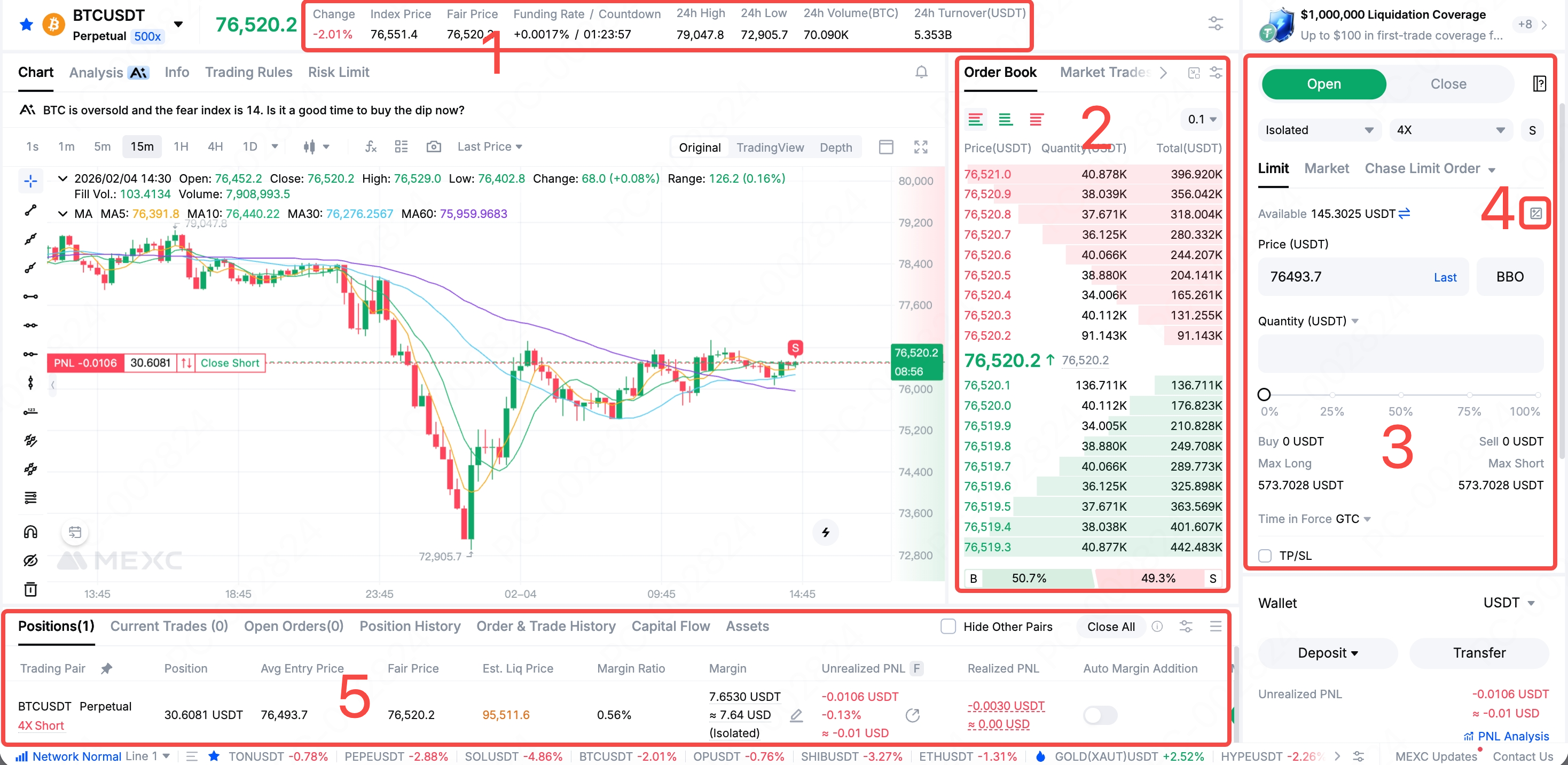


1. Basic Terminology


Perpetual: Perpetual means ongoing without an expiration date. Commonly known as Perpetual Futures, these products evolved from traditional Futures but do not have a settlement or expiry date. As long as a position is not liquidated, it can remain open indefinitely.

Price Change (%): Price change refers to the percentage increase or decrease in price over a specific period. Formula: Price Change (%) = (Closing Price − Opening Price) / Opening Price

Index Price: A composite price index calculated using a weighted average of prices from major mainstream exchanges. The index price shown on the page is the MX Index Price.

Fair Price: The real-time fair price of the Futures, calculated based on the index price and market price. It is used to calculate unrealized PNL and determine liquidation, and may differ from the last price to prevent price manipulation.

Funding Rate/Countdown: The current funding rate for the ongoing period. If the rate is positive, long positions pay short positions. If the rate is negative, short positions pay long positions.


2. Order Book Terminology


Order Book: A window for observing market activity during trading. In this section, users can view individual trades and the relative strength of buyers and sellers.

Market Movers: Assets that experience significant price fluctuations within a specific time range. This tool helps traders quickly identify potential opportunities based on price movements and other indicators.


3. Trading Terminology


Open Position/Close Position: After entering the price and quantity based on your market outlook, you can choose to open a long or short position. If you expect prices to rise, open a long position. If you expect prices to fall, open a short position. Closing a position means selling the Futures you previously opened. Open but unsettled positions are referred to aspositions, which can be viewed underPositions at the bottom of the page.

Open Long: Opening a position based on the expectation that the asset price will rise.

Open Short: Opening a position based on the expectation that the asset price will fall.

Margin and Margin Mode: Margin refers to a portion of funds that users deposit as financial margin in order to participate in Futures trading. This deposited amount is known as margin. Margin modes are divided into isolated margin mode and cross margin mode.

Isolated Margin: Under isolated margin mode, a fixed amount of margin is allocated to a specific position. If losses on the position reduce the margin below the maintenance margin level, the position will be liquidated. Users may also choose to add or reduce margin for this position.

Cross Margin: Under cross margin mode, all cross positions share the available cross margin of the corresponding asset. In the event of liquidation, traders may lose the entire margin as well as all cross positions under that margin asset.

Order Types: Order types include limit order, market order, chase limit order, trigger order, trailing stop, and post only.

Limit Order: A limit order is an order to buy or sell at a specified price or better. Execution of a limit order is not guaranteed.

Market Order: A market order is an order to buy or sell immediately at the best available market price.

Chase Limit Order: A chase limit order is a type of limit order placed at the best bid or ask price. It dynamically adjusts the entry price based on changing market conditions until the order is filled, canceled, or reaches the maximum chase distance.

Trigger Order: Users can pre-set a trigger price, order price, and quantity. When the market price reaches the trigger price, the system will automatically place the order at the specified order price. Before the trigger order is successfully activated, positions and margin will not be frozen.

Trailing Stop Order: A trailing stop order is a strategy order that submits an order to the market when prices retrace. The actual trigger price is calculated as:
  • Highest (lowest) market price ± retracement amount (price difference), or
  • Highest (lowest) market price × (1 ± retracement percentage)
Users can also set an activation price. The trigger price calculation only begins after the order is activated.

Post Only: Post only orders will not be executed immediately on the market, ensuring the user always acts as a maker. If the order immediately matches with an existing order, it will be canceled.

Take-Profit/Stop-Loss (TP/SL): A preset closing order with trigger conditions (take-profit price or stop-loss price). When the last price, fair price, or index price reaches the preset trigger price, the system will close the position at the best available market price based on the predefined quantity, allowing users to lock in profits or avoid unnecessary losses.

Limit Take-Profit/Stop-Loss: A limit TP/SL order is a preset order where users specify the stop price, limit price, and buy/sell amount. When the last price reaches the stop price, the system automatically places a limit order at the specified limit price.

Coin-Margined Futures: Coin-Margined Futures provided by MEXC are inverse futures, where cryptocurrency is used as margin and serves as the base currency. For example, in BTC-Margined Futures, BTC is used as the initial margin and for PNL calculation.

Stablecoin-Margined Futures: Stablecoin-Margined Futures provided by MEXC (for example USDT-M Futures) are linear derivatives quoted and settled in USDT. USDT is a stablecoin pegged to the value of the U.S. dollar.


4. Futures Calculation Terminology


PNL Calculation: Enter your entry price, futures position size, and leverage, then set your expected exit price to calculate the final profit amount and return on investment (ROI).

Target Price Calculation: Enter your entry price, Futures position size, and leverage, then set your desired ROI to calculate the target price and profit amount.

Liquidation Price: Enter your entry price, Futures position size, and leverage, and select the margin mode (cross or isolated) to calculate your liquidation price.

Maximum Position Size: Enter your entry price and leverage, then input the amount of margin available to calculate the maximum Futures position size you can open for long or short positions.

Average Entry Price: If you open multiple Futures positions for the same trading pair, enter the different entry prices and corresponding position sizes to calculate the combined average entry price for that trading pair.

Funding Fee: Enter the fair price, position size, and current funding rate to calculate the amount of funding fee you need to pay or receive.

Note: Futures calculation input terms are for reference only. Actual Futures trading calculations are subject to live trading.

For beginners, before placing your first Futures trade, you can practice using MEXC Futures Demo Trading to gain hands-on experience. After becoming familiar with the platform's features, you can then proceed to live trading.


5. Order Terminology


5.1 Positions


Position Size: The number of open (unclosed) Futures positions.

Average Entry Price: The average cost at which a position is opened. For example, if a user opens 100 cont. of long positions on MXUSDT Perpetual Futures at 2 USDT, and later opens another 100 cont. of long positions in the same direction at 2.1 USDT, then the average entry price is calculated as (2 × 100 + 2.1 × 100) / (100 + 100) = 2.05 USDT.

Fair Price: A mechanism introduced to prevent user losses caused by abnormal price fluctuations on a single platform. It is calculated using weighted price data from major exchanges and more fairly reflects the true market price. For more information, please refer to Index Price, Fair Price, and Last Price.

Estimated Liquidation Price: When the fair price reaches the estimated liquidation price, the position will be liquidated. To learn more about liquidation, please refer to What Is Liquidation? A Complete Guide to Its Mechanism, Price Calculation, and Risk Management.

Margin Ratio: Used to measure the risk level of a position. The lower the margin rate, the relatively lower the position risk. When the margin ratio reaches 100%, the position will be liquidated.

Margin: Position margin includes the initial margin and closing fees. In isolated margin mode, additional margin can be added to the position.

Unrealized PNL: Calculated based on the fair price or the last price. Position ROI = Unrealized PNL / Initial margin. Therefore, ROI is only related to the current leverage level and is not affected by increases or decreases in margin.

Realized PNL: All realized profits and losses generated by the position, including trading fees, funding fees, and PNL from closing positions.


5.2 Open Orders


Amount/Filled Amount: Order amount refers to the intended execution size set by the user when placing an order. When the order amount is large, it is usually filled in multiple smaller orders. Filled amount refers to the amount that has actually been executed. When the order amount equals the filled amount, it means the order has been fully filled.

Order Price/Average Fill Price: Order price refers to the expected execution price entered by the user. For limit orders, the order price is the price entered by the user. For market orders, the order price depends on the actual execution result. When large orders are split into multiple sub-orders, the fill prices may vary due to market fluctuations. The average of these execution prices is the average fill price.


5.3 Position History


Average Entry Price: The average cost of opening the position.

Average Close Price: The average price of all closing trades.

Realized PNL: All realized profits and losses generated by the position, including trading fees, funding fees, and PNL from closing positions (does not include fees offset by vouchers or MX deductions).


5.4 Assets


Total Equity: Wallet Balance + Unrealized PNL.

Wallet Balance: Total transferred-in funds − total transferred-out funds + Realized PNL.

Available Margin: The amount of funds available for opening new positions.


Understanding Futures trading terminology is only the first step in learning how to use Futures trading tools. To truly master them, you need to apply what you've learned through actual trading. Before starting live Futures trading, you can practice using the MEXC Futures Demo Trading to become familiar with the platform, and then proceed to live trading.

Futures Trading Page Terminology Guide

For beginner users, Futures trading is more complex than spot trading and involves a wider range of professional terms. To help you get started quickly, this article provides a systematic explanation of the key terms used on the MEXC Futures trading page, making it easier to understand and use the platform.


1. Basic Terminology


Perpetual: Perpetual means ongoing without an expiration date. Commonly known as Perpetual Futures, these products evolved from traditional Futures but do not have a settlement or expiry date. As long as a position is not liquidated, it can remain open indefinitely.

Price Change (%): Price change refers to the percentage increase or decrease in price over a specific period. Formula: Price Change (%) = (Closing Price − Opening Price) / Opening Price

Index Price: A composite price index calculated using a weighted average of prices from major mainstream exchanges. The index price shown on the page is the MX Index Price.

Fair Price: The real-time fair price of the Futures, calculated based on the index price and market price. It is used to calculate unrealized PNL and determine liquidation, and may differ from the last price to prevent price manipulation.

Funding Rate/Countdown: The current funding rate for the ongoing period. If the rate is positive, long positions pay short positions. If the rate is negative, short positions pay long positions.


2. Order Book Terminology


Order Book: A window for observing market activity during trading. In this section, users can view individual trades and the relative strength of buyers and sellers.

Market Movers: Assets that experience significant price fluctuations within a specific time range. This tool helps traders quickly identify potential opportunities based on price movements and other indicators.


3. Trading Terminology


Open Position/Close Position: After entering the price and quantity based on your market outlook, you can choose to open a long or short position. If you expect prices to rise, open a long position. If you expect prices to fall, open a short position. Closing a position means selling the Futures you previously opened. Open but unsettled positions are referred to aspositions, which can be viewed underPositions at the bottom of the page.

Open Long: Opening a position based on the expectation that the asset price will rise.

Open Short: Opening a position based on the expectation that the asset price will fall.

Margin and Margin Mode: Margin refers to a portion of funds that users deposit as financial margin in order to participate in Futures trading. This deposited amount is known as margin. Margin modes are divided into isolated margin mode and cross margin mode.

Isolated Margin: Under isolated margin mode, a fixed amount of margin is allocated to a specific position. If losses on the position reduce the margin below the maintenance margin level, the position will be liquidated. Users may also choose to add or reduce margin for this position.

Cross Margin: Under cross margin mode, all cross positions share the available cross margin of the corresponding asset. In the event of liquidation, traders may lose the entire margin as well as all cross positions under that margin asset.

Order Types: Order types include limit order, market order, chase limit order, trigger order, trailing stop, and post only.

Limit Order: A limit order is an order to buy or sell at a specified price or better. Execution of a limit order is not guaranteed.

Market Order: A market order is an order to buy or sell immediately at the best available market price.

Chase Limit Order: A chase limit order is a type of limit order placed at the best bid or ask price. It dynamically adjusts the entry price based on changing market conditions until the order is filled, canceled, or reaches the maximum chase distance.

Trigger Order: Users can pre-set a trigger price, order price, and quantity. When the market price reaches the trigger price, the system will automatically place the order at the specified order price. Before the trigger order is successfully activated, positions and margin will not be frozen.

Trailing Stop Order: A trailing stop order is a strategy order that submits an order to the market when prices retrace. The actual trigger price is calculated as:
  • Highest (lowest) market price ± retracement amount (price difference), or
  • Highest (lowest) market price × (1 ± retracement percentage)
Users can also set an activation price. The trigger price calculation only begins after the order is activated.

Post Only: Post only orders will not be executed immediately on the market, ensuring the user always acts as a maker. If the order immediately matches with an existing order, it will be canceled.

Take-Profit/Stop-Loss (TP/SL): A preset closing order with trigger conditions (take-profit price or stop-loss price). When the last price, fair price, or index price reaches the preset trigger price, the system will close the position at the best available market price based on the predefined quantity, allowing users to lock in profits or avoid unnecessary losses.

Limit Take-Profit/Stop-Loss: A limit TP/SL order is a preset order where users specify the stop price, limit price, and buy/sell amount. When the last price reaches the stop price, the system automatically places a limit order at the specified limit price.

Coin-Margined Futures: Coin-Margined Futures provided by MEXC are inverse futures, where cryptocurrency is used as margin and serves as the base currency. For example, in BTC-Margined Futures, BTC is used as the initial margin and for PNL calculation.

Stablecoin-Margined Futures: Stablecoin-Margined Futures provided by MEXC (for example USDT-M Futures) are linear derivatives quoted and settled in USDT. USDT is a stablecoin pegged to the value of the U.S. dollar.


4. Futures Calculation Terminology


PNL Calculation: Enter your entry price, futures position size, and leverage, then set your expected exit price to calculate the final profit amount and return on investment (ROI).

Target Price Calculation: Enter your entry price, Futures position size, and leverage, then set your desired ROI to calculate the target price and profit amount.

Liquidation Price: Enter your entry price, Futures position size, and leverage, and select the margin mode (cross or isolated) to calculate your liquidation price.

Maximum Position Size: Enter your entry price and leverage, then input the amount of margin available to calculate the maximum Futures position size you can open for long or short positions.

Average Entry Price: If you open multiple Futures positions for the same trading pair, enter the different entry prices and corresponding position sizes to calculate the combined average entry price for that trading pair.

Funding Fee: Enter the fair price, position size, and current funding rate to calculate the amount of funding fee you need to pay or receive.

Note: Futures calculation input terms are for reference only. Actual Futures trading calculations are subject to live trading.

For beginners, before placing your first Futures trade, you can practice using MEXC Futures Demo Trading to gain hands-on experience. After becoming familiar with the platform's features, you can then proceed to live trading.


5. Order Terminology


5.1 Positions


Position Size: The number of open (unclosed) Futures positions.

Average Entry Price: The average cost at which a position is opened. For example, if a user opens 100 cont. of long positions on MXUSDT Perpetual Futures at 2 USDT, and later opens another 100 cont. of long positions in the same direction at 2.1 USDT, then the average entry price is calculated as (2 × 100 + 2.1 × 100) / (100 + 100) = 2.05 USDT.

Fair Price: A mechanism introduced to prevent user losses caused by abnormal price fluctuations on a single platform. It is calculated using weighted price data from major exchanges and more fairly reflects the true market price. For more information, please refer to Index Price, Fair Price, and Last Price.

Estimated Liquidation Price: When the fair price reaches the estimated liquidation price, the position will be liquidated. To learn more about liquidation, please refer to What Is Liquidation? A Complete Guide to Its Mechanism, Price Calculation, and Risk Management.

Margin Ratio: Used to measure the risk level of a position. The lower the margin rate, the relatively lower the position risk. When the margin ratio reaches 100%, the position will be liquidated.

Margin: Position margin includes the initial margin and closing fees. In isolated margin mode, additional margin can be added to the position.

Unrealized PNL: Calculated based on the fair price or the last price. Position ROI = Unrealized PNL / Initial margin. Therefore, ROI is only related to the current leverage level and is not affected by increases or decreases in margin.

Realized PNL: All realized profits and losses generated by the position, including trading fees, funding fees, and PNL from closing positions.


5.2 Open Orders


Amount/Filled Amount: Order amount refers to the intended execution size set by the user when placing an order. When the order amount is large, it is usually filled in multiple smaller orders. Filled amount refers to the amount that has actually been executed. When the order amount equals the filled amount, it means the order has been fully filled.

Order Price/Average Fill Price: Order price refers to the expected execution price entered by the user. For limit orders, the order price is the price entered by the user. For market orders, the order price depends on the actual execution result. When large orders are split into multiple sub-orders, the fill prices may vary due to market fluctuations. The average of these execution prices is the average fill price.


5.3 Position History


Average Entry Price: The average cost of opening the position.

Average Close Price: The average price of all closing trades.

Realized PNL: All realized profits and losses generated by the position, including trading fees, funding fees, and PNL from closing positions (does not include fees offset by vouchers or MX deductions).


5.4 Assets


Total Equity: Wallet Balance + Unrealized PNL.

Wallet Balance: Total transferred-in funds − total transferred-out funds + Realized PNL.

Available Margin: The amount of funds available for opening new positions.


Understanding Futures trading terminology is only the first step in learning how to use Futures trading tools. To truly master them, you need to apply what you've learned through actual trading. Before starting live Futures trading, you can practice using the MEXC Futures Demo Trading to become familiar with the platform, and then proceed to live trading.