

Treasury advances GENIUS Act, tightening illicit-finance oversight
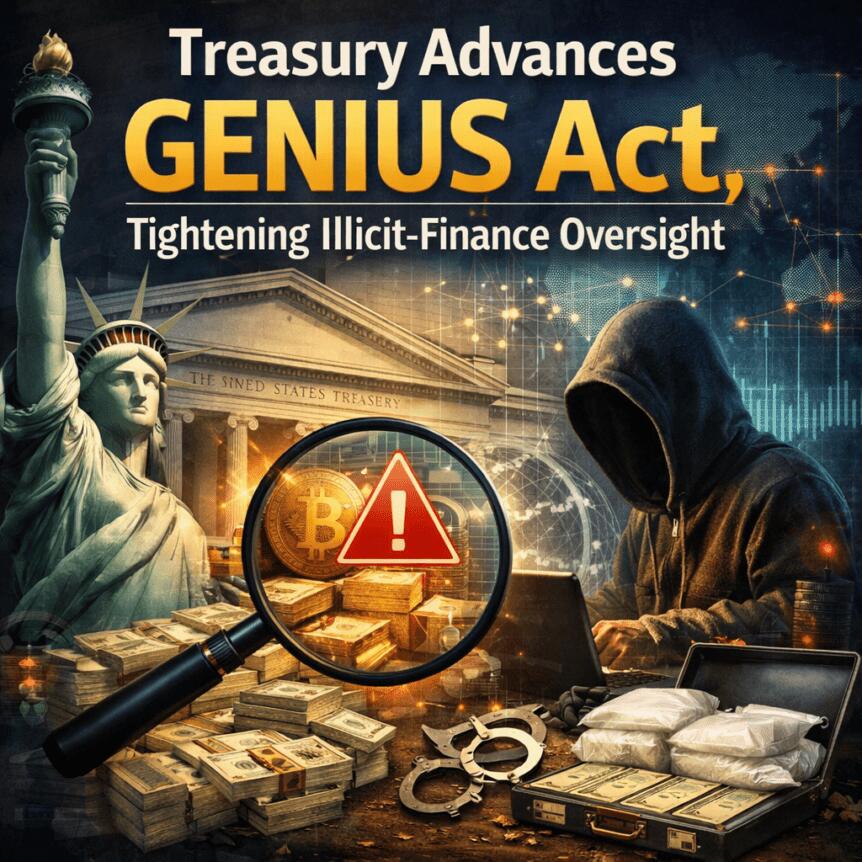
The United States Treasury’s Financial Crimes Enforcement Network (FinCEN) and the Office of Foreign Assets Control (OFAC) have jointly proposed a rule to implement provisions of the GENIUS Act, bringing payment stablecoin issuers under a comprehensive anti-money laundering (AML) and countering the financing of terrorism (CFT) regime. The draft rule would require issuers to establish and maintain AML/CFT programs, implement a formal sanctions compliance program, and possess the authority to block, freeze, or reject certain stablecoin transactions. Under the rule, issuers would be treated as financial institutions for purposes of the Bank Secrecy Act (BSA).
“Bringing stablecoin issuers into full BSA/OFAC compliance effectively turns them into bank-like gatekeepers,” said Snir Levi, CEO of blockchain intelligence firm Nominis. “That means significantly more wallet freezes, transaction blocking and asset seizures at scale.”
The Treasury notice forms part of the GENIUS Act’s implementation, a stablecoin payments framework signed into law by the White House last July. The legislation outlines the regulatory pathway for issuers and is generally viewed as a potential turning point for crypto markets, with the regime slated to take effect 18 months after signing or 120 days after the related regulations are issued by federal authorities.
In parallel, the Federal Deposit Insurance Corporation (FDIC) issued its own proposed rule as part of GENIUS Act implementation. The FDIC noted that while stablecoin holders would not be insured under the act, reserve deposits held by issuers would receive protection. This creates a nuanced layer of risk management for issuers and a different hurdle for users seeking safety for their stablecoin reserves.
Key takeaways
- Regulatory scope expands for stablecoins. Payment stablecoin issuers would be required to run AML/CFT programs, sanctions compliance, and a mechanism to block, freeze, or reject transactions, placing them on a comparable footing with traditional banks under the BSA.
- Issuer as a financial institution. Under the draft framework, stablecoin issuers would be treated as financial institutions for BSA purposes, elevating regulatory scrutiny and enforcement potential.
- FDIC protections limited to reserves, not holders. The FDIC proposal clarifies that stablecoin holders would not be insured, but reserve deposits backing issuers would receive protection, signaling a nuanced risk shield for some stablecoins.
GENIUS Act in motion: what changes for players now
The rulemaking activity underscores a broader shift in how the U.S. authorities intend to oversee digital assets that function as money-like instruments. By requiring AML/CFT programs and sanctions screening, issuers would need to implement robust monitoring, customer due diligence, and rapid response capabilities to comply with OFAC sanctions lists. The “block, freeze and reject” authority enshrined in the proposal is designed to curb illicit finance and align stablecoins with existing fiat- and crypto-related enforcement tools. These capabilities could, in practice, translate into more frequent inter-wallet restrictions and more aggressive response to compliance lapses across issuer networks.
For market participants, the changes mean a heightened compliance burden, with potential impacts on product design, liquidity provisioning, and customer experience. Issuers may need to invest significantly in transaction screening, on-chain analytics, and incident response playbooks to meet the new standards. Regulators, meanwhile, will be watching for practical trade-offs between user accessibility and the prevention of illicit finance, a balance that’s already a recurring topic in crypto policy debates.
Rendezvous with CLARITY and the politics of yield
Even as GENIUS Act implementation unfolds, lawmakers have stalled on a separate front: a broader digital asset market framework often referred to as the CLARITY Act, which cleared the House last year but awaits Senate markup. Industry participants and policymakers have been quietly negotiating around questions of stablecoin yields, tokenized securities, and ethics in crypto markets. The absence of a Senate timetable means the policy landscape remains uncertain, even as regulators press ahead with GENIUS Act rules.
In a recent White House briefing, the Council of Economic Advisers argued that banning stablecoin yields under any future framework would “do very little to protect bank lending,” suggesting that a yield ban would likely impose costs on users without delivering meaningful gains for traditional lenders. The stance illustrates a broader tension: policymakers aim to curb risk and protect the financial system while avoiding measures that could unduly constrain innovation or curtail access to stablecoins for ordinary users. As of now, the Senate Banking Committee has not announced a formal reschedule for markup on the CLARITY Act, leaving the sector in a wait-and-see mode.
What investors and users should watch next
Two strands will shape the near-term trajectory of stablecoin regulation in the United States. First, the GENIUS Act rulemaking process will continue to define the practical obligations for issuers, including the design of AML/CFT programs and the mechanics of sanctions enforcement. Observers will be keen to see how issuers adapt their onboarding flows, risk controls, and transaction controls to fit the regulator’s expectations, and how firms balance user experience with compliance complexity.
Second, the broader regulatory push around digital assets—most notably the status of the CLARITY Act in the Senate and any ensuing executive feedback—will determine whether the sector gains a clearer, predictable framework or remains mired in policy ambiguities. The White House signals that certain approaches to stablecoin governance may be acceptable if they preserve financial stability while fostering innovation, a stance that could influence how agencies and Congress calibrate future measures.
For market participants, the combined effect could be higher compliance costs and tighter operating protocols for stablecoin issuers, along with a more predictable, if still evolving, regulatory baseline. In the near term, attention will center on the timing of the GENIUS Act regulations’ finalization and the political timetable for CLARITY Act actions, as both will shape the pace and shape of stablecoin adoption and risk management in the United States.
As the regulatory clock ticks, stablecoin developers, custodians, and users should stay alert to any shifts in enforcement expectations and the potential for more aggressive takedown or blocking actions in cases of suspected illicit activity. The coming months will reveal how aggressively authorities intend to police on-chain money movement, and whether issuers can align product design with a rapidly expanding compliance regime without sacrificing user access or innovation.
Readers should keep an eye on updates from FinCEN and OFAC as well as the FDIC’s ongoing rules process, which together will illuminate how the GENIUS Act reshapes the operating landscape for stablecoins in the United States.
This article was originally published as Treasury advances GENIUS Act, tightening illicit-finance oversight on Crypto Breaking News – your trusted source for crypto news, Bitcoin news, and blockchain updates.


Potrebbe anche piacerti

How to earn from cloud mining: IeByte’s upgraded auto-cloud mining platform unlocks genuine passive earnings
your private keys shouldn’t live on a server somewhere




