

How the Iran War is Repricing Bitcoin
Bitcoin Magazine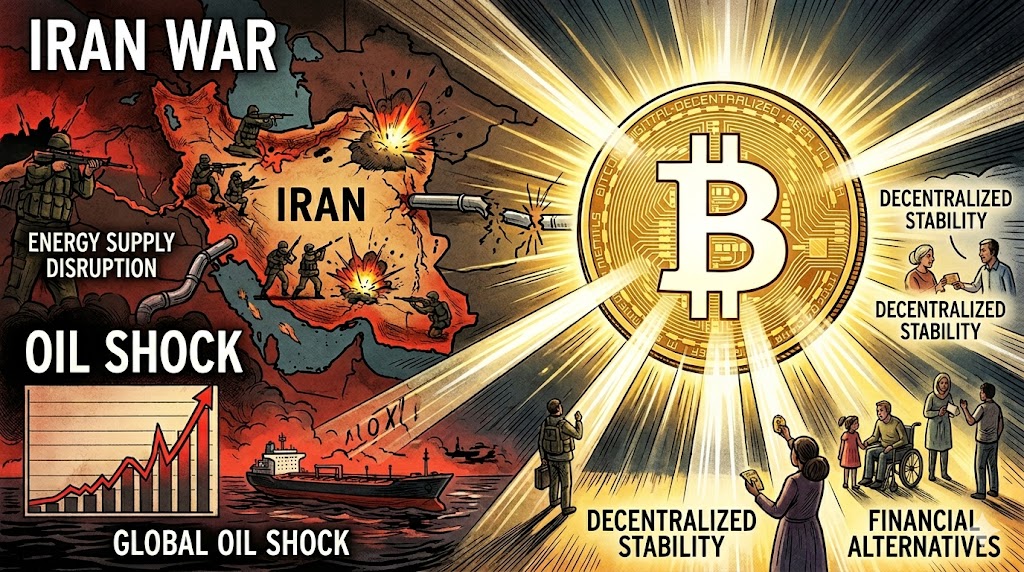
How the Iran War is Repricing Bitcoin
Since the U.S. and Israel began striking Iran on February 28, 2026, markets have had to wrestle with the financial and economic implications. The IEA described the disruption through Hormuz as the largest supply shock in the history of the global oil market. The strait normally carries about a quarter of maritime oil trade and is involved in about a fifth of global petroleum liquids consumption.
The Iran war has made monetary infrastructure visible again
The Strait of Hormuz is obviously a physical chokepoint. However, trade also depends on a monetary chokepoint. Cross-border payments usually move through correspondent banks, intermediary banks, screening layers, and trade-finance channels. Correspondent banking is an essential part of the global payment system for cross-border transactions, which involve a chain of linked correspondent banks. When that chain is stressed, settlement risk rises alongside freight and energy risk.
That is what this war has forced markets to confront. Reuters reported on April 9 that ship traffic through Hormuz was running at well below 10% of normal volumes, with just seven ships crossing in the prior 24 hours against roughly 140 normally. Iran’s posture around routing, permissions, and possible tolls made clear that access has become conditional.
Once trade access becomes conditional in the physical corridor, the other lever to pull is the monetary one. Here’s some important context.
OFAC prohibits U.S. banks from operating correspondent accounts for Iranian banks. In August 2025, the U.S. Treasury sanctioned the developer of Iran’s Cross-Border Interbank Messaging System, saying it had been built to let Iran and its partners route around controls on more widely used payment systems and to facilitate ties with foreign banks, including links involving Bank of Kunlun.
With the Iran war disrupting a major segment of global trade, it is practically inevitable that U.S. dollar rails will be used to try and force a resolution. If Iran wants money in exchange for Strait access, then it will need something else for monetary settlements.
Bitcoin really shines here
Bitcoin is an open settlement network. It does not require a correspondent bank, a reserve-currency issuer, or a central payments operator to authorize transfers. Although this does not remove friction from sanctions law, price volatility, or custody, Bitcoin nevertheless has a very different institutional dependency profile—one that could become extremely meaningful and useful in this context.
Consider that:
- A kinetic conflict can freeze cargo and supply lines.
- A banking crisis can freeze the payment for those items.
- A sanctions regime can force transactions into narrower channels with more intermediaries and more approval points.
Yet Bitcoin remains an open monetary rail.
On March 3, researchers tracked millions of dollars worth of crypto leaving Iranian crypto exchanges after the strikes. Iran’s 2025 crypto transaction volume was roughly $8 billion to $11 billion. Clearly we see open digital rails attracting more use when domestic and cross-border financial channels are under pressure.
This is where Bitcoin shines. Gold is a neutral asset, but it is slow to move and impossible to trustlessly transmit in digital form (tokenizing the gold requires trust). Bank money is efficient inside the existing system, but fully dependent on that system. Stablecoins are useful, but they usually still depend on issuers, banks, and redemption channels. Stablecoin issuers will, if compelled, freeze addresses. Therefore, stablecoins are really just a fancy addendum to the existing financial system.
Bitcoin is the largest liquid non-sovereign bearer asset that can be transferred natively over its own network. This utility seems to be getting more valuable, as we’ll see below.
Why this creates an opportunity for BTC
Please consider the cumulative returns of assets since the Iran War started. I use the commodity spot ETFs to ensure an apples-to-apples comparison on elapsed time (so that everything is trading during U.S. market hours):
| Asset | Cumulative Total Returns from Feb 27 to April 10 |
| IBIT (Bitcoin) | 11.75% |
| IWM (U.S. Small Caps) | 0.14% |
| SPY (U.S. Large Caps) | -0.68% |
| VXUS (Global Equities, excluding U.S.) | -2.93% |
| TLT (Treasury Bonds) | -4.07% |
| GLD (Gold) | -9.64% |
| SLV (Silver) | -18.72% |
This was an environment where long-duration bonds fell, gold fell, silver fell, international equities lagged, and Bitcoin exposure outperformed all of them.
This simply does not fit a “risk-off” narrative for Bitcoin. It does not fit a clean “inflation-hedge” narrative either.
The market appears to have priced several channels at once:
- higher energy costs
- inflation expectations (also exacerbated by recent PPI and CPI numbers)
- weaker conviction around rate cuts
- slower global activity
- greater value assigned to neutral monetary mobility
Gold had fallen 10% since the war began, arguably because higher energy prices fed inflation fears and pushed out expectations for rate cuts. That same mechanism helps explain weakness in TLT (increasing inflation expectations would push long term rates higher). If the dominant transmission channel is an oil shock with inflation consequences, longer duration and metals do not behave like safe havens.
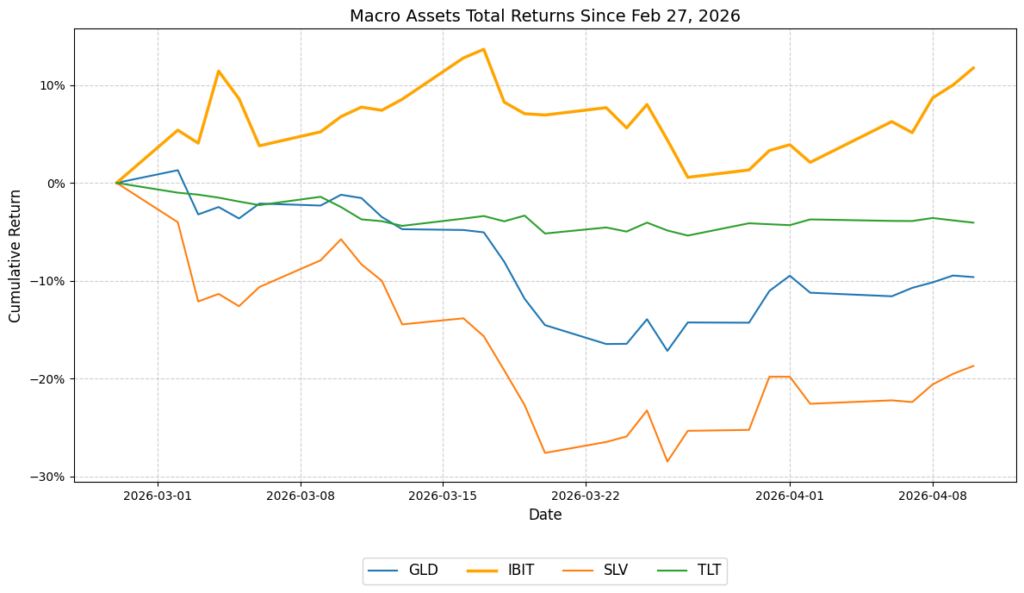 Bitcoin (IBIT) vs traditional safe havens like metals and U.S. T-Bonds since Iran War start.
Bitcoin was and is different. BTC-linked exposure outperformed while investors were confronting supply disruption, payment fragmentation, and more visible political control over access. That makes Bitcoin easier to price as strategic monetary optionality. The asset is scarce, portable, liquid, and non-sovereign. These features appear to have mattered more than the traditional safe-haven attributes associated with gold or long duration bonds.
Now, I want to be clear. This does NOT mean BTC is about to become a dominant trade currency (though this isn’t impossible either). The market might assign more value to an asset that remains transferable when institutional access becomes less predictable. This is all I am saying and, given the evidence, we can argue that this is happening right now.
Conclusion
The Iran war may have thrust a core feature of Bitcoin into the spotlight. It is a scarce asset and an open monetary rail. That combination matters more when trade routes, banks, sanctions, and state power start constraining one another.
If this really happens, Bitcoin stops looking like a speculative allocation to macro portfolios and starts looking more like resilient monetary infrastructure with valuable optionality. Every geopolitical fracture makes this easier to see.
This post How the Iran War is Repricing Bitcoin first appeared on Bitcoin Magazine and is written by Allard Peng.


Potrebbe anche piacerti

XRP Signals Imminent Breakout — Is A 10% Rally Coming?

Trump urges journalist to leave Pakistan as Iran peace talks stall




