Tech Trivia with Joy Evboifo, Brand Manager at SoftAlliance
What differentiates an Information Technology firm from a tech company often goes beyond the services they offer. It often lies in how they position themselves and communicate their value.
While IT firms typically focus on delivering technical solutions, tech companies tend to build brands around innovation, vision, and storytelling. This is why Joy believes every brand has a story worth telling.
Meet Joy Evboifo, Brand and Communications Manager at SoftAlliance, a Lagos-based Information Technology company that provides organisations with system integrations and technological resources required to achieve operational excellence.
At SoftAlliance, Joy leads the strategies that shape the company’s voice, visibility, and reputation, translating complex ideas into clear, compelling narratives that move people to decisions, not just awareness.
Before this role, she has worked as a Communications Executive, Copy and Content Creator and also as a Radio presenter, leading with a bachelor’s degree in Anatomy.
With a background in media, storytelling, and corporate communications, Joy brings both creative instinct and strategic discipline to every brief. Her work sits at the intersection of brand, marketing, and communication, and her conviction is simple: a brand is only as strong as the clarity behind it.
Outside of work, Joy is a professional event host with her stage name "Joyous Joy". This is because she engages diverse audiences with an adaptable hosting style, creating inclusive and energetic atmospheres tailored to each event's tone and objectives.
Read also: Tech Trivia with Adaeze Cynthia, Software Developer at Fowgate
 Joy Evboifo, Brand and Communications Manager at SoftAlliance
1. Summarise your mornings in one sentence
For a night owl like me, my mornings have to be very intentional. I’ve learned that structure helps me ease into the day, so I usually start with a clear to-do list to get focused and grounded.
From there, I sync with team members and colleagues on pending deliverables, which is what helps me set the tone and direction for the rest of my day. It’s less about rushing into work and more about creating clarity early.
2. Describe your gadget setup
My setup is simple. I use my laptop for most of my core work, my iPad for flexibility when I’m on the move or need to jot down ideas and to edit videos. Then, I use my phone to stay connected throughout the day.
I also rely on my headset or earpods for calls, especially when I’m out and about.
3. What tech tools/ applications do you use the most for work?
I use Microsoft tools daily, from Outlook and Word to Teams, for communication, collaboration, and day-to-day execution. I also use AI tools like ChatGPT and Claude AI to refine ideas, structure my thoughts, and support my creative process.
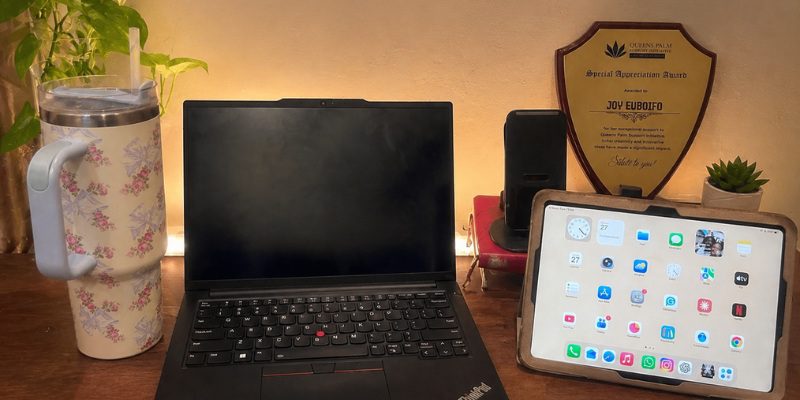 Joy’s gadget setup
4. What do you do when you need inspiration?
My first instinct is to stop. I close every open tab, mentally and literally. I step back from the pressure and let things settle.
Sometimes I write out whatever is in my head, one after the other, other times I leave it completely. I walk away, let it breathe, and come back when I’m not forcing it. For me, clarity doesn’t respond well to pressure. It shows up when I create space for it.
5. What mobile application can you not do without daily?
It would have to be WhatsApp. It keeps everything moving for me, from work conversations to quick updates, especially on days when I’m constantly on the go.
6. What tech solution do you wish someone had created?
An AI brand consistency auditor that scans all outgoing content – social posts, press releases, presentations — and flags tone, visual, or messaging inconsistencies before they go out. Right now, that’s mostly a manual, human eye job.
A tool that does it in real time would be a game-changer, especially when multiple departments are producing content without looping in the brand.
 Joy Evboifo
7. If you have unlimited time and money, what problem would you solve?
I will solve the imagination gap. Most conversations about access in Africa focus on infrastructure: internet connectivity, devices, and platforms.
But there’s a quieter problem sitting underneath all of that: young people who have access to information but no framework for what’s possible for them personally. They can scroll the whole world and still not see themselves in it.
I will create a system that helps young Africans between 15 and 23 expand their sense of what they’re allowed to become. Not just career choices or skills, but their identity.
Technology will be the backbone: personalised exposure pathways, mentorship matching, stories told at scale. But the real goal is a young person who stops shrinking themselves to fit the room they were born into and starts building bigger rooms.
That’s the problem I want to solve. Because everything else, the innovation, startups, and tech ecosystems we want to see on this continent, depends on who these young people believe they’re allowed to be.
8. Which woman in tech inspires you the most?
One person who really inspires me is Abiola Razaq, the founder of The Bug Detective. What stands out to me about her is how she has carved a unique space for herself within the tech ecosystem.
Beyond the work itself, I admire how she shows up as a thought leader, speaking in different spaces, reaching people across borders, and using her platform to make a real impact. She’s not just doing a job in tech; she’s shaping conversations and creating opportunities for others.
That, to me, is incredibly inspiring.
 Abiola Rasaq, Founder of Bug Detective
9. Which profound statement inspires you the most?
The statement that rewired how I think: confidence doesn’t come from motivation — it comes from data.
Most times, we are told to just believe in ourselves. But a belief built on nothing doesn’t hold. What actually builds confidence is data or evidence. The record of times you showed up, attempted something hard, and came through. You look back and see: I didn’t know how to do that, and then I did. I was afraid, and I did it anyway.
That history becomes the foundation and proof
It changed how I approach new challenges. Instead of waiting to feel ready, I focus on building evidence, one result at a time.
10. Whose women in tech trivia would you love to read?
Abiola Rasaq, the founder of The Bug Detective. What stands out to me about her is how she has carved a unique space for herself within the tech ecosystem.
While many people in tech tend to focus strictly on technical roles like frontend or backend development, she took a different path. Through her work, she has built a platform and a thriving community that empowers and educates others.
Read also: 5 ways low-income female entrepreneurs can boost their financial growth


Potrebbe anche piacerti

Crypto’s wash trading problem is ‘far more common’ than investors think, DOJ sting shows

AT&T (T) Stock: J.P. Morgan Keeps It as a Top Pick on Fiber and 5G Strength