

Ether Approaches $2K on Bitmine ETH Purchase and Robinhood L2 News
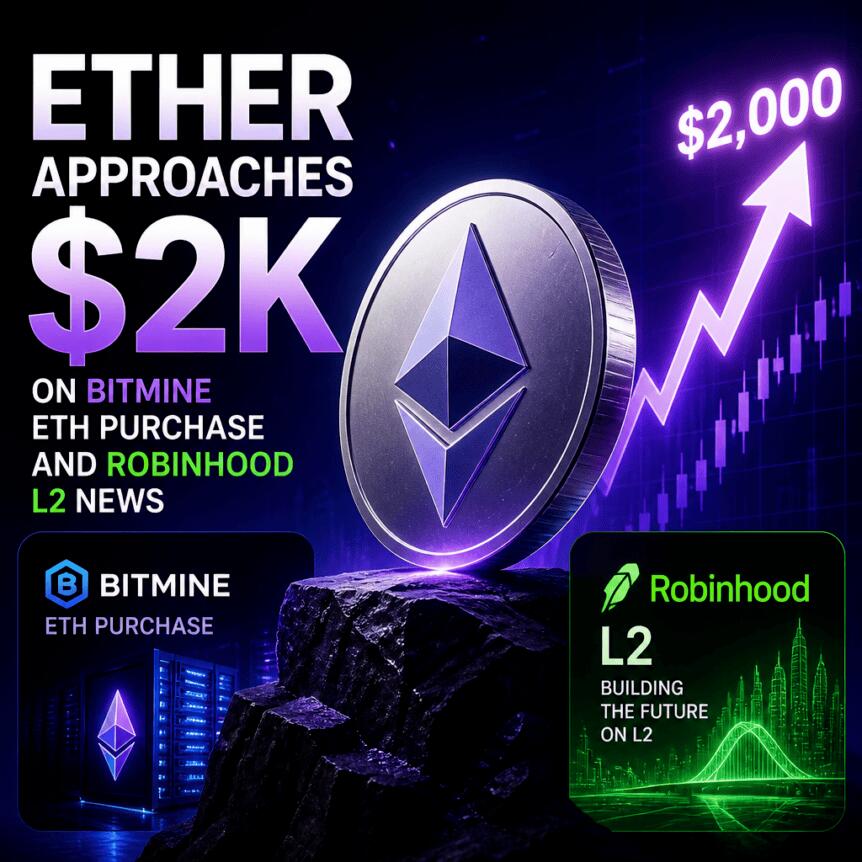
Ether has bounced back sharply, rising roughly 15% over the past five days and pulling away from the $1,500 area that marked a June 26 low. The recovery reflects a mix of renewed confidence around Ethereum’s roadmap and ongoing accumulation of ETH by BitMine Immersion Technologies.
Beyond price, Ethereum’s narrative is also shifting toward practical use cases: the Glamsterdam upgrade is still progressing through testing toward later in 2026, while the July 2 launch of Robinhood Chain has put additional attention on regulated, tokenized finance built on top of the Ethereum ecosystem.
Key takeaways
- Ether’s rebound followed the June 26 low, helped by optimism tied to final testing for Ethereum’s Glamsterdam upgrade.
- BitMine Immersion Technologies’ continued ETH buying is cited as a key factor supporting the $1,500 level, despite large unrealized losses.
- Ethereum options markets have cooled from fear conditions, with Deribit skew moving away from last week’s extremes.
- Robinhood Chain’s rollout and tokenized stock expansion reinforce a TradFi-focused growth angle for Ethereum-based infrastructure.
Ether strength, with support under $1,500
In the latest stretch of strength, Ether’s performance has outpaced the broader crypto complex. The article notes that ETH has gained about 7% relative to total crypto market capitalization over the last 30 days, suggesting demand for Ether specifically rather than a purely market-wide risk-on move.
Part of the backdrop is political and regulatory momentum. The piece points to optimism surrounding the proposed Digital Assets CLARITY Act, which has faced delays in Congress due to banking-sector pushback, particularly around stablecoin regulation and potential rewards for token holders. Even without immediate clarity, investor expectations can still influence short-term positioning in major assets like ETH.
Derivatives: fear metrics ease, but bullishness is not yet dominant
Ether’s rally toward $1,800 also coincided with improvement in ETH options positioning. According to the article, Deribit’s 25% delta skew (put-call) — a common measure used to infer the balance between protective puts and upside calls — moved out of the fear zone that persisted until Friday.
The current skew is described as showing a 9% premium for put options over equivalent call options. That is still not “bullish” in the strictest sense, but it is meaningfully less extreme than the 15% level recorded the prior week. The article adds that readings above 12% often align with heightened fear, implying sentiment improved even if traders remained cautious.
Deribit options skew data referenced in the article via Laevitas: Laevitas.
Ethereum’s upgrade path and what Glamsterdam is meant to fix
One persistent critique of Ethereum has been scalability at the base-layer level, especially as layer-2 rollups rely on data “blobs” to keep fees low. While blobs reduced transaction costs, the article highlights that the policy and resulting economics created wider debates around long-term data censorship and centralization, and also influenced base-layer fee dynamics.
With base-layer network revenue under pressure, ETH burning has been reduced, shifting the supply picture toward inflationary dynamics rather than consistent deflation. That makes every improvement to base-layer throughput more important to the broader thesis: if Ethereum can process more data and transactions efficiently without relying on tradeoffs that worsen long-term incentives, the market narrative improves.
In that context, the article focuses on the Glamsterdam upgrade. It states that Glamsterdam is in testing and is designed to improve Ethereum’s processing speed by allowing more transactions to run in parallel, expanding capacity to handle additional data at higher throughput, and reducing “database bloat.” The stated aim, per the article, is to provide institutional-grade infrastructure for financial use cases.
Ethereum upgrade reference in the article: Glamsterdam upgrade.
BitMine’s accumulation and the meaning of large unrealized losses
The article also credits continued spot accumulation by BitMine Immersion Technologies with helping reinforce the $1,500 support level. It notes that BitMine increased its ETH holdings by 325,000 ETH over the past month, bringing total reserves to 5.74 million ETH.
Crucially, the article acknowledges the risk embedded in this strategy: even with roughly $8 billion in unrealized losses on its ETH holdings, BitMine continues buying. It frames the company’s approach as aligned with a longer-term plan toward acquiring 5% of the existing supply.
For market participants, the practical takeaway is not just that a large holder is accumulating — it’s that the firm appears willing to sustain accumulation through drawdowns. Large, persistent demand can change how investors interpret support levels, particularly around psychological price ranges like $1,500.
BitMine holdings reference in the article: bmnr.rocks.
Robinhood Chain and tokenized stocks: TradFi grows inside Ethereum’s orbit
While onchain and derivatives metrics may still look cautious — particularly given low network fee conditions mentioned in the article — the upside case for ETH is being reinforced by traditional finance integration.
The piece highlights the launch of Robinhood Chain on July 2. It describes Robinhood Chain as an EVM-compatible Ethereum layer-2 built using Arbitrum technology, positioning the network for interoperability with Ethereum’s broader ecosystem.
More importantly for adoption, the article says Robinhood rolled out tokenized stock trading in more than 120 countries, alongside DeFi integrations including Uniswap, 1inch, and Morpho. This matters because it ties Ethereum-aligned infrastructure to real consumer-facing financial products rather than relying solely on speculative activity.
In effect, the article reframes the ETH rally as not merely a macro bet or a sentiment swing: it points to a structural narrative where Ethereum’s scaling roadmap and base-layer expansion could support an expanding layer-2 and application economy — and where TradFi participants are increasingly comfortable building tokenized instruments on Ethereum rails.
What to watch next for the $2,000 question
The article concludes that the path toward $2,000 looks plausible in the near term, given the combination of improving sentiment in options markets, ongoing ETH accumulation, and visible growth in tokenized finance use cases. Still, investors should watch how Ethereum’s base-layer economics evolve alongside Glamsterdam’s testing progress, and whether derivatives positioning continues to reflect a steady improvement rather than a temporary bounce.
This article was originally published as Ether Approaches $2K on Bitmine ETH Purchase and Robinhood L2 News on Crypto Breaking News – your trusted source for crypto news, Bitcoin news, and blockchain updates.


Potrebbe anche piacerti

Not a loophole: Singapore AI export controls let China tap US AI legally

CME Group to launch Solana and XRP futures options in October

Iran’s army chief warns of ‘total destruction’ for ground invasion


Notizie di tendenza
Altro
