

Key TakeawaysNvidia (NVDA) reported fiscal second quarter 2027 revenue of $96.22 billion on August 26, 2026, up 106% year over year and above the $92.1 billion consensus, with adjusted earnings of $2.Key TakeawaysNvidia (NVDA) reported fiscal second quarter 2027 revenue of $96.22 billion on August 26, 2026, up 106% year over year and above the $92.1 billion consensus, with adjusted earnings of $2.
Nvidia Earnings Explained: Record $96 Billion Quarter, $108 Billion Guide, a Margin Reset, and What It Means for Crypto

著者:OoJae
共有
Key Takeaways
Nvidia (NVDA) reported fiscal second quarter 2027 revenue of $96.22 billion on August 26, 2026, up 106% year over year and above the $92.1 billion consensus, with adjusted earnings of $2.22 per share against $2.09 expected. It was the fourteenth straight quarter above the company's own guidance.
Data Center revenue hit $89.02 billion, up 117% from a year ago and 18% from the prior quarter, driven by the Blackwell Ultra ramp. Sovereign AI revenue more than tripled year over year, and networking posted a record on Spectrum-X Ethernet growing 2.6 times.
Guidance was the real headline: $108 billion in third quarter revenue against a $104.2 billion consensus, assuming essentially zero Data Center compute sales to China, plus a rare preliminary forecast of roughly 70% revenue growth for fiscal 2028 that CEO Jensen Huang called supply constrained.
The catch is margins: gross margin held at 75% but is guided to 74% next quarter and a trough of 71% to 72% in the fourth quarter as memory costs soar, with supply obligations swelling to $279 billion, largely for memory tied to the Vera Rubin ramp.
For crypto, the print reinforces the AI risk complex that Bitcoin has traded within all year, feeds the memory boom behind names like SK Hynix, and validates the compute-as-revenue thesis driving miners into AI hosting and the AI agent token narrative.
The Numbers: Another Record, Another Beat
Nvidia's fiscal second quarter, reported after the close on Wednesday, August 26, was a masterclass by any traditional measure. Revenue reached $96.22 billion, more than doubling from a year earlier and rising 15% from the prior quarter, the fourth consecutive quarter of accelerating growth. Adjusted earnings of $2.22 per share beat the $2.09 consensus by more than 6%, extending Nvidia's streak of topping estimates to five quarters. The engine was Data Center at $89.02 billion, about 92% of total revenue, as hyperscalers and enterprises accelerated deployments of the Blackwell Ultra architecture. Sovereign AI revenue grew 35% sequentially and more than tripled year over year, networking set a record, and the company returned $26 billion to shareholders in the quarter.
Two details show how insulated the business has become. Shipments of Data Center products to China were less than 1% of segment revenue because of export restrictions, meaning the entire growth story is being driven by Western and allied demand. And roughly 70% of first half sales came from the United States, a concentration that analysts flag as both a strength and a policy risk.
The Guide That Mattered
Investors had made clear that anything below roughly $103 billion for the third quarter would trigger a selloff. Nvidia guided to $108 billion, plus or minus 2%, comfortably above the $104.2 billion consensus and again excluding any China compute revenue. It also did something unusual, offering a preliminary outlook for fiscal 2028 of approximately 70% revenue growth, a figure Huang described as supply constrained and well below what customers are asking for. Production shipments of the next generation Vera Rubin platform have begun, with management calling it the fastest ramp in company history, and Nvidia announced an expanded AWS partnership to deploy two million additional GPUs. Huang summarized the thesis in four words on the call: "Now, compute is revenue."
The Margin Reset That Caught the Market Off Guard
The reason the stock did not simply rip is margins. Gross margin held at 75% in the quarter, up from 72.5% a year ago, but management guided it down to 74% for the third quarter and to a bottom of 71% to 72% in the fourth, settling at 72% to 73% for fiscal 2028. The culprit is memory: prices for the high bandwidth memory that every AI accelerator needs have risen faster than Nvidia anticipated and are heading higher into next year. Supply obligations surged to $279 billion, largely memory procurement for the Rubin ramp. That dynamic flips the script for the memory makers, which is exactly why SK Hynix's record Nasdaq debut landed so well this summer: the cost pressure squeezing Nvidia's margins is the same force inflating memory suppliers' profits.
The reaction reflected that tension. Shares whipsawed in extended trading, dipping initially as investors absorbed the margin trajectory before rallying about 4% on the fiscal 2028 forecast, with analysts describing the mood as ambivalent rather than euphoric. A pending acquisition of Hugging Face, signaling a push to control the AI software layer, added another strategic wrinkle to digest.
Why Crypto Traders Care
Nvidia's results are the single most important data point for the AI trade, and in 2026 the AI trade and crypto move as one risk complex. Strong AI capital spending lifts equity risk appetite, which spills into digital assets; disappointment does the opposite, as this week's post Jackson Hole selloff showed when higher yields hit chips and crypto together. The print also validates a structural shift inside crypto: Bitcoin miners are converting power and data center capacity into AI hosting contracts, precisely because compute has become the scarcest asset in the economy. The same insight underpins Arthur Hayes' Flop Labs and its proof of useful inference design, in which mining work is AI inference. When the world's most valuable chipmaker says demand exceeds even 70% growth and supply is the bottleneck, every business selling compute, including tokenized ones, gets a tailwind.
What It Means for Traders on MEXC
NVDA trades on the Nasdaq, but the themes it drives are fully tradable in crypto. AI related tokens listed on MEXC tend to react to the same news flow that moves chip stocks, and the broader risk appetite Nvidia sets feeds directly into BTC/USDT and ETH/USDT. Traders can watch the AI token sector for follow through as Vera Rubin volumes ramp, keep an eye on memory cost headlines as the swing factor for the sector, and manage the volatility with MEXC Futures.
Disclaimer: This content is for educational and reference purposes only and does not constitute any investment advice. Digital asset investments carry high risk. Please evaluate carefully and assume full responsibility for your own decisions.
市場の機会
Audiera価格(BEAT)
--
----
USD
Audiera (BEAT) ライブ価格チャート
このページで共有されている記事は公開プラットフォームから収集したものであり、参考情報としてのみ提供されています。MEXCの立場や見解を代表するものではありません。すべての権利は OoJae に帰属します。第三者の権利を侵害するコンテンツがあると思われる場合は、service@support.mexc.com までご連絡いただければ速やかに削除いたします。MEXCはいかなるコンテンツの正確性、完全性、適時性も保証せず、提供された情報に基づいて取られたいかなる行動についても責任を負いません。本コンテンツは、金融、法律、またはその他の専門的なアドバイスを構成するものではなく、MEXCによる推奨または支持として解釈されるべきものでもありません。専門家の洞察と詳細な分析については、MEXC 学ぶ をご覧ください。
Audiera の最新情報
もっと見る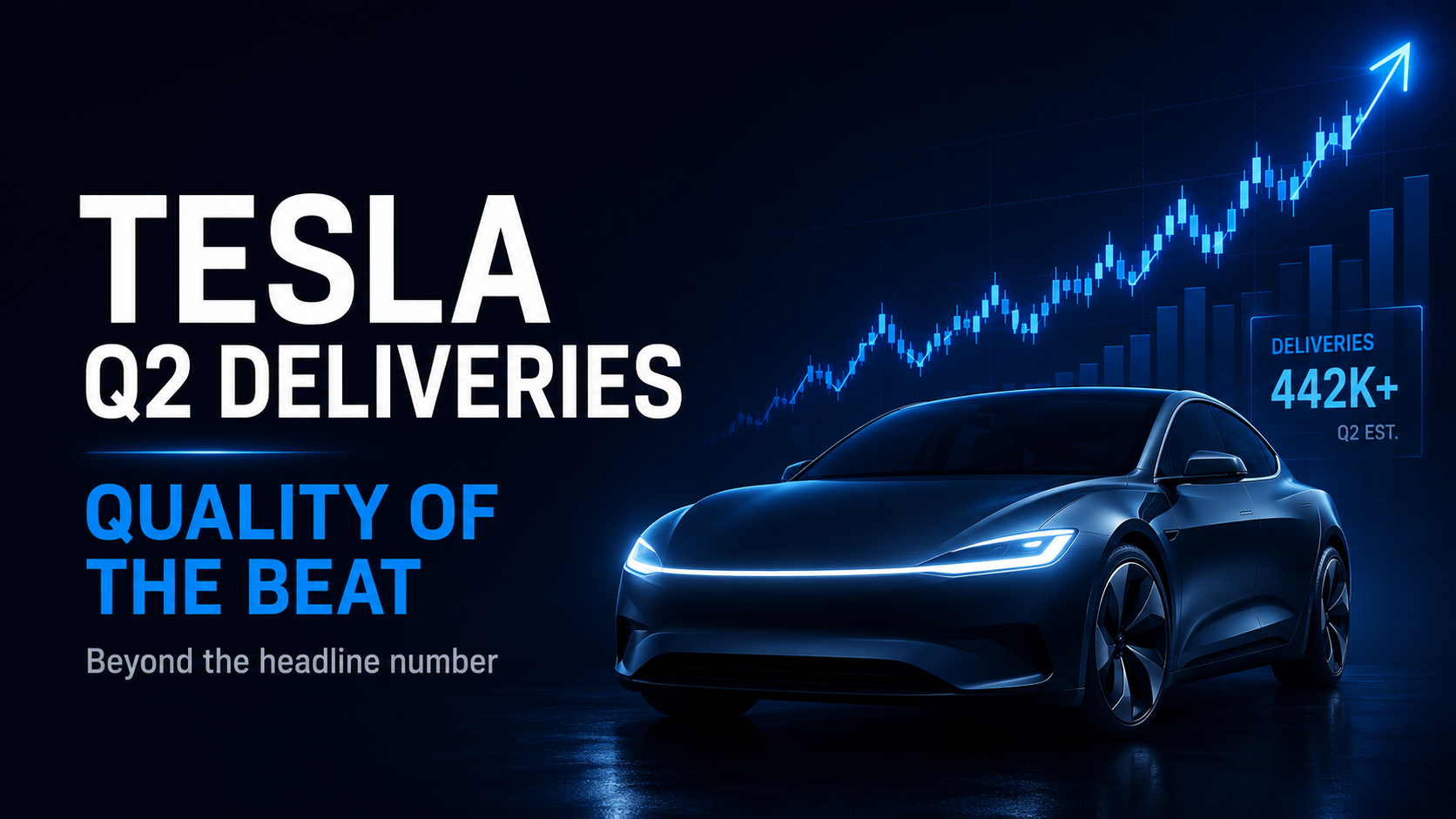
テスラ、Q2発表前に株価急騰:真の試練は「量」ではなく「質」にある理由
テスラ(TSLA)株は、第2四半期(Q2)の納車台数発表を前に8.46%急騰して411.84ドルとなり、主要株価指数を大幅にアウトパフォームしました。アナリストはこれを「期待値の書き換えトレード」と見ています。ウォール街はハードルを急激に引き上げており、大手金融機関はウィスパー数値を413,000〜420,000台の範囲に上方修正しました。これはテスラ公式がまとめたコンセンサスである406,024台を大きく上回ります。NHTSAの調査終了や、AIデータセンターをターゲットにしたSunrunとの16GW規模の巨大仮想発電所(VPP)提携がテスラのエネルギー・AIインフラの物語を支えているものの、最終的な市場の反応は、この納車台数の上振れが「持続可能な世界需要」を反映しているのか、それとも「利益率を削った在庫処分」に過ぎないのかという「質」にかかっています。
テスラ株はQ2納車台数レポートの発表を前に急騰しましたが、この動きを同社がすでに市場予想を上回ったことの確認と捉えるべきではありません。むしろ、公式データが到着する前に、市場が期待値をリセットするためのトレード(期待値書き換えトレード)と理解するのが適切です。
TSLAは先日、前日比8.46%高の411.84ドルで引け、市場全体を大幅にアウトパフォームしました。比較として、ナスダック総合指数は2.07%上昇、S&P 500は1.18%上昇、QQQは2.49%上昇しました。この上昇の大きさは、これが単なるハイテク株全体のラリーではないことを示唆しています。むしろ、テスラの株価の上昇は、市場のリスク許容度の高まり、納車予想の引き上げ、規制圧力の緩和、そしてテスラのエネルギーおよびAIインフラの物語への関心の再燃が組み合わさった結果を反映しています。
重要な問いは、テスラがコンセンサスを上回れるかどうかではなく、その上振れがこの最近のラリーを正当化するほど「質の高いもの」であるかどうかです。
2026/06/30

Bitget、日本市場撤退へ 12月末に未決済ポジション強制決済
Bitgetが2026年8月3日に日本居住者向けサービス終了を発表。12月31日までに未決済ポジションを決済しないと強制決済されるため、資産保有者は期限までの対応が必要です。
2026/08/04

Mastercardが最大18億ドルでBVNKを買収完了—ステーブルコインがグローバル決済の中核に参入
2026/8/3、Mastercardは3月に取引を発表した後、ステーブルコインインフラプロバイダーのBVNKの買収を完了しました。
2026/08/04


ホット
現在、市場で大きな注目を集めているトレンドの暗号資産
暗号資産価格
取引高が最も多い暗号資産