Exploring how the costs of a pandemic can lead to a self-enforcing lockdown in a networked economy, analyzing the resulting changes in network structure and the existence of stable equilibria.Exploring how the costs of a pandemic can lead to a self-enforcing lockdown in a networked economy, analyzing the resulting changes in network structure and the existence of stable equilibria.

The Economics of Self-Isolation: A Game-Theoretic Analysis of Contagion in a Free Economy

2025/09/17 23:00
3분 읽기
이 콘텐츠에 대한 의견이나 우려 사항이 있으시면 crypto.news@mexc.com으로 연락주시기 바랍니다

Abstract and 1. Introduction

  1. A free and fair economy: definition, existence and uniqueness

    2.1 A free economy

    2.2 A free and fair economy

  2. Equilibrium existence in a free and fair economy

    3.1 A free and fair economy as a strategic form game

    3.2 Existence of an equilibrium

  3. Equilibrium efficiency in a free and fair economy

  4. A free economy with social justice and inclusion

    5.1 Equilibrium existence and efficiency in a free economy with social justice

    5.2 Choosing a reference point to achieve equilibrium efficiency

  5. Some applications

    6.1 Teamwork: surplus distribution in a firm

    6.2 Contagion and self-enforcing lockdown in a networked economy

    6.3 Bias in academic publishing

    6.4 Exchange economies

  6. Contributions to the closely related literature

  7. Conclusion and References

Appendix

6.2 Contagion and self-enforcing lockdown in a networked economy

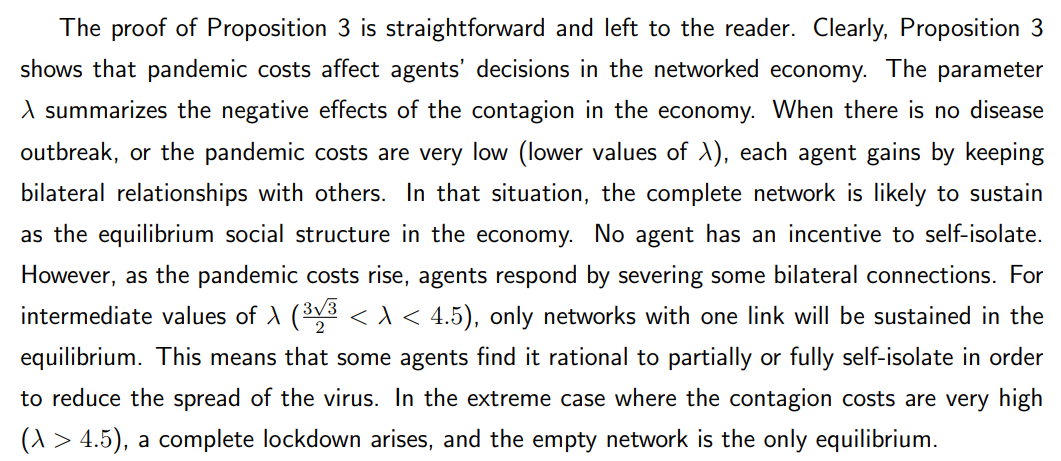
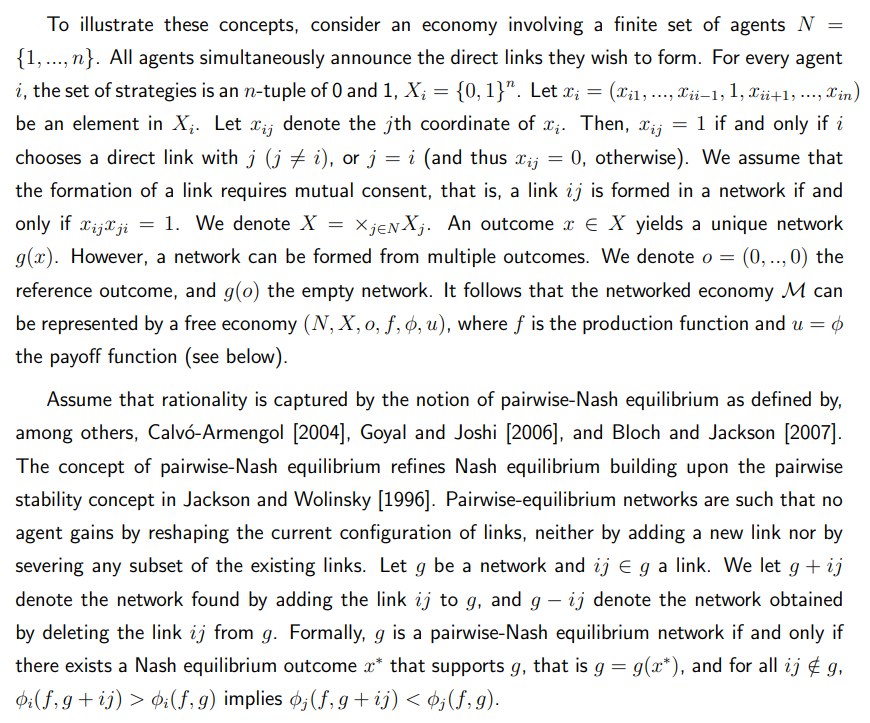
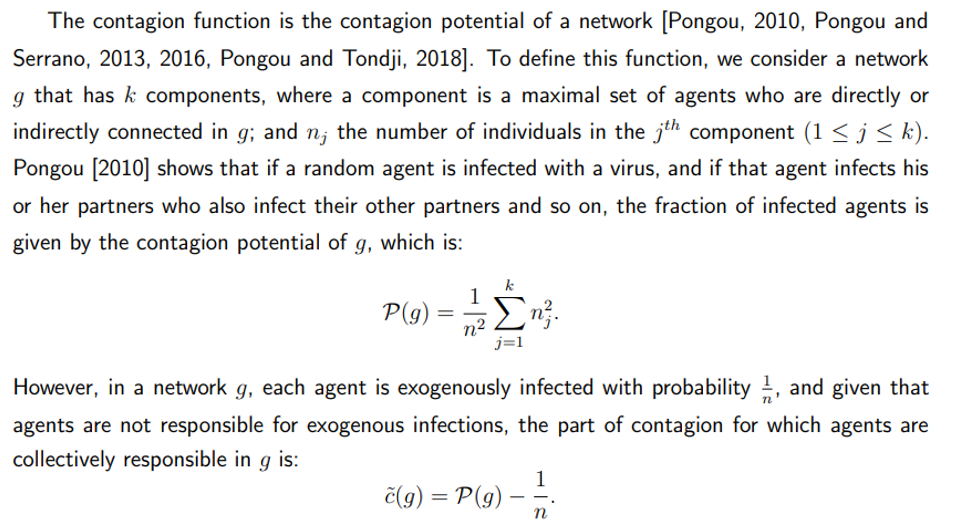
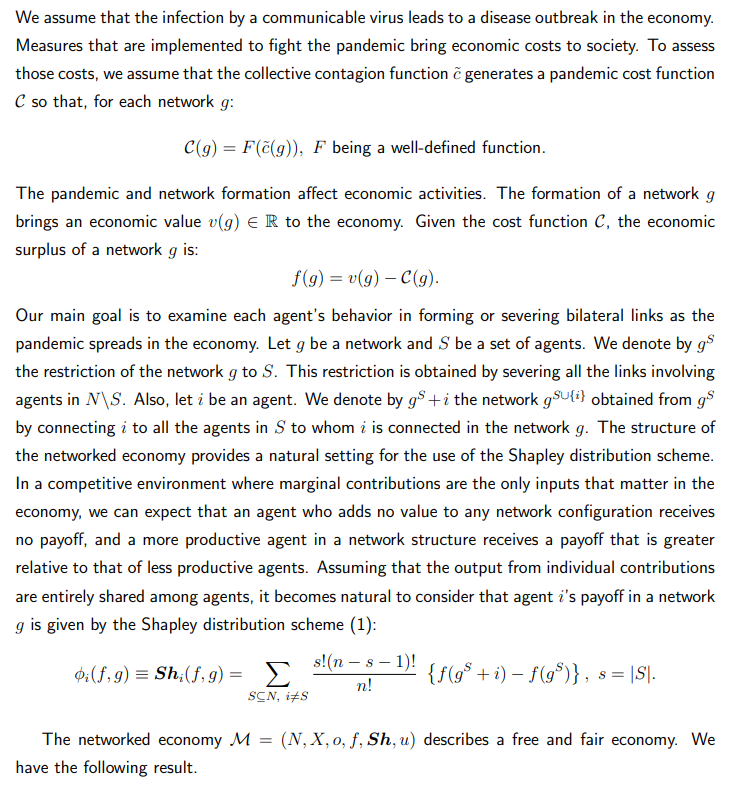
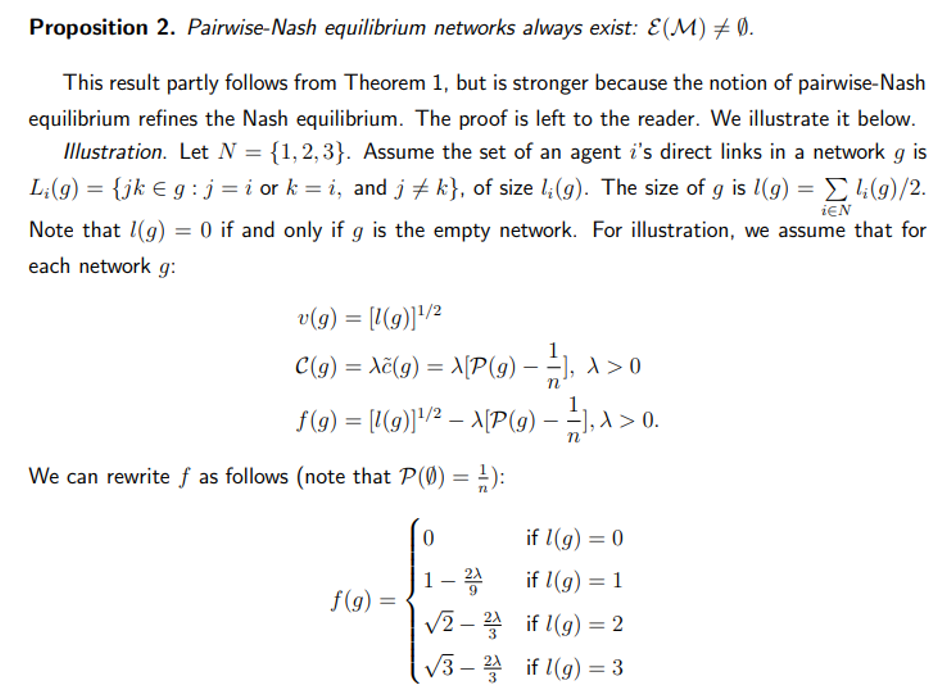
In this section, we provide an application of a free and fair economy to contagion and selfenforcing lockdown in a networked economy. We show how the costs of a pandemic from a virus outbreak can affect agents’ decisions to form and sever bilateral relationships in the economy. Specifically, we illustrate this application by using the contagion potential of a network [Pongou, 2010, Pongou and Serrano, 2013, 2016, Pongou and Tondji, 2018].

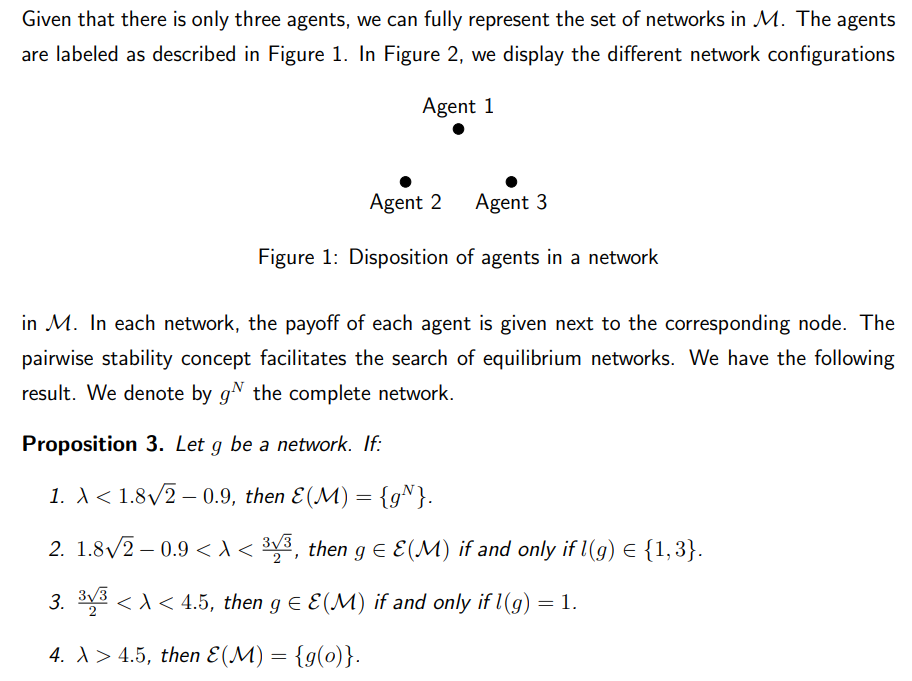
\ Consider an economy M involving agents who freely form and sever bilateral links according to their preferences. Agents’ choices lead to a network, defined as a set of bilateral links. Assume that rational behavior is captured by a certain equilibrium notion (for example, Nash equilibrium, pairwise-Nash equilibrium, etc.). Such an economy may have multiple equilibria. Denote by E(M) the set of its equilibria. Our main goal is to assess agent’s decisions in response to the spread of a random infection (for example, COVID-19) that might hit the economy. As the pandemic evolves in the economy, will some agents decide to sever existing links and self-isolate themselves? How does network structure depend on the infection cost?

\
\
\
\
\
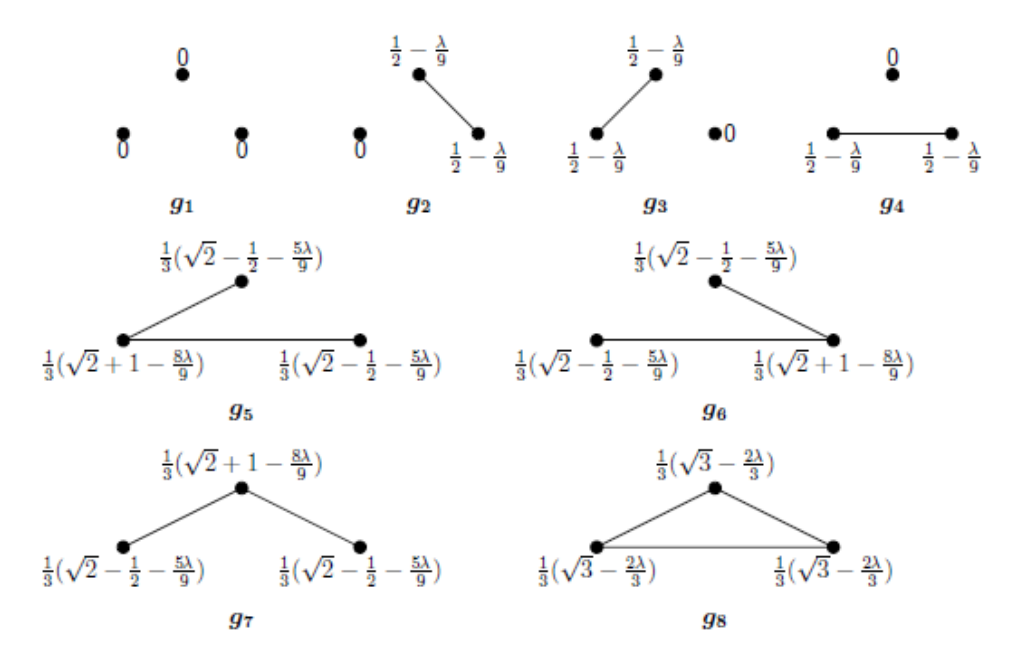
\ Figure 2: Possible network formation in M
\

\ Interestingly, the value of λ depends on the nature of the virus. Viruses induce different severity levels. For example, COVID-19 and the flu virus have different values, inducing different network configurations in equilibrium. The different network configurations in Figure 2 can therefore be interpreted as the networks that will arise in different scenarios regarding the nature of the virus.

\

:::info Authors:

(1) Ghislain H. Demeze-Jouatsa, Center for Mathematical Economics, University of Bielefeld (demeze jouatsa@uni-bielefeld.de);

(2) Roland Pongou, Department of Economics, University of Ottawa (rpongou@uottawa.ca);

(3) Jean-Baptiste Tondji, Department of Economics and Finance, The University of Texas Rio Grande Valley (jeanbaptiste.tondji@utrgv.edu).

:::


:::info This paper is available on arxiv under CC BY 4.0 DEED license.

:::

\

시장 기회
SQUID MEME 로고
SQUID MEME 가격(GAME)
$30.0499
$30.0499$30.0499
0.00%
USD
SQUID MEME (GAME) 실시간 가격 차트
면책 조항: 본 사이트에 재게시된 글들은 공개 플랫폼에서 가져온 것으로 정보 제공 목적으로만 제공됩니다. 이는 반드시 MEXC의 견해를 반영하는 것은 아닙니다. 모든 권리는 원저자에게 있습니다. 제3자의 권리를 침해하는 콘텐츠가 있다고 판단될 경우, crypto.news@mexc.com으로 연락하여 삭제 요청을 해주시기 바랍니다. MEXC는 콘텐츠의 정확성, 완전성 또는 시의적절성에 대해 어떠한 보증도 하지 않으며, 제공된 정보에 기반하여 취해진 어떠한 조치에 대해서도 책임을 지지 않습니다. 본 콘텐츠는 금융, 법률 또는 기타 전문적인 조언을 구성하지 않으며, MEXC의 추천이나 보증으로 간주되어서는 안 됩니다.

추천 콘텐츠

StrictlyVC San Francisco Unveils Electrifying Speaker Lineup with TDK Ventures and Replit Leaders

StrictlyVC San Francisco Unveils Electrifying Speaker Lineup with TDK Ventures and Replit Leaders

BitcoinWorld StrictlyVC San Francisco Unveils Electrifying Speaker Lineup with TDK Ventures and Replit Leaders The venture capital landscape prepares for a significant
공유하기
bitcoinworld2026/04/02 04:20
Next Crypto to $1: APEMARS 100X Presale Gains as Hedera and Tron Face Volatility

Next Crypto to $1: APEMARS 100X Presale Gains as Hedera and Tron Face Volatility

Crypto markets are acting like a meme coin that just discovered espresso, fast moves, sharp reversals, and plenty of confusion. One minute, traders are celebrating
공유하기
Techbullion2026/04/02 04:15
Trump Approval Rating Tracker: 39% In Latest Survey

Trump Approval Rating Tracker: 39% In Latest Survey

The post Trump Approval Rating Tracker: 39% In Latest Survey appeared on BitcoinEthereumNews.com. Sept. 16-18 net approval rating: Trump’s favorability rating declined three points to 39% and the share of U.S. adults who have an unfavorable view of him increased two points to 57% compared to last week in an Economist/YouGov survey of 1,567 U.S. adults conducted Sept. 12-15 (margin of error 3.6). The results represent an 11-point decline in Trump’s 50% favorability rating at the start of his term, according to Economist/YouGov polling. Sept. 15-6 net approval rating: Trump’s job performance improved one point, to 46%, in Morning Consult’s weekly survey compared to the previous week, while his disapproval rating stayed stagnant at 52% (the poll of 2,204 registered U.S. voters was conducted Sept. 12-14 and has a margin of error of 2). The poll found the killing of conservative activist Charlie Kirk is the top story of 2025, with 67% of voters saying they’ve seen, read or heart “a lot” about it, according to Morning Consult, well above hundreds of other news events Morning Consult has asked about this year. Sept. 10-14: On par with two other polls this week, Trump had a 42% approval rating in the latest Reuters/Ipsos survey conducted Sept. 5-9, while 56% disapproved, representing a two-point increase from the groups’ August poll in his disapproval rating and a two-point uptick in his approval rating (the poll of 1,084 U.S. adults has a margin of error of 3). Sept. 8-7: Trump’s approval rating declined one point from last week, to 45%, tied with his record low since taking office, according to Morning Consult’s weekly survey that found 52% disapprove of his job performance (the poll of 2,201 registered voters conducted Sept. 6-8 has a margin of error of 2). Sept. 7-12: Trump’s approval rating ticked up two points from July, to 44%, while his disapproval rating declined two…
공유하기
BitcoinEthereumNews2025/09/18 01:08

Trade GOLD, Share 1,000,000 USDT

Trade GOLD, Share 1,000,000 USDTTrade GOLD, Share 1,000,000 USDT

0 fees, up to 1,000x leverage, deep liquidity