Tokenization: The IMF’s 2026 Roadmap for Global Finance
The post Tokenization: The IMF’s 2026 Roadmap for Global Finance appeared first on Coinpedia Fintech News
On April 2, 2026, the International Monetary Fund (IMF) published a note regarding real-world assets (RWAs), noting both their advantages and shortcomings in the financial industry.
Entitled “Tokenized Finance,” the note acknowledges that permissioned shared ledgers, programmable assets (RWAs), and the smart contracts that connect the two, alter finance in terms of liquidity, settlement, and risks.
IMF and RWAs: the good, the bad, and the ugly
Per the note, the benefits of tokenization include atomic settlement, continuous liquidity management, new revenue streams, and operational savings from automated asset servicing.
Even more, RWAs are natively regulatory-compliant and offer lower investor entry barriers through fractional ownership.
That said, the organization warns that the lack of international coordination in policy development could amplify systemic risk and financial instability.
Here, the IMF points out that the very “lightning speed” efficiency of transactions is what could turn a minor financial crisis into a major one. This is because no safeguards exist to control liquidity flows, which can trigger flash crashes and massive liquidations.
Additionally, the fact that each institution develops its own unique ledger causes market fragmentation. This results in impaired asset transfer, high price divergence across assets, and high ledger bridging costs.
As a solution to these issues, the IMF suggests “anchoring digital finance in public trust” through safe settlement options such as Central Bank Digital Currencies (CBDCs).
Regulators could also supervise robust code governance by auditing smart contracts and stress testing tokenization algorithms.
Moreover, mandating ledger interoperability would reduce arbitrage issues by standardizing asset prices across different blockchains.
Industry growth
InvestaX values the on-chain tokenization industry between $24.9 billion and $36 billion (excluding stablecoins) in 2026.
With payment stablecoins, the figure rises to $300 billion, where the leading $10.8 billion comes from tokenized US Treasuries. Since the start of the year, the industry has grown by an estimated 66%.
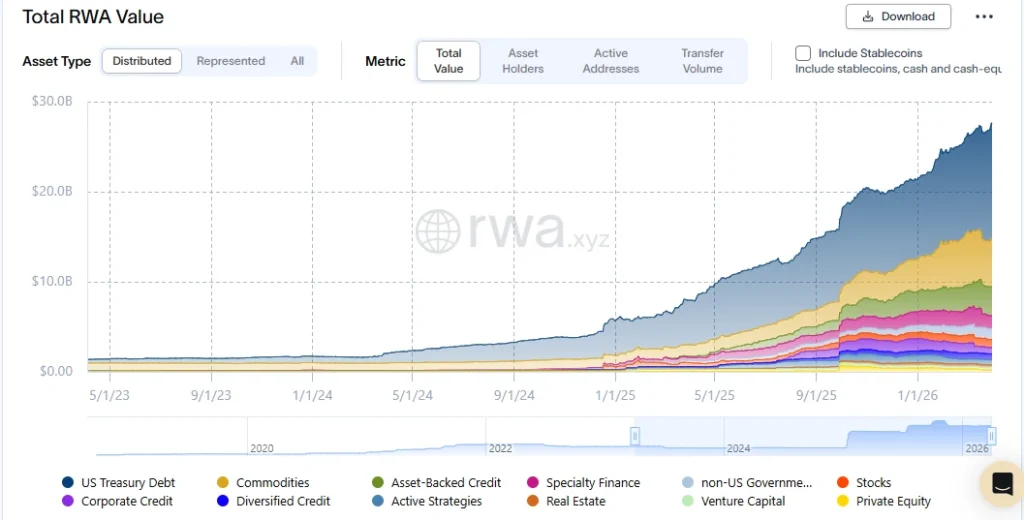
Source: rwa.xyz
BlackRock’s BUIDL fund contributed significantly to this, with assets under management exceeding $1.7 billion. Similar institutional players include JPMorgan Chase and Goldman Sachs, while specialized tokenization platforms include Securitize and Ondo Finance.
Critics argued that implementing the IMF’s recommendations would take away the true meaning of decentralization.
The industry must now choose its path: permissioned and safe, or decentralized and volatile.


추천 콘텐츠

Tokenized deals incoming? Franklin Templeton experiments with blockchain-based M&A

Today’s Biggest Crypto Movers: Dogecoin Leads the Pack