XRP’s burn mechanism, which is a long-term supply control feature of the network, is now facing serious questions after daily burns are now at almost zero. Particularly, on-chain metrics from CryptoQuant show that the once-active burn activity that removed thousands of coins per day from circulation has virtually disappeared in recent weeks. This collapse in burns is notable, as it shows how much XRP burns are contributing to the cryptocurrency’s overall token dynamics. Burn Activity Falls Off A Cliff XRP burns have dropped significantly in the past few months, and burn activity has been virtually nonexistent in August and September. This drop in burns is visualized in a detailed chart from CryptoQuant, which tracks the historical progression of XRP burn activity and the changes that have taken place since the beginning of the year. Related Reading: Market Expert Says Sell All Your XRP Once This Happens Back in December 2024, burns briefly surged to more than 15,000 coin in a single day during a period of high network activity. That momentum carried into the early months of 2025, when burn levels stabilized at a moderate but steady pace, ranging from 2,500 to 7,500 XRP per day.  By late August, however, activity had collapsed to historic lows, sliding below 1,000 tokens daily and remaining at those depressed levels throughout September. Current figures show only 400 to 750 XRP being burned each day, an amount that is almost insignificant when compared to the token’s massive supply of more than 60 billion. XRP’s burn mechanism is unlike that of popular crypto burns like Shiba Inu. Instead of large periodic burns, it has a constant, small-scale burn mechanism. Each time a transaction is processed on the XRP Ledger, a small fee (set at a minimum of 0.00001 XRP) is permanently destroyed. This mechanism means that every transfer contributes to reducing supply, but the effect is only meaningful when transaction volumes are consistently high. The huge decline in XRP burns, therefore, reflects not only the burn slowdown but also lower levels of transactions on the XRP Ledger itself, at least compared to Q4 2024. In effect, the burn statistics are serving as a mirror of current on-chain activity. XRP Successfully Defends $2.8 Interestingly, XRP’s price action in the past months has not mirrored the collapse in burns. In contrast, the XRP price has managed notable rallies, with it breaking to a new all-time high of $3.65 in July. Related Reading: $480 Million In 2 Weeks? XRP Whale Movements Could Reveal The Next Price Direction At the time of writing, however, the altcoin has retraced by over 20% from that all-time high. Particularly, recent price action in the most recent seven days saw the altcoin break below $3 again after rejecting an earlier rally between $3.18 and $3.15. However, it seems XRP bulls stepped in around support at $2.8 to prevent further declines.  At the time of writing, XRP is trading at $2.88, having staged a 2.2% rebound in the past 24 hours. Featured image from Getty Images, chart from Tradingview.comXRP’s burn mechanism, which is a long-term supply control feature of the network, is now facing serious questions after daily burns are now at almost zero. Particularly, on-chain metrics from CryptoQuant show that the once-active burn activity that removed thousands of coins per day from circulation has virtually disappeared in recent weeks. This collapse in burns is notable, as it shows how much XRP burns are contributing to the cryptocurrency’s overall token dynamics. Burn Activity Falls Off A Cliff XRP burns have dropped significantly in the past few months, and burn activity has been virtually nonexistent in August and September. This drop in burns is visualized in a detailed chart from CryptoQuant, which tracks the historical progression of XRP burn activity and the changes that have taken place since the beginning of the year. Related Reading: Market Expert Says Sell All Your XRP Once This Happens Back in December 2024, burns briefly surged to more than 15,000 coin in a single day during a period of high network activity. That momentum carried into the early months of 2025, when burn levels stabilized at a moderate but steady pace, ranging from 2,500 to 7,500 XRP per day.  By late August, however, activity had collapsed to historic lows, sliding below 1,000 tokens daily and remaining at those depressed levels throughout September. Current figures show only 400 to 750 XRP being burned each day, an amount that is almost insignificant when compared to the token’s massive supply of more than 60 billion. XRP’s burn mechanism is unlike that of popular crypto burns like Shiba Inu. Instead of large periodic burns, it has a constant, small-scale burn mechanism. Each time a transaction is processed on the XRP Ledger, a small fee (set at a minimum of 0.00001 XRP) is permanently destroyed. This mechanism means that every transfer contributes to reducing supply, but the effect is only meaningful when transaction volumes are consistently high. The huge decline in XRP burns, therefore, reflects not only the burn slowdown but also lower levels of transactions on the XRP Ledger itself, at least compared to Q4 2024. In effect, the burn statistics are serving as a mirror of current on-chain activity. XRP Successfully Defends $2.8 Interestingly, XRP’s price action in the past months has not mirrored the collapse in burns. In contrast, the XRP price has managed notable rallies, with it breaking to a new all-time high of $3.65 in July. Related Reading: $480 Million In 2 Weeks? XRP Whale Movements Could Reveal The Next Price Direction At the time of writing, however, the altcoin has retraced by over 20% from that all-time high. Particularly, recent price action in the most recent seven days saw the altcoin break below $3 again after rejecting an earlier rally between $3.18 and $3.15. However, it seems XRP bulls stepped in around support at $2.8 to prevent further declines.  At the time of writing, XRP is trading at $2.88, having staged a 2.2% rebound in the past 24 hours. Featured image from Getty Images, chart from Tradingview.com

XRP Burn Rate Suffers Drastic Crash To Near Zero, What’s Going On?

2025/09/24 05:00

XRP’s burn mechanism, which is a long-term supply control feature of the network, is now facing serious questions after daily burns are now at almost zero. Particularly, on-chain metrics from CryptoQuant show that the once-active burn activity that removed thousands of coins per day from circulation has virtually disappeared in recent weeks. This collapse in burns is notable, as it shows how much XRP burns are contributing to the cryptocurrency’s overall token dynamics.

Burn Activity Falls Off A Cliff

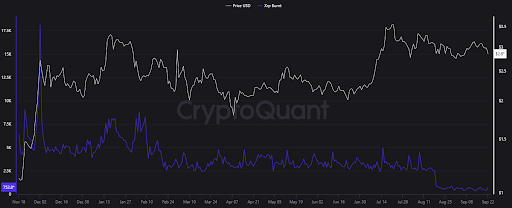
XRP burns have dropped significantly in the past few months, and burn activity has been virtually nonexistent in August and September. This drop in burns is visualized in a detailed chart from CryptoQuant, which tracks the historical progression of XRP burn activity and the changes that have taken place since the beginning of the year.

Back in December 2024, burns briefly surged to more than 15,000 coin in a single day during a period of high network activity. That momentum carried into the early months of 2025, when burn levels stabilized at a moderate but steady pace, ranging from 2,500 to 7,500 XRP per day. 

By late August, however, activity had collapsed to historic lows, sliding below 1,000 tokens daily and remaining at those depressed levels throughout September. Current figures show only 400 to 750 XRP being burned each day, an amount that is almost insignificant when compared to the token’s massive supply of more than 60 billion.
XRP

XRP’s burn mechanism is unlike that of popular crypto burns like Shiba Inu. Instead of large periodic burns, it has a constant, small-scale burn mechanism. Each time a transaction is processed on the XRP Ledger, a small fee (set at a minimum of 0.00001 XRP) is permanently destroyed. This mechanism means that every transfer contributes to reducing supply, but the effect is only meaningful when transaction volumes are consistently high.

The huge decline in XRP burns, therefore, reflects not only the burn slowdown but also lower levels of transactions on the XRP Ledger itself, at least compared to Q4 2024. In effect, the burn statistics are serving as a mirror of current on-chain activity.

XRP Successfully Defends $2.8

Interestingly, XRP’s price action in the past months has not mirrored the collapse in burns. In contrast, the XRP price has managed notable rallies, with it breaking to a new all-time high of $3.65 in July.

At the time of writing, however, the altcoin has retraced by over 20% from that all-time high. Particularly, recent price action in the most recent seven days saw the altcoin break below $3 again after rejecting an earlier rally between $3.18 and $3.15. However, it seems XRP bulls stepped in around support at $2.8 to prevent further declines. 

At the time of writing, XRP is trading at $2.88, having staged a 2.2% rebound in the past 24 hours.

XRP
시장 기회
니어 로고
니어 가격(NEAR)
$1.514
$1.514$1.514
-0.19%
USD
니어 (NEAR) 실시간 가격 차트
면책 조항: 본 사이트에 재게시된 글들은 공개 플랫폼에서 가져온 것으로 정보 제공 목적으로만 제공됩니다. 이는 반드시 MEXC의 견해를 반영하는 것은 아닙니다. 모든 권리는 원저자에게 있습니다. 제3자의 권리를 침해하는 콘텐츠가 있다고 판단될 경우, service@support.mexc.com으로 연락하여 삭제 요청을 해주시기 바랍니다. MEXC는 콘텐츠의 정확성, 완전성 또는 시의적절성에 대해 어떠한 보증도 하지 않으며, 제공된 정보에 기반하여 취해진 어떠한 조치에 대해서도 책임을 지지 않습니다. 본 콘텐츠는 금융, 법률 또는 기타 전문적인 조언을 구성하지 않으며, MEXC의 추천이나 보증으로 간주되어서는 안 됩니다.

추천 콘텐츠

Fundstrat’s Internal Report Contradicts CIO Tom Lee’s Bold Crypto Forecasts

Fundstrat’s Internal Report Contradicts CIO Tom Lee’s Bold Crypto Forecasts

The post Fundstrat’s Internal Report Contradicts CIO Tom Lee’s Bold Crypto Forecasts appeared on BitcoinEthereumNews.com. Key Points: Fundstrat internal report
공유하기
BitcoinEthereumNews2025/12/21 13:19
SEC Backs Nasdaq, CBOE, NYSE Push to Simplify Crypto ETF Rules

SEC Backs Nasdaq, CBOE, NYSE Push to Simplify Crypto ETF Rules

The US SEC on Wednesday approved new listing rules for major exchanges, paving the way for a surge of crypto spot exchange-traded funds. On Wednesday, the regulator voted to let Nasdaq, Cboe BZX and NYSE Arca adopt generic listing standards for commodity-based trust shares. The decision clears the final hurdle for asset managers seeking to launch spot ETFs tied to cryptocurrencies beyond Bitcoin and Ether. In July, the SEC outlined how exchanges could bring new products to market under the framework. Asset managers and exchanges must now meet specific criteria, but will no longer need to undergo drawn-out case-by-case reviews. Solana And XRP Funds Seen to Be First In Line Under the new system, the time from filing to launch can shrink to as little as 75 days, compared with up to 240 days or more under the old rules. “This is the crypto ETP framework we’ve been waiting for,” Bloomberg research analyst James Seyffart said on X, predicting a wave of new products in the coming months. The first filings likely to benefit are those tracking Solana and XRP, both of which have sat in limbo for more than a year. SEC Chair Paul Atkins said the approval reflects a commitment to reduce barriers and foster innovation while maintaining investor protections. The move comes under the administration of President Donald Trump, which has signaled strong support for digital assets after years of hesitation during the Biden era. New Standards Replace Lengthy Reviews And Repeated Denials Until now, the commission reviewed each application separately, requiring one filing from the exchange and another from the asset manager. This dual process often dragged on for months and led to repeated denials. Even Bitcoin spot ETFs, finally approved in Jan. 2024, arrived only after years of resistance and a legal battle with Grayscale. According to Bloomberg ETF analyst Eric Balchunas, the streamlined rules could apply to any cryptocurrency with at least six months of futures trading on the Coinbase Derivatives Exchange. That means more than a dozen tokens may now qualify for listing, potentially unleashing a new wave of altcoin ETFs. SEC Clears Grayscale Large Cap Fund Tracking CoinDesk 5 Index The SEC also approved the Grayscale Digital Large Cap Fund, which tracks the CoinDesk 5 Index, including Bitcoin, Ether, XRP, Solana and Cardano. Alongside this, it cleared the launch of options linked to the Cboe Bitcoin US ETF Index and its mini contract, broadening the set of crypto-linked derivatives on regulated US markets. Analysts say the shift shows how far US policy has moved. Where once regulators resisted digital assets, the latest changes show a growing willingness to bring them into the mainstream financial system under established safeguards
공유하기
CryptoNews2025/09/18 12:40
Bank of Canada cuts rate to 2.5% as tariffs and weak hiring hit economy

Bank of Canada cuts rate to 2.5% as tariffs and weak hiring hit economy

The Bank of Canada lowered its overnight rate to 2.5% on Wednesday, responding to mounting economic damage from US tariffs and a slowdown in hiring. The quarter-point cut was the first since March and met predictions from markets and economists. Governor Tiff Macklem, speaking in Ottawa, said the decision was unanimous. “With a weaker economy […]
공유하기
Cryptopolitan2025/09/17 23:09