

Only 10% of Nigeria’s working-age population uses generative AI – report
New data from Microsoft’s AI Economy Institute shows South Africa has become the clear leader in generative AI adoption in Africa, far ahead of continental rivals like Nigeria and Kenya.
The report, ‘Global AI Diffusion Q1 2026′, tracked the use of generative AI across 147 countries and found a widening digital divide across the continent.
The report revealed that South Africa ranked first in the region and 46th globally with 23.1% of the working-age population actively using a generative AI product in the first quarter of 2026.
 Artificial Intelligence adoption in Africa
This figure is a clear outlier from the rest of the continent and positions the country as the only African country in the club of mid-tier economies in the world in terms of AI adoption.
Conversely, the data for other leading African tech hubs presents a sobering reality. Nigeria, the continent’s largest economy by GDP and home to a vibrant, digitally engaged, youthful population, was a distant fourth with just 10.1%, less than half the South African figure. Kenya did even worse, trailing at 8.7%. The picture in much of sub-Saharan Africa remains grim, with countries like Uganda and Ethiopia reporting adoption rates well below the 8% level.
Microsoft’s Generative AI Index: The risk of exclusion
This is more crucial as generative AI has rapidly transitioned from an experimental novelty into core infrastructure. It is actively reshaping hiring practices, boosting productivity, and defining economic competitiveness in ways that will only compound over the coming years. For African nations lagging in adoption today, the long-term economic costs could be dire.
Microsoft’s report places Africa’s figures within a broader, unforgiving global context. The upper echelons of the diffusion index are dominated by high-income economies characterised by established digital ecosystems, robust broadband penetration, and substantial enterprise investment in AI tooling.
The concentration of African nations near the bottom of the table exposes a convergence of structural barriers that analysts have long warned about, but which this quantified data now makes undeniably concrete.
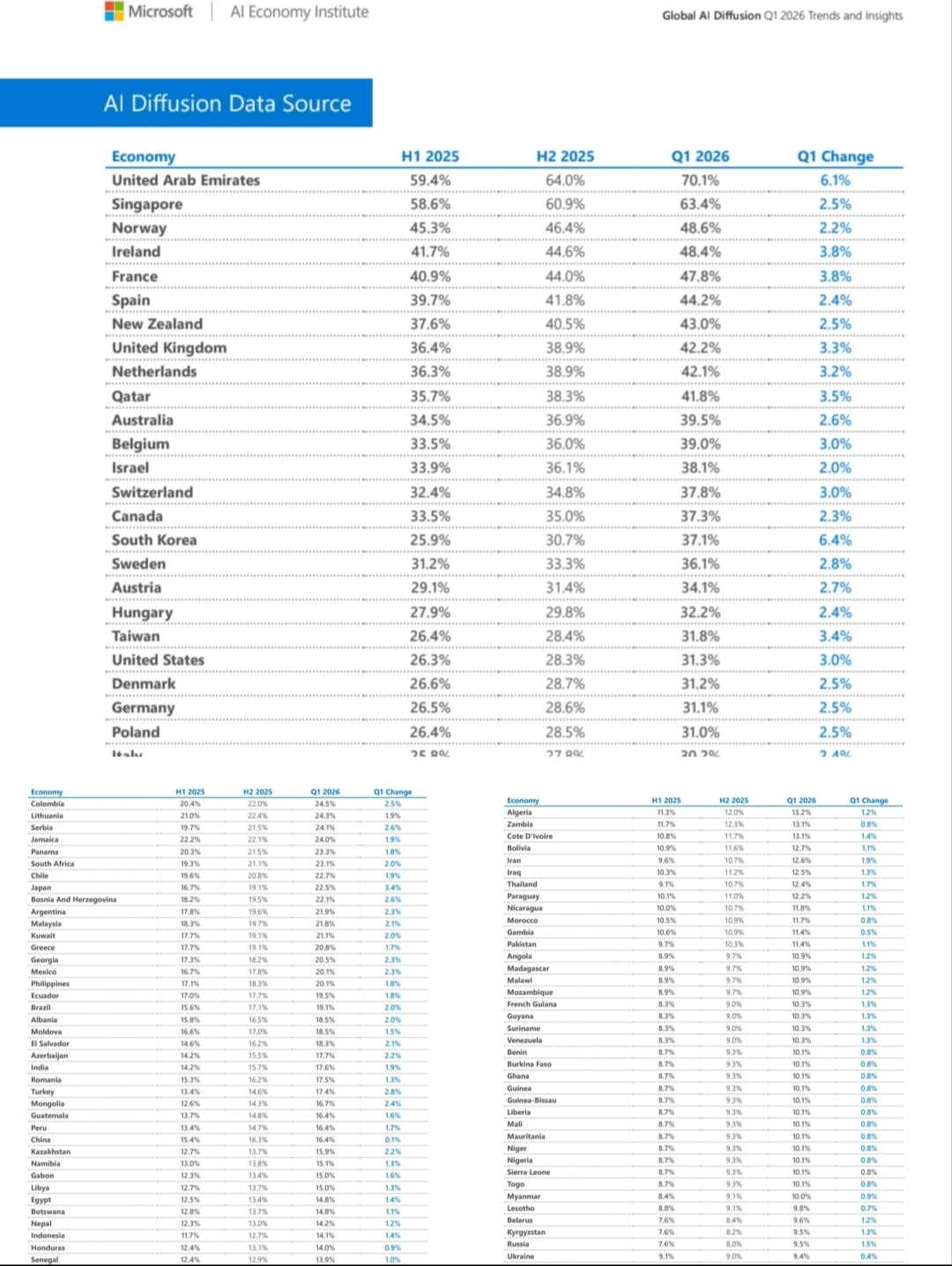 Microsoft’s Generative AI Index
At the forefront of these barriers is foundational infrastructure. But reliable and affordable broadband access is still highly fragmented across sub-Saharan Africa. Generative AI tools in the cloud require stable high-speed internet connections.
Otherwise, the entry barrier remains prohibitively high for millions of potential users. And while smartphone adoption is accelerating across the continent, it still lags far behind that of the world’s leading AI economies, which constricts the mobile-first pathways through which emerging markets typically adopt new technologies.
Economic realities add to the complication. More sophisticated consumer AI tools and business software are priced for Western markets. Where the affordability of products is significantly eroded by purchasing power parity, there are structural headwinds that even enthusiasm for technology may not be able to overcome in terms of uptake.
Education and baseline awareness complete the restrictive triad. Generative AI literacy is unevenly distributed. Within the continent, this literacy tends to remain siloed in major urban centres and among knowledge workers who already possess exposure to advanced digital workflows.
South Africa’s relative success is attributed to simultaneous advantages across these dimensions: higher broadband penetration, a larger formal knowledge economy, and greater corporate investment in digital transformation.
 Artificial intelligence
This collaborates with the recent call by Emmanuel Lubanzadio, OpenAI’s Africa lead, during the Africa CEO Summit in Kenya, where he said, “AI cannot benefit all of humanity if Africa is not included,” he argued.
He warned that the exclusion of the continent from the generative AI revolution would severely undermine the core mission of these transformative technologies. Underscoring the necessity of bridging this technological gap to ensure equitable progress.
Microsoft’s Q1 2026 data is a stark warning to African governments and private sector leaders to deliberate on how best to invest in tech and innovations.
The generative AI adoption gap between South Africa and the rest of the continent is not going to self-correct; it requires coordinated action on tech literacy, software affordability, and digital infrastructure, else, today’s AI divide could become a lasting economic deficit.


추천 콘텐츠

Ethereum Price Today: ETH At $2,138

$4 Trillion Tokenized Assets by 2028 Could Ignite DeFi Boom, Standard Chartered Says




