What Is DIGY11? How the Bitcoin-Backed Digital Credit ETF Differs From a Spot Bitcoin ETF
Overview
DIGY11 introduces a different way for investors to gain exposure to the expanding Bitcoin corporate-finance ecosystem. Developed around securities issued by Bitcoin treasury companies, the ETF is designed to invest primarily in perpetual preferred shares such as Strategy's STRC and Strive's SATA rather than holding Bitcoin directly.
This distinction is essential. DIGY11 is not a spot Bitcoin ETF. Its underlying exposure comes from income-oriented securities issued by companies whose balance sheets contain substantial Bitcoin holdings. The ETF is designed to transform that preferred-equity exposure into a portfolio capable of making monthly distributions in Brazilian reais while incorporating currency-hedging mechanisms.
The term Bitcoin-backed digital credit ETF describes the relationship between the securities and Bitcoin-heavy corporate balance sheets, but it should not be interpreted to mean that ETF investors own Bitcoin collateral directly. Bitcoin remains on the balance sheets of the issuing companies rather than inside DIGY11 itself.
As a result, DIGY11 combines Bitcoin-related corporate exposure with preferred-equity income, interest-rate sensitivity, issuer credit risk, liquidity considerations, and foreign-exchange hedging. Understanding these differences is essential before comparing the product with a conventional spot Bitcoin ETF.
Key Takeaways
- DIGY11 does not directly purchase or custody Bitcoin.
- Its portfolio focuses on preferred securities issued by Bitcoin treasury companies.
- STRC and SATA are among the main securities associated with its initial investment universe.
- The ETF targets monthly distributions in Brazilian reais and incorporates currency hedging.
- Estimated returns such as CDI plus 3%–5% are illustrative rather than guaranteed.
- DIGY11 carries issuer, preferred-equity, interest-rate, liquidity, and Bitcoin-related balance-sheet risks.
What Is the Bitcoin-Backed Digital Credit ETF DIGY11?
DIGY11 Invests in Bitcoin Treasury Preferred Securities
DIGY11 is structured as a Digital Yield ETF designed to provide exposure to preferred securities issued by companies with significant Bitcoin holdings.
Rather than buying BTC itself, the fund tracks an investment universe centered on Bitcoin treasury preferred equity.
The underlying index evaluates factors such as the issuer's Bitcoin reserves, balance-sheet structure, leverage, liquidity, volatility, and ability to make distributions.
Eligibility requirements are intended to ensure that the companies included in the strategy have meaningful Bitcoin exposure rather than incidental cryptocurrency holdings.
The investment chain can be understood as:
Investor → DIGY11 → Preferred Securities → Bitcoin Treasury Company → Corporate Bitcoin Holdings
Bitcoin therefore sits on the issuer's balance sheet rather than inside the ETF's custody structure.
That difference is fundamental to understanding both the potential return profile and the risks of DIGY11.
Why Is It Described as Digital Credit?
Bitcoin treasury companies increasingly use more than ordinary common shares or traditional corporate debt to raise capital.
Preferred equity has become another financing channel.
These securities typically sit between common equity and conventional debt in a company's capital structure. Investors may receive distributions that are higher or more predictable than ordinary common-stock dividends, but preferred securities can also be perpetual, meaning they may have no fixed maturity date.
Their market prices can therefore respond to interest rates, issuer credit conditions, liquidity, Bitcoin prices, and changes in the company's financing strategy.
The term digital credit is used to describe this emerging capital-market segment built around companies whose financial structure is closely connected to large Bitcoin reserves.
However, preferred shares remain securities issued by corporations. They should not automatically be treated as conventional secured bonds.
Owning DIGY11 does not provide investors with a direct legal claim on a specific amount of Bitcoin.
How Does DIGY11 Generate Monthly Income?
STRC and SATA Are Important Sources of Yield Exposure
The investment universe associated with DIGY11 includes securities such as Strategy's STRC and Strive's SATA.
These preferred instruments are designed to make distributions to holders, creating a potential income stream that can be collected by the ETF and ultimately reflected in distributions to fund investors.
Based on figures presented in the product materials using data from August 4, 2026, STRC showed an annualized distribution rate of 12.00%, while SATA showed 13.00%. The corresponding weighted index yield was estimated at approximately 12% annually.
These figures should not be interpreted as a guaranteed DIGY11 return.
Distribution rates on the underlying securities can change, portfolio weights can change during index rebalancing, and preferred-share prices can move significantly.
An investor can therefore receive distributions while still experiencing a capital loss if the market value of the underlying securities declines by a larger amount.
What Does CDI Plus 3%–5% Mean?
Product materials have presented an illustrative potential annual return of approximately CDI plus 3%–5%.
This is an estimate rather than a promised rate of return.
The underlying preferred securities are primarily dollar-denominated, while DIGY11 is designed for Brazilian investors. The final return profile therefore depends on several adjustments.
These can include the yield generated by the preferred securities, foreign-exchange hedging costs, Brazilian country-risk conditions, prime-broker financing costs, ETF expenses, and changes in the market value of the underlying assets.
This means DIGY11 should not be treated like a bank deposit or a fixed-rate government security.
Its distributions can change, and investors can lose principal.
Is DIGY11 the Same as a Spot Bitcoin ETF?
No. DIGY11 Does Not Hold Bitcoin Directly
The most important difference between DIGY11 and a spot Bitcoin ETF is the underlying asset.
A spot Bitcoin ETF generally holds Bitcoin directly through a qualified custody arrangement. Its primary investment objective is to reflect changes in the market price of BTC, minus fees and tracking differences.
DIGY11 does not follow this model.
Its underlying assets are preferred securities issued by Bitcoin treasury companies.
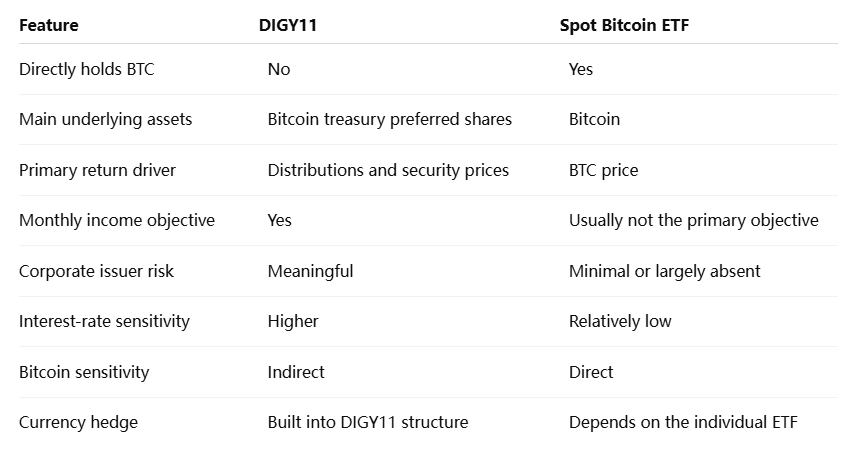
The distinction produces different market behavior.
If Bitcoin rises 20%, DIGY11 does not necessarily rise by a similar percentage because the prices of preferred securities are also influenced by yield expectations, interest rates, issuer-specific risk, and liquidity.
Likewise, if Bitcoin declines, the preferred securities may not move exactly in line with BTC. Their income characteristics could soften some price movements, although worsening balance-sheet conditions could also create additional pressure.
Why Does Bitcoin Still Matter to DIGY11?
Although DIGY11 does not hold BTC, Bitcoin remains central to the investment thesis because the underlying issuers maintain substantial Bitcoin reserves.
The value of those reserves can influence asset coverage, financing conditions, market confidence, and the perceived strength of the issuer's balance sheet.
When Bitcoin rises substantially, the market value of an issuer's treasury assets can increase, potentially strengthening balance-sheet coverage.
When Bitcoin falls sharply, the opposite can occur.
However, these calculations describe corporate asset coverage rather than formal collateral pledged specifically to DIGY11 investors.
The Bitcoin held by Strategy, Strive, or another issuer remains a corporate asset. It is not automatically segregated for DIGY11 shareholders, and ETF investors generally cannot redeem their fund shares for the issuer's underlying BTC.
What Are the Main Risks of DIGY11?
Bitcoin Asset Coverage Does Not Guarantee Distributions
A common misunderstanding is to assume that preferred securities issued by Bitcoin treasury companies are automatically secured by the companies' Bitcoin holdings.
That is not necessarily the case.
Corporate Bitcoin can strengthen an issuer's balance sheet, but that does not mean a specific quantity of BTC has been legally pledged to guarantee every preferred-share distribution.
If Bitcoin prices fall significantly, the market value of the issuer's assets can decline.
At the same time, weaker market conditions could increase financing costs, reduce access to capital, or place pressure on preferred securities.
DIGY11 investors are therefore exposed to a combination of Bitcoin-related balance-sheet risk and traditional corporate capital-structure risk.
Interest Rates and Liquidity Also Matter
Preferred securities can be highly sensitive to changes in interest rates.
When risk-free yields rise, investors may demand higher yields from preferred shares. Existing securities can fall in price to compensate for the difference.
Liquidity is another consideration.
Some preferred securities may have substantially lower trading volumes than major common stocks or Bitcoin itself. Wider bid-ask spreads and lower market depth can increase price volatility during periods of stress.
DIGY11 also introduces additional layers of risk through index concentration, foreign-exchange hedging, ETF trading liquidity, fund expenses, and the financial condition of individual issuers.
These factors make the product structurally more complex than a conventional spot Bitcoin ETF.
Why Could DIGY11 Matter to the Bitcoin Market?
Bitcoin Treasury Companies Are Building New Capital Structures
The early Bitcoin treasury model was relatively straightforward.
A company raised capital through common equity or debt and used some of the proceeds to accumulate Bitcoin.
The development of preferred securities such as STRC and SATA suggests that this model is becoming more sophisticated.
Companies can now attempt to serve different investor groups through different layers of their capital structures.
Common shareholders may seek higher sensitivity to Bitcoin and corporate growth.
Preferred shareholders may prioritize distributions, asset coverage, and income.
An ETF such as DIGY11 adds another layer by packaging several of these preferred securities into an exchange-traded product.
If this model continues to expand, the relationship between Bitcoin and traditional capital markets could extend well beyond spot ETFs.
Bitcoin could increasingly influence preferred equity, structured credit-like products, corporate treasury strategies, indexes, and income-focused investment funds.
How Should the "World's First" Description Be Interpreted?
DIGY11 belongs to a very new product category, but the phrase world's first Bitcoin-backed digital credit ETF requires careful interpretation.
Digital credit is not a universally standardized regulatory category, and several investment products globally already provide exposure to companies or securities connected to Bitcoin.
A more precise description is that DIGY11 is a Digital Yield ETF built around preferred securities issued by Bitcoin treasury companies and designed specifically for the Brazilian market.
Its distinctive feature is the combination of Bitcoin treasury preferred equity, an ETF wrapper, currency hedging, and a monthly distribution objective.
DIGY11 Is a Different Branch of Bitcoin Financialization
DIGY11 should not be viewed as another version of a spot Bitcoin ETF.
Its investment structure is fundamentally different.
Instead of holding BTC directly, DIGY11 invests in preferred securities issued by companies whose balance sheets contain substantial Bitcoin holdings. It combines Bitcoin treasury exposure with income-oriented preferred equity and an ETF structure designed for Brazilian investors.
That creates a potentially attractive source of diversified Bitcoin-related exposure, but it also introduces additional variables that do not exist in a straightforward spot Bitcoin ETF.
Investors must consider issuer quality, asset coverage, distribution policies, interest rates, preferred-security liquidity, currency hedging, fund expenses, and Bitcoin market conditions.
The broader significance of DIGY11 lies in what it suggests about Bitcoin's evolution within capital markets.
Bitcoin is increasingly functioning not only as an investable asset but also as an important balance-sheet asset around which corporations can construct different layers of financing.
If Bitcoin treasury companies continue developing preferred shares and other income-oriented securities, future Bitcoin financialization may extend far beyond simply buying and holding BTC.
DIGY11 represents one example of that transition—from direct Bitcoin exposure toward an expanding ecosystem of securities built around Bitcoin-heavy corporate balance sheets.
Sources
https://www.oranjebtc.com/digy1
https://www.analistas.com.br/noticias/digy11-oranjebtc-marca-lancamento-do-etf-para-15-de-setembro
Risk Disclaimer: This article is for reference only and does not constitute investment advice. The cryptocurrency market is highly volatile. Please make decisions cautiously based on your individual circumstances.
추천 콘텐츠

BIKETYSON Coin Surges as Solana Traders Chase a New Absurd Meme

Strategic Bitcoin Reserve Bill: What H.R. 8957 Means Before the Committee Vote