Leveraging Normalizing Flows for Conservative 6D Beam Reconstruction: Conclusions and Extensions
Table of Links
I. Introduction
II. Maximum Entropy Tomography
- A. Ment
- B. Ment-Flow
III. Numerical Experiments
- A. 2D reconstructions from 1D projections
- B. 6D reconstructions from 1D projections
IV. Conclusion and Extensions
V. Acknowledgments and References
IV. CONCLUSION AND EXTENSIONS
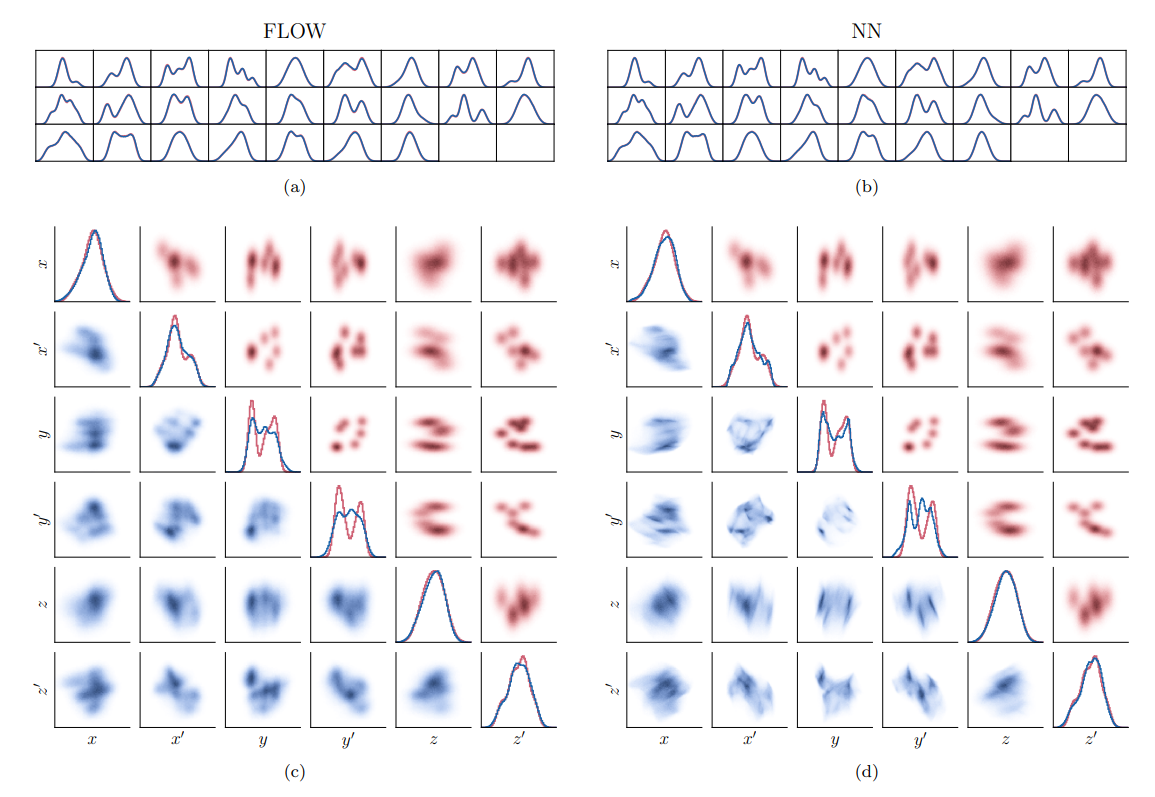
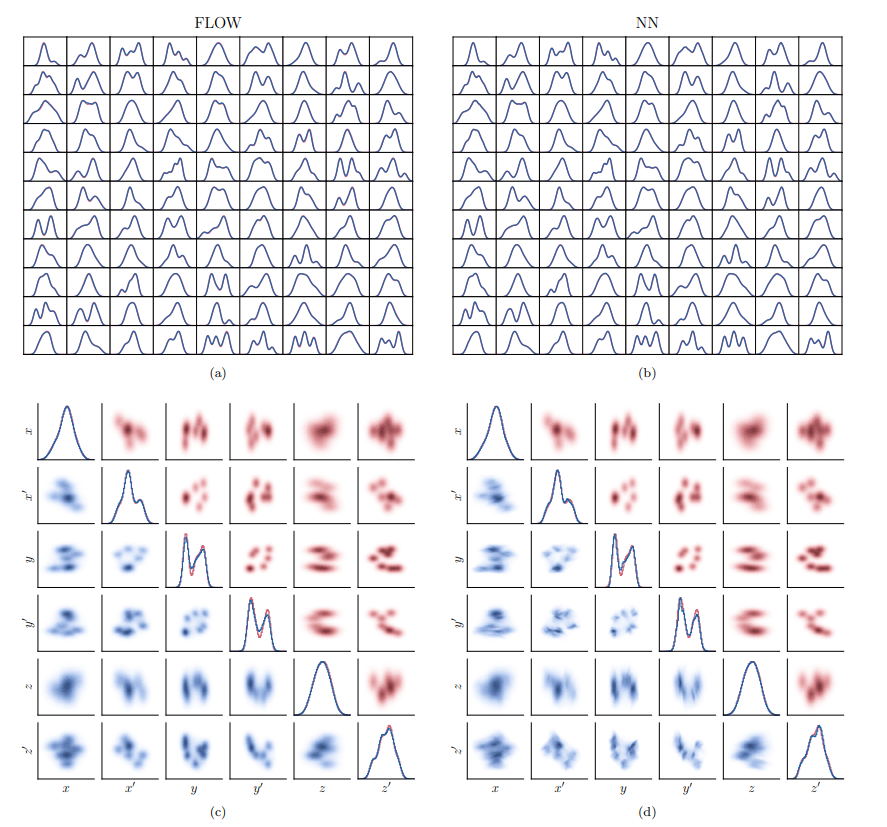
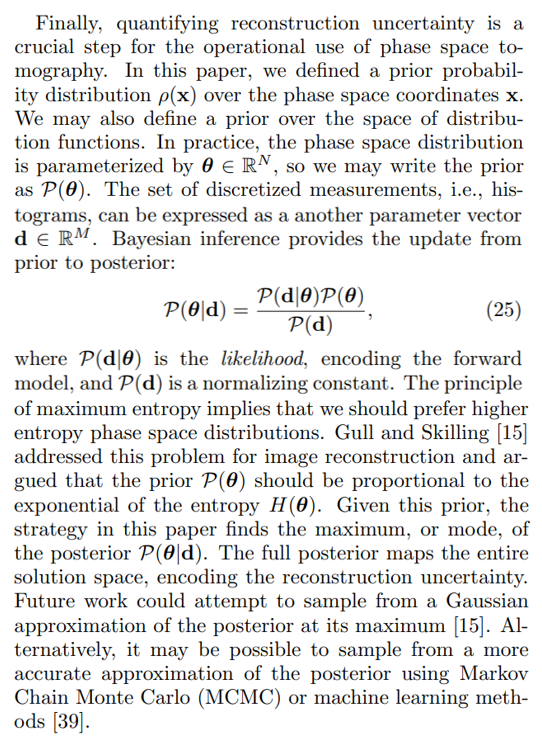
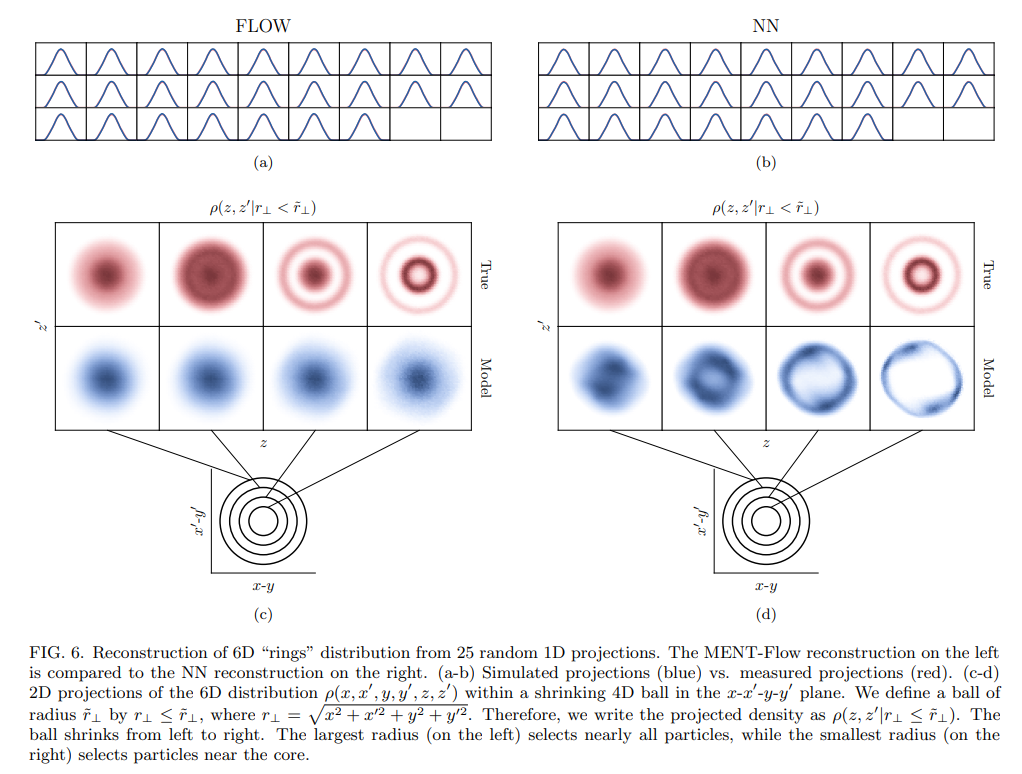
In conclusion, MENT-Flow is a promising approach to high-dimensional phase space tomography. Numerical experiments demonstrate consistency with known 2D maximum-entropy solutions and the ability to fit complex 6D distributions to large measurement sets. In the 6D tests, although there are no available benchmarks, we found that entropic regularization pulls the solution closer to the prior. Thus, MENT-Flow is an effective way to incorporate prior information in high-dimensional reconstructions. Our numerical experiments also emphasize the potential importance of uncertainty quantification in high-dimensional tomography, as we found that some distributions can only be reconstructed from large numbers of 1D measurements. Future work should apply MENT-Flow to more realistic distributions, accelerator
\ 
\ models, and diagnostics, especially 2D projections. Future work should also aim to extend MENT to higher dimensions to serve as a benchmark.
\ MENT-Flow has several limitations. First, particle sampling is over 50% slower than a conventional neural network, and the total runtime is inflated by the need to solve multiple subproblems to approach the maximum-entropy distribution from below. This motivates the search for more efficient flows and sample-based entropy estimates. Note that our training times ranged from 5 to 20 minutes on a single GPU, depending on the number of projections, phase space dimension, batch size, and penalty parameter updates. Second, MENT-Flow maximizes the entropy using a penalty method that does not generate exact solutions and requires a hand-tuned penalty parameter schedule to avoid ill-conditioning. It is unclear whether this process can be automated or whether alternative strategies can better prevent ill-conditioning. Third, MENT-Flow does not attach uncertainty to its output.
\ We now discuss possible extensions to new problems. First, it may be possible to fit n-dimensional distributions to m-dimensional projections when m > 2. This problem is of theoretical interest but also has some practical relevance. 3D and 4D projections can be measured relatively quickly using slit-screen-dipole measurement systems in low-energy hadron accelerators [1–3]. We propose to draw samples from the measured projections and minimize a differentiable statistical distance between these samples and samples from the normalizing flow.
\ Second, an interesting application of maximum-entropy tomography is to intense hadron beams, in which particles respond to both applied and self-generated electromagnetic fields. Phase space tomography is a significant challenge for such beams because the forward process depends on the unknown initial distribution. We do not know if the maximum-entropy distribution is unique in this case. Including space charge in the GPSR forward process may be possible using differentiable space charge solvers [38].
\ 
\ 
\ 
\
:::info Authors:
(1) Austin Hoover, Oak Ridge National Laboratory, Oak Ridge, Tennessee 37830, USA (hooveram@ornl.gov);
(2) Jonathan C. Wong, Institute of Modern Physics, Chinese Academy of Sciences, Lanzhou 730000, China.
:::
:::info This paper is available on arxiv under CC BY 4.0 DEED license.
:::
\


추천 콘텐츠

Solana Remains Above Its $75 Support Level

PMI-ACP Exam Preparation: How to Use a Simulator and Practice Questions Effectively