Swiss-regulated crypto bank AMINA Bank AG announced that it has become the first regulated financial institution globally to offer staking services for POL, the native token of the Polygon blockchain ecosystem. The Zug-based bank, supervised by Switzerland’s Financial Market Supervisory Authority (FINMA), now provides qualified institutional participants a compliant pathway to participate in network validation while earning up to 15% in staking rewards. Through a partnership with the Polygon Foundation, AMINA’s institutional clients—including family offices, asset managers, pension funds, and corporate treasuries—can now stake POL in a regulated environment. The offering builds on AMINA’s existing crypto custody and trading services, further expanding its institutional-grade digital asset capabilities. Polygon’s Expanding Institutional Footprint The announcement shows Polygon’s growing role as a preferred blockchain infrastructure for major institutions and enterprises. The network supports nearly $3 billion in stablecoin market capitalization, dominates the micro- and small-payment segment for USDC, and is integrated with Stripe, allowing for sub-$0.01 transaction fees and near-instant settlements. Polygon’s Proof-of-Stake (PoS) chain recently surpassed $1 billion in tokenized real-world assets (RWAs) and now hosts several high-profile deployments, including BlackRock’s BUIDL Fund, a tokenized money-market fund, and integrations by JPMorgan and Franklin Templeton. These developments indicate a broader institutional shift toward on-chain finance, where efficiency, transparency, and regulatory alignment are paramount. Institutional Demand Meets Regulated Staking Myles Harrison, chief product officer at AMINA Bank, said the initiative reflects growing institutional interest in blockchain participation beyond passive investment. “Our expansion of POL services provides institutional clients with regulated access to the blockchain, enabling them to be rewarded for providing stability and security to a network used by some of the biggest financial institutions and brands in the world,” he said. The move also provides a bridge between traditional finance and decentralized infrastructure. AMINA’s staking rewards—4–5% standard, plus a Polygon Foundation boost up to 15%—are among the most competitive in the market. The bank’s risk disclosure framework addresses regulatory and market risks, including potential slashing and lockup periods. Polygon’s Market Outlook and Price Action The Polygon Ecosystem Token (POL)—formerly known as MATIC—is currently trading at $0.2369, down 0.77% over the past 24 hours, according to data from CryptoNews. The token has seen mild volatility this week, fluctuating between $0.24 and $0.23, with modest trading volume around 1.45K POL. Since its migration from MATIC earlier this year, POL has served as the upgraded native asset of the Polygon ecosystem, underpinning network security and governance as part of Polygon’s shift toward a multichain ecosystem. Despite short-term price softness, POL remains one of the top 70 cryptocurrencies by market capitalization, with a total supply exceeding 10.5 billion tokens, reflecting steady investor interest as institutional use cases for Polygon continue to grow. Analysts note that institutional integrations like AMINA’s staking program could reinforce long-term confidence in POL’s utility as a core asset underpinning Polygon’s expanding role in real-world asset tokenization and DeFi infrastructure. As Marc Boiron, CEO of Polygon Labs, put it: “Institutions aren’t just buying tokens anymore—they want to participate in the networks that matter. This gives real capital a regulated, bank-grade entry point to secure the internet’s next value layer.”Swiss-regulated crypto bank AMINA Bank AG announced that it has become the first regulated financial institution globally to offer staking services for POL, the native token of the Polygon blockchain ecosystem. The Zug-based bank, supervised by Switzerland’s Financial Market Supervisory Authority (FINMA), now provides qualified institutional participants a compliant pathway to participate in network validation while earning up to 15% in staking rewards. Through a partnership with the Polygon Foundation, AMINA’s institutional clients—including family offices, asset managers, pension funds, and corporate treasuries—can now stake POL in a regulated environment. The offering builds on AMINA’s existing crypto custody and trading services, further expanding its institutional-grade digital asset capabilities. Polygon’s Expanding Institutional Footprint The announcement shows Polygon’s growing role as a preferred blockchain infrastructure for major institutions and enterprises. The network supports nearly $3 billion in stablecoin market capitalization, dominates the micro- and small-payment segment for USDC, and is integrated with Stripe, allowing for sub-$0.01 transaction fees and near-instant settlements. Polygon’s Proof-of-Stake (PoS) chain recently surpassed $1 billion in tokenized real-world assets (RWAs) and now hosts several high-profile deployments, including BlackRock’s BUIDL Fund, a tokenized money-market fund, and integrations by JPMorgan and Franklin Templeton. These developments indicate a broader institutional shift toward on-chain finance, where efficiency, transparency, and regulatory alignment are paramount. Institutional Demand Meets Regulated Staking Myles Harrison, chief product officer at AMINA Bank, said the initiative reflects growing institutional interest in blockchain participation beyond passive investment. “Our expansion of POL services provides institutional clients with regulated access to the blockchain, enabling them to be rewarded for providing stability and security to a network used by some of the biggest financial institutions and brands in the world,” he said. The move also provides a bridge between traditional finance and decentralized infrastructure. AMINA’s staking rewards—4–5% standard, plus a Polygon Foundation boost up to 15%—are among the most competitive in the market. The bank’s risk disclosure framework addresses regulatory and market risks, including potential slashing and lockup periods. Polygon’s Market Outlook and Price Action The Polygon Ecosystem Token (POL)—formerly known as MATIC—is currently trading at $0.2369, down 0.77% over the past 24 hours, according to data from CryptoNews. The token has seen mild volatility this week, fluctuating between $0.24 and $0.23, with modest trading volume around 1.45K POL. Since its migration from MATIC earlier this year, POL has served as the upgraded native asset of the Polygon ecosystem, underpinning network security and governance as part of Polygon’s shift toward a multichain ecosystem. Despite short-term price softness, POL remains one of the top 70 cryptocurrencies by market capitalization, with a total supply exceeding 10.5 billion tokens, reflecting steady investor interest as institutional use cases for Polygon continue to grow. Analysts note that institutional integrations like AMINA’s staking program could reinforce long-term confidence in POL’s utility as a core asset underpinning Polygon’s expanding role in real-world asset tokenization and DeFi infrastructure. As Marc Boiron, CEO of Polygon Labs, put it: “Institutions aren’t just buying tokens anymore—they want to participate in the networks that matter. This gives real capital a regulated, bank-grade entry point to secure the internet’s next value layer.”

AMINA Bank Launches Polygon POL Staking for Institutions – Compliance First, Yield Up to 15%

2025/10/10 01:01
3분 읽기
이 콘텐츠에 대한 의견이나 우려 사항이 있으시면 crypto.news@mexc.com으로 연락주시기 바랍니다

Swiss-regulated crypto bank AMINA Bank AG announced that it has become the first regulated financial institution globally to offer staking services for POL, the native token of the Polygon blockchain ecosystem.

The Zug-based bank, supervised by Switzerland’s Financial Market Supervisory Authority (FINMA), now provides qualified institutional participants a compliant pathway to participate in network validation while earning up to 15% in staking rewards.

Through a partnership with the Polygon Foundation, AMINA’s institutional clients—including family offices, asset managers, pension funds, and corporate treasuries—can now stake POL in a regulated environment. The offering builds on AMINA’s existing crypto custody and trading services, further expanding its institutional-grade digital asset capabilities.

Polygon’s Expanding Institutional Footprint

The announcement shows Polygon’s growing role as a preferred blockchain infrastructure for major institutions and enterprises. The network supports nearly $3 billion in stablecoin market capitalization, dominates the micro- and small-payment segment for USDC, and is integrated with Stripe, allowing for sub-$0.01 transaction fees and near-instant settlements.

Polygon’s Proof-of-Stake (PoS) chain recently surpassed $1 billion in tokenized real-world assets (RWAs) and now hosts several high-profile deployments, including BlackRock’s BUIDL Fund, a tokenized money-market fund, and integrations by JPMorgan and Franklin Templeton.

These developments indicate a broader institutional shift toward on-chain finance, where efficiency, transparency, and regulatory alignment are paramount.

Institutional Demand Meets Regulated Staking

Myles Harrison, chief product officer at AMINA Bank, said the initiative reflects growing institutional interest in blockchain participation beyond passive investment.

“Our expansion of POL services provides institutional clients with regulated access to the blockchain, enabling them to be rewarded for providing stability and security to a network used by some of the biggest financial institutions and brands in the world,” he said.

The move also provides a bridge between traditional finance and decentralized infrastructure. AMINA’s staking rewards—4–5% standard, plus a Polygon Foundation boost up to 15%—are among the most competitive in the market. The bank’s risk disclosure framework addresses regulatory and market risks, including potential slashing and lockup periods.

Polygon’s Market Outlook and Price Action

The Polygon Ecosystem Token (POL)—formerly known as MATIC—is currently trading at $0.2369, down 0.77% over the past 24 hours, according to data from CryptoNews.
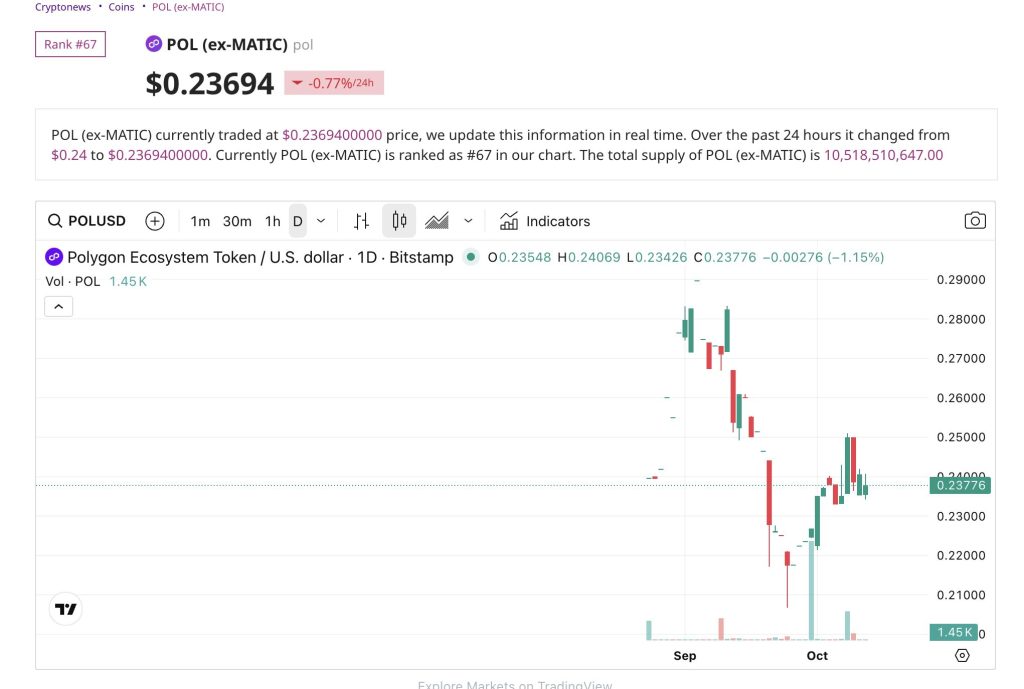
The token has seen mild volatility this week, fluctuating between $0.24 and $0.23, with modest trading volume around 1.45K POL. Since its migration from MATIC earlier this year, POL has served as the upgraded native asset of the Polygon ecosystem, underpinning network security and governance as part of Polygon’s shift toward a multichain ecosystem.

Despite short-term price softness, POL remains one of the top 70 cryptocurrencies by market capitalization, with a total supply exceeding 10.5 billion tokens, reflecting steady investor interest as institutional use cases for Polygon continue to grow.

Analysts note that institutional integrations like AMINA’s staking program could reinforce long-term confidence in POL’s utility as a core asset underpinning Polygon’s expanding role in real-world asset tokenization and DeFi infrastructure.

As Marc Boiron, CEO of Polygon Labs, put it: “Institutions aren’t just buying tokens anymore—they want to participate in the networks that matter. This gives real capital a regulated, bank-grade entry point to secure the internet’s next value layer.”


시장 기회
Lorenzo Protocol 로고
Lorenzo Protocol 가격(BANK)
$0.02778
$0.02778$0.02778
-1.06%
USD
Lorenzo Protocol (BANK) 실시간 가격 차트
면책 조항: 본 사이트에 재게시된 글들은 공개 플랫폼에서 가져온 것으로 정보 제공 목적으로만 제공됩니다. 이는 반드시 MEXC의 견해를 반영하는 것은 아닙니다. 모든 권리는 원저자에게 있습니다. 제3자의 권리를 침해하는 콘텐츠가 있다고 판단될 경우, crypto.news@mexc.com으로 연락하여 삭제 요청을 해주시기 바랍니다. MEXC는 콘텐츠의 정확성, 완전성 또는 시의적절성에 대해 어떠한 보증도 하지 않으며, 제공된 정보에 기반하여 취해진 어떠한 조치에 대해서도 책임을 지지 않습니다. 본 콘텐츠는 금융, 법률 또는 기타 전문적인 조언을 구성하지 않으며, MEXC의 추천이나 보증으로 간주되어서는 안 됩니다.

$30,000 in PRL + 15,000 USDT

$30,000 in PRL + 15,000 USDT$30,000 in PRL + 15,000 USDT

Deposit & trade PRL to boost your rewards!