Why Zcash Beats Monero And Even Bitcoin: MIT Research Scientist
MIT research scientist and Zcash co-founder Madars Virza has set off a fresh round of privacy-coin debate after arguing that Zcash’s shielded pool delivers materially stronger anonymity than Monero’s ring-signature model—and that Zcash’s design choices also give it an edge over Bitcoin in a post-quantum world.
Virza framed the discussion with a pointed update to the “conservative advice” that circulated in Bitcoin’s early years. “Conservative advice back then: ‘allocate 1% of your NW to Bitcoin,’” he wrote on October 7. “Conservative advice today: ‘encrypt at least 1% of your Bitcoin.’” The shift in emphasis—from owning BTC to hardening its transactional privacy—set the stage for an extended technical exchange about how different privacy systems hold up under modern analysis.
Zcash Better Than Monero And Bitcoin?
Pressed by an X user on “Why not Monero?”, Virza argued that Monero’s core privacy primitive—ring signatures with fixed-size decoy sets—creates a relatively small and attackable anonymity set. “Each Monero spend references the actual spend (just like in Bitcoin) plus 16 randomly decoys,” he wrote. “16 is not a large number and easily falls to generic attacks,” he added, pointing to research presentations on tracing heuristics.
He further noted that real-world sampling biases can shrink the effective protection: “Because of biases in the random distribution, 16 is more like 4.2 in practice (OSPEAD attack).” In other words, even though each spend is bundled with 16 decoys, selection patterns can leak enough information that the true spender becomes statistically distinguishable far more often than users expect.
By contrast, Virza said, Zcash’s fully shielded transfers avoid the small, fixed ring entirely. “Each shielded Zcash spend has an anonymity set of all previous Zcash outputs in that shielded pool—that’s millions and thus much more private,” he wrote. Because the system proves correctness with zero-knowledge proofs, the transaction does not have to disclose which prior note is being spent, so the anonymity set scales with the entire shielded pool rather than a handful of decoys.
Virza also pointed to practical composability as a strategic advantage: “Another reason for Zcash is DeFi integrations—you have deep liquidity for atomic swaps.” In his view, those integrations make it easier for users to move value into and out of the shielded pool and, potentially, to “encrypt” portions of their Bitcoin exposure via swap-based workflows.
ZEC Is Almost Quantum-Secure
A second vector in Virza’s critique concerned long-term security against quantum adversaries. “Zcash is also post-quantum private (if you use unique shielded addresses) but a quantum adversary will be able to completely recover Monero transaction graph by breaking discrete logs for all key images,” he wrote.
The point is subtle but consequential: Monero’s linkability-prevention relies on properties (discrete logarithms) that are known to be vulnerable to sufficiently advanced quantum computers, which could allow future attackers to map historical spending relations. Zcash’s shielded model, by design, leaves far less reconstructable metadata on-chain—so even if public-key systems eventually fall to quantum attacks, there is less transactional structure for an adversary to “unwind.”
Zcash engineer Sean Bowe reinforced the same theme in a July exchange that Virza cited, arguing that Zcash’s privacy stems from the omission of sensitive data rather than the obfuscation of it. “For example, there is no quantum computer or powerful AI that will be able to look back at the Zcash blockchain 1000 years from now and figure out who made every fully shielded transaction,” Bowe wrote.
“That information, among other things, never even touches the ledger. It’s already gone.” He added that while boundary surfaces—where shielded transactions meet exchanges, wallets, or other public systems—can still leak, the baseline is unusually strong: “To be certain about your privacy you must start by using shielded Zcash. You almost cannot even begin otherwise.” In Bowe’s words, Zcash begins from “something that is already extremely private” and is working toward global scalability from that foundation.
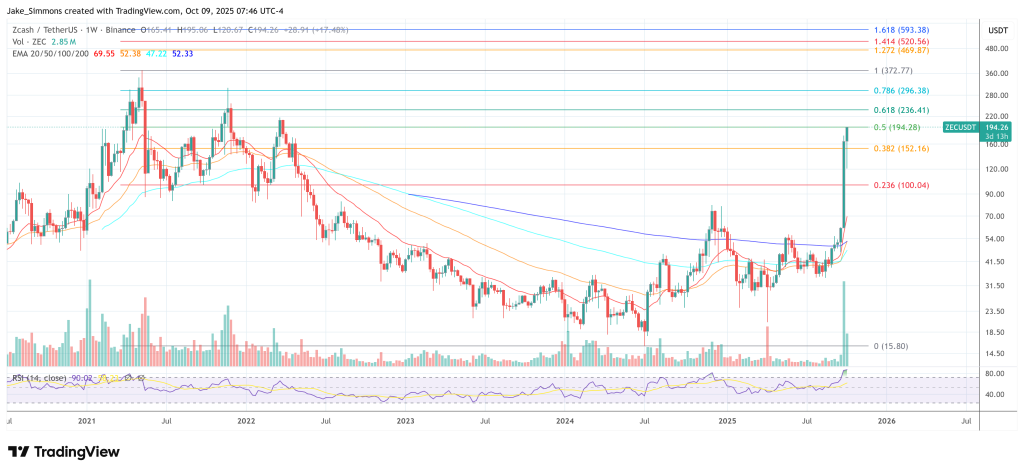
At press time, ZEC is up almost 52% since yesterday, trading at $194.


추천 콘텐츠

Strategy (MSTR) Stock Jumps Back Into Buy Mode After Bitcoin Pause

Solo Bitcoin Miner Wins $210K After 1-in-28,000 Odds