Institutional investors expect tokenized assets to take up a much larger role in global portfolios by the end of the decade, with private markets seen as the first to shift. A State Street study published Thursday projects that by 2030, between 10% and 24% of institutional investments could be made through tokenized instruments. Private equity and private fixed income are viewed as the most likely early candidates for tokenization. These markets have long struggled with illiquidity and high operational costs, making them prime targets for digital instruments designed to boost efficiency and unlock liquidity. “The acceleration in adoption of emerging technologies is remarkable. Institutional investors are moving beyond experimentation, and digital assets are now a strategic lever for growth, efficiency, and innovation,” said Joerg Ambrosius, president of Investment Services at State Street. He added that tokenization, artificial intelligence and quantum computing are converging to reshape the future of finance, with early adopters leading the charge. Digital Assets Average 7% of Portfolios, Set to More Than Double in Three Years The research also shows that while tokenization is gaining traction, many investors believe other technologies will have an even greater impact on operations. More than half of respondents pointed to generative AI and quantum computing as more transformative than blockchain, though they see the technologies working in tandem. Currently, institutional portfolios hold an average of 7% in digital assets, according to the study. That figure is expected to rise to 16% within three years. The most common forms are digital cash, along with tokenized versions of listed equities and fixed income. On average, respondents hold 1% of their portfolios in each of these categories. Asset Managers Outpace Owners in Bitcoin, Ethereum and Tokenized Assets Asset managers reported higher exposure than asset owners across nearly every category. 14% of managers said they held 2% to 5% of portfolios in Bitcoin, compared with 7% of asset owners. A small share of managers also admitted to having at least 5% of assets in Ethereum, meme coins or NFTs, pointing to the broader range of risk appetite. Tokenization of real-world assets is another area where managers are ahead. They reported greater exposure to tokenized public assets, tokenized private assets and digital cash than asset owners. Even so, cryptocurrencies remain the biggest driver of returns within digital portfolios. 27% of respondents said Bitcoin is their strongest performer today. A quarter also expect it to remain the top performer in three years. Meanwhile, Ethereum ranked second. 21% cited it as their biggest return generator now, and 22% expect that trend to continue. By contrast, only 13% said tokenized public assets drive most of their digital returns. Just 10% pointed to private assets. These figures are expected to remain mostly unchanged over the next three years. State Street Finds Confidence Growing That Tokenization Trend Is Durable State Street’s study suggests that private assets could be the first major beneficiaries of tokenization. This would likely happen once infrastructure improves and investor confidence matures. Moreover, institutions broadly expect digital assets to become mainstream within a decade. This reflects growing acceptance that the shift is structural rather than cyclical. The findings add weight to the view that tokenization could transform capital markets. By digitizing ownership of assets such as real estate and private credit, institutions could cut settlement times, reduce costs, and expand access to investors who were previously excluded from private marketsInstitutional investors expect tokenized assets to take up a much larger role in global portfolios by the end of the decade, with private markets seen as the first to shift. A State Street study published Thursday projects that by 2030, between 10% and 24% of institutional investments could be made through tokenized instruments. Private equity and private fixed income are viewed as the most likely early candidates for tokenization. These markets have long struggled with illiquidity and high operational costs, making them prime targets for digital instruments designed to boost efficiency and unlock liquidity. “The acceleration in adoption of emerging technologies is remarkable. Institutional investors are moving beyond experimentation, and digital assets are now a strategic lever for growth, efficiency, and innovation,” said Joerg Ambrosius, president of Investment Services at State Street. He added that tokenization, artificial intelligence and quantum computing are converging to reshape the future of finance, with early adopters leading the charge. Digital Assets Average 7% of Portfolios, Set to More Than Double in Three Years The research also shows that while tokenization is gaining traction, many investors believe other technologies will have an even greater impact on operations. More than half of respondents pointed to generative AI and quantum computing as more transformative than blockchain, though they see the technologies working in tandem. Currently, institutional portfolios hold an average of 7% in digital assets, according to the study. That figure is expected to rise to 16% within three years. The most common forms are digital cash, along with tokenized versions of listed equities and fixed income. On average, respondents hold 1% of their portfolios in each of these categories. Asset Managers Outpace Owners in Bitcoin, Ethereum and Tokenized Assets Asset managers reported higher exposure than asset owners across nearly every category. 14% of managers said they held 2% to 5% of portfolios in Bitcoin, compared with 7% of asset owners. A small share of managers also admitted to having at least 5% of assets in Ethereum, meme coins or NFTs, pointing to the broader range of risk appetite. Tokenization of real-world assets is another area where managers are ahead. They reported greater exposure to tokenized public assets, tokenized private assets and digital cash than asset owners. Even so, cryptocurrencies remain the biggest driver of returns within digital portfolios. 27% of respondents said Bitcoin is their strongest performer today. A quarter also expect it to remain the top performer in three years. Meanwhile, Ethereum ranked second. 21% cited it as their biggest return generator now, and 22% expect that trend to continue. By contrast, only 13% said tokenized public assets drive most of their digital returns. Just 10% pointed to private assets. These figures are expected to remain mostly unchanged over the next three years. State Street Finds Confidence Growing That Tokenization Trend Is Durable State Street’s study suggests that private assets could be the first major beneficiaries of tokenization. This would likely happen once infrastructure improves and investor confidence matures. Moreover, institutions broadly expect digital assets to become mainstream within a decade. This reflects growing acceptance that the shift is structural rather than cyclical. The findings add weight to the view that tokenization could transform capital markets. By digitizing ownership of assets such as real estate and private credit, institutions could cut settlement times, reduce costs, and expand access to investors who were previously excluded from private markets

Tokenized Assets Could Form Up to a Quarter of Portfolios By 2030: State Street

2025/10/10 13:21
3분 읽기
이 콘텐츠에 대한 의견이나 우려 사항이 있으시면 crypto.news@mexc.com으로 연락주시기 바랍니다

Institutional investors expect tokenized assets to take up a much larger role in global portfolios by the end of the decade, with private markets seen as the first to shift.

A State Street study published Thursday projects that by 2030, between 10% and 24% of institutional investments could be made through tokenized instruments.

Private equity and private fixed income are viewed as the most likely early candidates for tokenization. These markets have long struggled with illiquidity and high operational costs, making them prime targets for digital instruments designed to boost efficiency and unlock liquidity.

“The acceleration in adoption of emerging technologies is remarkable. Institutional investors are moving beyond experimentation, and digital assets are now a strategic lever for growth, efficiency, and innovation,” said Joerg Ambrosius, president of Investment Services at State Street.

He added that tokenization, artificial intelligence and quantum computing are converging to reshape the future of finance, with early adopters leading the charge.

Digital Assets Average 7% of Portfolios, Set to More Than Double in Three Years

The research also shows that while tokenization is gaining traction, many investors believe other technologies will have an even greater impact on operations.

More than half of respondents pointed to generative AI and quantum computing as more transformative than blockchain, though they see the technologies working in tandem.

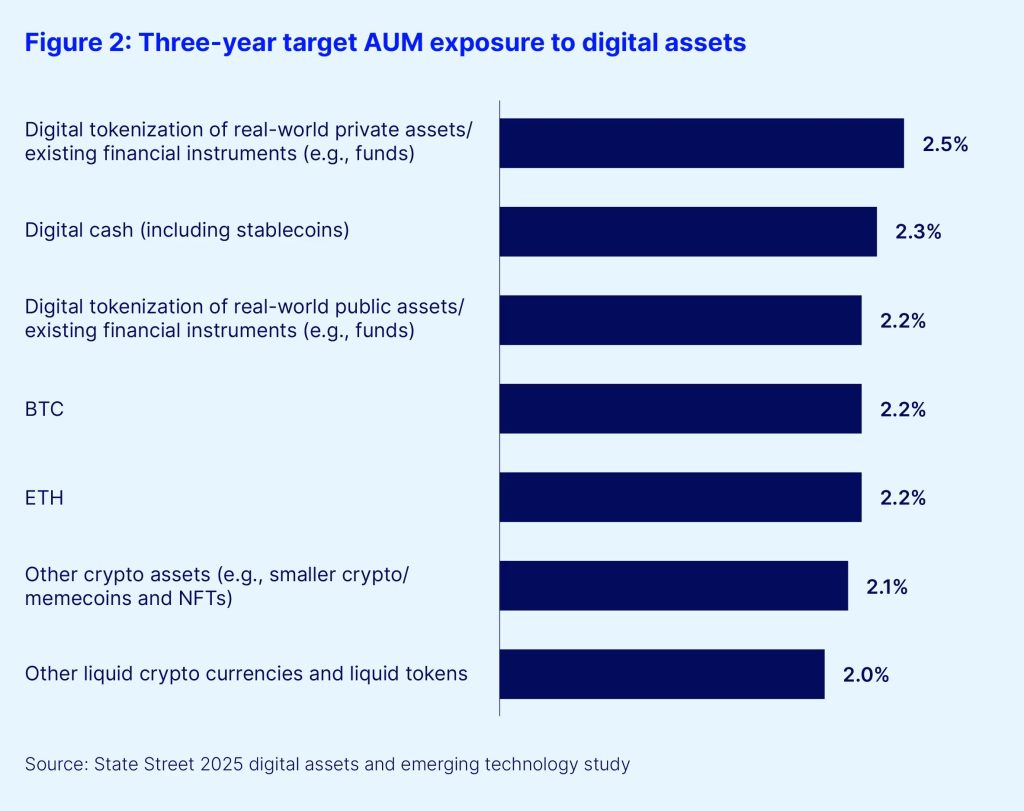
Currently, institutional portfolios hold an average of 7% in digital assets, according to the study. That figure is expected to rise to 16% within three years. The most common forms are digital cash, along with tokenized versions of listed equities and fixed income. On average, respondents hold 1% of their portfolios in each of these categories.
Asset Managers Outpace Owners in Bitcoin, Ethereum and Tokenized Assets

Asset managers reported higher exposure than asset owners across nearly every category. 14% of managers said they held 2% to 5% of portfolios in Bitcoin, compared with 7% of asset owners. A small share of managers also admitted to having at least 5% of assets in Ethereum, meme coins or NFTs, pointing to the broader range of risk appetite.

Tokenization of real-world assets is another area where managers are ahead. They reported greater exposure to tokenized public assets, tokenized private assets and digital cash than asset owners.

Even so, cryptocurrencies remain the biggest driver of returns within digital portfolios.

27% of respondents said Bitcoin is their strongest performer today. A quarter also expect it to remain the top performer in three years.

Meanwhile, Ethereum ranked second. 21% cited it as their biggest return generator now, and 22% expect that trend to continue.

By contrast, only 13% said tokenized public assets drive most of their digital returns. Just 10% pointed to private assets. These figures are expected to remain mostly unchanged over the next three years.

State Street Finds Confidence Growing That Tokenization Trend Is Durable

State Street’s study suggests that private assets could be the first major beneficiaries of tokenization. This would likely happen once infrastructure improves and investor confidence matures.

Moreover, institutions broadly expect digital assets to become mainstream within a decade. This reflects growing acceptance that the shift is structural rather than cyclical.

The findings add weight to the view that tokenization could transform capital markets. By digitizing ownership of assets such as real estate and private credit, institutions could cut settlement times, reduce costs, and expand access to investors who were previously excluded from private markets.


시장 기회
FORM 로고
FORM 가격(FORM)
$0.2575
$0.2575$0.2575
-2.86%
USD
FORM (FORM) 실시간 가격 차트
면책 조항: 본 사이트에 재게시된 글들은 공개 플랫폼에서 가져온 것으로 정보 제공 목적으로만 제공됩니다. 이는 반드시 MEXC의 견해를 반영하는 것은 아닙니다. 모든 권리는 원저자에게 있습니다. 제3자의 권리를 침해하는 콘텐츠가 있다고 판단될 경우, crypto.news@mexc.com으로 연락하여 삭제 요청을 해주시기 바랍니다. MEXC는 콘텐츠의 정확성, 완전성 또는 시의적절성에 대해 어떠한 보증도 하지 않으며, 제공된 정보에 기반하여 취해진 어떠한 조치에 대해서도 책임을 지지 않습니다. 본 콘텐츠는 금융, 법률 또는 기타 전문적인 조언을 구성하지 않으며, MEXC의 추천이나 보증으로 간주되어서는 안 됩니다.

USD1 Genesis: 0 Fees + 12% APR

USD1 Genesis: 0 Fees + 12% APRUSD1 Genesis: 0 Fees + 12% APR

New users: stake for up to 600% APR. Limited time!