Cardano Enters New Scalability Era With Hydra Node V1.0 Release
Cardano’s scaling roadmap hit a visible milestone yesterday as the Hydra team tagged hydra-node v1.0.0 on GitHub—positioning the isomorphic state-channels protocol for production use while still flagging remaining limitations. In a brief comment on X, Cardano founder Charles Hoskinson struck an upbeat tone about the near-term trajectory: “Hydra is going to have an awesome 2026,” he wrote, amplifying a community post that framed the upgrade as a step-change for throughput-sensitive use cases.
Cardano’s Hydra Node V1.0 Is Live
The release notes, published under the “A big release of hydra-node! It’s official. We’re at version 1.0.0!” banner, emphasize that the team intends to “continue to support [the] Hydra Head protocol implementation into production environments,” even as they continue work on the “largest outstanding known problem,” partial fanout. Crucially, the tag itself is marked “Pre-release” on GitHub—an important nuance for developers and integrators who follow semantic signals from the repository.
At a technical level, v1.0.0 consolidates months of incremental changes into a package that’s been tested with cardano-node 10.1.2 and cardano-cli 10.1.1.0. The build introduces a beta of incremental commits, allowing funds to be committed to a running Head; adds a –deposit-deadline parameter so operators can define how long a node should watch for deposits before enabling safe recovery; and rewrites the commit and initial scripts in Aiken, moving the initial script to Plutus V3 and shrinking it by 1,337 bytes.
One consequential trade-off appears in the commit-path rewrite: the documented maximum number of Head participants is now eight. The release also notes API refinements (for example, a POST /transaction endpoint) and persistence format changes tied to more efficient snapshot handling.
For builders, these specifics matter because Hydra’s promise has always been pragmatic rather than purely theoretical: execute fast, low-cost transactions off-chain inside a Head while preserving Cardano’s extended-UTXO semantics, then fan the final state back to L1.
The Hydra Head protocol has been mainnet-compatible since v0.10.0, but the v1.0.0 tag signals a harder push toward real-world deployment across DeFi, gaming, and latency-sensitive apps—precisely the domains community voices highlighted in today’s discourse. As one KOL put it in a widely shared post, “Cardano just entered a new era of speed and scalability. Hydra Node v1.0.0 is here — DeFi, gaming, and real-time apps are about to level up.”
While the release notes are measured, the throughput optics behind Hydra are anything but. In prior public stress tests tied to the community’s Hydra Doom project and its CPLAY summit finale, Input Output recorded Hydra hitting 1 million transactions per second.
That figure was presented as a demonstration of how off-chain Hydra Heads can absorb extreme, frame-by-frame game state updates without interrupting service—useful for real-time interactive apps and high-fan-out venues. “We proved that Hydra can scale to 1 million TPS,” Hoskinson said in the company’s recap of the event.
Beneath the headline peak, telemetry circulating during the qualifier rounds showed sustained readings in the hundreds of thousands of TPS, with community dashboards and posts commonly citing plateaus around ~650,000 TPS before the Las Vegas finale pushed beyond the seven-figure mark.
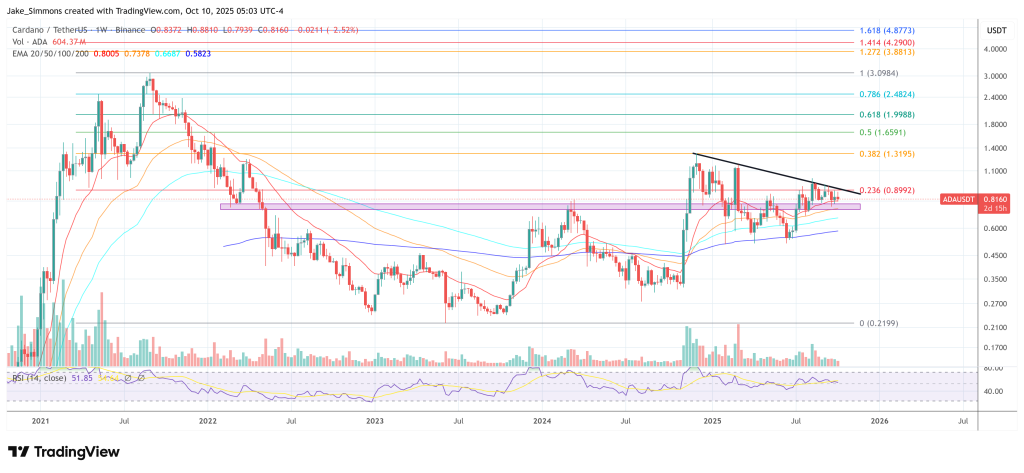
At press time, ADA traded at $0.816.


추천 콘텐츠

GOP lawmaker hit with death threats from irate conservatives for pushing immigration deal

Silver Price Analysis: Plummets After Critical Trendline Break, Eyes $70 Target