The sudden and violent market correction triggered by geopolitical shockwaves served as an unprecedented stress test for the entire cryptocurrency ecosystem, exposing critical differences in network architecture. While the multi-billion-dollar liquidation event sent prices plunging across the board, Solana demonstrated remarkable resilience, whereas the Ethereum network and liquidity thinned during the peak volatility. Why Solana High-Performance Design Continues To Shine In an X post, the Nasdaq-listed go-to Solana Digital Asset Treasury (DAT), DefDevCorp, has revealed that when the largest liquidation event in crypto history hit last Friday, most of the market froze, and Ethereum stumbled. However, Solana didn’t flinch, powering through one of the most chaotic trading sessions ever recorded. Related Reading: Solana Shines Bright: Network Excels Amid Largest Crypto Liquidation Event At the peak of volatility, Solana sustained 1,225 transactions per second, finalized blocks in just 350 milliseconds, and saw transaction fees briefly rise to $0.25 before normalizing below $0.01. Meanwhile, ETH’s infrastructure buckled under demand as the network struggled to process beyond 26 TPS. Its block times extended to 15 seconds, and saw average gas fees explode to $616, effectively locking out users and rendering the chain unusable during the crisis. ETH became unreliable, impractical, and effectively unusable during the chaos. As DefiDevCorp noted, when users are priced out and transactions can’t clear, the network might as well be offline. In moments of high load, the core promise of a blockchain to remain accessible, affordable, and reliable must hold. However, after nearly 20 months of uninterrupted uptime, weathering its busiest moments, it’s abundantly clear that SOL’s continued upgrades and optimizations have paid off dramatically.  DefiDevCorp concluded that no other chain currently comes close to handling global value transfer at this scale, under such extreme conditions, with the same level of performance. The takeaway from the firm’s post is that only SOL stays fast, cheap, and usable, even when global markets melt down. Why SOL Price Doesn’t Match Its Reliability A Researcher at alphapleaseHQ and Advisor at KaminoFinance, Aylo, has also mentioned that he had assets and Decentralized Finance (DeFi) positions open on both Solana and Ethereum when the crypto market collapsed last Friday. During this time, he had zero issues using the SOL network, while the ETH network was unusable due to the costs, which often led to market crashes, and the Rabby wallet also went down. Related Reading: No Chain Comes Close: Solana Leads With 2.5x Ethereum’s Revenue Aylo added that the ETH maxis should be much angrier about the performance of their L1. With this development, SOL continues to prove it’s the most performant and reliable blockchain under real-world pressure that we have in crypto. He pointed out that SOL’s valuation doesn’t reflect the resilience it is proving in the digital world. Featured image from Adobe Stock, chart from Tradingview.comThe sudden and violent market correction triggered by geopolitical shockwaves served as an unprecedented stress test for the entire cryptocurrency ecosystem, exposing critical differences in network architecture. While the multi-billion-dollar liquidation event sent prices plunging across the board, Solana demonstrated remarkable resilience, whereas the Ethereum network and liquidity thinned during the peak volatility. Why Solana High-Performance Design Continues To Shine In an X post, the Nasdaq-listed go-to Solana Digital Asset Treasury (DAT), DefDevCorp, has revealed that when the largest liquidation event in crypto history hit last Friday, most of the market froze, and Ethereum stumbled. However, Solana didn’t flinch, powering through one of the most chaotic trading sessions ever recorded. Related Reading: Solana Shines Bright: Network Excels Amid Largest Crypto Liquidation Event At the peak of volatility, Solana sustained 1,225 transactions per second, finalized blocks in just 350 milliseconds, and saw transaction fees briefly rise to $0.25 before normalizing below $0.01. Meanwhile, ETH’s infrastructure buckled under demand as the network struggled to process beyond 26 TPS. Its block times extended to 15 seconds, and saw average gas fees explode to $616, effectively locking out users and rendering the chain unusable during the crisis. ETH became unreliable, impractical, and effectively unusable during the chaos. As DefiDevCorp noted, when users are priced out and transactions can’t clear, the network might as well be offline. In moments of high load, the core promise of a blockchain to remain accessible, affordable, and reliable must hold. However, after nearly 20 months of uninterrupted uptime, weathering its busiest moments, it’s abundantly clear that SOL’s continued upgrades and optimizations have paid off dramatically.  DefiDevCorp concluded that no other chain currently comes close to handling global value transfer at this scale, under such extreme conditions, with the same level of performance. The takeaway from the firm’s post is that only SOL stays fast, cheap, and usable, even when global markets melt down. Why SOL Price Doesn’t Match Its Reliability A Researcher at alphapleaseHQ and Advisor at KaminoFinance, Aylo, has also mentioned that he had assets and Decentralized Finance (DeFi) positions open on both Solana and Ethereum when the crypto market collapsed last Friday. During this time, he had zero issues using the SOL network, while the ETH network was unusable due to the costs, which often led to market crashes, and the Rabby wallet also went down. Related Reading: No Chain Comes Close: Solana Leads With 2.5x Ethereum’s Revenue Aylo added that the ETH maxis should be much angrier about the performance of their L1. With this development, SOL continues to prove it’s the most performant and reliable blockchain under real-world pressure that we have in crypto. He pointed out that SOL’s valuation doesn’t reflect the resilience it is proving in the digital world. Featured image from Adobe Stock, chart from Tradingview.com

Historic Liquidation Event Highlights Solana Resilience Against Ethereum, Which Is Leading?

2025/10/15 09:00
3분 읽기
이 콘텐츠에 대한 의견이나 우려 사항이 있으시면 crypto.news@mexc.com으로 연락주시기 바랍니다

The sudden and violent market correction triggered by geopolitical shockwaves served as an unprecedented stress test for the entire cryptocurrency ecosystem, exposing critical differences in network architecture. While the multi-billion-dollar liquidation event sent prices plunging across the board, Solana demonstrated remarkable resilience, whereas the Ethereum network and liquidity thinned during the peak volatility.

Why Solana High-Performance Design Continues To Shine

In an X post, the Nasdaq-listed go-to Solana Digital Asset Treasury (DAT), DefDevCorp, has revealed that when the largest liquidation event in crypto history hit last Friday, most of the market froze, and Ethereum stumbled. However, Solana didn’t flinch, powering through one of the most chaotic trading sessions ever recorded.

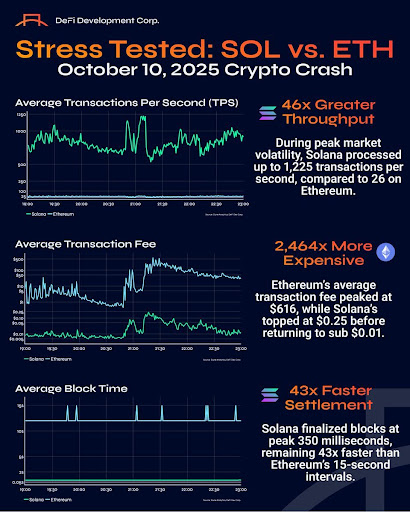
At the peak of volatility, Solana sustained 1,225 transactions per second, finalized blocks in just 350 milliseconds, and saw transaction fees briefly rise to $0.25 before normalizing below $0.01. Meanwhile, ETH’s infrastructure buckled under demand as the network struggled to process beyond 26 TPS. Its block times extended to 15 seconds, and saw average gas fees explode to $616, effectively locking out users and rendering the chain unusable during the crisis. ETH became unreliable, impractical, and effectively unusable during the chaos.
Solana

As DefiDevCorp noted, when users are priced out and transactions can’t clear, the network might as well be offline. In moments of high load, the core promise of a blockchain to remain accessible, affordable, and reliable must hold. However, after nearly 20 months of uninterrupted uptime, weathering its busiest moments, it’s abundantly clear that SOL’s continued upgrades and optimizations have paid off dramatically. 

DefiDevCorp concluded that no other chain currently comes close to handling global value transfer at this scale, under such extreme conditions, with the same level of performance. The takeaway from the firm’s post is that only SOL stays fast, cheap, and usable, even when global markets melt down.

Why SOL Price Doesn’t Match Its Reliability

A Researcher at alphapleaseHQ and Advisor at KaminoFinance, Aylo, has also mentioned that he had assets and Decentralized Finance (DeFi) positions open on both Solana and Ethereum when the crypto market collapsed last Friday. During this time, he had zero issues using the SOL network, while the ETH network was unusable due to the costs, which often led to market crashes, and the Rabby wallet also went down.

Aylo added that the ETH maxis should be much angrier about the performance of their L1. With this development, SOL continues to prove it’s the most performant and reliable blockchain under real-world pressure that we have in crypto. He pointed out that SOL’s valuation doesn’t reflect the resilience it is proving in the digital world.


Solana
시장 기회
스레숄드 로고
스레숄드 가격(T)
$0,006346
$0,006346$0,006346
+%5,13
USD
스레숄드 (T) 실시간 가격 차트
면책 조항: 본 사이트에 재게시된 글들은 공개 플랫폼에서 가져온 것으로 정보 제공 목적으로만 제공됩니다. 이는 반드시 MEXC의 견해를 반영하는 것은 아닙니다. 모든 권리는 원저자에게 있습니다. 제3자의 권리를 침해하는 콘텐츠가 있다고 판단될 경우, crypto.news@mexc.com으로 연락하여 삭제 요청을 해주시기 바랍니다. MEXC는 콘텐츠의 정확성, 완전성 또는 시의적절성에 대해 어떠한 보증도 하지 않으며, 제공된 정보에 기반하여 취해진 어떠한 조치에 대해서도 책임을 지지 않습니다. 본 콘텐츠는 금융, 법률 또는 기타 전문적인 조언을 구성하지 않으며, MEXC의 추천이나 보증으로 간주되어서는 안 됩니다.

$30,000 in PRL + 15,000 USDT

$30,000 in PRL + 15,000 USDT$30,000 in PRL + 15,000 USDT

Deposit & trade PRL to boost your rewards!