SEC Chair Paul Atkins has acknowledged that the U.S. is ’10 Years Behind’ in crypto regulation and pledges to fast-track crypto progress. According to him, “The crypto aspect is our job one,” marking it as a priority for the regulatory body. During the DC Fintech Week event at Amazon HQ on Wednesday, Atkins stated that the SEC intends to build a robust framework to bring back industry participants who may have left the country, enabling innovation to flourish. Atkins Vows to Fast-Track U.S. Crypto Progress “I like to say that we’re the securities and innovation commission now,” he added.Source: YouTube When asked how regulatory bodies support innovation, Atkins responded that the past approach to the digital asset industry had been somewhat disingenuous, but confirmed the situation has changed. The SEC is now working full-time on crypto regulation and will introduce an “innovation exemption” to permit experimentation with new ideas. “We at SEC with respect to our statutes have pretty broad authority for exemptions to be made, and so I think we can be, you know, very forward-leaning in that in order to accommodate new ideas,” he said. “And if the ideas are not good, the free market reaction would tell.” He noted that the crypto industry benefits from having pro-crypto executives at the SEC, like “crypto mama,” whose understanding of the space helps the agency embrace innovation. He emphasized that crypto is the agency’s top priority to close the 10-year gap created by previous regulatory approaches. When questioned about tokenization and real-world assets, Atkins replied that tokenization is essential because blockchain technology is the most exciting aspect of crypto. “Tokenization is not necessarily the numerous crypto coins as many would come and go, but I think putting things on-chain presents huge potential benefits for the financial industry and elsewhere.” He added that blockchain’s transparency makes it incredibly powerful for solving compliance issues. The 1946 Howey Test Struggles With Modern Crypto Atkins’ comments have renewed attention on how existing securities laws, particularly the Securities Act of 1933 and the Securities Exchange Act of 1934, apply to digital assets. Under the 1933 Act, any asset classified as a “security” must be registered with the SEC unless an exemption applies. The 1934 Act extends oversight to secondary markets, regulating broker-dealers, exchanges, and market manipulation. The classification question often depends on the Howey Test, a 1946 Supreme Court standard determining whether a transaction constitutes an “investment contract.”Source: Kyrian Alex The SEC has used this test to pursue enforcement actions against token issuers like Ripple and Coinbase, arguing that many crypto offerings meet these criteria. However, the test’s application to decentralized networks remains disputed. Critics argue that blockchain tokens, which can power networks, enable governance, or represent stable value, don’t fit neatly into the traditional definition of a security. SEC’s Innovation Exemption Coming by Year-End Atkins acknowledged that the regulatory lag is hurting U.S. competitiveness, as jurisdictions like the UAE and Singapore advance clearer digital asset frameworks. He hinted at moving away from the agency’s enforcement-first strategy toward a more collaborative framework balancing investor protection with innovation. This may include expanding no-action letters and closer coordination with the CFTC and the Treasury Department. In September, Atkins said the SEC is working closely with Congress to provide technical support on securities law. “We want to see this get over the finish line,” he said, pointing to the GENIUS Act’s passage, which gave statutory recognition to stablecoins, as evidence of growing momentum. Speaking on Fox Business, Atkins confirmed that by year-end, the agency intends to roll out an “innovation exemption” designed to let crypto firms bring new products to market without immediately facing burdensome requirementsSEC Chair Paul Atkins has acknowledged that the U.S. is ’10 Years Behind’ in crypto regulation and pledges to fast-track crypto progress. According to him, “The crypto aspect is our job one,” marking it as a priority for the regulatory body. During the DC Fintech Week event at Amazon HQ on Wednesday, Atkins stated that the SEC intends to build a robust framework to bring back industry participants who may have left the country, enabling innovation to flourish. Atkins Vows to Fast-Track U.S. Crypto Progress “I like to say that we’re the securities and innovation commission now,” he added.Source: YouTube When asked how regulatory bodies support innovation, Atkins responded that the past approach to the digital asset industry had been somewhat disingenuous, but confirmed the situation has changed. The SEC is now working full-time on crypto regulation and will introduce an “innovation exemption” to permit experimentation with new ideas. “We at SEC with respect to our statutes have pretty broad authority for exemptions to be made, and so I think we can be, you know, very forward-leaning in that in order to accommodate new ideas,” he said. “And if the ideas are not good, the free market reaction would tell.” He noted that the crypto industry benefits from having pro-crypto executives at the SEC, like “crypto mama,” whose understanding of the space helps the agency embrace innovation. He emphasized that crypto is the agency’s top priority to close the 10-year gap created by previous regulatory approaches. When questioned about tokenization and real-world assets, Atkins replied that tokenization is essential because blockchain technology is the most exciting aspect of crypto. “Tokenization is not necessarily the numerous crypto coins as many would come and go, but I think putting things on-chain presents huge potential benefits for the financial industry and elsewhere.” He added that blockchain’s transparency makes it incredibly powerful for solving compliance issues. The 1946 Howey Test Struggles With Modern Crypto Atkins’ comments have renewed attention on how existing securities laws, particularly the Securities Act of 1933 and the Securities Exchange Act of 1934, apply to digital assets. Under the 1933 Act, any asset classified as a “security” must be registered with the SEC unless an exemption applies. The 1934 Act extends oversight to secondary markets, regulating broker-dealers, exchanges, and market manipulation. The classification question often depends on the Howey Test, a 1946 Supreme Court standard determining whether a transaction constitutes an “investment contract.”Source: Kyrian Alex The SEC has used this test to pursue enforcement actions against token issuers like Ripple and Coinbase, arguing that many crypto offerings meet these criteria. However, the test’s application to decentralized networks remains disputed. Critics argue that blockchain tokens, which can power networks, enable governance, or represent stable value, don’t fit neatly into the traditional definition of a security. SEC’s Innovation Exemption Coming by Year-End Atkins acknowledged that the regulatory lag is hurting U.S. competitiveness, as jurisdictions like the UAE and Singapore advance clearer digital asset frameworks. He hinted at moving away from the agency’s enforcement-first strategy toward a more collaborative framework balancing investor protection with innovation. This may include expanding no-action letters and closer coordination with the CFTC and the Treasury Department. In September, Atkins said the SEC is working closely with Congress to provide technical support on securities law. “We want to see this get over the finish line,” he said, pointing to the GENIUS Act’s passage, which gave statutory recognition to stablecoins, as evidence of growing momentum. Speaking on Fox Business, Atkins confirmed that by year-end, the agency intends to roll out an “innovation exemption” designed to let crypto firms bring new products to market without immediately facing burdensome requirements

“We’re 10 Years Behind”, SEC Chair Vows to Fast-Track U.S. Crypto Progress

2025/10/16 22:09
4분 읽기
이 콘텐츠에 대한 의견이나 우려 사항이 있으시면 crypto.news@mexc.com으로 연락주시기 바랍니다

SEC Chair Paul Atkins has acknowledged that the U.S. is ’10 Years Behind’ in crypto regulation and pledges to fast-track crypto progress.

According to him, “The crypto aspect is our job one,” marking it as a priority for the regulatory body.

During the DC Fintech Week event at Amazon HQ on Wednesday, Atkins stated that the SEC intends to build a robust framework to bring back industry participants who may have left the country, enabling innovation to flourish.

Atkins Vows to Fast-Track U.S. Crypto Progress

“I like to say that we’re the securities and innovation commission now,” he added.
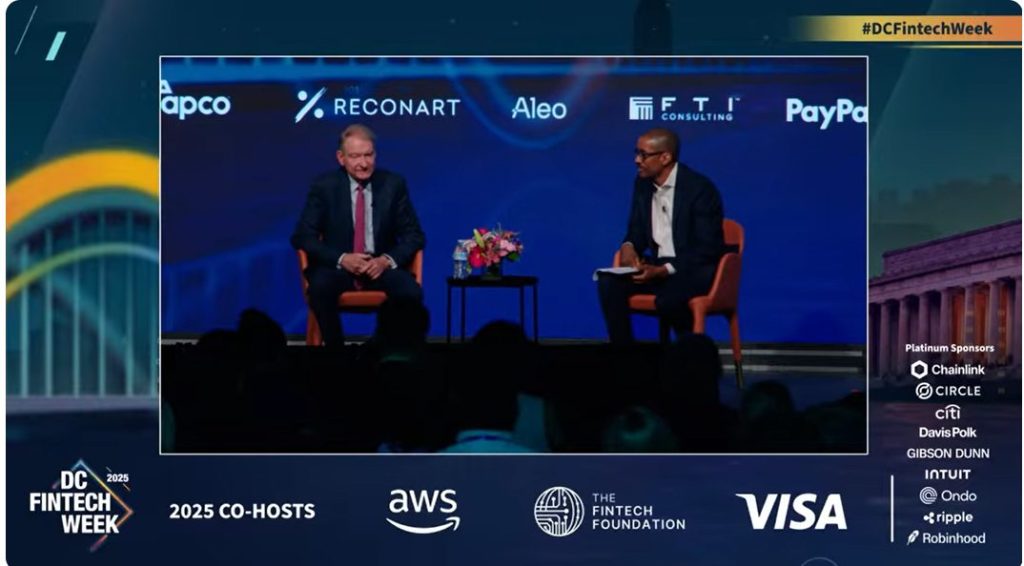
“We’re 10 Years Behind”, SEC Chair Vows to Fast-Track U.S. Crypto ProgressSource: YouTube

When asked how regulatory bodies support innovation, Atkins responded that the past approach to the digital asset industry had been somewhat disingenuous, but confirmed the situation has changed.

The SEC is now working full-time on crypto regulation and will introduce an “innovation exemption” to permit experimentation with new ideas.

“We at SEC with respect to our statutes have pretty broad authority for exemptions to be made, and so I think we can be, you know, very forward-leaning in that in order to accommodate new ideas,” he said.

“And if the ideas are not good, the free market reaction would tell.”

He noted that the crypto industry benefits from having pro-crypto executives at the SEC, like “crypto mama,” whose understanding of the space helps the agency embrace innovation.

He emphasized that crypto is the agency’s top priority to close the 10-year gap created by previous regulatory approaches.

When questioned about tokenization and real-world assets, Atkins replied that tokenization is essential because blockchain technology is the most exciting aspect of crypto.

“Tokenization is not necessarily the numerous crypto coins as many would come and go, but I think putting things on-chain presents huge potential benefits for the financial industry and elsewhere.”

He added that blockchain’s transparency makes it incredibly powerful for solving compliance issues.

The 1946 Howey Test Struggles With Modern Crypto

Atkins’ comments have renewed attention on how existing securities laws, particularly the Securities Act of 1933 and the Securities Exchange Act of 1934, apply to digital assets.

Under the 1933 Act, any asset classified as a “security” must be registered with the SEC unless an exemption applies.

The 1934 Act extends oversight to secondary markets, regulating broker-dealers, exchanges, and market manipulation.

The classification question often depends on the Howey Test, a 1946 Supreme Court standard determining whether a transaction constitutes an “investment contract.”

“We’re 10 Years Behind”, SEC Chair Vows to Fast-Track U.S. Crypto ProgressSource: Kyrian Alex

The SEC has used this test to pursue enforcement actions against token issuers like Ripple and Coinbase, arguing that many crypto offerings meet these criteria.

However, the test’s application to decentralized networks remains disputed.

Critics argue that blockchain tokens, which can power networks, enable governance, or represent stable value, don’t fit neatly into the traditional definition of a security.

SEC’s Innovation Exemption Coming by Year-End

Atkins acknowledged that the regulatory lag is hurting U.S. competitiveness, as jurisdictions like the UAE and Singapore advance clearer digital asset frameworks.

He hinted at moving away from the agency’s enforcement-first strategy toward a more collaborative framework balancing investor protection with innovation.

This may include expanding no-action letters and closer coordination with the CFTC and the Treasury Department.

In September, Atkins said the SEC is working closely with Congress to provide technical support on securities law.

“We want to see this get over the finish line,” he said, pointing to the GENIUS Act’s passage, which gave statutory recognition to stablecoins, as evidence of growing momentum.

Speaking on Fox Business, Atkins confirmed that by year-end, the agency intends to roll out an “innovation exemption” designed to let crypto firms bring new products to market without immediately facing burdensome requirements.


시장 기회
Union 로고
Union 가격(UNION)
$0.0006647
$0.0006647$0.0006647
-3.07%
USD
Union (UNION) 실시간 가격 차트
면책 조항: 본 사이트에 재게시된 글들은 공개 플랫폼에서 가져온 것으로 정보 제공 목적으로만 제공됩니다. 이는 반드시 MEXC의 견해를 반영하는 것은 아닙니다. 모든 권리는 원저자에게 있습니다. 제3자의 권리를 침해하는 콘텐츠가 있다고 판단될 경우, crypto.news@mexc.com으로 연락하여 삭제 요청을 해주시기 바랍니다. MEXC는 콘텐츠의 정확성, 완전성 또는 시의적절성에 대해 어떠한 보증도 하지 않으며, 제공된 정보에 기반하여 취해진 어떠한 조치에 대해서도 책임을 지지 않습니다. 본 콘텐츠는 금융, 법률 또는 기타 전문적인 조언을 구성하지 않으며, MEXC의 추천이나 보증으로 간주되어서는 안 됩니다.

USD1 Genesis: 0 Fees + 12% APR

USD1 Genesis: 0 Fees + 12% APRUSD1 Genesis: 0 Fees + 12% APR

New users: stake for up to 600% APR. Limited time!