Exploiting Memorization: Understanding the CLM Objective for Knowledge Encoding in LLMs
Table of Links
Abstract and 1. Introduction
-
Background
-
Method
-
Experiments
4.1 Multi-hop Reasoning Performance
4.2 Reasoning with Distractors
4.3 Generalization to Real-World knowledge
4.4 Run-time Analysis
4.5 Memorizing Knowledge
-
Related Work
-
Conclusion, Acknowledgements, and References
\ A. Dataset
B. In-context Reasoning with Distractors
C. Implementation Details
D. Adaptive Learning Rate
E. Experiments with Large Language Models
2 Background
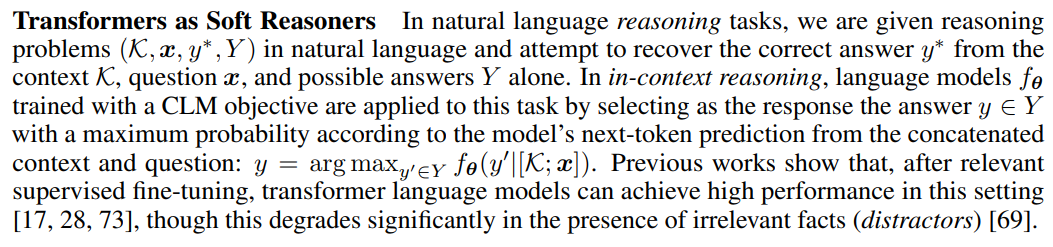
Notation We use f : X × θ → Y to refer to parameterised functions in which X is the set of possible inputs and θ are their possible weights (parameters). We use fθ : x 7→ f(x, θ) to easily refer to any f with a given set of parameters θ. We describe reasoning problems using tuples (K, x, y∗ , Y ) such that y ∈ Y is the correct answer for the question x given facts K, and use D to refer to sets of such problems. When it is clear from context, we drop Y and use only (K, x, y∗ ).
\ Language Modeling and Memorization In the causal language modeling (CLM) objective, a parameterized model fθ is trained to estimate the conditional probabilities of each token in a sequence given its predecessors: p(xt|x) Specifically, we train fθ to approximate p using the CLM loss:
\ 
\ This training objective allows language models to memorize individual training examples [10, 11], and we will exploit this ability to memorize and draw on contextual knowledge in our work.
\ 
\
:::info Authors:
(1) Zeming Chen, EPFL (zeming.chen@epfl.ch);
(2) Gail Weiss, EPFL (antoine.bosselut@epfl.ch);
(3) Eric Mitchell, Stanford University (eric.mitchell@cs.stanford.edu)';
(4) Asli Celikyilmaz, Meta AI Research (aslic@meta.com);
(5) Antoine Bosselut, EPFL (antoine.bosselut@epfl.ch).
:::
:::info This paper is available on arxiv under CC BY 4.0 DEED license.
:::
\


추천 콘텐츠

Nakamoto Announces Actively Managed Bitcoin Derivatives Program Designed to Generate Volatility Income and Hedge Downside Exposure

Canadian Dollar Soars As Trump’s Explosive Energy Address Roils Global Oil Markets