Written by: Hazel Source: Zhiwubuyan Research I read a news report last night that the state of Wyoming in the United States conducted a public scoring to select a publicWritten by: Hazel Source: Zhiwubuyan Research I read a news report last night that the state of Wyoming in the United States conducted a public scoring to select a public

How do U.S. state governments choose public chains for issuing stablecoins?

2025/06/21 15:19
8분 읽기
이 콘텐츠에 대한 의견이나 우려 사항이 있으시면 crypto.news@mexc.com으로 연락주시기 바랍니다

Written by: Hazel

Source: Zhiwubuyan Research

I read a news report last night that the state of Wyoming in the United States conducted a public scoring to select a public chain for its upcoming stablecoin WYST. In the end, 11 chains entered the candidate list. Aptos and Solana tied for first place with 32 points, followed by Sei with 30 points. Ethereum and a number of L2s only scored 26 points or less, which may be quite different from the public chain ecosystem activity and coin price that everyone feels in daily life. How is this score determined? I was very curious, so I studied it with teacher GPT.

First of all, I would like to praise the US state government for building in public. The Wyoming Stablecoin Committee behind the stablecoin WYST was established in March 2023 in accordance with the state's Stable Token Act. This committee has a public notion document, which includes a project introduction, meeting calendar and records, scoring criteria results and memo, Q&A, contact information, and lists its own YouTube channel, X account, Warpcast account and Github account. It is more serious and transparent than many current careless project parties.

If you are interested, you can go and watch:

How do U.S. state governments choose public chains for issuing stablecoins?

In Q4 2024, the committee preliminarily selected 28 public chains. First, 14 were screened out based on four yes-or-no questions: whether there is permissionless access, supply transparency, on-chain analysis, and whether it can be frozen; secondly, they were scored based on 9 indicators (3 points each), including network stability, number of active users, TVL, stablecoin market value, TPS, transaction fees, transaction finality time, block time, and whether it is registered in Wyoming; finally, points were added or subtracted based on 5 additional advantages (2 points each) (privacy, interoperability, smart contracts/programmability, use cases, partners) and 6 additional risks (-2 points each) (illegal behavior of the entity, illegal behavior of the team, history of security vulnerabilities, poor network availability, lack of bug bounty, lack of code maintenance).

The final recommendation is to include 5 Layer 1 main chains: Solana (32 points), Avalanche (26 points), Ethereum (26 points), Stellar (24 points), Sui (26 points) and 4 qualified Layer 2 chains: Arbitrum (26 points), Base (25 points), Optimism (19 points), and Polygon (26 points) into the "candidate blockchain".

Aptos and SEI were actually newly included in the selection in Q1 this year. This quarter, the committee updated the selection criteria and added a new item "whether there is supplier support" to the right and wrong criteria, that is, "the blockchain must have the committee's partner manufacturers to support development, auditing, and infrastructure deployment. It can be undertaken by the foundation with approval."

One updated line states, “The chain must be fully indexed and supported by on-chain analysis platforms that the Commission collaborates with (such as Chainalysis, TRM Labs)”.

Two new items have been added to the additional advantage points, namely:

  • Emerging Market Trends: Whether it carries emerging track projects such as AI, DePIN, virtual reality, and game assets
  • Foundation Support: Whether the foundation can support one or all of the following three items: technology development, WYST liquidity, and market promotion

In this scoring, Aptos and SEI scored 32 and 30 points respectively, and were therefore added to the candidate chain.

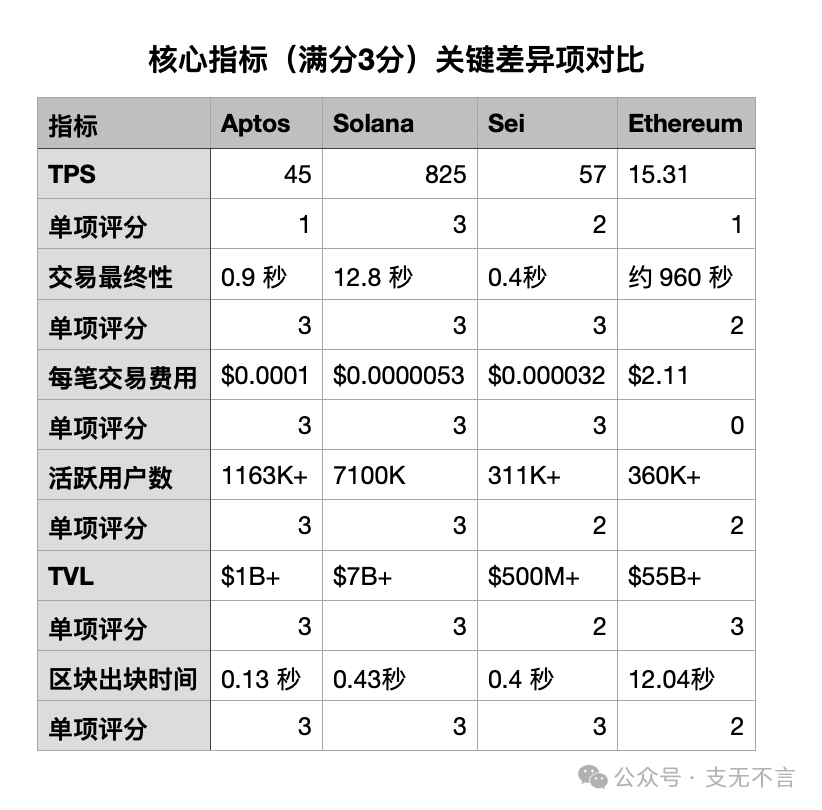
So how did this score difference come about? I first made a comparison chart of the key differences around the core indicators. Please note that since the new round of scoring did not re-score the 9 public chains that had been selected before, some of the data here is at the end of 2024 and is not the latest.
How do U.S. state governments choose public chains for issuing stablecoins?

It can be seen that Ethereum's TVL is leading by a large margin, but in terms of transactions per second (TPS), transaction finality time, transaction fees, and block generation time, this decentralized chain still suffers a lot. It can also be seen here that the diversion of Layer2 has caused the number of active users on the Ethereum mainnet to be only at the same level as SEI, far behind Aptos and Solana.

But how did Aptos get the highest score with Solana? I read it and found that, on the one hand, Aptos is indeed very balanced, with strong compliance, fast speed, low cost, and relatively stable network. On the other hand, it is also because the second round of scoring added two points in the additional advantage bonus items, but Solana did not re-participate in this round of scoring. If these two items are removed, Solana should still have the highest score.

It is worth noting here for Ethereum fans that although Ethereum has always advertised itself as the best choice for carrying real assets on the chain, when it comes to technology selection at the government level, the permissionless network is a threshold that can be passed, and network stability only accounts for one of the core indicators. The lack of technical barriers and insufficient network availability are risk deduction items. Solana was offline and crashed, which deducted 1 point each, but it had little impact on the overall situation. There is no score for the degree of decentralization. Instead, the state government pays more attention to whether it can be frozen and whether it has an entity in Wyoming. The vast majority of core indicators are performance, cost and scale.

Of course, this state-level stablecoin issuance has stated from the beginning that it will abide by the principles of "multi-chain support and technology neutrality". It will continue to update the rules and collect feedback. At the same time, it welcomes chains that have not been shortlisted to continue to submit applications to participate in the selection. Therefore, public chains that are on the candidate list and even those that have not yet been on the list theoretically have a chance.

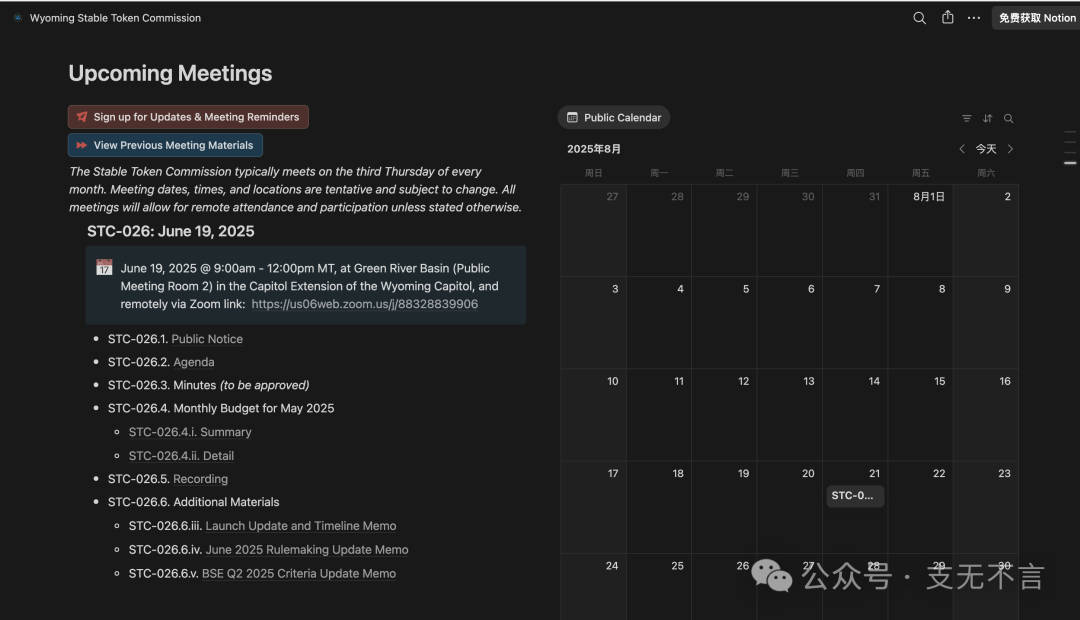
In addition to the selection of public chains, the state-level stablecoin project in Wyoming is also worth noting. As the first state in the United States to plan to issue a stablecoin, WYST was originally planned to be launched before July 4, but at the regular meeting at the end of May, this timeline has been postponed to the third quarter of 2025, and the new proposed date is August 20. Subsequent work also involves the public opinion solicitation and final approval of the reserve management rules, the formulation of the committee's exclusive general ledger/chart of accounts, the establishment of trust accounts and liquidity fund accounts with third-party custodians, and contact with licensed service providers, including centralized exchanges, payment platforms, digital wallets, and market makers, for the purchase and resale of WYST, etc.
How do U.S. state governments choose public chains for issuing stablecoins?

Ultimately, the reserve behind the stablecoin will be managed by Franklin Templeton Funds, with Chainalysis responsible for on-chain analysis, working with LayerZero and Fireblocks to complete the integration, complete the decentralized verification network and official website launch, deploy the WYST contract to the mainnet before August 20, and then officially release it in a public statement at the Wyoming Blockchain Symposium.

In addition to Wyoming, Nebraska has passed its "Financial Innovation Act" to authorize an entity called Telcoin to issue a state-backed stablecoin, temporarily called eUSD. Tinian Island in the Northern Mariana Islands, an overseas territory under the jurisdiction of the United States federal government, attempted to issue a US dollar stablecoin called Marianas US Dollar (MUSD), which was vetoed by the governor in April this year, and the Senate overturned the governor's veto in May.

This scenario of U.S. states and major companies gearing up to issue their own stablecoins easily reminds people of the free banking era from 1837 to 1866, when states, cities, private banks, railroads and construction companies, stores, restaurants, churches and individuals issued approximately 8,000 different currencies by 1860. There were many varieties and a lack of unified standards. The picture in this article is the private $1 currency issued by the Delaware Bridge Company of New Jersey from 1836 to 1841.

There have been a lot of discussions about RMB stablecoins recently, and some big companies are eager to try. After the question of whether to have it or not, the next question may be which chain to run on. Whether to launch a dedicated chain, use the alliance chain of a big company such as Ant Chain and JD Chain, connect to the common international public chain, or use some domestic public chains such as Hashkey Chain, Conflux, etc. This question is a new topic for governments and companies in China, the United States, and even other countries in the world. Wyoming's scoring system and public disclosure system may not be perfect, but it can be regarded as a model for later generations. We should see more interesting governance progress in the future.


면책 조항: 본 사이트에 재게시된 글들은 공개 플랫폼에서 가져온 것으로 정보 제공 목적으로만 제공됩니다. 이는 반드시 MEXC의 견해를 반영하는 것은 아닙니다. 모든 권리는 원저자에게 있습니다. 제3자의 권리를 침해하는 콘텐츠가 있다고 판단될 경우, crypto.news@mexc.com으로 연락하여 삭제 요청을 해주시기 바랍니다. MEXC는 콘텐츠의 정확성, 완전성 또는 시의적절성에 대해 어떠한 보증도 하지 않으며, 제공된 정보에 기반하여 취해진 어떠한 조치에 대해서도 책임을 지지 않습니다. 본 콘텐츠는 금융, 법률 또는 기타 전문적인 조언을 구성하지 않으며, MEXC의 추천이나 보증으로 간주되어서는 안 됩니다.

추천 콘텐츠

Lovable AI’s Astonishing Rise: Anton Osika Reveals Startup Secrets at Bitcoin World Disrupt 2025

Lovable AI’s Astonishing Rise: Anton Osika Reveals Startup Secrets at Bitcoin World Disrupt 2025

BitcoinWorld Lovable AI’s Astonishing Rise: Anton Osika Reveals Startup Secrets at Bitcoin World Disrupt 2025 Are you ready to witness a phenomenon? The world of technology is abuzz with the incredible rise of Lovable AI, a startup that’s not just breaking records but rewriting the rulebook for rapid growth. Imagine creating powerful apps and websites just by speaking to an AI – that’s the magic Lovable brings to the masses. This groundbreaking approach has propelled the company into the spotlight, making it one of the fastest-growing software firms in history. And now, the visionary behind this sensation, co-founder and CEO Anton Osika, is set to share his invaluable insights on the Disrupt Stage at the highly anticipated Bitcoin World Disrupt 2025. If you’re a founder, investor, or tech enthusiast eager to understand the future of innovation, this is an event you cannot afford to miss. Lovable AI’s Meteoric Ascent: Redefining Software Creation In an era where digital transformation is paramount, Lovable AI has emerged as a true game-changer. Its core premise is deceptively simple yet profoundly impactful: democratize software creation. By enabling anyone to build applications and websites through intuitive AI conversations, Lovable is empowering the vast majority of individuals who lack coding skills to transform their ideas into tangible digital products. This mission has resonated globally, leading to unprecedented momentum. The numbers speak for themselves: Achieved an astonishing $100 million Annual Recurring Revenue (ARR) in less than a year. Successfully raised a $200 million Series A funding round, valuing the company at $1.8 billion, led by industry giant Accel. Is currently fielding unsolicited investor offers, pushing its valuation towards an incredible $4 billion. As industry reports suggest, investors are unequivocally “loving Lovable,” and it’s clear why. This isn’t just about impressive financial metrics; it’s about a company that has tapped into a fundamental need, offering a solution that is both innovative and accessible. The rapid scaling of Lovable AI provides a compelling case study for any entrepreneur aiming for similar exponential growth. The Visionary Behind the Hype: Anton Osika’s Journey to Innovation Every groundbreaking company has a driving force, and for Lovable, that force is co-founder and CEO Anton Osika. His journey is as fascinating as his company’s success. A physicist by training, Osika previously contributed to the cutting-edge research at CERN, the European Organization for Nuclear Research. This deep technical background, combined with his entrepreneurial spirit, has been instrumental in Lovable’s rapid ascent. Before Lovable, he honed his skills as a co-founder of Depict.ai and a Founding Engineer at Sana. Based in Stockholm, Osika has masterfully steered Lovable from a nascent idea to a global phenomenon in record time. His leadership embodies a unique blend of profound technical understanding and a keen, consumer-first vision. At Bitcoin World Disrupt 2025, attendees will have the rare opportunity to hear directly from Osika about what it truly takes to build a brand that not only scales at an incredible pace in a fiercely competitive market but also adeptly manages the intense cultural conversations that inevitably accompany such swift and significant success. His insights will be crucial for anyone looking to understand the dynamics of high-growth tech leadership. Unpacking Consumer Tech Innovation at Bitcoin World Disrupt 2025 The 20th anniversary of Bitcoin World is set to be marked by a truly special event: Bitcoin World Disrupt 2025. From October 27–29, Moscone West in San Francisco will transform into the epicenter of innovation, gathering over 10,000 founders, investors, and tech leaders. It’s the ideal platform to explore the future of consumer tech innovation, and Anton Osika’s presence on the Disrupt Stage is a highlight. His session will delve into how Lovable is not just participating in but actively shaping the next wave of consumer-facing technologies. Why is this session particularly relevant for those interested in the future of consumer experiences? Osika’s discussion will go beyond the superficial, offering a deep dive into the strategies that have allowed Lovable to carve out a unique category in a market long thought to be saturated. Attendees will gain a front-row seat to understanding how to identify unmet consumer needs, leverage advanced AI to meet those needs, and build a product that captivates users globally. The event itself promises a rich tapestry of ideas and networking opportunities: For Founders: Sharpen your pitch and connect with potential investors. For Investors: Discover the next breakout startup poised for massive growth. For Innovators: Claim your spot at the forefront of technological advancements. The insights shared regarding consumer tech innovation at this event will be invaluable for anyone looking to navigate the complexities and capitalize on the opportunities within this dynamic sector. Mastering Startup Growth Strategies: A Blueprint for the Future Lovable’s journey isn’t just another startup success story; it’s a meticulously crafted blueprint for effective startup growth strategies in the modern era. Anton Osika’s experience offers a rare glimpse into the practicalities of scaling a business at breakneck speed while maintaining product integrity and managing external pressures. For entrepreneurs and aspiring tech leaders, his talk will serve as a masterclass in several critical areas: Strategy Focus Key Takeaways from Lovable’s Journey Rapid Scaling How to build infrastructure and teams that support exponential user and revenue growth without compromising quality. Product-Market Fit Identifying a significant, underserved market (the 99% who can’t code) and developing a truly innovative solution (AI-powered app creation). Investor Relations Balancing intense investor interest and pressure with a steadfast focus on product development and long-term vision. Category Creation Carving out an entirely new niche by democratizing complex technologies, rather than competing in existing crowded markets. Understanding these startup growth strategies is essential for anyone aiming to build a resilient and impactful consumer experience. Osika’s session will provide actionable insights into how to replicate elements of Lovable’s success, offering guidance on navigating challenges from product development to market penetration and investor management. Conclusion: Seize the Future of Tech The story of Lovable, under the astute leadership of Anton Osika, is a testament to the power of innovative ideas meeting flawless execution. Their remarkable journey from concept to a multi-billion-dollar valuation in record time is a compelling narrative for anyone interested in the future of technology. By democratizing software creation through Lovable AI, they are not just building a company; they are fostering a new generation of creators. His appearance at Bitcoin World Disrupt 2025 is an unmissable opportunity to gain direct insights from a leader who is truly shaping the landscape of consumer tech innovation. Don’t miss this chance to learn about cutting-edge startup growth strategies and secure your front-row seat to the future. Register now and save up to $668 before Regular Bird rates end on September 26. To learn more about the latest AI market trends, explore our article on key developments shaping AI features. This post Lovable AI’s Astonishing Rise: Anton Osika Reveals Startup Secrets at Bitcoin World Disrupt 2025 first appeared on BitcoinWorld.
공유하기
Coinstats2025/09/17 23:40
This New Crypto Is Selling Rapidly as Whales Accumulate Before It Hits $0.06
This New Crypto Is Selling Rapidly as Whales Accumulate Before It Hits $0.06

The crypto market is once again entering a phase where early positioning is becoming critical. As investors search for the best crypto to buy now, attention is
공유하기
Techbullion2026/04/05 19:52
Next Crypto to Explode: Altcoin Season Jumps as Pepeto Targets 100x

Next Crypto to Explode: Altcoin Season Jumps as Pepeto Targets 100x

The Altcoin Season Index climbed 30 points in one week to 52, and Solana meme coin DEX volume hit $87.8 billion weekly, proving speculative capital rotates back
공유하기
Techbullion2026/04/05 20:43

$30,000 in PRL + 15,000 USDT

$30,000 in PRL + 15,000 USDT$30,000 in PRL + 15,000 USDT

Deposit & trade PRL to boost your rewards!



