

Has Mastercard accepted the inevitability of crypto? Spends $2B on tokenization platform
Mastercard may soon make a significant investment to fully enter the crypto space.
According to Reuters, the company is in advanced talks to acquire Zero Hash for roughly $1.5 to $2 billion, a move that, if completed, would fold a regulated crypto-settlement network into one of the world’s largest payment processors.
On the surface, it looks like another corporate experiment with digital assets. Underneath, it’s something bigger: an attempt to rebuild the plumbing of money itself around stablecoins, not banks.
Zero Hash isn’t a consumer-facing brand but the quiet infrastructure behind several tokenization efforts.
Founded in 2017, it’s regulated as a money transmitter across the US, holds a New York BitLicense, and operates under equivalent virtual-asset frameworks in Europe, Canada, and Australia.
The firm already processes flows for issuers such as BlackRock, Franklin Templeton, and Republic, enabling their tokenized funds to move value across twenty-two chains and seven major stablecoins.
Earlier this year, it raised $104 million at a $1 billion valuation, led by Interactive Brokers, with backing from Morgan Stanley, Apollo, and SoFi. This demonstrates that traditional finance is treating on-chain settlement less like a curiosity and more like a utility.
From pilots to platform
For Mastercard, the attraction is obvious. Its network moves trillions each year but remains tethered to the old calendar of money: weekday clearing, T+1 or T+2 settlement, closed on weekends. Zero Hash runs twenty-four hours a day.
Owning it would enable Mastercard to settle card and account-to-account payments in regulated stablecoins, compressing those delays to T+0 while keeping everything within its compliance perimeter.
The company has hinted at this direction before, with its “wallets-to-checkouts” stablecoin pilot launched in April 2025, but that was still a sandbox. A purchase would turn it into infrastructure.
The timing couldn’t be better. Stablecoins now total more than $300 billion in circulation, with monthly on-chain settlements of around $1.25 trillion, according to a16z’s State of Crypto 2025 report.
Most of that volume still flows between exchanges and DeFi protocols; however, a rising share comes from cross-border payouts and fintech wallets, the very niches where card networks have struggled to maintain high margins.
Visa has already partnered with Allium to publish stablecoin analytics, Stripe quietly re-enabled USDC settlements, and PayPal is running its own token. Mastercard risks disintermediation unless it controls a comparable rail of its own.
Zero Hash also sits at the intersection of two fast-growing markets: stablecoins and tokenized treasuries. Much of the $35 billion now locked in on-chain real-world-asset products, mainly short-term T-bills backing stablecoins, moves through entities like it.
That gives Mastercard an entry point not only into consumer payments but also into institutional treasury flows, a part of the market where instant, programmable settlement could replace the slower web of correspondent banks and clearinghouses.
The overlap of these two systems, consumer payouts and institutional liquidity, may explain why Mastercard is willing to pay roughly twice Zero Hash’s last valuation.
The rails war goes on-chain
If the deal closes, it would mark the first time a tier-one card network owns a fully regulated stablecoin processor outright. The broader context is a quiet arms race. Visa, Stripe, and even Coinbase are investing in fiat-to-stablecoin bridges to capture future settlement fees.
Each knows that whoever runs the compliant, always-on layer between bank accounts and blockchains will effectively own the next generation of payments. Mastercard’s move reframes that race: rather than experiment on the side, it is pulling the rails in-house.
There are hurdles. Zero Hash’s licenses will require change-of-control approvals from state regulators, the NYDFS, and European authorities under MiCA. Those sign-offs could take months. And while the US Senate’s stablecoin bill passed earlier this year, it still awaits full enactment.
Yet the direction of policy is clear. Both the US and EU frameworks now treat fiat-backed stablecoins as legitimate financial instruments, establishing reserve and disclosure standards that institutional users can accept. That clarity lowers the reputational risk for Mastercard to integrate them directly.
The economics are enticing. Even a sliver of global stablecoin flow could generate material revenue if monetized like a network. A 0.75% share of the $12 trillion annualized stablecoin volume would give Mastercard roughly $90 billion of addressable settlement activity.
At a blended take-rate of 12-20 basis points, that’s $100 to $180 million in potential yearly revenue, small next to its $25 billion top line but growing far faster than card transactions. And unlike interchange, those fees accrue around data, compliance, and liquidity, not consumer spending.
The bigger prize is strategic. As more money lives on-chain, card networks must decide whether to compete with or become the settlement layer. Mastercard appears to have made its choice.
Zero Hash offers not just APIs and licenses but a template for how traditional payment giants might survive the shift: by absorbing the crypto infrastructure before it absorbs them.
The post Has Mastercard accepted the inevitability of crypto? Spends $2B on tokenization platform appeared first on CryptoSlate.


추천 콘텐츠
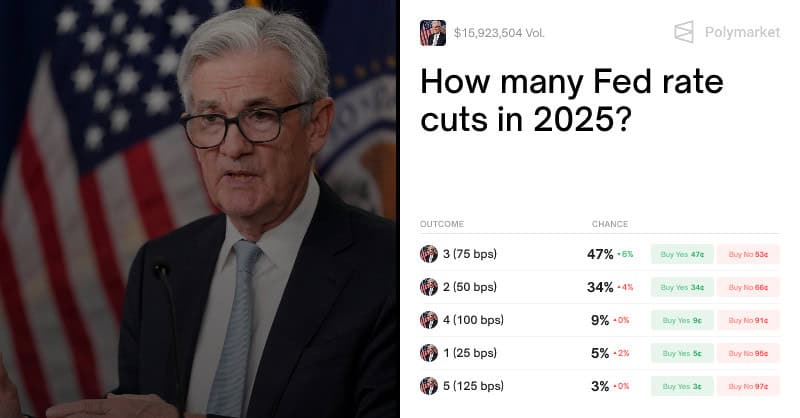
The Fed Cuts Rates by 25bps, Bitcoin Steady For Now

BNB slips below $590 as Trump threatens to strike Iranian power plants




