A New York bankruptcy court has granted provisional relief to Singapore-based liquidators overseeing the collapse of Multichain Foundation Ltd., directing stablecoin issuer Circle to keep wallets holding millions of dollars in stolen USD Coin (USDC) frozen. Judge David S. Jones of the U.S. Bankruptcy Court for the Southern District of New York issued the order on Thursday, extending the freeze on three Ethereum wallets tied to the July 2023 Multichain hack. The ruling requires Circle to maintain the addresses on its blacklist, effectively blocking any movement of the roughly $63 million in stolen USDC until further notice. The court’s decision marks a major step in the cross-border effort to recover assets drained from Multichain’s cross-chain bridge protocol, which lost more than $210 million in one of 2023’s largest DeFi exploits. Inside the Multichain Case: How Liquidators Win by Freezing USDC The order, issued under Section 1519 of the U.S. Bankruptcy Code, allows temporary relief before a foreign case receives formal recognition under Chapter 15, the framework that governs cooperation between U.S. courts and foreign insolvency proceedings.Source: Cornell Law School Liquidators appointed in Singapore, from KPMG Services Pte. Ltd., filed for provisional relief on October 23, arguing that lifting Circle’s freeze could cause “immediate and irreparable harm” by allowing stolen assets to move beyond recovery. The request sought to preserve the funds until the U.S. court determines whether to recognize the Singapore case as a “foreign main proceeding,” a designation that would allow the liquidators to pursue recovery efforts across jurisdictions. Circle, which issues the U.S. dollar–pegged USDC stablecoin, typically enforces freezes by blacklisting addresses directly through the token’s smart contract, a feature that blocks any transfers involving those wallets. The company first froze the three hacker-linked addresses in October 2023 at the direction of the U.S. Department of Justice (DOJ), which obtained a seizure warrant shortly after the exploit. The DOJ later lifted the warrant after failing to identify the hackers, leaving Circle without a legal basis to keep the wallets locked. The latest order restores that authority. According to the court filing, the freeze is necessary to prevent competing claims over the same funds. A group of U.S. investors had filed a separate class action lawsuit against Circle in New York State court, seeking control of the stolen USDC. That case has now been paused following the federal court’s ruling. Circle moved the matter to the Southern District of New York under the Class Action Fairness Act, which allows large, multi-jurisdictional class actions to be heard in federal court. After the $125M Hack, Multichain Faces Its Final Chapter in Court The Multichain collapse, one of the most high-profile failures in the decentralized finance sector, stemmed from an exploit discovered in July 2023. Unidentified attackers drained over $125 million from Multichain’s bridge contracts on Fantom, Moonriver, and Dogechain, transferring funds to unknown addresses. Multichain, formerly known as Anyswap, operated as one of the largest cross-chain bridge protocols, allowing users to move assets across blockchains like Ethereum, BNB Chain, Avalanche, and Polygon. The platform had a total value locked of about $9.2 billion in early 2022, according to data from DeFiLlama, before its troubles began in mid-2023. Reports later surfaced that the company’s CEO, known as Zhaojun, had been detained in China, leaving the project in disarray. Following the hack, affected projects, including the Fantom Foundation, launched legal actions in Singapore. In March 2024, the High Court of Singapore issued a default judgment in Fantom’s favor, finding that Multichain had breached contractual obligations. By May 2025, the same court approved a winding-up order against Multichain Foundation Ltd., appointing KPMG’s Bob Yap Cheng Ghee, Toh Ai Ling, and Tan Yen Chiaw as joint liquidators to oversee asset recovery and dissolution. The frozen $63 million in USDC represents a portion of the total $210 million stolen from Multichain. The liquidators are seeking to recover these assets as part of the broader winding-up process. In their U.S. filing, they described the New York court’s provisional relief as “an effective mechanism to implement Chapter 15’s policies of promoting cooperation between courts of the United States and foreign courts involved in cross-border restructuring cases.”A New York bankruptcy court has granted provisional relief to Singapore-based liquidators overseeing the collapse of Multichain Foundation Ltd., directing stablecoin issuer Circle to keep wallets holding millions of dollars in stolen USD Coin (USDC) frozen. Judge David S. Jones of the U.S. Bankruptcy Court for the Southern District of New York issued the order on Thursday, extending the freeze on three Ethereum wallets tied to the July 2023 Multichain hack. The ruling requires Circle to maintain the addresses on its blacklist, effectively blocking any movement of the roughly $63 million in stolen USDC until further notice. The court’s decision marks a major step in the cross-border effort to recover assets drained from Multichain’s cross-chain bridge protocol, which lost more than $210 million in one of 2023’s largest DeFi exploits. Inside the Multichain Case: How Liquidators Win by Freezing USDC The order, issued under Section 1519 of the U.S. Bankruptcy Code, allows temporary relief before a foreign case receives formal recognition under Chapter 15, the framework that governs cooperation between U.S. courts and foreign insolvency proceedings.Source: Cornell Law School Liquidators appointed in Singapore, from KPMG Services Pte. Ltd., filed for provisional relief on October 23, arguing that lifting Circle’s freeze could cause “immediate and irreparable harm” by allowing stolen assets to move beyond recovery. The request sought to preserve the funds until the U.S. court determines whether to recognize the Singapore case as a “foreign main proceeding,” a designation that would allow the liquidators to pursue recovery efforts across jurisdictions. Circle, which issues the U.S. dollar–pegged USDC stablecoin, typically enforces freezes by blacklisting addresses directly through the token’s smart contract, a feature that blocks any transfers involving those wallets. The company first froze the three hacker-linked addresses in October 2023 at the direction of the U.S. Department of Justice (DOJ), which obtained a seizure warrant shortly after the exploit. The DOJ later lifted the warrant after failing to identify the hackers, leaving Circle without a legal basis to keep the wallets locked. The latest order restores that authority. According to the court filing, the freeze is necessary to prevent competing claims over the same funds. A group of U.S. investors had filed a separate class action lawsuit against Circle in New York State court, seeking control of the stolen USDC. That case has now been paused following the federal court’s ruling. Circle moved the matter to the Southern District of New York under the Class Action Fairness Act, which allows large, multi-jurisdictional class actions to be heard in federal court. After the $125M Hack, Multichain Faces Its Final Chapter in Court The Multichain collapse, one of the most high-profile failures in the decentralized finance sector, stemmed from an exploit discovered in July 2023. Unidentified attackers drained over $125 million from Multichain’s bridge contracts on Fantom, Moonriver, and Dogechain, transferring funds to unknown addresses. Multichain, formerly known as Anyswap, operated as one of the largest cross-chain bridge protocols, allowing users to move assets across blockchains like Ethereum, BNB Chain, Avalanche, and Polygon. The platform had a total value locked of about $9.2 billion in early 2022, according to data from DeFiLlama, before its troubles began in mid-2023. Reports later surfaced that the company’s CEO, known as Zhaojun, had been detained in China, leaving the project in disarray. Following the hack, affected projects, including the Fantom Foundation, launched legal actions in Singapore. In March 2024, the High Court of Singapore issued a default judgment in Fantom’s favor, finding that Multichain had breached contractual obligations. By May 2025, the same court approved a winding-up order against Multichain Foundation Ltd., appointing KPMG’s Bob Yap Cheng Ghee, Toh Ai Ling, and Tan Yen Chiaw as joint liquidators to oversee asset recovery and dissolution. The frozen $63 million in USDC represents a portion of the total $210 million stolen from Multichain. The liquidators are seeking to recover these assets as part of the broader winding-up process. In their U.S. filing, they described the New York court’s provisional relief as “an effective mechanism to implement Chapter 15’s policies of promoting cooperation between courts of the United States and foreign courts involved in cross-border restructuring cases.”

Multichain Liquidators Win Key Ruling as New York Court Extends Freeze on Stolen USDC

2025/11/01 04:53
4분 읽기
이 콘텐츠에 대한 의견이나 우려 사항이 있으시면 crypto.news@mexc.com으로 연락주시기 바랍니다

A New York bankruptcy court has granted provisional relief to Singapore-based liquidators overseeing the collapse of Multichain Foundation Ltd., directing stablecoin issuer Circle to keep wallets holding millions of dollars in stolen USD Coin (USDC) frozen.

Judge David S. Jones of the U.S. Bankruptcy Court for the Southern District of New York issued the order on Thursday, extending the freeze on three Ethereum wallets tied to the July 2023 Multichain hack.

The ruling requires Circle to maintain the addresses on its blacklist, effectively blocking any movement of the roughly $63 million in stolen USDC until further notice.

The court’s decision marks a major step in the cross-border effort to recover assets drained from Multichain’s cross-chain bridge protocol, which lost more than $210 million in one of 2023’s largest DeFi exploits.

Inside the Multichain Case: How Liquidators Win by Freezing USDC

The order, issued under Section 1519 of the U.S. Bankruptcy Code, allows temporary relief before a foreign case receives formal recognition under Chapter 15, the framework that governs cooperation between U.S. courts and foreign insolvency proceedings.
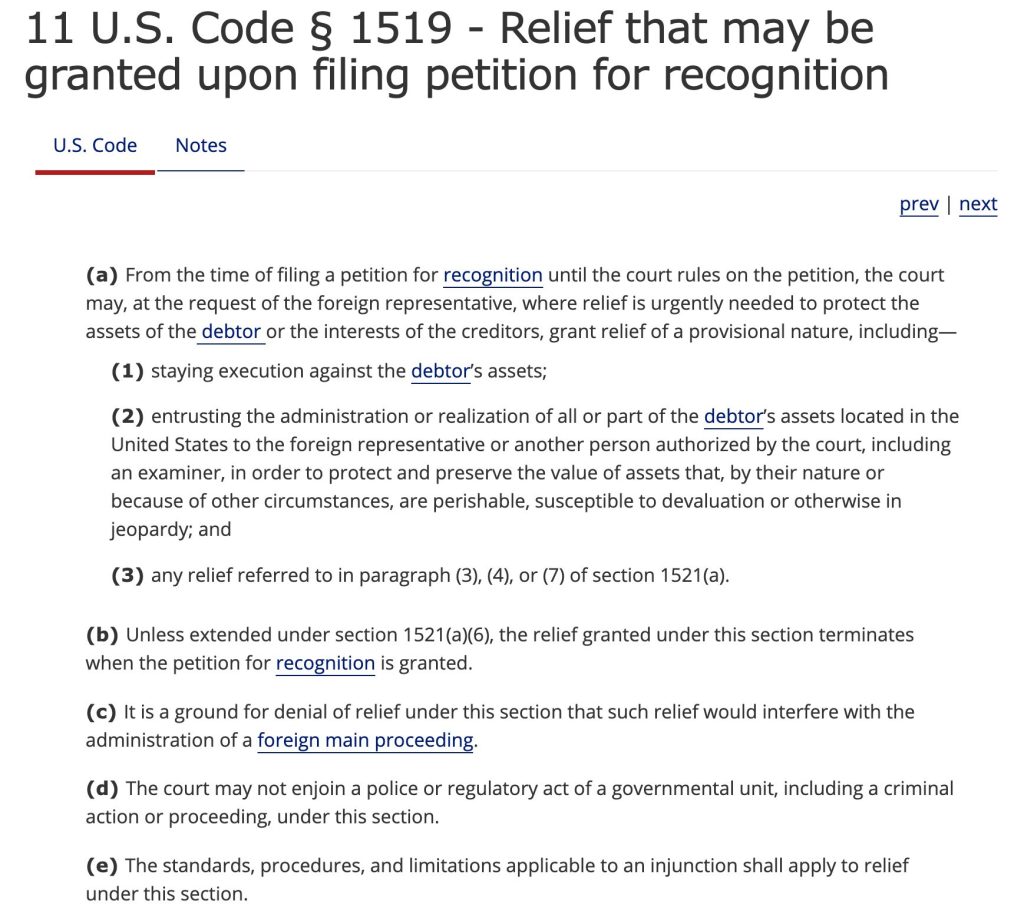
Source: Cornell Law School

Liquidators appointed in Singapore, from KPMG Services Pte. Ltd., filed for provisional relief on October 23, arguing that lifting Circle’s freeze could cause “immediate and irreparable harm” by allowing stolen assets to move beyond recovery.

The request sought to preserve the funds until the U.S. court determines whether to recognize the Singapore case as a “foreign main proceeding,” a designation that would allow the liquidators to pursue recovery efforts across jurisdictions.

Circle, which issues the U.S. dollar–pegged USDC stablecoin, typically enforces freezes by blacklisting addresses directly through the token’s smart contract, a feature that blocks any transfers involving those wallets.

The company first froze the three hacker-linked addresses in October 2023 at the direction of the U.S. Department of Justice (DOJ), which obtained a seizure warrant shortly after the exploit.

The DOJ later lifted the warrant after failing to identify the hackers, leaving Circle without a legal basis to keep the wallets locked. The latest order restores that authority.

According to the court filing, the freeze is necessary to prevent competing claims over the same funds. A group of U.S. investors had filed a separate class action lawsuit against Circle in New York State court, seeking control of the stolen USDC.

That case has now been paused following the federal court’s ruling. Circle moved the matter to the Southern District of New York under the Class Action Fairness Act, which allows large, multi-jurisdictional class actions to be heard in federal court.

After the $125M Hack, Multichain Faces Its Final Chapter in Court

The Multichain collapse, one of the most high-profile failures in the decentralized finance sector, stemmed from an exploit discovered in July 2023.

Unidentified attackers drained over $125 million from Multichain’s bridge contracts on Fantom, Moonriver, and Dogechain, transferring funds to unknown addresses.

Multichain, formerly known as Anyswap, operated as one of the largest cross-chain bridge protocols, allowing users to move assets across blockchains like Ethereum, BNB Chain, Avalanche, and Polygon.

The platform had a total value locked of about $9.2 billion in early 2022, according to data from DeFiLlama, before its troubles began in mid-2023.

Reports later surfaced that the company’s CEO, known as Zhaojun, had been detained in China, leaving the project in disarray.

Following the hack, affected projects, including the Fantom Foundation, launched legal actions in Singapore. In March 2024, the High Court of Singapore issued a default judgment in Fantom’s favor, finding that Multichain had breached contractual obligations.

By May 2025, the same court approved a winding-up order against Multichain Foundation Ltd., appointing KPMG’s Bob Yap Cheng Ghee, Toh Ai Ling, and Tan Yen Chiaw as joint liquidators to oversee asset recovery and dissolution.

The frozen $63 million in USDC represents a portion of the total $210 million stolen from Multichain. The liquidators are seeking to recover these assets as part of the broader winding-up process.

In their U.S. filing, they described the New York court’s provisional relief as “an effective mechanism to implement Chapter 15’s policies of promoting cooperation between courts of the United States and foreign courts involved in cross-border restructuring cases.”


시장 기회
윙크 로고
윙크 가격(WIN)
$0.00002048
$0.00002048$0.00002048
+0.34%
USD
윙크 (WIN) 실시간 가격 차트
면책 조항: 본 사이트에 재게시된 글들은 공개 플랫폼에서 가져온 것으로 정보 제공 목적으로만 제공됩니다. 이는 반드시 MEXC의 견해를 반영하는 것은 아닙니다. 모든 권리는 원저자에게 있습니다. 제3자의 권리를 침해하는 콘텐츠가 있다고 판단될 경우, crypto.news@mexc.com으로 연락하여 삭제 요청을 해주시기 바랍니다. MEXC는 콘텐츠의 정확성, 완전성 또는 시의적절성에 대해 어떠한 보증도 하지 않으며, 제공된 정보에 기반하여 취해진 어떠한 조치에 대해서도 책임을 지지 않습니다. 본 콘텐츠는 금융, 법률 또는 기타 전문적인 조언을 구성하지 않으며, MEXC의 추천이나 보증으로 간주되어서는 안 됩니다.

Roll the Dice & Win Up to 1 BTC

Roll the Dice & Win Up to 1 BTCRoll the Dice & Win Up to 1 BTC

Invite friends & share 500,000 USDT!



