President Donald Trump declared crypto “takes a lot of pressure off the dollar” during a speech at Miami’s America Business Forum on November 5, 2025, positioning the U.S. as “the bitcoin superpower” and “crypto capital of the world.” Speaking to thousands of attendees, Trump credited his executive orders with ending what he called the federal government’s “war on crypto,” contrasting his approach with the Biden administration’s enforcement-heavy stance, which he said left industry figures “under indictment.” Beyond regulatory relief, Trump framed crypto adoption as economically strategic, suggesting digital assets could alleviate strain on the dollar while positioning America as the global leader in both crypto and artificial intelligence, where he claimed the U.S. leads China “by a lot.” The Dollar-Bitcoin Paradox Trump’s endorsement reflects growing momentum behind stablecoins and strategic Bitcoin reserves in Washington, yet economic fundamentals suggest an inherent tension. Bitcoin has historically exhibited an inverse correlation of approximately -0.7 with the U.S. Dollar Index (DXY), meaning a strengthened dollar typically suppresses Bitcoin prices while dollar weakness tends to boost them.Source: MacroMicro During the Federal Reserve’s 2022 tightening cycle, the DXY surged to 114, while Bitcoin crashed from $47,000 to below $17,000, a textbook demonstration of this inverse relationship. Conversely, the 2020-21 easing period saw dollar weakness coincide with Bitcoin’s rally to then-record highs around $64,000. Market observers note Bitcoin behaves more like a high-beta risk asset than a safe haven, rising with loose financial conditions and falling during liquidity withdrawals. If cryptocurrency genuinely reduces pressure on the dollar by offering alternative transaction and store-of-value mechanisms, a stronger dollar could paradoxically undermine Bitcoin’s appeal. The crypto typically attracts capital when investors seek alternatives to weakening fiat currencies, not when traditional money strengthens. Academic research using wavelet analysis confirms Bitcoin’s out-of-phase dynamics with the dollar, though the relationship remains “more sporadic” than with conventional assets. Strategic Reserve and Stablecoin Push Senator Cynthia Lummis recently called a Strategic Bitcoin Reserve “the only path“ to meaningfully offset America’s $35 trillion debt burden, praising the Trump administration for embracing the concept. She revealed Treasury Secretary Scott Bessent and White House staff are exploring structures beyond simply revaluing gold certificates, though financing details remain unclear. The administration’s March fact sheet indicated the reserve would start with over 130,000 BTC already held through criminal forfeitures, worth approximately $34 billion, without requiring new taxpayer spending. Similarly, Eric Trump recently told the New York Post that stablecoins could “save the U.S. dollar” by channeling “trillions from around the world” into U.S. markets through World Liberty Financial’s USD1 token. However, critics, including Representative Maxine Waters and Senator Elizabeth Warren, have warned of what they see as conflicts of interest, noting the GENIUS Act stablecoin framework signed in July contains no provisions preventing the president or family members from profiting. Market Dynamics Reveal Dollar-Bitcoin Tension in Real Time Recent market action demonstrates the paradox between the dollar and Bitcoin. When surprisingly strong U.S. jobs data emerged in late September, initial claims dropped to 218,000, and Q2 GDP was revised upward to 3.8%. The U.S. Dollar Index surged to a three-week high while Bitcoin tumbled below $111,000. The pattern repeated on Thursday when better-than-expected services activity and payroll figures lifted the dollar to a five-month peak, capping Bitcoin’s recovery even as it climbed back above $103,000. Current trading reflects this dollar dominance. Despite Bitcoin’s Thursday bounce, traders described a “buy the dip, sell the rip” bias, with rapid profit-taking, as the higher-for-longer rate narrative and firm dollar limit follow-through persisted. Rate expectations for a December Fed cut slipped to 60% from 70% earlier in the week, keeping yields firm and the dollar elevated. Notably, in the early hours of today, Turkey’s lira plunged to a record 42.1 per dollar on November 6, a 97% depreciation since 2010, as persistent inflation drives capital toward the US dollar. Alok Jain described this saying, “they will keep adding paper till people keep considering it of any value.”President Donald Trump declared crypto “takes a lot of pressure off the dollar” during a speech at Miami’s America Business Forum on November 5, 2025, positioning the U.S. as “the bitcoin superpower” and “crypto capital of the world.” Speaking to thousands of attendees, Trump credited his executive orders with ending what he called the federal government’s “war on crypto,” contrasting his approach with the Biden administration’s enforcement-heavy stance, which he said left industry figures “under indictment.” Beyond regulatory relief, Trump framed crypto adoption as economically strategic, suggesting digital assets could alleviate strain on the dollar while positioning America as the global leader in both crypto and artificial intelligence, where he claimed the U.S. leads China “by a lot.” The Dollar-Bitcoin Paradox Trump’s endorsement reflects growing momentum behind stablecoins and strategic Bitcoin reserves in Washington, yet economic fundamentals suggest an inherent tension. Bitcoin has historically exhibited an inverse correlation of approximately -0.7 with the U.S. Dollar Index (DXY), meaning a strengthened dollar typically suppresses Bitcoin prices while dollar weakness tends to boost them.Source: MacroMicro During the Federal Reserve’s 2022 tightening cycle, the DXY surged to 114, while Bitcoin crashed from $47,000 to below $17,000, a textbook demonstration of this inverse relationship. Conversely, the 2020-21 easing period saw dollar weakness coincide with Bitcoin’s rally to then-record highs around $64,000. Market observers note Bitcoin behaves more like a high-beta risk asset than a safe haven, rising with loose financial conditions and falling during liquidity withdrawals. If cryptocurrency genuinely reduces pressure on the dollar by offering alternative transaction and store-of-value mechanisms, a stronger dollar could paradoxically undermine Bitcoin’s appeal. The crypto typically attracts capital when investors seek alternatives to weakening fiat currencies, not when traditional money strengthens. Academic research using wavelet analysis confirms Bitcoin’s out-of-phase dynamics with the dollar, though the relationship remains “more sporadic” than with conventional assets. Strategic Reserve and Stablecoin Push Senator Cynthia Lummis recently called a Strategic Bitcoin Reserve “the only path“ to meaningfully offset America’s $35 trillion debt burden, praising the Trump administration for embracing the concept. She revealed Treasury Secretary Scott Bessent and White House staff are exploring structures beyond simply revaluing gold certificates, though financing details remain unclear. The administration’s March fact sheet indicated the reserve would start with over 130,000 BTC already held through criminal forfeitures, worth approximately $34 billion, without requiring new taxpayer spending. Similarly, Eric Trump recently told the New York Post that stablecoins could “save the U.S. dollar” by channeling “trillions from around the world” into U.S. markets through World Liberty Financial’s USD1 token. However, critics, including Representative Maxine Waters and Senator Elizabeth Warren, have warned of what they see as conflicts of interest, noting the GENIUS Act stablecoin framework signed in July contains no provisions preventing the president or family members from profiting. Market Dynamics Reveal Dollar-Bitcoin Tension in Real Time Recent market action demonstrates the paradox between the dollar and Bitcoin. When surprisingly strong U.S. jobs data emerged in late September, initial claims dropped to 218,000, and Q2 GDP was revised upward to 3.8%. The U.S. Dollar Index surged to a three-week high while Bitcoin tumbled below $111,000. The pattern repeated on Thursday when better-than-expected services activity and payroll figures lifted the dollar to a five-month peak, capping Bitcoin’s recovery even as it climbed back above $103,000. Current trading reflects this dollar dominance. Despite Bitcoin’s Thursday bounce, traders described a “buy the dip, sell the rip” bias, with rapid profit-taking, as the higher-for-longer rate narrative and firm dollar limit follow-through persisted. Rate expectations for a December Fed cut slipped to 60% from 70% earlier in the week, keeping yields firm and the dollar elevated. Notably, in the early hours of today, Turkey’s lira plunged to a record 42.1 per dollar on November 6, a 97% depreciation since 2010, as persistent inflation drives capital toward the US dollar. Alok Jain described this saying, “they will keep adding paper till people keep considering it of any value.”

Trump Praises Crypto for Easing Dollar Burden – Ironically, That Could Hurt Bitcoin

2025/11/06 19:55
4분 읽기
이 콘텐츠에 대한 의견이나 우려 사항이 있으시면 crypto.news@mexc.com으로 연락주시기 바랍니다

President Donald Trump declared crypto “takes a lot of pressure off the dollar” during a speech at Miami’s America Business Forum on November 5, 2025, positioning the U.S. as “the bitcoin superpower” and “crypto capital of the world.

Speaking to thousands of attendees, Trump credited his executive orders with ending what he called the federal government’s “war on crypto,” contrasting his approach with the Biden administration’s enforcement-heavy stance, which he said left industry figures “under indictment.”

Beyond regulatory relief, Trump framed crypto adoption as economically strategic, suggesting digital assets could alleviate strain on the dollar while positioning America as the global leader in both crypto and artificial intelligence, where he claimed the U.S. leads China “by a lot.”

The Dollar-Bitcoin Paradox

Trump’s endorsement reflects growing momentum behind stablecoins and strategic Bitcoin reserves in Washington, yet economic fundamentals suggest an inherent tension.

Bitcoin has historically exhibited an inverse correlation of approximately -0.7 with the U.S. Dollar Index (DXY), meaning a strengthened dollar typically suppresses Bitcoin prices while dollar weakness tends to boost them.
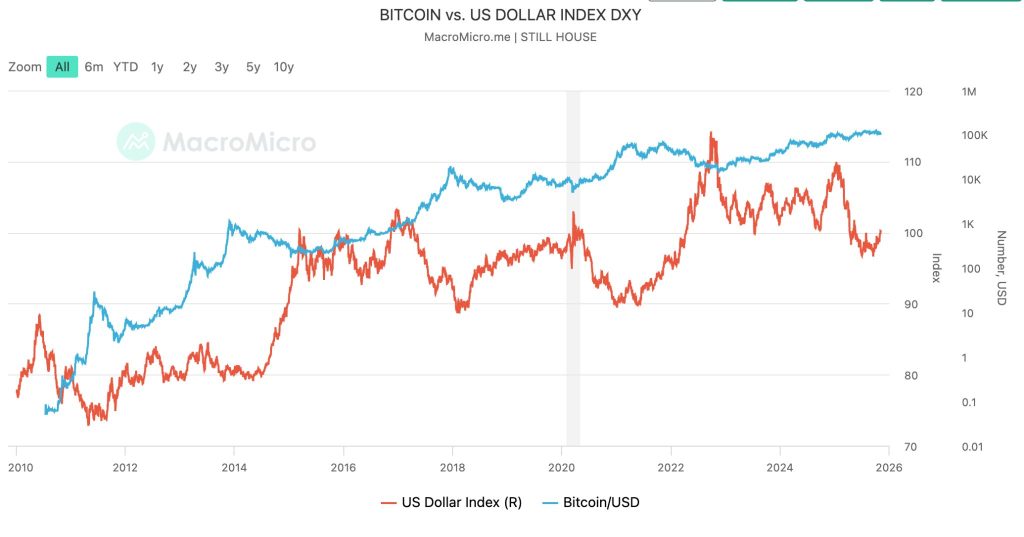
Trump Praises Crypto for Easing Dollar Burden – Ironically, That Could Hurt BitcoinSource: MacroMicro

During the Federal Reserve’s 2022 tightening cycle, the DXY surged to 114, while Bitcoin crashed from $47,000 to below $17,000, a textbook demonstration of this inverse relationship.

Conversely, the 2020-21 easing period saw dollar weakness coincide with Bitcoin’s rally to then-record highs around $64,000.

Market observers note Bitcoin behaves more like a high-beta risk asset than a safe haven, rising with loose financial conditions and falling during liquidity withdrawals.

If cryptocurrency genuinely reduces pressure on the dollar by offering alternative transaction and store-of-value mechanisms, a stronger dollar could paradoxically undermine Bitcoin’s appeal.

The crypto typically attracts capital when investors seek alternatives to weakening fiat currencies, not when traditional money strengthens.

Academic research using wavelet analysis confirms Bitcoin’s out-of-phase dynamics with the dollar, though the relationship remains “more sporadic” than with conventional assets.

Strategic Reserve and Stablecoin Push

Senator Cynthia Lummis recently called a Strategic Bitcoin Reserve “the only path“ to meaningfully offset America’s $35 trillion debt burden, praising the Trump administration for embracing the concept.

She revealed Treasury Secretary Scott Bessent and White House staff are exploring structures beyond simply revaluing gold certificates, though financing details remain unclear.

The administration’s March fact sheet indicated the reserve would start with over 130,000 BTC already held through criminal forfeitures, worth approximately $34 billion, without requiring new taxpayer spending.

Similarly, Eric Trump recently told the New York Post that stablecoins could “save the U.S. dollar” by channeling “trillions from around the world” into U.S. markets through World Liberty Financial’s USD1 token.

However, critics, including Representative Maxine Waters and Senator Elizabeth Warren, have warned of what they see as conflicts of interest, noting the GENIUS Act stablecoin framework signed in July contains no provisions preventing the president or family members from profiting.

Market Dynamics Reveal Dollar-Bitcoin Tension in Real Time

Recent market action demonstrates the paradox between the dollar and Bitcoin.

When surprisingly strong U.S. jobs data emerged in late September, initial claims dropped to 218,000, and Q2 GDP was revised upward to 3.8%. The U.S. Dollar Index surged to a three-week high while Bitcoin tumbled below $111,000.

The pattern repeated on Thursday when better-than-expected services activity and payroll figures lifted the dollar to a five-month peak, capping Bitcoin’s recovery even as it climbed back above $103,000.

Current trading reflects this dollar dominance. Despite Bitcoin’s Thursday bounce, traders described a “buy the dip, sell the rip” bias, with rapid profit-taking, as the higher-for-longer rate narrative and firm dollar limit follow-through persisted.

Rate expectations for a December Fed cut slipped to 60% from 70% earlier in the week, keeping yields firm and the dollar elevated.

Notably, in the early hours of today, Turkey’s lira plunged to a record 42.1 per dollar on November 6, a 97% depreciation since 2010, as persistent inflation drives capital toward the US dollar.

Alok Jain described this saying, “they will keep adding paper till people keep considering it of any value.”


시장 기회
OFFICIAL TRUMP 로고
OFFICIAL TRUMP 가격(TRUMP)
$2.522
$2.522$2.522
+0.75%
USD
OFFICIAL TRUMP (TRUMP) 실시간 가격 차트
면책 조항: 본 사이트에 재게시된 글들은 공개 플랫폼에서 가져온 것으로 정보 제공 목적으로만 제공됩니다. 이는 반드시 MEXC의 견해를 반영하는 것은 아닙니다. 모든 권리는 원저자에게 있습니다. 제3자의 권리를 침해하는 콘텐츠가 있다고 판단될 경우, crypto.news@mexc.com으로 연락하여 삭제 요청을 해주시기 바랍니다. MEXC는 콘텐츠의 정확성, 완전성 또는 시의적절성에 대해 어떠한 보증도 하지 않으며, 제공된 정보에 기반하여 취해진 어떠한 조치에 대해서도 책임을 지지 않습니다. 본 콘텐츠는 금융, 법률 또는 기타 전문적인 조언을 구성하지 않으며, MEXC의 추천이나 보증으로 간주되어서는 안 됩니다.

Roll the Dice & Win Up to 1 BTC

Roll the Dice & Win Up to 1 BTCRoll the Dice & Win Up to 1 BTC

Invite friends & share 500,000 USDT!