Circle, the issuer of the world’s second-largest stablecoin, USDC, has reversed a controversial policy that prohibited firearm purchases, following weeks of political pressure and public criticism from gun rights groups and Republican lawmakers. The company confirmed that it has updated its terms of service to permit lawful transactions involving firearms, after the National Shooting Sports Foundation (NSSF), a major firearms trade association, challenged what it described as “financial discrimination” against lawful commerce. “Circle has clarified our Terms to reflect that USDC may be used for the lawful purchase and sale of firearms, as protected under the Second Amendment,” a Circle spokesperson told the NSSF. “We have not and will not deny the use of USDC for legally permissible transactions involving firearms.”Source: NSSF Circle Aligns USDC Policy With GENIUS Act Stablecoin Framework The reversal comes after Americans for Tax Reform (ATR), a conservative advocacy group, published a report last month revealing that Circle’s terms prohibited transactions involving “weapons of any kind, including firearms, ammunition, knives, or explosives.” ATR argued that the ban highlighted the risk of private financial intermediaries restricting lawful transactions based on political bias. The group also pointed to campaign donations made by Circle CEO Jeremy Allaire to Democratic politicians, including Rep. Jake Auchincloss (D-MA), who has sponsored gun control legislation. The clause, which went largely unnoticed until recently, stated that using USDC for “weapons of any kind” violated the company’s prohibited transactions policy. Circle reserved the right to monitor and block such activity, potentially suspending accounts that violated the terms. Following ATR’s report, the NSSF accused Circle of engaging in “ideological enforcement” against gun owners and retailers. “Freedom cannot survive if your financial tools are turned against you and your Second Amendment rights,” the organization said in a statement. The group compared Circle’s actions to historical “Operation Choke Point”-style practices, in which U.S. regulators were accused of pressuring banks to deny services to politically disfavored industries. The policy quickly drew attention in Washington, with several Republican lawmakers citing it as evidence of “financial weaponization.” Senator Bill Hagerty (R-TN), author of the recently enacted GENIUS Act stablecoin framework, said the reversal marked “a victory against Choke Point-inspired mechanisms to achieve partisan goals.” “America will no longer tolerate discrimination against citizens who are exercising their constitutional rights.” Senator Cynthia Lummis (R-WY), another co-sponsor of the GENIUS Act, praised Circle’s decision, saying it “aligns its terms of service with existing legal requirements and ensures financial systems cannot be used against law-abiding gun owners.” Circle’s Policy U-Turn Exposes a Key Stablecoin Dilemma Circle’s update, which now only prohibits weapons purchases “in contravention of applicable laws,” comes at a time when stablecoins are gaining unprecedented influence in the U.S. financial system. With USDC’s market capitalization hovering around $75 billion, Circle has become one of the most significant players in digital finance. The company went public in June, raising over $1 billion through its initial public offering on the New York Stock Exchange.Source: DefiLlama Stablecoins have also surged in mainstream adoption since President Donald Trump signed the GENIUS Act into law in July, establishing a federal framework for their issuance and oversight. The law’s passage triggered a wave of new stablecoin initiatives from major financial institutions, including Bank of America, Morgan Stanley, and Robinhood. Yet Circle’s controversy has drawn parallels to the same issues critics have raised about government-backed digital currencies. ATR’s report compared Circle’s original restrictions to potential central bank digital currency (CBDC) controls, warning that private firms could similarly “monitor and censor” transactions under political influence. The NSSF called Circle’s reversal “a welcome sign” that private companies are beginning to recognize the dangers of financial biasCircle, the issuer of the world’s second-largest stablecoin, USDC, has reversed a controversial policy that prohibited firearm purchases, following weeks of political pressure and public criticism from gun rights groups and Republican lawmakers. The company confirmed that it has updated its terms of service to permit lawful transactions involving firearms, after the National Shooting Sports Foundation (NSSF), a major firearms trade association, challenged what it described as “financial discrimination” against lawful commerce. “Circle has clarified our Terms to reflect that USDC may be used for the lawful purchase and sale of firearms, as protected under the Second Amendment,” a Circle spokesperson told the NSSF. “We have not and will not deny the use of USDC for legally permissible transactions involving firearms.”Source: NSSF Circle Aligns USDC Policy With GENIUS Act Stablecoin Framework The reversal comes after Americans for Tax Reform (ATR), a conservative advocacy group, published a report last month revealing that Circle’s terms prohibited transactions involving “weapons of any kind, including firearms, ammunition, knives, or explosives.” ATR argued that the ban highlighted the risk of private financial intermediaries restricting lawful transactions based on political bias. The group also pointed to campaign donations made by Circle CEO Jeremy Allaire to Democratic politicians, including Rep. Jake Auchincloss (D-MA), who has sponsored gun control legislation. The clause, which went largely unnoticed until recently, stated that using USDC for “weapons of any kind” violated the company’s prohibited transactions policy. Circle reserved the right to monitor and block such activity, potentially suspending accounts that violated the terms. Following ATR’s report, the NSSF accused Circle of engaging in “ideological enforcement” against gun owners and retailers. “Freedom cannot survive if your financial tools are turned against you and your Second Amendment rights,” the organization said in a statement. The group compared Circle’s actions to historical “Operation Choke Point”-style practices, in which U.S. regulators were accused of pressuring banks to deny services to politically disfavored industries. The policy quickly drew attention in Washington, with several Republican lawmakers citing it as evidence of “financial weaponization.” Senator Bill Hagerty (R-TN), author of the recently enacted GENIUS Act stablecoin framework, said the reversal marked “a victory against Choke Point-inspired mechanisms to achieve partisan goals.” “America will no longer tolerate discrimination against citizens who are exercising their constitutional rights.” Senator Cynthia Lummis (R-WY), another co-sponsor of the GENIUS Act, praised Circle’s decision, saying it “aligns its terms of service with existing legal requirements and ensures financial systems cannot be used against law-abiding gun owners.” Circle’s Policy U-Turn Exposes a Key Stablecoin Dilemma Circle’s update, which now only prohibits weapons purchases “in contravention of applicable laws,” comes at a time when stablecoins are gaining unprecedented influence in the U.S. financial system. With USDC’s market capitalization hovering around $75 billion, Circle has become one of the most significant players in digital finance. The company went public in June, raising over $1 billion through its initial public offering on the New York Stock Exchange.Source: DefiLlama Stablecoins have also surged in mainstream adoption since President Donald Trump signed the GENIUS Act into law in July, establishing a federal framework for their issuance and oversight. The law’s passage triggered a wave of new stablecoin initiatives from major financial institutions, including Bank of America, Morgan Stanley, and Robinhood. Yet Circle’s controversy has drawn parallels to the same issues critics have raised about government-backed digital currencies. ATR’s report compared Circle’s original restrictions to potential central bank digital currency (CBDC) controls, warning that private firms could similarly “monitor and censor” transactions under political influence. The NSSF called Circle’s reversal “a welcome sign” that private companies are beginning to recognize the dangers of financial bias

Circle Caves to Political Pressure, Reverses USDC Gun Purchasing Ban

2025/11/06 22:38
4분 읽기
이 콘텐츠에 대한 의견이나 우려 사항이 있으시면 crypto.news@mexc.com으로 연락주시기 바랍니다

Circle, the issuer of the world’s second-largest stablecoin, USDC, has reversed a controversial policy that prohibited firearm purchases, following weeks of political pressure and public criticism from gun rights groups and Republican lawmakers.

The company confirmed that it has updated its terms of service to permit lawful transactions involving firearms, after the National Shooting Sports Foundation (NSSF), a major firearms trade association, challenged what it described as “financial discrimination” against lawful commerce.

“Circle has clarified our Terms to reflect that USDC may be used for the lawful purchase and sale of firearms, as protected under the Second Amendment,” a Circle spokesperson told the NSSF. “We have not and will not deny the use of USDC for legally permissible transactions involving firearms.”
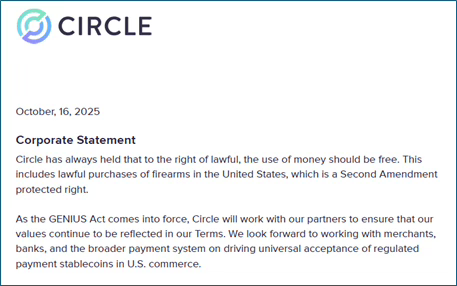
Source: NSSF

Circle Aligns USDC Policy With GENIUS Act Stablecoin Framework

The reversal comes after Americans for Tax Reform (ATR), a conservative advocacy group, published a report last month revealing that Circle’s terms prohibited transactions involving “weapons of any kind, including firearms, ammunition, knives, or explosives.”

ATR argued that the ban highlighted the risk of private financial intermediaries restricting lawful transactions based on political bias. The group also pointed to campaign donations made by Circle CEO Jeremy Allaire to Democratic politicians, including Rep. Jake Auchincloss (D-MA), who has sponsored gun control legislation.

The clause, which went largely unnoticed until recently, stated that using USDC for “weapons of any kind” violated the company’s prohibited transactions policy.

Circle reserved the right to monitor and block such activity, potentially suspending accounts that violated the terms.

Following ATR’s report, the NSSF accused Circle of engaging in “ideological enforcement” against gun owners and retailers. “Freedom cannot survive if your financial tools are turned against you and your Second Amendment rights,” the organization said in a statement.

The group compared Circle’s actions to historical “Operation Choke Point”-style practices, in which U.S. regulators were accused of pressuring banks to deny services to politically disfavored industries.

The policy quickly drew attention in Washington, with several Republican lawmakers citing it as evidence of “financial weaponization.”

Senator Bill Hagerty (R-TN), author of the recently enacted GENIUS Act stablecoin framework, said the reversal marked “a victory against Choke Point-inspired mechanisms to achieve partisan goals.”

“America will no longer tolerate discrimination against citizens who are exercising their constitutional rights.”

Senator Cynthia Lummis (R-WY), another co-sponsor of the GENIUS Act, praised Circle’s decision, saying it “aligns its terms of service with existing legal requirements and ensures financial systems cannot be used against law-abiding gun owners.”

Circle’s Policy U-Turn Exposes a Key Stablecoin Dilemma

Circle’s update, which now only prohibits weapons purchases “in contravention of applicable laws,” comes at a time when stablecoins are gaining unprecedented influence in the U.S. financial system.

With USDC’s market capitalization hovering around $75 billion, Circle has become one of the most significant players in digital finance. The company went public in June, raising over $1 billion through its initial public offering on the New York Stock Exchange.

Source: DefiLlama

Stablecoins have also surged in mainstream adoption since President Donald Trump signed the GENIUS Act into law in July, establishing a federal framework for their issuance and oversight.

The law’s passage triggered a wave of new stablecoin initiatives from major financial institutions, including Bank of America, Morgan Stanley, and Robinhood.

Yet Circle’s controversy has drawn parallels to the same issues critics have raised about government-backed digital currencies.

ATR’s report compared Circle’s original restrictions to potential central bank digital currency (CBDC) controls, warning that private firms could similarly “monitor and censor” transactions under political influence.

The NSSF called Circle’s reversal “a welcome sign” that private companies are beginning to recognize the dangers of financial bias.


시장 기회
유에스디코인 로고
유에스디코인 가격(USDC)
$1
$1$1
+0.01%
USD
유에스디코인 (USDC) 실시간 가격 차트
면책 조항: 본 사이트에 재게시된 글들은 공개 플랫폼에서 가져온 것으로 정보 제공 목적으로만 제공됩니다. 이는 반드시 MEXC의 견해를 반영하는 것은 아닙니다. 모든 권리는 원저자에게 있습니다. 제3자의 권리를 침해하는 콘텐츠가 있다고 판단될 경우, crypto.news@mexc.com으로 연락하여 삭제 요청을 해주시기 바랍니다. MEXC는 콘텐츠의 정확성, 완전성 또는 시의적절성에 대해 어떠한 보증도 하지 않으며, 제공된 정보에 기반하여 취해진 어떠한 조치에 대해서도 책임을 지지 않습니다. 본 콘텐츠는 금융, 법률 또는 기타 전문적인 조언을 구성하지 않으며, MEXC의 추천이나 보증으로 간주되어서는 안 됩니다.

추천 콘텐츠

Riot Sells 500 BTC for $34.87 Million

Riot Sells 500 BTC for $34.87 Million

Riot Platforms has sold another 500 BTC worth approximately $34.87 million, bringing its total sales to 1,500 BTC—over $102 million—in just five days. Moves of
공유하기
Coinfomania2026/04/07 19:02
Edges higher ahead of BoC-Fed policy outcome

Edges higher ahead of BoC-Fed policy outcome

The post Edges higher ahead of BoC-Fed policy outcome appeared on BitcoinEthereumNews.com. USD/CAD gains marginally to near 1.3760 ahead of monetary policy announcements by the Fed and the BoC. Both the Fed and the BoC are expected to lower interest rates. USD/CAD forms a Head and Shoulder chart pattern. The USD/CAD pair ticks up to near 1.3760 during the late European session on Wednesday. The Loonie pair gains marginally ahead of monetary policy outcomes by the Bank of Canada (BoC) and the Federal Reserve (Fed) during New York trading hours. Both the BoC and the Fed are expected to cut interest rates amid mounting labor market conditions in their respective economies. Inflationary pressures in the Canadian economy have cooled down, emerging as another reason behind the BoC’s dovish expectations. However, the Fed is expected to start the monetary-easing campaign despite the United States (US) inflation remaining higher. Investors will closely monitor press conferences from both Fed Chair Jerome Powell and BoC Governor Tiff Macklem to get cues about whether there will be more interest rate cuts in the remainder of the year. According to analysts from Barclays, the Fed’s latest median projections for interest rates are likely to call for three interest rate cuts by 2025. Ahead of the Fed’s monetary policy, the US Dollar Index (DXY), which tracks the Greenback’s value against six major currencies, holds onto Tuesday’s losses near 96.60. USD/CAD forms a Head and Shoulder chart pattern, which indicates a bearish reversal. The neckline of the above-mentioned chart pattern is plotted near 1.3715. The near-term trend of the pair remains bearish as it stays below the 20-day Exponential Moving Average (EMA), which trades around 1.3800. The 14-day Relative Strength Index (RSI) slides to near 40.00. A fresh bearish momentum would emerge if the RSI falls below that level. Going forward, the asset could slide towards the round level of…

공유하기
BitcoinEthereumNews2025/09/18 01:23
Polymarket Expands Into Stocks and Commodities With Pyth-Powered Pricing

Polymarket Expands Into Stocks and Commodities With Pyth-Powered Pricing

Polymarket launched daily equity and commodity markets powered by Pyth Network's real-time price feeds, expanding prediction trading into traditional finance. The
공유하기
Cryptonews AU2026/04/03 13:52

$30,000 in PRL + 15,000 USDT

$30,000 in PRL + 15,000 USDT$30,000 in PRL + 15,000 USDT

Deposit & trade PRL to boost your rewards!