The Bank of England has cautioned that loosening proposed stablecoin regulations could threaten financial stability and trigger a credit crunch, as officials seek to balance innovation with risk in the transition to digital money. Deputy Governor Sarah Breeden said the U.K. faces a “different set of risks” from the United States as it integrates stablecoins into its financial system. “We have to manage those carefully as we bring in this new form of money,” she told Reuters on Tuesday. The comments followed the bank’s release of a long-awaited consultation outlining a regulatory framework for systemic stablecoins, tokens expected to be widely used for payments. The plan includes temporary holding caps of £20,000 ($26,000) for individuals and £10 million ($13 million) for firms, alongside a requirement for issuers to keep 40% of their reserves at the central bank in non-interest-bearing accounts. Will the U.K.’s Stablecoin Limits Prevent a Credit Crunch — or Create One? Breeden said the measure is designed to reduce stress on banks from deposit outflows into stablecoins. “Look at what happened with SVB and Circle; those numbers are broadly in line with that,” she said, referring to USDC’s depeg in 2023 after $3.3 billion of its reserves were trapped at Silicon Valley Bank. Officials fear that large-scale transfers of deposits from commercial banks into stablecoins could weaken banks’ lending capacity, leading to a credit crunch that could raise borrowing costs and slow growth. Governor Andrew Bailey recently warned that such outflows could cause “a precipitous drop in credit for businesses and households.” The proposed limits mark a softer stance than the Bank’s 2023 plan, which would have required stablecoin issuers to hold all reserves at the BoE. Still, the crypto industry says the current version remains overly restrictive. Coinbase executive Tom Duff Gordon called the limits “bad for UK savers, bad for the City, and bad for sterling,” adding that “no other major jurisdiction has deemed caps necessary.” Industry groups also questioned how such limits could be enforced without real-time tracking or digital ID systems. Simon Jennings, head of the UK Cryptoasset Business Council, said, “Limits simply don’t work in practice.” The Bank’s consultation comes as the U.K. seeks to keep pace with U.S. developments. Earlier this year, President Donald Trump signed the GENIUS Act, establishing a federal stablecoin regime without ownership caps. Breeden said Britain is “moving just as quickly” and expects to finalize its framework in 2026. UK Eyes Global Stablecoin Leadership with New BoE-FCA Oversight Blueprint Under the U.K.’s dual-tier system, the BoE will oversee systemic payment stablecoins, while the Financial Conduct Authority (FCA) regulates non-systemic ones used mainly in trading. Issuers will be required to deposit part of their reserves with the central bank, earning returns on the remainder through short-term government securities. The initiative reflects growing government interest in blockchain modernization. In September, Chancellor Rachel Reeves and U.S. Treasury Secretary Scott Bessent agreed to deepen transatlantic cooperation on crypto oversight. London has also launched a Digital Securities Sandbox, where firms including HSBC, J.P. Morgan, and the London Stock Exchange Group plan to issue regulated stablecoins and digital gilts. However, disagreements persist between the Bank and Treasury over how strict the rules should be. Reform UK leader Nigel Farage called the BoE’s proposed limits “frankly ridiculous,” pledging to cut crypto capital gains tax to 10% and establish a £5 billion Bitcoin reserve if elected. The global stablecoin market has now surpassed $312 billion, dominated by dollar-backed tokens from Tether and Circle, while sterling-based stablecoins remain under £600,000 in circulation.Source: DefiLlama Despite their limited footprint, officials say stablecoins could soon play a key role in domestic and cross-border payments as regulation takes shapeThe Bank of England has cautioned that loosening proposed stablecoin regulations could threaten financial stability and trigger a credit crunch, as officials seek to balance innovation with risk in the transition to digital money. Deputy Governor Sarah Breeden said the U.K. faces a “different set of risks” from the United States as it integrates stablecoins into its financial system. “We have to manage those carefully as we bring in this new form of money,” she told Reuters on Tuesday. The comments followed the bank’s release of a long-awaited consultation outlining a regulatory framework for systemic stablecoins, tokens expected to be widely used for payments. The plan includes temporary holding caps of £20,000 ($26,000) for individuals and £10 million ($13 million) for firms, alongside a requirement for issuers to keep 40% of their reserves at the central bank in non-interest-bearing accounts. Will the U.K.’s Stablecoin Limits Prevent a Credit Crunch — or Create One? Breeden said the measure is designed to reduce stress on banks from deposit outflows into stablecoins. “Look at what happened with SVB and Circle; those numbers are broadly in line with that,” she said, referring to USDC’s depeg in 2023 after $3.3 billion of its reserves were trapped at Silicon Valley Bank. Officials fear that large-scale transfers of deposits from commercial banks into stablecoins could weaken banks’ lending capacity, leading to a credit crunch that could raise borrowing costs and slow growth. Governor Andrew Bailey recently warned that such outflows could cause “a precipitous drop in credit for businesses and households.” The proposed limits mark a softer stance than the Bank’s 2023 plan, which would have required stablecoin issuers to hold all reserves at the BoE. Still, the crypto industry says the current version remains overly restrictive. Coinbase executive Tom Duff Gordon called the limits “bad for UK savers, bad for the City, and bad for sterling,” adding that “no other major jurisdiction has deemed caps necessary.” Industry groups also questioned how such limits could be enforced without real-time tracking or digital ID systems. Simon Jennings, head of the UK Cryptoasset Business Council, said, “Limits simply don’t work in practice.” The Bank’s consultation comes as the U.K. seeks to keep pace with U.S. developments. Earlier this year, President Donald Trump signed the GENIUS Act, establishing a federal stablecoin regime without ownership caps. Breeden said Britain is “moving just as quickly” and expects to finalize its framework in 2026. UK Eyes Global Stablecoin Leadership with New BoE-FCA Oversight Blueprint Under the U.K.’s dual-tier system, the BoE will oversee systemic payment stablecoins, while the Financial Conduct Authority (FCA) regulates non-systemic ones used mainly in trading. Issuers will be required to deposit part of their reserves with the central bank, earning returns on the remainder through short-term government securities. The initiative reflects growing government interest in blockchain modernization. In September, Chancellor Rachel Reeves and U.S. Treasury Secretary Scott Bessent agreed to deepen transatlantic cooperation on crypto oversight. London has also launched a Digital Securities Sandbox, where firms including HSBC, J.P. Morgan, and the London Stock Exchange Group plan to issue regulated stablecoins and digital gilts. However, disagreements persist between the Bank and Treasury over how strict the rules should be. Reform UK leader Nigel Farage called the BoE’s proposed limits “frankly ridiculous,” pledging to cut crypto capital gains tax to 10% and establish a £5 billion Bitcoin reserve if elected. The global stablecoin market has now surpassed $312 billion, dominated by dollar-backed tokens from Tether and Circle, while sterling-based stablecoins remain under £600,000 in circulation.Source: DefiLlama Despite their limited footprint, officials say stablecoins could soon play a key role in domestic and cross-border payments as regulation takes shape

Bank of England Warns Weak Stablecoin Rules Could Trigger a ‘Credit Crunch’

2025/11/12 19:43
4분 읽기
이 콘텐츠에 대한 의견이나 우려 사항이 있으시면 crypto.news@mexc.com으로 연락주시기 바랍니다

The Bank of England has cautioned that loosening proposed stablecoin regulations could threaten financial stability and trigger a credit crunch, as officials seek to balance innovation with risk in the transition to digital money.

Deputy Governor Sarah Breeden said the U.K. faces a “different set of risks” from the United States as it integrates stablecoins into its financial system. “We have to manage those carefully as we bring in this new form of money,” she told Reuters on Tuesday.

The comments followed the bank’s release of a long-awaited consultation outlining a regulatory framework for systemic stablecoins, tokens expected to be widely used for payments.

The plan includes temporary holding caps of £20,000 ($26,000) for individuals and £10 million ($13 million) for firms, alongside a requirement for issuers to keep 40% of their reserves at the central bank in non-interest-bearing accounts.

Will the U.K.’s Stablecoin Limits Prevent a Credit Crunch — or Create One?

Breeden said the measure is designed to reduce stress on banks from deposit outflows into stablecoins. “Look at what happened with SVB and Circle; those numbers are broadly in line with that,” she said, referring to USDC’s depeg in 2023 after $3.3 billion of its reserves were trapped at Silicon Valley Bank.

Officials fear that large-scale transfers of deposits from commercial banks into stablecoins could weaken banks’ lending capacity, leading to a credit crunch that could raise borrowing costs and slow growth.

Governor Andrew Bailey recently warned that such outflows could cause “a precipitous drop in credit for businesses and households.”

The proposed limits mark a softer stance than the Bank’s 2023 plan, which would have required stablecoin issuers to hold all reserves at the BoE. Still, the crypto industry says the current version remains overly restrictive.

Coinbase executive Tom Duff Gordon called the limits “bad for UK savers, bad for the City, and bad for sterling,” adding that “no other major jurisdiction has deemed caps necessary.”

Industry groups also questioned how such limits could be enforced without real-time tracking or digital ID systems. Simon Jennings, head of the UK Cryptoasset Business Council, said, “Limits simply don’t work in practice.”

The Bank’s consultation comes as the U.K. seeks to keep pace with U.S. developments. Earlier this year, President Donald Trump signed the GENIUS Act, establishing a federal stablecoin regime without ownership caps.

Breeden said Britain is “moving just as quickly” and expects to finalize its framework in 2026.

UK Eyes Global Stablecoin Leadership with New BoE-FCA Oversight Blueprint

Under the U.K.’s dual-tier system, the BoE will oversee systemic payment stablecoins, while the Financial Conduct Authority (FCA) regulates non-systemic ones used mainly in trading.

Issuers will be required to deposit part of their reserves with the central bank, earning returns on the remainder through short-term government securities.

The initiative reflects growing government interest in blockchain modernization. In September, Chancellor Rachel Reeves and U.S. Treasury Secretary Scott Bessent agreed to deepen transatlantic cooperation on crypto oversight.

London has also launched a Digital Securities Sandbox, where firms including HSBC, J.P. Morgan, and the London Stock Exchange Group plan to issue regulated stablecoins and digital gilts.

However, disagreements persist between the Bank and Treasury over how strict the rules should be.

Reform UK leader Nigel Farage called the BoE’s proposed limits “frankly ridiculous,” pledging to cut crypto capital gains tax to 10% and establish a £5 billion Bitcoin reserve if elected.

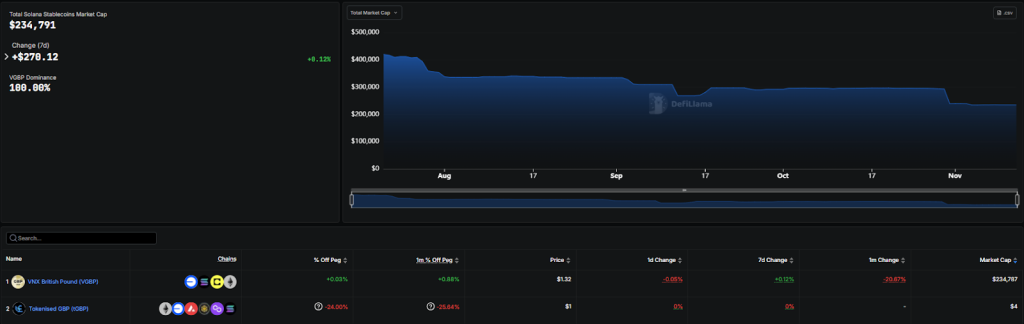
The global stablecoin market has now surpassed $312 billion, dominated by dollar-backed tokens from Tether and Circle, while sterling-based stablecoins remain under £600,000 in circulation.
Source: DefiLlama

Despite their limited footprint, officials say stablecoins could soon play a key role in domestic and cross-border payments as regulation takes shape.


시장 기회
Lorenzo Protocol 로고
Lorenzo Protocol 가격(BANK)
$0,0286
$0,0286$0,0286
-2,98%
USD
Lorenzo Protocol (BANK) 실시간 가격 차트
면책 조항: 본 사이트에 재게시된 글들은 공개 플랫폼에서 가져온 것으로 정보 제공 목적으로만 제공됩니다. 이는 반드시 MEXC의 견해를 반영하는 것은 아닙니다. 모든 권리는 원저자에게 있습니다. 제3자의 권리를 침해하는 콘텐츠가 있다고 판단될 경우, crypto.news@mexc.com으로 연락하여 삭제 요청을 해주시기 바랍니다. MEXC는 콘텐츠의 정확성, 완전성 또는 시의적절성에 대해 어떠한 보증도 하지 않으며, 제공된 정보에 기반하여 취해진 어떠한 조치에 대해서도 책임을 지지 않습니다. 본 콘텐츠는 금융, 법률 또는 기타 전문적인 조언을 구성하지 않으며, MEXC의 추천이나 보증으로 간주되어서는 안 됩니다.

$30,000 in PRL + 15,000 USDT

$30,000 in PRL + 15,000 USDT$30,000 in PRL + 15,000 USDT

Deposit & trade PRL to boost your rewards!