Bitcoin’s momentum has weakened sharply, and the market has slipped into one of its most bearish phases of the year, according to the latest CryptoQuant weekly report. Sentiment has deteriorated quickly as Bitcoin hovers dangerously close to the $100,000 level. The shift began after the October 10 “Big Liquidation” event, which drained upward momentum and pushed several key indicators into bearish territory. Spot demand contracted earlier in October, while growth in stablecoin liquidity—a key driver of market inflows—slowed sharply. Together, these factors have created a fragile environment in which Bitcoin’s price struggles to sustain meaningful support. A Market Losing Its Grip on Momentum CryptoQuant’s Bull Score Index reflects the extent of the downturn. Earlier in October, when Bitcoin reached its all-time high of $126,000, the index stood at a strongly optimistic reading of 80. That optimism evaporated quickly as Bitcoin slipped below $100,000 for the first time since June. The index has now fallen to 20, indicating an extremely bearish environment. The steep decline shows how quickly the market has shifted from aggressive buying to hesitation and caution, with fewer new inflows and weaker spot demand contributing to the downward pressure. Long-Term Holders Unload at Rare Levels One of the most concerning signs in the report is the behaviour of long-term holders. Over the past month, they have sold roughly 815,000 BTC, marking their heaviest distribution since January 2024. This selling occurred as Bitcoin pushed into the $118,000 to $121,000 range, a moment when spot demand had already begun to fade. In earlier phases of the cycle, strong demand from ETFs, institutional traders, and retail buyers was sufficient to absorb heavy selling from long-term holders. That buffer is now absent. Instead, the combination of steady supply from long-term holders and weakening demand is placing clear downward pressure on the market, raising the risk of further price deterioration. Profit-Taking Stays Strong, but Capitulation Is Absent Profit realization remains elevated. On November 7, investors locked in approximately $3 billion in net profits, mirroring the aggressive selling seen throughout October. Despite the heavy profit-taking, the market has yet to show signs of capitulation. Realized losses remain extremely low, suggesting that holders are not panic-selling even as price support weakens. This dynamic—strong profits but minimal losses—indicates that the market has not formed a bottom. Historically, price floors emerge only after losses rise and weak hands exit the market, a pattern that has not yet appeared. The Battle at the 365-Day Moving Average Bitcoin’s current struggle centres on the 365-day moving average, which sits near $102,000. This line has served as the ultimate support level throughout the current bull cycle and was one of the last major indicators to turn bearish during the 2021–2022 transition into a prolonged downturn. Bitcoin has now dipped below this level several times—a warning sign not seen earlier in this cycle. If the price continues to close beneath the 365-day average, the risk of a deeper correction grows considerably. CryptoQuant notes that the next areas of meaningful support lie lower, suggesting that failure to reclaim this moving average could accelerate a broader market decline. Bitcoin now stands at a key juncture. With momentum fading, long-term holders selling heavily, and spot demand failing to keep pace, the market’s ability to stabilize depends heavily on whether Bitcoin can reclaim its 365-day moving average. The coming weeks may determine whether this is a temporary pullback or the start of a more severe correctionBitcoin’s momentum has weakened sharply, and the market has slipped into one of its most bearish phases of the year, according to the latest CryptoQuant weekly report. Sentiment has deteriorated quickly as Bitcoin hovers dangerously close to the $100,000 level. The shift began after the October 10 “Big Liquidation” event, which drained upward momentum and pushed several key indicators into bearish territory. Spot demand contracted earlier in October, while growth in stablecoin liquidity—a key driver of market inflows—slowed sharply. Together, these factors have created a fragile environment in which Bitcoin’s price struggles to sustain meaningful support. A Market Losing Its Grip on Momentum CryptoQuant’s Bull Score Index reflects the extent of the downturn. Earlier in October, when Bitcoin reached its all-time high of $126,000, the index stood at a strongly optimistic reading of 80. That optimism evaporated quickly as Bitcoin slipped below $100,000 for the first time since June. The index has now fallen to 20, indicating an extremely bearish environment. The steep decline shows how quickly the market has shifted from aggressive buying to hesitation and caution, with fewer new inflows and weaker spot demand contributing to the downward pressure. Long-Term Holders Unload at Rare Levels One of the most concerning signs in the report is the behaviour of long-term holders. Over the past month, they have sold roughly 815,000 BTC, marking their heaviest distribution since January 2024. This selling occurred as Bitcoin pushed into the $118,000 to $121,000 range, a moment when spot demand had already begun to fade. In earlier phases of the cycle, strong demand from ETFs, institutional traders, and retail buyers was sufficient to absorb heavy selling from long-term holders. That buffer is now absent. Instead, the combination of steady supply from long-term holders and weakening demand is placing clear downward pressure on the market, raising the risk of further price deterioration. Profit-Taking Stays Strong, but Capitulation Is Absent Profit realization remains elevated. On November 7, investors locked in approximately $3 billion in net profits, mirroring the aggressive selling seen throughout October. Despite the heavy profit-taking, the market has yet to show signs of capitulation. Realized losses remain extremely low, suggesting that holders are not panic-selling even as price support weakens. This dynamic—strong profits but minimal losses—indicates that the market has not formed a bottom. Historically, price floors emerge only after losses rise and weak hands exit the market, a pattern that has not yet appeared. The Battle at the 365-Day Moving Average Bitcoin’s current struggle centres on the 365-day moving average, which sits near $102,000. This line has served as the ultimate support level throughout the current bull cycle and was one of the last major indicators to turn bearish during the 2021–2022 transition into a prolonged downturn. Bitcoin has now dipped below this level several times—a warning sign not seen earlier in this cycle. If the price continues to close beneath the 365-day average, the risk of a deeper correction grows considerably. CryptoQuant notes that the next areas of meaningful support lie lower, suggesting that failure to reclaim this moving average could accelerate a broader market decline. Bitcoin now stands at a key juncture. With momentum fading, long-term holders selling heavily, and spot demand failing to keep pace, the market’s ability to stabilize depends heavily on whether Bitcoin can reclaim its 365-day moving average. The coming weeks may determine whether this is a temporary pullback or the start of a more severe correction

Bitcoin Tests Key Support as Bearish Momentum Deepens and Long-Term Holders Unload 815K BTC: CryptoQuant

2025/11/14 00:01
3분 읽기
이 콘텐츠에 대한 의견이나 우려 사항이 있으시면 crypto.news@mexc.com으로 연락주시기 바랍니다

Bitcoin’s momentum has weakened sharply, and the market has slipped into one of its most bearish phases of the year, according to the latest CryptoQuant weekly report.

Sentiment has deteriorated quickly as Bitcoin hovers dangerously close to the $100,000 level. The shift began after the October 10 “Big Liquidation” event, which drained upward momentum and pushed several key indicators into bearish territory.

Spot demand contracted earlier in October, while growth in stablecoin liquidity—a key driver of market inflows—slowed sharply. Together, these factors have created a fragile environment in which Bitcoin’s price struggles to sustain meaningful support.

A Market Losing Its Grip on Momentum

CryptoQuant’s Bull Score Index reflects the extent of the downturn. Earlier in October, when Bitcoin reached its all-time high of $126,000, the index stood at a strongly optimistic reading of 80. That optimism evaporated quickly as Bitcoin slipped below $100,000 for the first time since June.
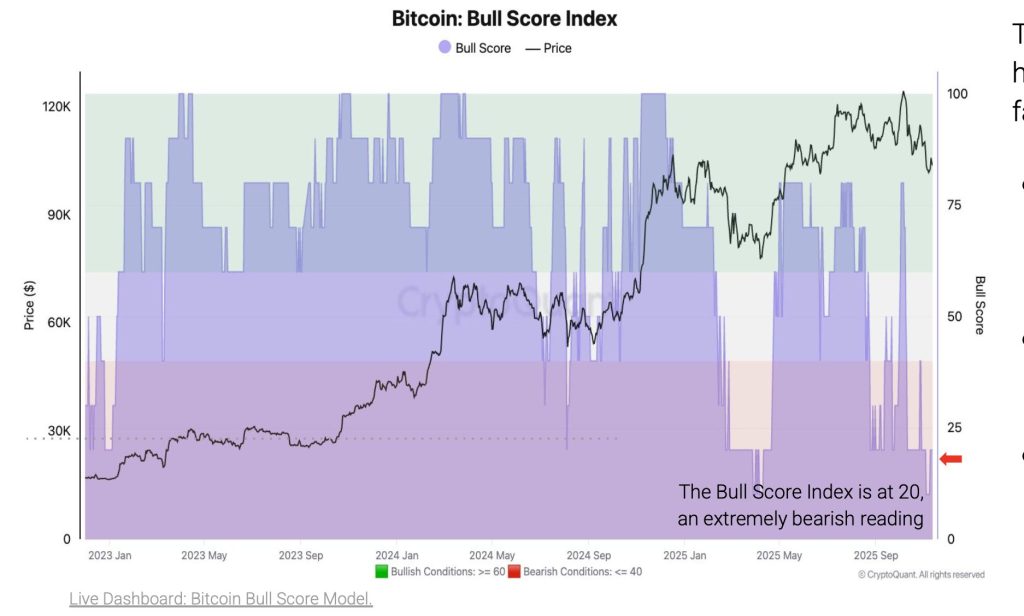
The index has now fallen to 20, indicating an extremely bearish environment. The steep decline shows how quickly the market has shifted from aggressive buying to hesitation and caution, with fewer new inflows and weaker spot demand contributing to the downward pressure.

Long-Term Holders Unload at Rare Levels

One of the most concerning signs in the report is the behaviour of long-term holders. Over the past month, they have sold roughly 815,000 BTC, marking their heaviest distribution since January 2024. This selling occurred as Bitcoin pushed into the $118,000 to $121,000 range, a moment when spot demand had already begun to fade.

In earlier phases of the cycle, strong demand from ETFs, institutional traders, and retail buyers was sufficient to absorb heavy selling from long-term holders. That buffer is now absent. Instead, the combination of steady supply from long-term holders and weakening demand is placing clear downward pressure on the market, raising the risk of further price deterioration.

Profit-Taking Stays Strong, but Capitulation Is Absent

Profit realization remains elevated. On November 7, investors locked in approximately $3 billion in net profits, mirroring the aggressive selling seen throughout October. Despite the heavy profit-taking, the market has yet to show signs of capitulation.

Realized losses remain extremely low, suggesting that holders are not panic-selling even as price support weakens. This dynamic—strong profits but minimal losses—indicates that the market has not formed a bottom. Historically, price floors emerge only after losses rise and weak hands exit the market, a pattern that has not yet appeared.

The Battle at the 365-Day Moving Average

Bitcoin’s current struggle centres on the 365-day moving average, which sits near $102,000. This line has served as the ultimate support level throughout the current bull cycle and was one of the last major indicators to turn bearish during the 2021–2022 transition into a prolonged downturn.

Bitcoin has now dipped below this level several times—a warning sign not seen earlier in this cycle. If the price continues to close beneath the 365-day average, the risk of a deeper correction grows considerably.

CryptoQuant notes that the next areas of meaningful support lie lower, suggesting that failure to reclaim this moving average could accelerate a broader market decline.

Bitcoin now stands at a key juncture. With momentum fading, long-term holders selling heavily, and spot demand failing to keep pace, the market’s ability to stabilize depends heavily on whether Bitcoin can reclaim its 365-day moving average. The coming weeks may determine whether this is a temporary pullback or the start of a more severe correction.


시장 기회
Belong 로고
Belong 가격(LONG)
$0.001625
$0.001625$0.001625
+5.72%
USD
Belong (LONG) 실시간 가격 차트
면책 조항: 본 사이트에 재게시된 글들은 공개 플랫폼에서 가져온 것으로 정보 제공 목적으로만 제공됩니다. 이는 반드시 MEXC의 견해를 반영하는 것은 아닙니다. 모든 권리는 원저자에게 있습니다. 제3자의 권리를 침해하는 콘텐츠가 있다고 판단될 경우, crypto.news@mexc.com으로 연락하여 삭제 요청을 해주시기 바랍니다. MEXC는 콘텐츠의 정확성, 완전성 또는 시의적절성에 대해 어떠한 보증도 하지 않으며, 제공된 정보에 기반하여 취해진 어떠한 조치에 대해서도 책임을 지지 않습니다. 본 콘텐츠는 금융, 법률 또는 기타 전문적인 조언을 구성하지 않으며, MEXC의 추천이나 보증으로 간주되어서는 안 됩니다.

$30,000 in PRL + 15,000 USDT

$30,000 in PRL + 15,000 USDT$30,000 in PRL + 15,000 USDT

Deposit & trade PRL to boost your rewards!