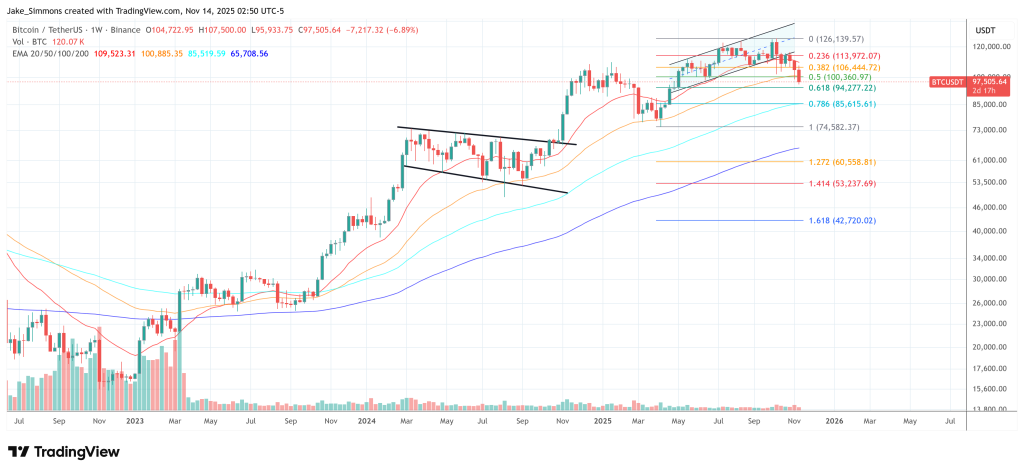
JPMorgan has put a numerical marker under this Bitcoin cycle, telling clients that the market’s “pain threshold” now sits near $94,000 — a level the bank frames as both a mining-economics floor and an answer to the question of how low spot can realistically trade before fundamentals start to bite. According to reporting by The Block, the analyst team led by Nikolaos Panigirtzoglou argues that “Bitcoin’s downside from current levels appears to be ‘very limited,’” because they “see its support price at around $94,000.” How Low Can Bitcoin Go? The core of the call is JPMorgan’s updated estimate of Bitcoin’s production cost. In their latest note, cited by The Block, the analysts say the all-in cost to mine one bitcoin has risen from about $92,000 to roughly $94,000 as network difficulty has surged over recent months. That jump in difficulty forces miners to deploy more hashpower per block, lifting the marginal cost per coin. The team reiterates a framework they have used in prior cycles, stressing that “the bitcoin production cost has empirically acted as a floor for bitcoin,” so a higher cost mechanically pulls the support zone higher as well. Related Reading: Bitcoin Death Cross Is Coming: Don’t Be Fooled By The Name On JPMorgan’s numbers, the ratio of spot price to production cost now sits just above 1.0, close to the lower end of its historical range. That implies miners’ operating margin is thin and that there is limited room for an extended move far below the modeled cost without triggering stress in the mining sector. From that perspective, the bank’s $94,000 level is not presented as a precise line in the sand, but as a statistically grounded region where downside risk becomes compressed because miners’ incentives to keep selling into weakness deteriorate. The same note keeps a much more optimistic medium-term scenario in place. JPMorgan reiterates a 6–12 month upside case around $170,000 per bitcoin, derived from a volatility-adjusted comparison with gold. As summarized by The Block, the analysts estimate that Bitcoin currently “consumes” around 1.8 times more risk capital than gold, yet still has a smaller market capitalization — roughly $2.1 trillion versus about $6.2 trillion in private-sector gold investment via ETFs, bars and coins. To close that gap on a volatility-adjusted basis, they calculate Bitcoin’s market cap would need to rise by about 67%, “implying a theoretical bitcoin price of close to $170,000.” Related Reading: Bitcoin Crashes To $98,000 As HODLer Selling Accelerates The Block also highlights how this view fits into JPMorgan’s recent track record of calls. In an earlier note last month, the same team argued that Bitcoin looked significantly undervalued relative to gold, implying upside toward about $165,000 by year-end. Panigirtzoglou has since dialed back the timing, telling The Block that, “it would not be realistic to expect this price target by year’s end,” given recent liquidations and very weak sentiment, and reframing $170,000 as a 6–12 month scenario rather than a near-term objective. The note further recalls an August projection around $126,000 by year-end; Bitcoin later printed an all-time high above $126,200 on Oct. 6 before a record liquidation event on Oct. 10 abruptly reset positioning. Those earlier pieces of research are consistent with a broader framework JPMorgan has been articulating publicly. In a separate analysis earlier this month, also led by Panigirtzoglou and reported by MarketWatch, the bank argued that post-October deleveraging left Bitcoin “very cheap to gold” on a volatility-adjusted basis and concluded that “this mechanical exercise thus implies significant upside for bitcoin over the next 6–12 months,” with fair value again clustering near $170,000. What the new note, as relayed by The Block, adds is a more explicit downside anchor: as long as network difficulty and energy-input assumptions keep the estimated production cost around $94,000, JPMorgan sees that level as the effective floor that answers how low Bitcoin can go before mining economics force the market to confront its constraints. At press time, BTC traded at $97,505. Featured image created with DALL.E, chart from TradingView.comJPMorgan has put a numerical marker under this Bitcoin cycle, telling clients that the market’s “pain threshold” now sits near $94,000 — a level the bank frames as both a mining-economics floor and an answer to the question of how low spot can realistically trade before fundamentals start to bite. According to reporting by The Block, the analyst team led by Nikolaos Panigirtzoglou argues that “Bitcoin’s downside from current levels appears to be ‘very limited,’” because they “see its support price at around $94,000.” How Low Can Bitcoin Go? The core of the call is JPMorgan’s updated estimate of Bitcoin’s production cost. In their latest note, cited by The Block, the analysts say the all-in cost to mine one bitcoin has risen from about $92,000 to roughly $94,000 as network difficulty has surged over recent months. That jump in difficulty forces miners to deploy more hashpower per block, lifting the marginal cost per coin. The team reiterates a framework they have used in prior cycles, stressing that “the bitcoin production cost has empirically acted as a floor for bitcoin,” so a higher cost mechanically pulls the support zone higher as well. Related Reading: Bitcoin Death Cross Is Coming: Don’t Be Fooled By The Name On JPMorgan’s numbers, the ratio of spot price to production cost now sits just above 1.0, close to the lower end of its historical range. That implies miners’ operating margin is thin and that there is limited room for an extended move far below the modeled cost without triggering stress in the mining sector. From that perspective, the bank’s $94,000 level is not presented as a precise line in the sand, but as a statistically grounded region where downside risk becomes compressed because miners’ incentives to keep selling into weakness deteriorate. The same note keeps a much more optimistic medium-term scenario in place. JPMorgan reiterates a 6–12 month upside case around $170,000 per bitcoin, derived from a volatility-adjusted comparison with gold. As summarized by The Block, the analysts estimate that Bitcoin currently “consumes” around 1.8 times more risk capital than gold, yet still has a smaller market capitalization — roughly $2.1 trillion versus about $6.2 trillion in private-sector gold investment via ETFs, bars and coins. To close that gap on a volatility-adjusted basis, they calculate Bitcoin’s market cap would need to rise by about 67%, “implying a theoretical bitcoin price of close to $170,000.” Related Reading: Bitcoin Crashes To $98,000 As HODLer Selling Accelerates The Block also highlights how this view fits into JPMorgan’s recent track record of calls. In an earlier note last month, the same team argued that Bitcoin looked significantly undervalued relative to gold, implying upside toward about $165,000 by year-end. Panigirtzoglou has since dialed back the timing, telling The Block that, “it would not be realistic to expect this price target by year’s end,” given recent liquidations and very weak sentiment, and reframing $170,000 as a 6–12 month scenario rather than a near-term objective. The note further recalls an August projection around $126,000 by year-end; Bitcoin later printed an all-time high above $126,200 on Oct. 6 before a record liquidation event on Oct. 10 abruptly reset positioning. Those earlier pieces of research are consistent with a broader framework JPMorgan has been articulating publicly. In a separate analysis earlier this month, also led by Panigirtzoglou and reported by MarketWatch, the bank argued that post-October deleveraging left Bitcoin “very cheap to gold” on a volatility-adjusted basis and concluded that “this mechanical exercise thus implies significant upside for bitcoin over the next 6–12 months,” with fair value again clustering near $170,000. What the new note, as relayed by The Block, adds is a more explicit downside anchor: as long as network difficulty and energy-input assumptions keep the estimated production cost around $94,000, JPMorgan sees that level as the effective floor that answers how low Bitcoin can go before mining economics force the market to confront its constraints. At press time, BTC traded at $97,505. Featured image created with DALL.E, chart from TradingView.com

How Low Can Bitcoin Price Go? JPMorgan Points To A Key Threshold

2025/11/14 18:00
4분 읽기
이 콘텐츠에 대한 의견이나 우려 사항이 있으시면 crypto.news@mexc.com으로 연락주시기 바랍니다

JPMorgan has put a numerical marker under this Bitcoin cycle, telling clients that the market’s “pain threshold” now sits near $94,000 — a level the bank frames as both a mining-economics floor and an answer to the question of how low spot can realistically trade before fundamentals start to bite. According to reporting by The Block, the analyst team led by Nikolaos Panigirtzoglou argues that “Bitcoin’s downside from current levels appears to be ‘very limited,’” because they “see its support price at around $94,000.”

How Low Can Bitcoin Go?

The core of the call is JPMorgan’s updated estimate of Bitcoin’s production cost. In their latest note, cited by The Block, the analysts say the all-in cost to mine one bitcoin has risen from about $92,000 to roughly $94,000 as network difficulty has surged over recent months. That jump in difficulty forces miners to deploy more hashpower per block, lifting the marginal cost per coin. The team reiterates a framework they have used in prior cycles, stressing that “the bitcoin production cost has empirically acted as a floor for bitcoin,” so a higher cost mechanically pulls the support zone higher as well.

On JPMorgan’s numbers, the ratio of spot price to production cost now sits just above 1.0, close to the lower end of its historical range. That implies miners’ operating margin is thin and that there is limited room for an extended move far below the modeled cost without triggering stress in the mining sector. From that perspective, the bank’s $94,000 level is not presented as a precise line in the sand, but as a statistically grounded region where downside risk becomes compressed because miners’ incentives to keep selling into weakness deteriorate.

The same note keeps a much more optimistic medium-term scenario in place. JPMorgan reiterates a 6–12 month upside case around $170,000 per bitcoin, derived from a volatility-adjusted comparison with gold. As summarized by The Block, the analysts estimate that Bitcoin currently “consumes” around 1.8 times more risk capital than gold, yet still has a smaller market capitalization — roughly $2.1 trillion versus about $6.2 trillion in private-sector gold investment via ETFs, bars and coins. To close that gap on a volatility-adjusted basis, they calculate Bitcoin’s market cap would need to rise by about 67%, “implying a theoretical bitcoin price of close to $170,000.”

The Block also highlights how this view fits into JPMorgan’s recent track record of calls. In an earlier note last month, the same team argued that Bitcoin looked significantly undervalued relative to gold, implying upside toward about $165,000 by year-end. Panigirtzoglou has since dialed back the timing, telling The Block that, “it would not be realistic to expect this price target by year’s end,” given recent liquidations and very weak sentiment, and reframing $170,000 as a 6–12 month scenario rather than a near-term objective. The note further recalls an August projection around $126,000 by year-end; Bitcoin later printed an all-time high above $126,200 on Oct. 6 before a record liquidation event on Oct. 10 abruptly reset positioning.

Those earlier pieces of research are consistent with a broader framework JPMorgan has been articulating publicly. In a separate analysis earlier this month, also led by Panigirtzoglou and reported by MarketWatch, the bank argued that post-October deleveraging left Bitcoin “very cheap to gold” on a volatility-adjusted basis and concluded that “this mechanical exercise thus implies significant upside for bitcoin over the next 6–12 months,” with fair value again clustering near $170,000.

What the new note, as relayed by The Block, adds is a more explicit downside anchor: as long as network difficulty and energy-input assumptions keep the estimated production cost around $94,000, JPMorgan sees that level as the effective floor that answers how low Bitcoin can go before mining economics force the market to confront its constraints.

At press time, BTC traded at $97,505.

Bitcoin price
시장 기회
니어 로고
니어 가격(NEAR)
$1.3255
$1.3255$1.3255
+0.34%
USD
니어 (NEAR) 실시간 가격 차트
면책 조항: 본 사이트에 재게시된 글들은 공개 플랫폼에서 가져온 것으로 정보 제공 목적으로만 제공됩니다. 이는 반드시 MEXC의 견해를 반영하는 것은 아닙니다. 모든 권리는 원저자에게 있습니다. 제3자의 권리를 침해하는 콘텐츠가 있다고 판단될 경우, crypto.news@mexc.com으로 연락하여 삭제 요청을 해주시기 바랍니다. MEXC는 콘텐츠의 정확성, 완전성 또는 시의적절성에 대해 어떠한 보증도 하지 않으며, 제공된 정보에 기반하여 취해진 어떠한 조치에 대해서도 책임을 지지 않습니다. 본 콘텐츠는 금융, 법률 또는 기타 전문적인 조언을 구성하지 않으며, MEXC의 추천이나 보증으로 간주되어서는 안 됩니다.

Roll the Dice & Win Up to 1 BTC

Roll the Dice & Win Up to 1 BTCRoll the Dice & Win Up to 1 BTC

Invite friends & share 500,000 USDT!