For decades, gold has anchored global portfolios as the quintessential safe-haven asset. But in the past ten years, bitcoin has rapidly emerged as its digital counterpart — and, in many cases, its outperformer. New research from Dovile Silenskyte, Director of Digital Assets Research at WisdomTree, suggests that investors may no longer need to choose between the two. Instead, the data increasingly supports a combined approach, where gold provides stability and bitcoin offers asymmetric upside. Gold vs. Bitcoin: A Changing Store-of-Value Hierarchy Gold’s safe-haven characteristics remain structurally intact. Its scarcity, established role in global markets and historical performance during periods of stress have kept it resilient. Since 2013, gold posted annualised returns of 10.4% with 14.5% volatility, delivering a Sharpe ratio of 0.6, according to Silenskyte’s analysis. Bitcoin, however, has shifted the paradigm. Over the same period, it generated annualised returns of 50.5% with 67.0% volatility, resulting in a Sharpe ratio of 0.7 — marginally outperforming gold on a risk-adjusted basis despite its extreme swings. On the Sortino ratio, which focuses on downside risk, the gap is even wider: 1.0 for bitcoin versus 0.3 for gold. In simple terms, bitcoin has historically compensated investors more efficiently for the risk taken. “Even with high volatility, bitcoin has offered superior risk-adjusted returns,” Silenskyte notes. Bitcoin Volatility: From Barrier to Manageable Risk Bitcoin’s volatility is frequently cited as the primary reason some investors remain hesitant. Yet Silenskyte’s research shows that this volatility has declined significantly over the past decade. Its 90-day annualised volatility has compressed from above 150% to under 40%, putting it within range of several commodities. At the same time, liquidity has deepened, with daily spot volumes comparable to major S&P 500 equities. Derivatives markets — particularly futures and options — provide sophisticated hedging tools that make volatility increasingly manageable for institutional allocators. “Volatility is a tax, but a declining one,” Silenskyte says. Macro Conditions Favour a Combined Allocation Rather than competing, bitcoin and gold appear to hedge different types of macro risk. Gold thrives during inflation, geopolitical turmoil and periods of negative real yields. Bitcoin, with its 21-million-supply cap and decentralised issuance, serves as a hedge against fiat debasement and technological disruption. Importantly, bitcoin and gold display a low long-term correlation of just 6%, according to WisdomTree. This gives them powerful diversification properties: gold anchors the defensive side of a portfolio, while bitcoin provides convex upside driven by digital adoption. Portfolio Implications: Not Either-Or, but Both WisdomTree’s modelling shows that adding even 1% bitcoin to a traditional 60/40 portfolio can increase the Sharpe ratio by 0.06, with only a marginal change in maximum drawdowns. The takeaway from Silenskyte’s research is clear: gold remains foundational, but bitcoin enhances the opportunity set. As digital assets mature, the case for treating the two as complementary hedges — not rivals — becomes stronger. Together, they broaden the safe-haven spectrum for the modern investorFor decades, gold has anchored global portfolios as the quintessential safe-haven asset. But in the past ten years, bitcoin has rapidly emerged as its digital counterpart — and, in many cases, its outperformer. New research from Dovile Silenskyte, Director of Digital Assets Research at WisdomTree, suggests that investors may no longer need to choose between the two. Instead, the data increasingly supports a combined approach, where gold provides stability and bitcoin offers asymmetric upside. Gold vs. Bitcoin: A Changing Store-of-Value Hierarchy Gold’s safe-haven characteristics remain structurally intact. Its scarcity, established role in global markets and historical performance during periods of stress have kept it resilient. Since 2013, gold posted annualised returns of 10.4% with 14.5% volatility, delivering a Sharpe ratio of 0.6, according to Silenskyte’s analysis. Bitcoin, however, has shifted the paradigm. Over the same period, it generated annualised returns of 50.5% with 67.0% volatility, resulting in a Sharpe ratio of 0.7 — marginally outperforming gold on a risk-adjusted basis despite its extreme swings. On the Sortino ratio, which focuses on downside risk, the gap is even wider: 1.0 for bitcoin versus 0.3 for gold. In simple terms, bitcoin has historically compensated investors more efficiently for the risk taken. “Even with high volatility, bitcoin has offered superior risk-adjusted returns,” Silenskyte notes. Bitcoin Volatility: From Barrier to Manageable Risk Bitcoin’s volatility is frequently cited as the primary reason some investors remain hesitant. Yet Silenskyte’s research shows that this volatility has declined significantly over the past decade. Its 90-day annualised volatility has compressed from above 150% to under 40%, putting it within range of several commodities. At the same time, liquidity has deepened, with daily spot volumes comparable to major S&P 500 equities. Derivatives markets — particularly futures and options — provide sophisticated hedging tools that make volatility increasingly manageable for institutional allocators. “Volatility is a tax, but a declining one,” Silenskyte says. Macro Conditions Favour a Combined Allocation Rather than competing, bitcoin and gold appear to hedge different types of macro risk. Gold thrives during inflation, geopolitical turmoil and periods of negative real yields. Bitcoin, with its 21-million-supply cap and decentralised issuance, serves as a hedge against fiat debasement and technological disruption. Importantly, bitcoin and gold display a low long-term correlation of just 6%, according to WisdomTree. This gives them powerful diversification properties: gold anchors the defensive side of a portfolio, while bitcoin provides convex upside driven by digital adoption. Portfolio Implications: Not Either-Or, but Both WisdomTree’s modelling shows that adding even 1% bitcoin to a traditional 60/40 portfolio can increase the Sharpe ratio by 0.06, with only a marginal change in maximum drawdowns. The takeaway from Silenskyte’s research is clear: gold remains foundational, but bitcoin enhances the opportunity set. As digital assets mature, the case for treating the two as complementary hedges — not rivals — becomes stronger. Together, they broaden the safe-haven spectrum for the modern investor

Bitcoin and Gold: A New Era of Complementary Safe-Haven Assets, Says WisdomTree Analyst

2025/11/14 22:18
3분 읽기
이 콘텐츠에 대한 의견이나 우려 사항이 있으시면 crypto.news@mexc.com으로 연락주시기 바랍니다

For decades, gold has anchored global portfolios as the quintessential safe-haven asset. But in the past ten years, bitcoin has rapidly emerged as its digital counterpart — and, in many cases, its outperformer.

New research from Dovile Silenskyte, Director of Digital Assets Research at WisdomTree, suggests that investors may no longer need to choose between the two. Instead, the data increasingly supports a combined approach, where gold provides stability and bitcoin offers asymmetric upside.

Gold vs. Bitcoin: A Changing Store-of-Value Hierarchy

Gold’s safe-haven characteristics remain structurally intact. Its scarcity, established role in global markets and historical performance during periods of stress have kept it resilient.

Since 2013, gold posted annualised returns of 10.4% with 14.5% volatility, delivering a Sharpe ratio of 0.6, according to Silenskyte’s analysis.
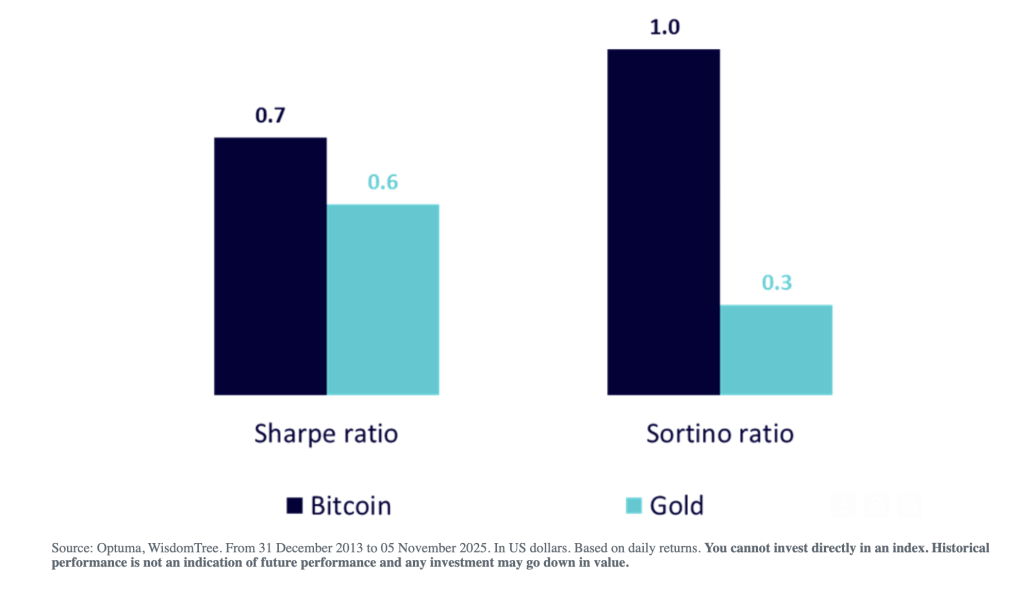
Bitcoin, however, has shifted the paradigm. Over the same period, it generated annualised returns of 50.5% with 67.0% volatility, resulting in a Sharpe ratio of 0.7 — marginally outperforming gold on a risk-adjusted basis despite its extreme swings.

On the Sortino ratio, which focuses on downside risk, the gap is even wider: 1.0 for bitcoin versus 0.3 for gold. In simple terms, bitcoin has historically compensated investors more efficiently for the risk taken.

“Even with high volatility, bitcoin has offered superior risk-adjusted returns,” Silenskyte notes.

Bitcoin Volatility: From Barrier to Manageable Risk

Bitcoin’s volatility is frequently cited as the primary reason some investors remain hesitant. Yet Silenskyte’s research shows that this volatility has declined significantly over the past decade. Its 90-day annualised volatility has compressed from above 150% to under 40%, putting it within range of several commodities.

At the same time, liquidity has deepened, with daily spot volumes comparable to major S&P 500 equities. Derivatives markets — particularly futures and options — provide sophisticated hedging tools that make volatility increasingly manageable for institutional allocators.

“Volatility is a tax, but a declining one,” Silenskyte says.

Macro Conditions Favour a Combined Allocation

Rather than competing, bitcoin and gold appear to hedge different types of macro risk. Gold thrives during inflation, geopolitical turmoil and periods of negative real yields. Bitcoin, with its 21-million-supply cap and decentralised issuance, serves as a hedge against fiat debasement and technological disruption.

Importantly, bitcoin and gold display a low long-term correlation of just 6%, according to WisdomTree. This gives them powerful diversification properties: gold anchors the defensive side of a portfolio, while bitcoin provides convex upside driven by digital adoption.

Portfolio Implications: Not Either-Or, but Both

WisdomTree’s modelling shows that adding even 1% bitcoin to a traditional 60/40 portfolio can increase the Sharpe ratio by 0.06, with only a marginal change in maximum drawdowns.

The takeaway from Silenskyte’s research is clear: gold remains foundational, but bitcoin enhances the opportunity set. As digital assets mature, the case for treating the two as complementary hedges — not rivals — becomes stronger.

Together, they broaden the safe-haven spectrum for the modern investor.

시장 기회
ERA 로고
ERA 가격(ERA)
$0.1219
$0.1219$0.1219
+0.32%
USD
ERA (ERA) 실시간 가격 차트
면책 조항: 본 사이트에 재게시된 글들은 공개 플랫폼에서 가져온 것으로 정보 제공 목적으로만 제공됩니다. 이는 반드시 MEXC의 견해를 반영하는 것은 아닙니다. 모든 권리는 원저자에게 있습니다. 제3자의 권리를 침해하는 콘텐츠가 있다고 판단될 경우, crypto.news@mexc.com으로 연락하여 삭제 요청을 해주시기 바랍니다. MEXC는 콘텐츠의 정확성, 완전성 또는 시의적절성에 대해 어떠한 보증도 하지 않으며, 제공된 정보에 기반하여 취해진 어떠한 조치에 대해서도 책임을 지지 않습니다. 본 콘텐츠는 금융, 법률 또는 기타 전문적인 조언을 구성하지 않으며, MEXC의 추천이나 보증으로 간주되어서는 안 됩니다.

$30,000 in PRL + 15,000 USDT

$30,000 in PRL + 15,000 USDT$30,000 in PRL + 15,000 USDT

Deposit & trade PRL to boost your rewards!